

Cloud
Architecture
Learning Path
Distributed control planes, cost topology, and sovereign cloud design.
>_ Cloud Is Not a Location Decision
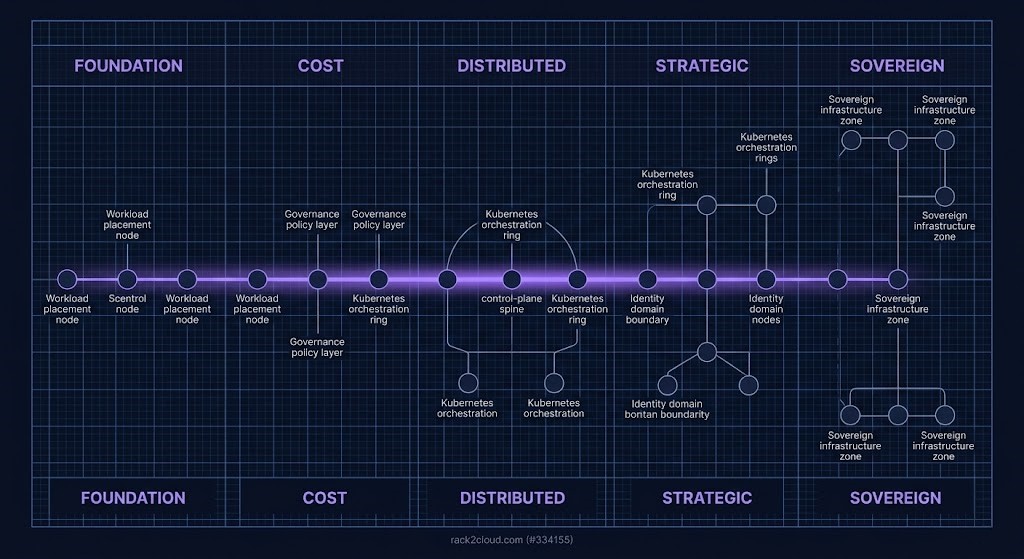
Cloud architecture is not provider selection. It is distributed control plane design — the engineering of programmable fabrics that abstract compute, storage, networking, and identity at scale. The provider is an implementation detail. The architectural decisions that determine blast radius, cost topology, workload portability, and operational sovereignty are made before the provider is chosen, and they outlast any contract.
This cloud architecture learning path is a maturity-guided reading sequence for senior enterprise infrastructure architects — from provider control plane mechanics through cost topology, distributed cloud-native systems, workload placement economics, and sovereign cloud design. It sequences published architecture analysis by operational complexity and architectural consequence, not by provider or certification objective.
The path covers five maturity stages: Cloud Foundations & Architecture Strategy, Cloud Cost Architecture, Cloud-Native & Distributed Architecture, Platform Economics & Workload Placement, and Sovereign Cloud & Control Plane Independence. Each stage builds on the architectural decisions established before it. The control plane framing introduced in Stage 1 runs as connective thread through every subsequent stage — cost visibility, placement decisions, and sovereignty constraints all resolve back to who owns the control plane and what that ownership costs operationally.
What This Path Is Not
- Not certification prep — no exam objectives, no flashcard sequences
- Not vendor training — no preferred platforms, no product tutorials
- Not beginner tutorials — foundational mechanics are covered, not hand-held
- Not feature documentation — the focus is tradeoffs, failure domains, and operational consequence
>_ Estimated Reading Depth
| Path Depth | Approx Time | Coverage |
|---|---|---|
| Essential Sequence | 3–4 hours | Stage 1 + Stage 5 — control plane foundations and sovereign architecture |
| Full Domain Path | 10–12 hours | All five stages in sequence |
>_ Where to Enter This Path
Not every reader starts at Foundation. Start at the stage that matches your current operational context.
| Audience | Recommended Entry | Reason |
|---|---|---|
| Engineers new to cloud architecture | Stage 1 — Foundation | Provider control plane mechanics and shared responsibility framing are prerequisites for cost and placement decisions |
| Cloud engineers managing at scale | Stage 2 — Cloud Cost Architecture | Cost topology and egress design are the first architectural problems that surface at production scale |
| Platform and application architects | Stage 3 — Cloud-Native & Distributed Architecture | Orchestration, service mesh, and ingress design are the live architectural problems for teams running distributed workloads |
| Architects evaluating repatriation or multi-cloud | Stage 4 — Platform Economics & Workload Placement | Placement economics and repatriation tradeoffs are the decision layer most architects reach without a framework |
| Architects designing for control and portability | Stage 5 — Sovereign Cloud & Control Plane Independence | Identity isolation, sovereign networking, and CI/CD control plane ownership are the live problems for teams managing exit optionality |
>_ The Architecture Maturity Spine
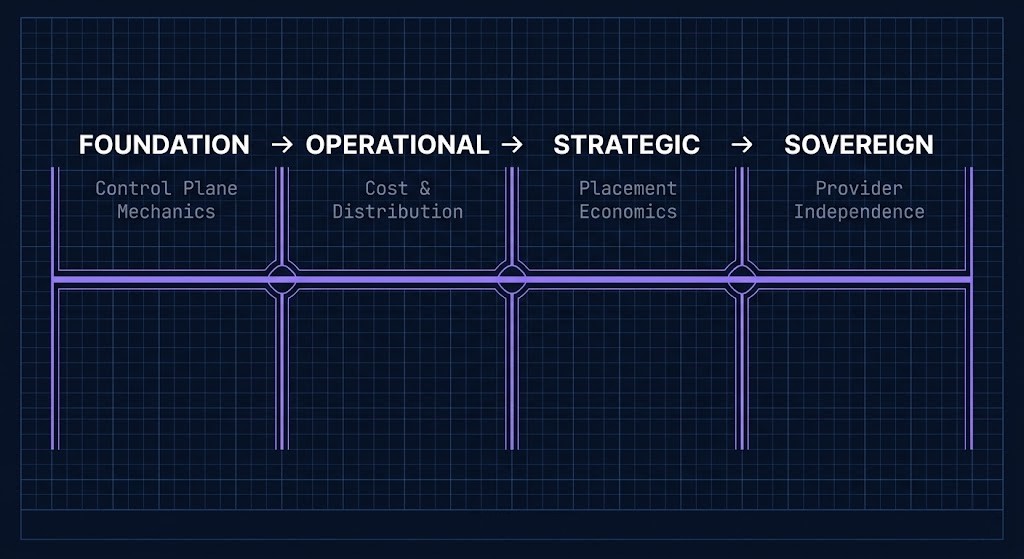
This Domain Path uses all five Architecture Maturity Levels. Each level describes the class of architectural problem being solved — not the reader’s experience level or provider familiarity.
| Level | Positioning | Architectural Goal |
|---|---|---|
| Foundation | Core principles and architectural mechanics | Understand provider control planes and shared responsibility boundaries |
| Operational | Day-2 operations and scalable execution | Reduce unmanaged cloud sprawl and operate distributed systems predictably |
| Strategic | Optimization, governance, and economics | Optimize workload placement economics and platform governance |
| Sovereign | Portability, control, and provider independence | Preserve architectural independence and exit optionality |
This Domain Path uses four levels: Foundation → Operational → Strategic → Sovereign. Two content stages run at Operational.
>_ Cloud Architecture Reading Sequence
The reading sequence below follows the maturity spine — each stage builds architecturally on the decisions established before it. The control plane ownership question introduced in Stage 1 runs as connective thread through cost topology, distributed systems design, placement economics, and sovereign architecture.
Cloud Foundations & Architecture Strategy
Cloud is a programmable control plane — a globally distributed fabric that abstracts compute, storage, networking, and identity at scale. This stage establishes the architectural framing that every subsequent stage depends on: shared responsibility boundaries, control plane ownership, and provider selection as an architectural constraint rather than a procurement decision. Provider-specific architecture follows; the framework comes first.
Cloud Cost Architecture
At scale, cloud cost is not a finance problem — it is an architecture visibility problem. Cloud bills are a structural artifact of architectural decisions made at design time: tagging discipline, egress topology, tenancy model, ownership boundaries. This stage covers the cost architecture decisions that determine whether the bill is legible, governable, and controllable — or a monthly surprise that nobody can trace to a decision.
Cloud-Native & Distributed Architecture
Orchestration, service mesh, container networking, and ingress design are not configuration problems — they are distributed systems architecture decisions that determine blast radius, operational coupling, and network failure domains. This stage covers the cloud-native architectural layer: how workloads are orchestrated, how services communicate, how traffic enters and exits the platform, and how the network control plane behaves under failure.
>_ Common Cloud Architecture Failure Patterns
Platform Economics & Workload Placement
The workload placement decision — “should this run here, and at what cost?” — is the most consequential architectural question at Strategic maturity. This stage covers the resource control architecture that governs what runs where, the platform engineering layer that abstracts it, and the repatriation economics that force the question when provider costs exceed on-premises alternatives. Authority Layer analysis covers who actually controls the platform and what that governance failure costs.
Sovereign Cloud & Control Plane Independence
Provider independence is not the same as provider exit. Sovereign architecture preserves optionality — the ability to move without the cost of movement becoming prohibitive.
Sovereign cloud architecture is the outcome of the entire path — the identity isolation, networking control, CI/CD ownership, and private cloud governance decisions that determine whether an organization retains architectural independence or surrenders it incrementally. Sovereignty is a design property, not a deployment location. It requires deliberate architecture at every layer that touches provider control planes.
>_ Deterministic Infrastructure Tools
>_ Where Do You Go From Here
>_ Continue Your Architecture Reading Sequence
Five Domains. One Maturity Framework.
The Cloud Architecture Domain Path is one of five structured reading sequences across the Rack2Cloud platform. Each path follows the same maturity spine — applied to the operational realities of its domain.
>_ Frequently Asked Questions
Q: What is the Cloud Architecture Learning Path?
A: The Cloud Architecture Learning Path is a maturity-guided reading sequence for senior enterprise infrastructure architects covering provider control plane mechanics, cloud cost architecture, cloud-native and distributed systems design, workload placement economics, and sovereign cloud architecture. It sequences published analysis from this site by architectural consequence and operational complexity — not by provider, certification objective, or feature category. The path uses four Architecture Maturity Levels: Foundation, Operational, Strategic, and Sovereign.
Q: How is this different from AWS, Azure, or GCP certification training?
A: Certification training sequences content around exam objectives and provider feature coverage. This path sequences content around the architectural decisions you face in production — control plane ownership, cost topology, blast radius design, workload placement economics, and sovereign architecture. The goal is architectural judgment that applies across providers, not credential familiarity with a single platform’s service catalog.
Q: What does ‘sovereign cloud architecture’ mean in Stage 5?
A: Sovereign cloud architecture is the deliberate design of infrastructure that preserves architectural independence from provider control planes — through identity isolation, sovereign networking, CI/CD control plane ownership, and private cloud governance. It is not a prescription to avoid public cloud. It is the architectural framework for ensuring that provider dependency is a conscious, reversible decision rather than an accumulated constraint. Stage 5 covers the specific design decisions that determine whether exit optionality is preserved or surrendered.
Q: Where should I start if I already run cloud infrastructure at scale?
A: Start at Stage 2 — Cloud Cost Architecture — if cost topology, egress design, or FinOps governance are live operational problems. Start at Stage 3 — Cloud-Native and Distributed Architecture — if orchestration, service mesh, or ingress design are the current architectural problems. Start at Stage 4 — Platform Economics and Workload Placement — if repatriation, placement decisions, or platform governance are the immediate questions. The entry point table in the Where to Enter This Path section maps each audience profile to its recommended stage.
Q: What is the Architecture Maturity Spine and why does it structure this path?
A: The Architecture Maturity Spine is a five-level framework — Foundation, Operational, Strategic, Resilient, Sovereign — that describes the class of architectural problem being solved at each level, not the reader’s experience or seniority. The Cloud Architecture Path uses four of the five levels. Two content stages run at Operational because cloud cost architecture and cloud-native distributed systems are both operational-maturity problems with distinct architectural content. The spine is platform-wide and consistent across all five Domain Paths — the same levels, the same meanings, applied to the operational realities of each domain.
Q: How often is the reading sequence reviewed and updated?
A: The architecture sequence is reviewed when significant changes occur — major provider pricing structure changes, platform deprecations, new published analysis that changes the recommended reading order, or new Authority Layer series posts that belong in Stage 4 or Stage 5. The last review date is shown in the governance metadata block above the reading sequence. Articles remain in the sequence as long as the architectural principles they cover remain accurate — they are flagged or replaced when provider-specific details become materially outdated.