

Why Most “Cheaper Cloud” Strategies Fail
The organization runs the program. Reserved instances purchased, rightsizing applied, maybe a workload consolidation push across three regions. Spend drops 18%. Leadership calls it a win.
Six months later, inter-region data transfer climbs again. Kubernetes clusters proliferate across environments that were supposed to consolidate. Idle compute returns. By the end of Q4, cloud spend has rebounded to within 4% of the original baseline.
The cheaper cloud strategy succeeded financially. The architecture that generated the spend was never touched. This isn’t an execution failure — it’s a structural one. And it’s the most common pattern in enterprise cloud cost programs.
What “Cheaper Cloud” Usually Means in Practice
When an organization announces a cloud cost reduction initiative, it typically resolves into one of three plays: reserved instance or savings plan purchases, a rightsizing exercise across running workloads, or a migration to a provider with lower headline rates.
Each of these can produce a real reduction. None of them is durable without architectural change.
Reserved instances and savings plans work by committing spend in advance in exchange for a discount. What they don’t do is change the workload placement decisions, service dependency patterns, or provisioning behaviors that generated the original spend. The commitment reduces unit cost. The architectural decisions that determine volume remain untouched. When those decisions drift — and they always drift — the volume climbs back.
Rightsizing exercises reset the baseline by aligning instance sizes to observed utilization. The problem is that utilization patterns are a downstream artifact of provisioning decisions made at the team or platform level. Without fixing the request and limit strategies, the namespace and cluster proliferation tendencies, and the “provision first, optimize later” culture embedded in those decisions, the next provisioning cycle recreates the bloat. You’ve cleaned the invoice line items. The behavior that generates them is unchanged.
Provider migration is the most expensive version of this pattern. The assumption is that a different provider’s pricing model will produce structurally lower spend. What actually happens is that data gravity, egress paths, service dependency graphs, and control plane architecture all travel with the workload. The invoice looks different. The architectural decisions generating it are identical. The real-world egress calculator makes this concrete — the numbers that follow a workload across providers are rarely what the headline rate comparison suggests.
The Authority Problem Behind the Bill
There’s a specific structural condition that explains why cost reduction programs fail even when they’re well-executed. It isn’t budget discipline, tooling, or process. It’s a misalignment between who makes architectural decisions and who owns the resulting spend.
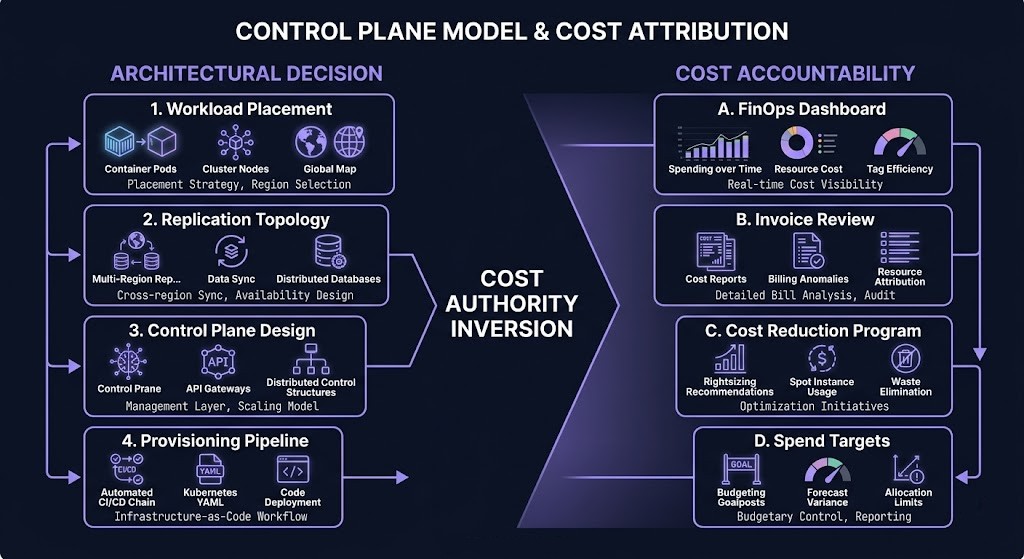
COST AUTHORITY INVERSION
Cost Authority Inversion is the condition where the team generating infrastructure cost through architectural decisions is not the team accountable for the resulting spend. The farther those two groups drift apart, the less effective cost reduction programs become.
Architectural decisions that generate cloud spend happen at the team and platform level. A platform team chooses a multi-region replication topology. An application team provisions a dedicated Kubernetes cluster per environment. A data engineering team designs a pipeline that moves terabytes across availability zones on a schedule that made sense at 10GB and became expensive at 10TB. These decisions are made by engineers solving specific problems — latency requirements, isolation requirements, throughput requirements — without direct visibility into or accountability for the cost they’re committing.
The bill lands in a FinOps function, a finance team, or a VP of Engineering who has reporting authority over spend but no direct architectural authority over the decisions generating it. Cost reduction programs run by that function therefore produce reports, escalations, and targets. They rarely produce architectural change — because the people receiving the bill can’t change the architecture creating it.
This is Cost Authority Inversion. It isn’t a failure of FinOps tooling. It isn’t a process problem. It’s a design failure in how cost accountability is assigned relative to architectural authority.
DIAGNOSTIC QUESTION
“Which team owns the architectural decision that produced your five largest bill line items — and do they also own the resulting spend?”
In most organizations, the answer to that question reveals a gap. The team that designed the replication topology doesn’t own the egress line. The team that provisioned the clusters doesn’t see the idle compute cost. The team that built the data pipeline isn’t accountable for the cross-region transfer charge. The inversion is structural — and cost programs that don’t address it are working around the wrong constraint.
Why Provider Switches Don’t Fix the Inversion
Provider migration as a cost strategy is appealing because it reframes the problem as a procurement decision rather than an architectural one. A different provider means different rates, different discounts, different commercial terms. It also means the same architectural decisions, made by the same teams, operating under the same Cost Authority Inversion that generated the original spend.
Data gravity follows the workload. A service architecture built around low-latency access to a specific data store doesn’t become cheaper to run because the data store moved providers — it becomes more expensive if the migration introduced latency that forced additional caching layers or changed the access pattern. Egress paths don’t disappear; they get renegotiated. The control plane architecture — the cluster topology, the namespace strategy, the provisioning pipeline — is rebuilt in the new environment by the same teams who built it the first time.
The Cost Authority Inversion survives the migration intact. The teams making architectural decisions in the new environment still don’t own the resulting spend. The FinOps function in the new environment still has reporting authority without architectural authority. The only thing that changed is the provider logo on the invoice.
The Cloud Strategy pillar covers the architectural dimensions of provider selection in more depth — the point here is that provider choice is a second-order decision. The first-order question is who owns the architectural decisions generating your spend, and whether that accountability is correctly placed.
What Architectural Change Actually Looks Like
The argument here is not “refactor everything.” Refactoring workloads as a cost strategy has the same structural problem as rightsizing — it’s a one-time intervention against a continuous process. The architecture will drift again if the ownership model doesn’t change.
The argument is more specific: align workload placement and cost accountability with the architecture already generating the spend. Three shifts that move the number durably:
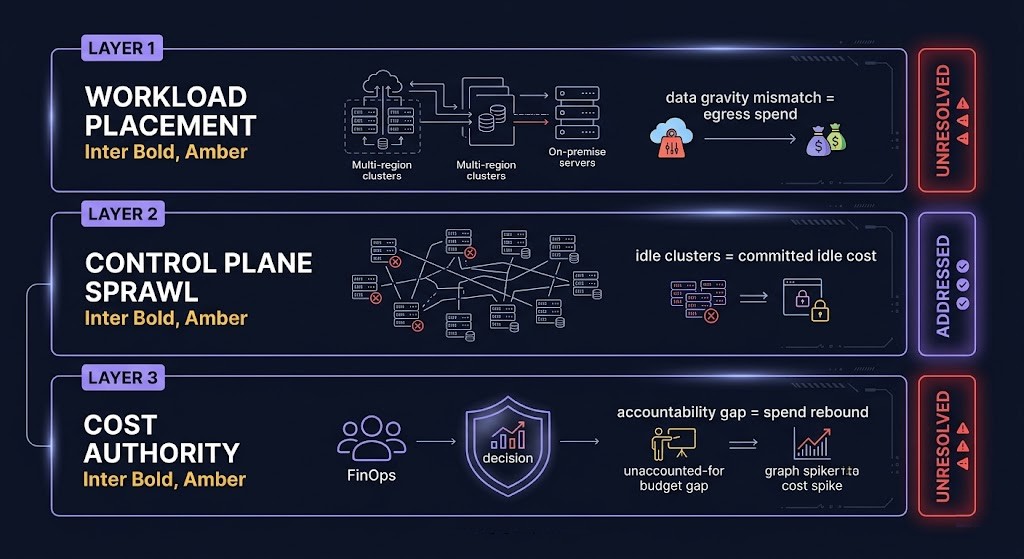
ARCHITECTURAL LEVERS THAT ACTUALLY MOVE THE NUMBER
- Fix workload placement to match data gravity — the inter-region transfer line exists because a placement decision was made without modeling the replication path it would create
- Address control plane sprawl — idle clusters, orphaned namespaces, and underutilized control planes are architectural decisions made by teams who don’t receive the bill for them
- Establish cost authority at the team level — FinOps is a measurement layer, not an authority layer; cost accountability belongs with the team that owns the architectural decision generating the spend
The third shift is the hardest and the most consequential. It requires changing how cost accountability is assigned at the point of architectural decision, not at the point of invoice receipt. Platform teams that provision shared infrastructure need a chargeback or showback model that makes the cost of their provisioning decisions visible to themselves, not just to a central FinOps function. Application teams that choose service topologies need to see the egress and replication cost of those choices at design time, not six weeks later in a Slack message from finance.
This isn’t a tooling problem. Visibility tooling is abundant. The gap is authority — who has both the information and the mandate to change the architectural decision before it compounds.
The Spend Was Decided Earlier Than You Think
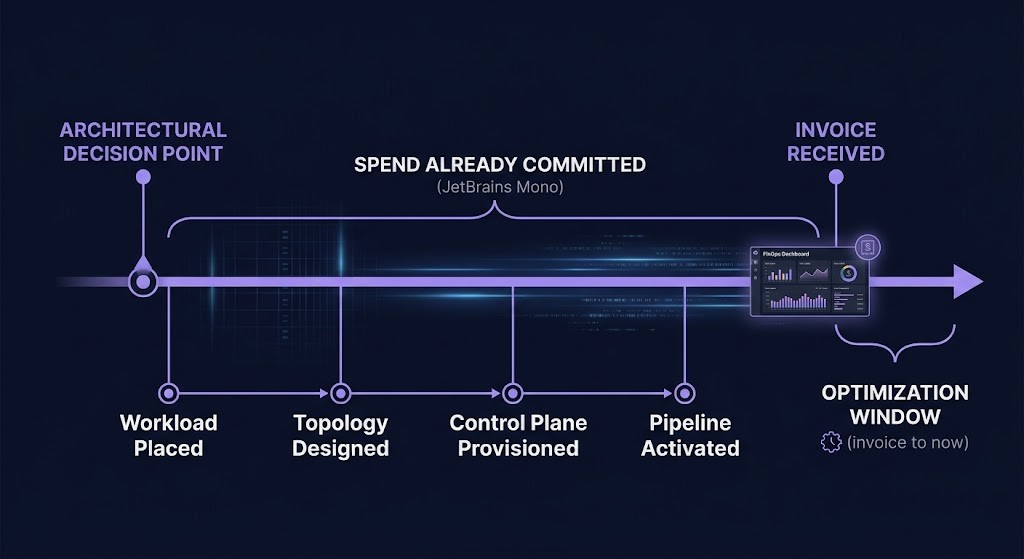
By the time a FinOps team opens the invoice, most of the spend it contains is already structurally committed. The workload was placed in a region chosen months ago. The replication topology was designed in a sprint that closed before the traffic patterns that made it expensive were visible. The control plane was provisioned to a size that made sense for the peak load projection at the time. The data movement pattern already exists — it’s been running every six hours since the pipeline went live in Q3.
The invoice is a reporting artifact. It’s documenting architectural decisions that were made weeks or months before the bill was generated. A cost program that starts with the invoice is working backwards into already-committed architecture. The decision window — the moment when placement, topology, and provisioning choices could actually have been shaped for cost — closed before the invoice was produced.
This is why cost reduction programs that operate primarily at the invoice layer produce diminishing returns. The first pass finds the obvious waste: orphaned resources, obvious overprovisioning, idle environments that should have been torn down. The second pass finds less. The third pass produces a report that recommends architectural changes — and those changes don’t happen because the authority to make them doesn’t sit with the team reading the report.
The organizations that reduce cloud spend durably are the ones that move cost accountability upstream — into the provisioning pipeline, the platform team’s operating model, and the architectural review process — rather than downstream into a FinOps dashboard. The How to Read a Cloud Bill Like an Architect post covers the diagnostic layer in detail. The Cloud Bill Is an Org Chart post maps the ownership topology that produces the patterns you find there.
Architect’s Verdict
A cheaper cloud strategy without architectural change is a cost relocation exercise. The number moves. The driver doesn’t. Reserved instances reduce unit cost while volume climbs back. Rightsizing resets the baseline while the provisioning behavior that produced it continues unchanged. Provider migration recreates the same spend profile in a new environment with a different logo on the invoice.
Cost Authority Inversion is the structural condition that makes this pattern inevitable. It isn’t a FinOps tooling problem or an engineering discipline problem — it’s a design failure in how cost accountability is assigned relative to architectural authority. When the teams generating infrastructure cost through their decisions don’t own the resulting spend, cost programs produce reports rather than architectural change. The inversion can survive reserved instance purchases, rightsizing cycles, and full provider migrations without being disturbed.
The spend was decided before the invoice arrived. By the time a cost reduction program opens the dashboard, most of what it finds is already committed — placed, replicated, provisioned, and running. The organizations that actually reduce cloud spend durably are the ones that treat cost accountability as an architectural responsibility, assigned at the point where decisions are made — not the point where bills are received.
Additional Resources
Editorial Integrity & Security Protocol
This technical deep-dive adheres to the Rack2Cloud Deterministic Integrity Standard. All benchmarks and security audits are derived from zero-trust validation protocols within our isolated lab environments. No vendor influence.

R.M.
Senior Solutions Architect with 25+ years of experience in HCI, cloud strategy, and data resilience. As the lead behind Rack2Cloud, I focus on lab-verified guidance for complex enterprise transitions. View Credentials →
Get the Playbooks Vendors Won’t Publish
Choose the architecture problems you care about. Get field-tested playbooks and frameworks delivered to your inbox.
- > AI Infrastructure & Inference Economics
- > Cloud Strategy & Hidden Cost Models
- > Virtualization & Deterministic Migration
- > Kubernetes, IaC & Modern Infrastructure
- > Data Protection & Recovery Engineering
Zero spam. Includes The Dispatch weekly drop.
Need Architectural Guidance?
Independent review before major infrastructure decisions.
- > Validate assumptions
- > Identify hidden dependencies
- > Quantify migration risk
- > Challenge vendor narratives
Triage · Advisory · Fractional · Direct Hire