

HARDWARE SECURITY
The Cryptographic Substrate Everything Else Inherits From.
A Hardware Security Module is not a security product. It is the cryptographic substrate every other security control in your infrastructure inherits from. TLS, disk encryption, IAM tokens, code signing, certificate chains, database encryption, container secrets — every one of these mechanisms terminates its trust in a private key held somewhere. The location of that key, the hardware that holds it, and the authority that can compel its use determine whether the rest of your security architecture is sovereign or borrowed.
Most organizations that have invested in cryptographic security have invested in the visible layer. TLS everywhere. Disk encryption enabled. KMS configured. Certificates rotating. The investment is real. The visibility is real. The cryptographic sovereignty, in many cases, is not.
Underneath the TLS, the disk encryption, and the KMS, there is a root key. That root key was generated somewhere. By someone. Under some authority. If any of those answers point outside your boundary, the entire stack above inherits the dependency — regardless of how much encryption is layered on top.
This page answers one question: What does cryptographic sovereignty actually require, and how does the Hardware Security Module deliver it?
The Rack2Cloud Cryptographic Sovereignty Stack
Cryptographic sovereignty is not a single decision. It is a four-layer property — a stack where each layer either operates within the sovereign boundary or escapes it.
The layers are not independent. Each layer inherits trust from the one below. A failure at the bottom invalidates everything above. A failure in the middle silently undermines the layers it supports. There is no partial sovereignty in cryptography. There is sovereign trust at every layer, or there is borrowed trust pretending to be sovereign.
This is the Rack2Cloud Cryptographic Sovereignty Stack.
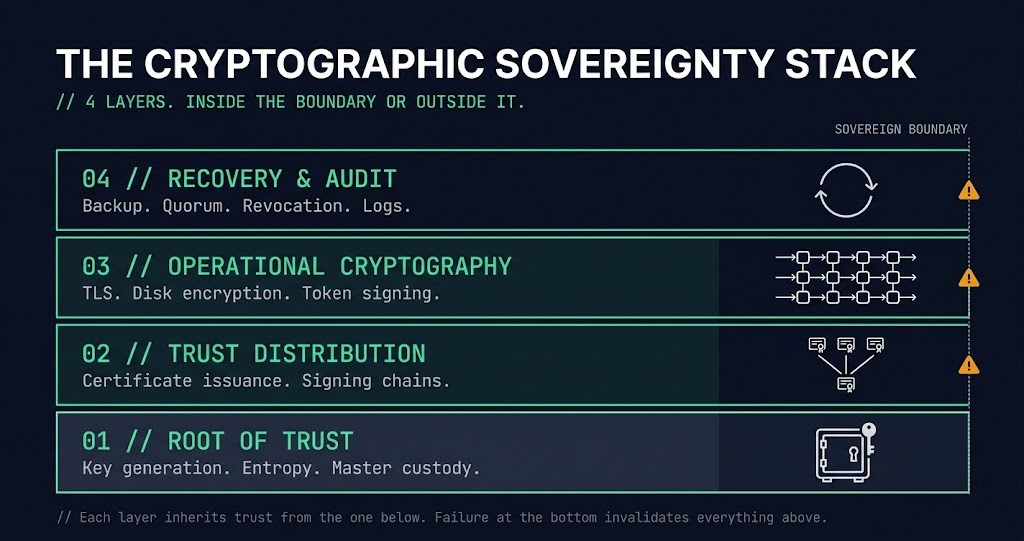
| Layer | What It Controls | Sovereignty Test | Fails When |
|---|---|---|---|
| Root of Trust | Key generation, entropy source, master key custody, root CA private key | Can root keys be generated and retained inside your boundary, with provable physical custody? | Root generated externally; entropy sourced from cloud RNG; root CA hosted by external provider |
| Trust Distribution | Certificate issuance, intermediate CA signing, trust propagation, cross-signing relationships | Can trust be issued and propagated without external dependency at any signing step? | External CA cross-signs the internal root; intermediate CA hosted by SaaS provider; signing path traverses external API |
| Operational Cryptography | TLS handshakes, disk encryption, secrets sealing, token signing, code signing, application-level encryption | Can workloads perform cryptographic operations without leaving the sovereign boundary? | KMS calls go to cloud provider; token signing happens at external endpoint; code signing requires cloud CI/CD signing service |
| Recovery & Audit | Backup of cryptographic material, restore ceremony, M-of-N quorum operations, revocation, immutable audit trail | Can cryptographic trust be restored and proven offline, with audit continuity through the recovery event? | HSM recovery depends on vendor cloud tooling; quorum members are provider-managed; audit logs forwarded only to external SIEM |
The stack reads bottom-up architecturally and top-down operationally. Architectures are designed bottom-up — establishing root of trust first, then trust distribution, then operational cryptography, then recovery. Failures surface top-down — operational cryptography fails first because that is the layer applications touch every second; recovery fails last because that is the layer no one tests until they need it. Most cryptographic sovereignty audits find the same pattern: layers 3 and 4 are documented in detail, layers 1 and 2 are documented at high altitude with assumptions that don’t survive close inspection.
The Cryptographic Sovereignty Illusion
The illusion of cryptographic sovereignty is maintained by a set of beliefs that are individually reasonable and collectively wrong. Each belief describes a real security investment. None describes sovereignty. Recognizing the gap between what was purchased and what was actually achieved is the prerequisite to closing it.
| What Teams Believe | What It Actually Means |
|---|---|
| Encryption everywhere = sovereignty | Encryption without sovereign key custody is outsourced trust. The cipher is strong; the key holder is not you. Strong encryption with a borrowed key is a stronger lock on someone else’s door. |
| BYOK = sovereign control | Bring Your Own Key delivers customer-supplied key material into a provider-controlled trust boundary. The key originated with you. The hardware that uses it, the operations performed against it, and the audit trail covering it are all provider operational authority. |
| Cloud HSM = sovereign cryptography | Provider-operated HSMs reduce exposure to multi-tenant key escrow risk. They do not reduce dependency. The hardware sits in a provider data center. The firmware update path, the recovery ceremony, the personnel with physical access — all provider-controlled. |
| FIPS validated = secure architecture | FIPS 140-3 validates cryptographic module behavior — the algorithms, the random number generator, the tamper detection. It validates nothing about custody, sovereignty, deployment topology, or who holds the keys. A FIPS 140-3 Level 3 module operated by an external provider is FIPS-validated and not sovereign. |
| Key rotation = cryptographic resilience | Rotation without independent custody just rotates the dependency. A new key generated by the same provider, stored in the same HSM, governed by the same authority is operational hygiene — not sovereignty improvement. |
| Multi-region key replication = resilience | Replicating a key across provider regions creates redundancy under provider operational continuity. It creates zero redundancy under provider authority loss. If the provider relationship terminates, every replica terminates simultaneously. |
The illusion persists because cryptographic sovereignty failures are invisible at rest. The encryption works. The TLS terminates. The signatures verify. Day-to-day operations show no symptom. The sovereignty gap activates only at the moment it would matter most: when external authority is exercised against your data, when a provider relationship is severed, when a jurisdictional access order arrives, or when post-quantum decryption invalidates the cryptography that protected the keys themselves.
Why Hardware Trust Cannot Be Software-Substituted
Software encryption is a locked door with the key under the mat. The door is real. The lock is real. The key sits in memory accessible to anything else running on the same host — including the kernel, the hypervisor, anyone with elevated privilege, and any code that successfully escalates from any of those contexts.
Hardware Security Modules exist because the threat model that software-only key custody assumes is the threat model attackers stopped operating under decades ago. The five threat vectors below describe what the HSM defends against. Each represents an adversary capability that software-only key storage cannot meaningfully counter — because the adversary does not need to break the cipher; they need to read the key, and the key is sitting unprotected in the same execution context they control.
The defensive value is not that HSMs make cryptography stronger. The cryptographic algorithms are the same. The defensive value is that HSMs make the key extraction problem physical instead of logical — and physical attacks on tamper-resistant hardware are categorically harder, slower, and more visible than logical attacks on software-resident keys. The shift from software custody to hardware custody is not a security tweak. It is a different threat model.
The HSM Deployment Spectrum
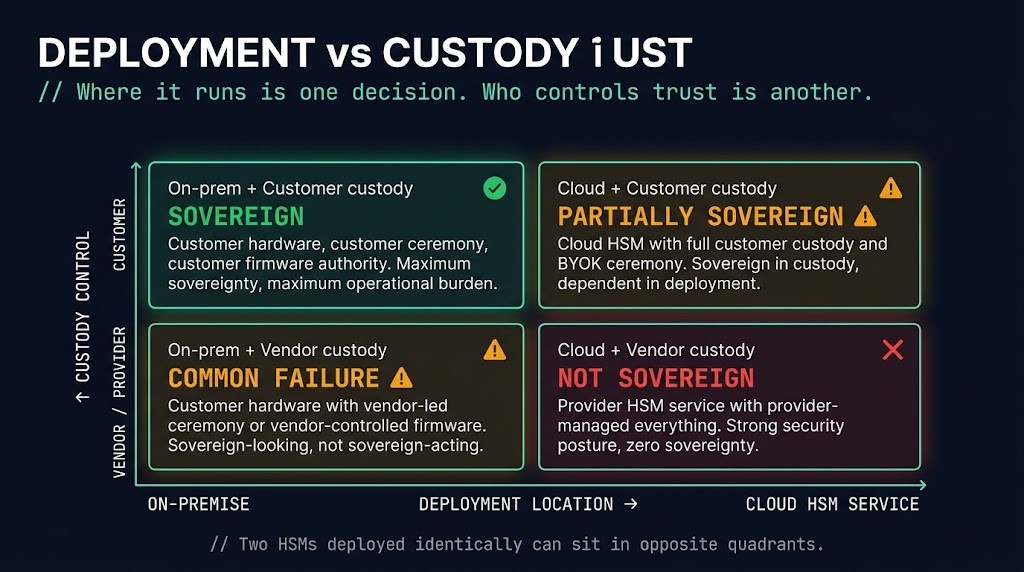
Where the HSM physically lives is the first architectural decision. It is not the most important decision — that distinction belongs to the custody model in the next section — but it is the one that constrains everything else. Four deployment models cover the production spectrum, each with a distinct sovereignty profile, latency characteristic, and operational model.
| Deployment Model | Where It Runs | Sovereignty Profile | Operational Model |
|---|---|---|---|
| Dedicated On-Premise HSM | Customer-owned hardware in customer data center, customer physical facility, customer jurisdiction | Maximum sovereignty — physical custody, jurisdictional control, no provider operational authority over the module | Customer manages procurement, racking, firmware, key ceremony, recovery, audit. Maximum operational burden, maximum control. |
| Colocation HSM | Customer-owned hardware in colocation facility — physical possession remains customer’s, facility is third-party | Strong sovereignty — physical custody, jurisdictional control via colo contract, facility access governed by colo provider | Customer manages firmware and keys. Colo provider manages physical facility access. Hybrid operational responsibility with clear demarcation. |
| Cloud-Attached HSM | Customer-owned hardware physically located in a cloud provider data center, dedicated to a single customer | Partial sovereignty — physical isolation from cloud fabric, but operational dependency on provider for facility access and integration | Customer manages keys. Provider manages physical access, network integration, and infrastructure connectivity. Operational simplicity at the cost of full custody. |
| Cloud HSM Service | Provider-owned hardware in provider data center, accessed via API as a managed service | Provider operational authority — keys may be customer-generated, but every operation against them flows through provider control | Provider manages everything. Customer issues API calls. Lowest operational burden, highest dependency, weakest sovereignty claim. |
The deployment decision is conventionally framed as a tradeoff between sovereignty and operational complexity — and that framing is partially correct. The dedicated on-premise model carries the highest operational burden and the strongest sovereignty position. The cloud HSM service inverts both. But the decision is more architecturally subtle than that simple tradeoff suggests, because deployment is only half of the question. The other half — who actually controls trust operations — is the next section.
The Custody Model
Where the HSM runs matters less than who controls trust operations against it. Two HSMs deployed identically can have completely different sovereignty postures depending on the custody model — who generates root keys, who holds firmware update authority, who can invoke signing operations, who participates in M-of-N quorum, and who can execute the recovery ceremony when something fails.
The custody model is the architectural decision that determines whether sovereign claims are real or borrowed. A cloud HSM service with full customer custody is more sovereign than an on-premise HSM with vendor-controlled firmware updates. Deployment defines the perimeter. Custody defines who has authority inside it.
| Custody Dimension | What It Owns | Sovereign Requirement | Common Failure Pattern |
|---|---|---|---|
| Hardware Custody | Physical possession of the cryptographic module — the device itself, the chassis, the location it sits in | Customer holds physical possession or has unilateral physical access through controlled facility contract | Cloud HSM service: provider holds physical possession; customer has API access only |
| Firmware Authority | Control over what code runs inside the HSM — including security-critical updates that change cryptographic behavior | Customer authorizes every firmware update; vendor cannot push code into the module without explicit customer consent | Auto-updating cloud HSMs where firmware decisions sit with the provider; vendor-managed firmware in cloud-attached models |
| Root Generation Authority | The act of generating the master root key — the bootstrap moment of cryptographic sovereignty | Root key generated inside customer-controlled hardware, under customer-managed key ceremony, with customer-held quorum | Root generated by provider during HSM provisioning; root cross-signed by external CA at creation; root generated under vendor support engagement |
| Quorum Composition | The M-of-N personnel who must collectively authorize critical operations — root recovery, firmware updates, key ceremony | All quorum members are customer personnel under customer employment with customer-issued credentials | Vendor support engineers required as quorum participants; provider-managed cryptographic officers; quorum tied to vendor accounts |
| Recovery Ceremony | The procedure for restoring HSM-backed trust after hardware failure, key loss, or quorum collapse | Recovery executable by customer personnel using customer-controlled material; no vendor intervention required to complete | Recovery requires vendor RMA process; recovery material held in vendor cloud; recovery procedure undocumented or untested |
The custody model is what separates an HSM that delivers cryptographic sovereignty from an HSM that delivers cryptographic outsourcing in better-looking packaging. The deployment spectrum and the custody model are independent variables. Architectures that get one right and the other wrong are common — and consistently surprised when sovereignty fails to materialize during the event that was supposed to validate it. The physical perimeter the HSM lives inside is what makes that custody actually defensible.
The Cryptographic Call Path
Abstract sovereignty models are easy to dismiss. Concrete failure paths are not. Below is a single cryptographic operation — the kind that happens millions of times per day in any production environment — mapped against its sovereignty dependencies. Most architects have never traced this call path explicitly. Most environments have at least one external dependency in it.
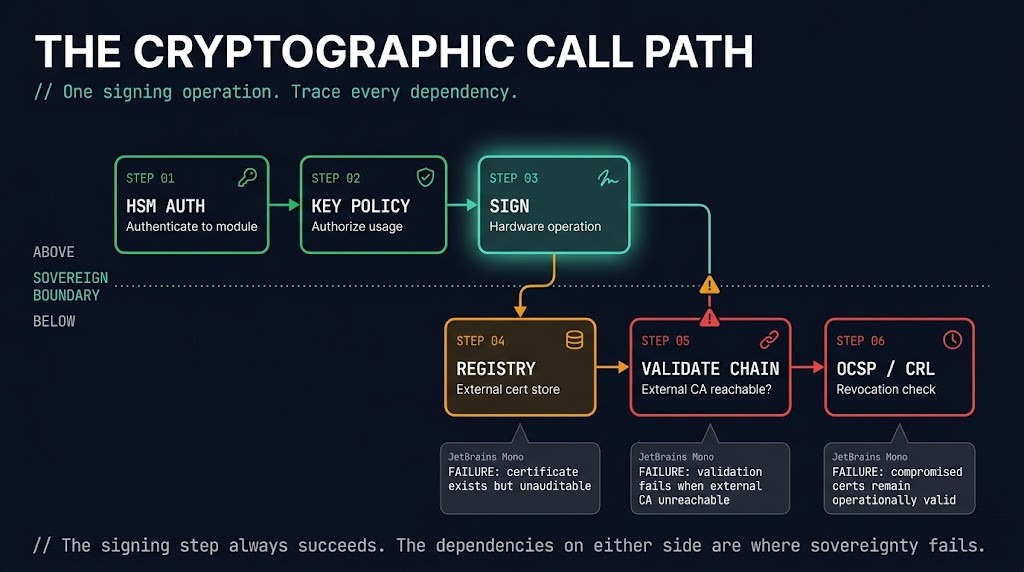
The flow: a workload requests a signed certificate to assert its identity to a downstream service. The intermediate CA receives the request. The intermediate authenticates against the HSM holding its signing key. The HSM executes the signing operation. The certificate is returned. A downstream service receiving a TLS connection backed by the new certificate validates the signature, walks the chain to the root, and checks revocation status. Six steps. Multiple dependency boundaries. Each boundary is either inside the sovereign perimeter or outside it.
| Step | What Happens | External Dependency Risk | Sovereignty Failure Outcome |
|---|---|---|---|
| HSM Authentication | The intermediate CA presents credentials to the HSM to authorize signing | Authentication may go through provider IAM (cloud HSM); authentication may require external KMS reachability | Cannot sign during provider IAM outage; signing authority bound to external identity system |
| Key Usage Authorization | HSM policy evaluates whether the requesting principal is permitted to invoke this key for this operation | Policy may be stored externally (cloud HSM service control plane); policy evaluation may require API call out | Authorization decisions cannot be made under network isolation; signing fails closed during provider unreachability |
| Signing Operation | HSM executes the cryptographic signing operation against the requested data using the protected key | None for properly architected HSMs — signing happens entirely inside the module hardware | This is the layer that should always succeed; if it doesn’t, the HSM hardware itself is the failure point |
| Certificate Issuance | Signed certificate is returned to the requesting workload, recorded in the certificate registry | Registry may be external (cloud certificate service); audit log may go only to external SIEM | Issued certificate exists but is not auditable; certificate registry diverges from authoritative state |
| Validation Chain Walk | Downstream service validates the signature, walks the certificate chain to the root | Root CA hosted externally; intermediate CA hosted externally; validation depends on external resolution | Validation fails when external CA is unreachable; downstream services reject connections during isolation |
| Revocation Check | Downstream service consults OCSP responder or CRL to confirm the certificate has not been revoked | OCSP/CRL endpoints external; revocation cannot be confirmed during isolation | Compromised certificates remain operationally valid because revocation cannot be verified; blast radius expands |
The signing step itself is the only step in the chain that always succeeds in a properly architected HSM. Every other step has potential external dependencies. The sovereign architecture is the one where every step in the chain stays inside the boundary — not just the cryptographically interesting one. A signing operation that completes flawlessly inside an HSM but produces a certificate that cannot be validated against an unreachable root CA has produced exactly zero useful work.
HSM in Modern Architecture Patterns
The HSM is not a standalone product. It is an integration point. Six architectural patterns dominate modern HSM usage in production environments, each anchoring a different layer of the operational stack to hardware-backed trust. This is where the data protection plane terminates its trust chain in cryptographic hardware. The pattern selection determines what classes of compromise the HSM actually defends against — and what it does not.
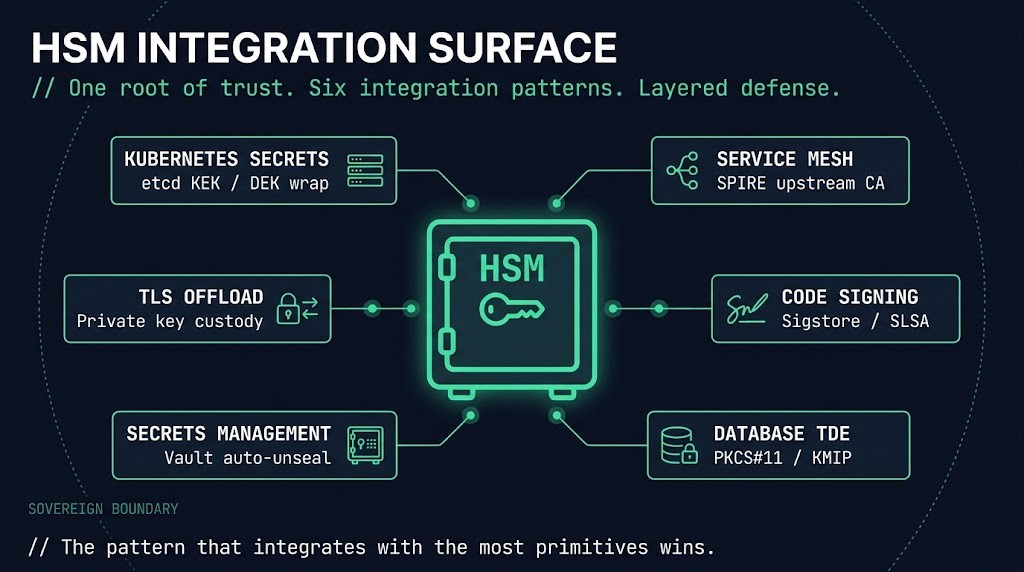
The pattern that integrates with the most architectural primitives wins. An HSM that protects only TLS keys delivers narrow defensive value. An HSM that anchors Kubernetes secrets, service mesh identity, code signing, database encryption, secrets management, and TLS termination simultaneously becomes the cryptographic substrate for the entire stack — and that integration depth is what justifies the operational investment in dedicated HSM infrastructure for environments where cryptographic sovereignty is a real architectural requirement.
HSMs in AI Infrastructure
AI infrastructure introduces three new categories of cryptographic trust requirements that did not exist in traditional infrastructure architecture. Model integrity, training provenance, and inference authority all require cryptographic assertions that someone in the chain has to be able to make and someone else has to be able to verify. Without HSM-backed roots of trust, those assertions are claims. With them, they are provable.
The AI cryptographic trust surface is new enough that most architectures have not yet addressed it. Model signing is treated as an MLOps concern. Training provenance is treated as a data engineering concern. Inference token signing is often not addressed at all. None of these surfaces are MLOps concerns — they are cryptographic sovereignty concerns that happen to manifest in AI infrastructure. This is the control plane shift at the cryptographic layer. The Sovereign AI Mandate covers the broader AI sovereignty surface; this section covers the specific HSM dependencies underneath it.
The Post-Quantum Reckoning
RSA and ECC — the asymmetric cryptography that protects most of the internet — are vulnerable to quantum decryption. Not theoretically. Mathematically. A sufficiently capable quantum computer running Shor’s algorithm breaks both. The remaining question is timing: when does the capability arrive, and how much encrypted traffic captured before that point becomes readable when it does.
The threat model has a name: Harvest Now, Decrypt Later (HNDL). Adversaries are archiving encrypted traffic now, against the assumption that quantum decryption capability arrives within the standard sensitivity window for that data — typically 10 to 30 years for regulated information, well beyond the lifespan of any single data hardening posture. A patient adversary doesn’t need to decrypt today. They need to capture today and decrypt later.
NIST’s post-quantum cryptography standardization program — finalizing CRYSTALS-Kyber for key encapsulation, CRYSTALS-Dilithium and SPHINCS+ for signatures — is the migration target. The architectural question for HSMs is whether they can adopt those algorithms when the migration window opens.
What “PQC-ready” means in HSM marketing vs. what it actually delivers:
| Marketing Claim | What to Verify |
|---|---|
| “PQC-ready firmware” | Are NIST-finalized algorithms implemented in firmware today, or is firmware “field-upgradeable to PQC when standardization completes”? The first is operational. The second is a marketing assertion about future capability. |
| “Quantum-resistant by design” | Quantum-resistant against which threat model? Symmetric algorithms with adequate key length are resistant to known quantum attacks. Asymmetric algorithms requiring PQC migration are different. Marketing copy frequently conflates these. |
| “Crypto-agile architecture” | Can the HSM accept new algorithm implementations via field-programmable firmware (FPGA-based) without hardware replacement? Or does crypto-agility require buying new units when algorithms change? |
| “Hybrid algorithm support” | Can the HSM execute hybrid signatures combining classical and PQC algorithms — protecting against the case where the PQC algorithm is later compromised? This is the migration-period requirement most marketing copy doesn’t address. |
The architectural answer to the post-quantum reckoning is field-programmable cryptographic capability — HSMs whose firmware can adopt new algorithms during their operational lifetime. FPGA-based HSMs designed for crypto-agility can update their algorithm implementations without hardware replacement. ASIC-based HSMs locked to specific algorithms cannot. For environments where the data sensitivity window exceeds the expected hardware lifecycle — which is most regulated environments — crypto-agility is not a feature, it is a fundamental architectural requirement.
The Key Ceremony Problem
Cryptographic sovereignty does not fail during steady state. Under normal operations, with vendor relationships intact and infrastructure functioning, the HSM signs, the certificates issue, the encryption protects. Nothing looks broken. Everything functions.
Cryptographic sovereignty fails at initialization.
The Key Ceremony Problem is this: establishing a sovereign cryptographic infrastructure requires a first root key. Before that key exists, there is no cryptographic authority. Before there is cryptographic authority, there is no signed identity. Before there is signed identity, there is no audit trail. The system you are trying to build cannot authenticate itself until it exists — and bringing it into existence requires acts that, if performed under external authority, taint the entire trust chain that descends from them.
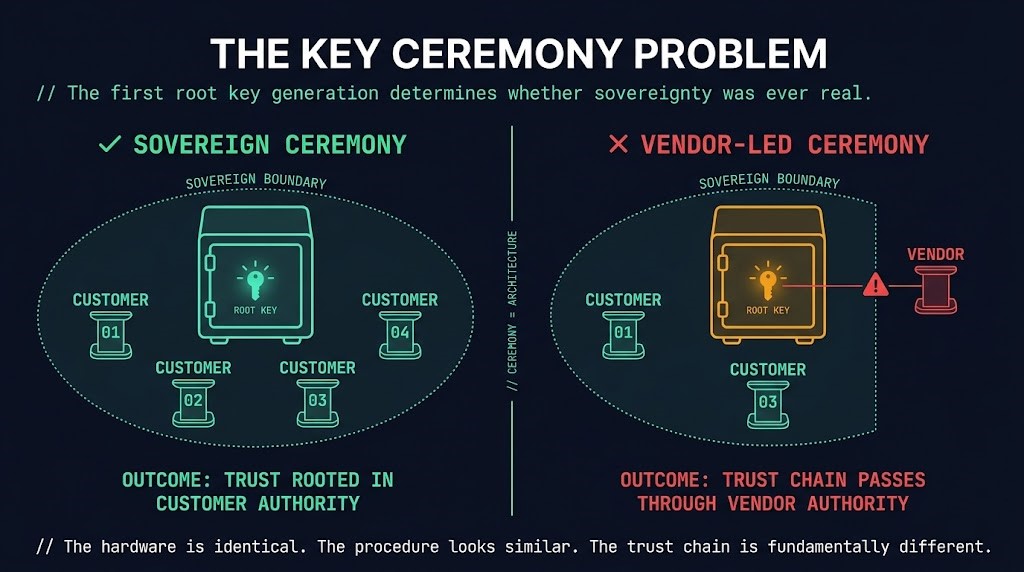
This circular dependency is not theoretical. It manifests in a specific pattern: the team deploying sovereign cryptographic infrastructure relies on the most convenient initialization path — vendor support engaging in the key ceremony, cloud provider tooling generating the root, an external CA cross-signing the new root for “compatibility,” provider-supplied quorum officers participating in the ceremony. Each of these is operationally easier than the alternative. Each of them invalidates the sovereignty claim that the HSM was deployed to deliver.
If your first root key generation involved any external authority, your cryptographic sovereignty was never real. It was sovereign-adjacent, initialized from a dependency that was never removed.
The Minimum Viable Ceremony (MVC). A sovereign cryptographic infrastructure must be able to perform four operations without any external authority. These are not implementation steps — they are requirements. How they are implemented belongs to the execution layer. Whether they are possible at all is the sovereignty test.
Where HSM Strategy Actually Fails
The visible HSM failure modes — hardware tampering, cryptographic algorithm weakness, FIPS validation gaps — get most of the attention in vendor documentation. They are also the failure modes that least frequently break sovereign architectures in practice.
The actual failure modes are subtler. They share a common pattern: cryptographic trust exits the sovereign boundary without most teams realizing it. The architecture diagram shows HSM at the center. The dependency graph shows external authority somewhere in the chain. The diagram and the graph rarely match, and when they don’t, the sovereignty claim is the casualty.
Cloud KMS dependency masquerading as custody. The most common pattern. An organization adopts cloud KMS for operational simplicity, configures BYOK for compliance optics, and then describes the architecture as customer-controlled. The keys are in provider hardware. The signing operations run on provider infrastructure. The audit trail is provider-managed. The customer’s “control” is API access. This is custody outsourcing dressed in the language of sovereignty. The same dynamic plays out one layer up in private cloud sovereignty — managed services that look sovereign and operate as outsourced authority.
External CA chains in trust hierarchies that should be self-contained. An internal PKI is established with a customer-controlled root, then cross-signed by a public CA “for compatibility with browser trust stores.” The cross-signature creates a permanent trust path through the external CA. Every certificate issued under that root carries the external dependency forward. The trust chain is sovereign on paper and federated in practice.
OCSP and CRL external dependency in revocation paths. The internal CA issues certificates correctly. The revocation infrastructure points outward. CRL distribution points are hosted on internet-accessible URLs. OCSP responders are external. Under network isolation, certificates can be issued but cannot be confirmed as not-revoked. Compromised credentials remain operationally valid for the duration of the isolation event.
SaaS signing path dependency. Code signing infrastructure outsourced to a SaaS provider. Document signing routed through a third-party signing service. The artifacts are signed; the signing authority is rented. The vendor relationship terminating ends the ability to verify previously-signed artifacts. The same dynamic compounds when agentic CLI execution layers begin invoking those signing services autonomously — the rented authority now acts under non-human credentials at machine velocity.
HSM quorum collapse during incident response. M-of-N quorum schemes that require five officers but only have four authorized personnel currently employed. Quorum members traveling, on leave, or recently departed. The recovery ceremony cannot be assembled when it needs to be. Sovereignty becomes operationally unreachable through personnel turnover that was never modeled against ceremony requirements.
Recovery ceremony dependency on vendor tooling. The HSM was deployed sovereignly. The original ceremony was customer-led. The recovery procedure — the one that runs after hardware failure — requires vendor RMA, vendor-supplied recovery material, or vendor engineers on the bridge call. The steady state was sovereign. The recovery state is not.
The HSM Failure Modes Nobody Markets
The failure modes below are not theoretical. Each is a documented pattern that has compromised cryptographic sovereignty in production environments. None of them appear in vendor datasheets. All of them determine whether HSM architecture holds when the conditions it was deployed to survive actually arrive.
The pattern shared across all six failures is the same: the architecture was sovereign in design and dependent in execution. The gap between the two only surfaces under conditions that the steady state never exposes. The Cryptographic Sovereignty Test below is the diagnostic that catches these gaps before the conditions they hide under arrive.
The Cryptographic Sovereignty Test
Before treating cryptographic sovereignty as complete, run this test. It is not a checkbox — it is a diagnostic. The scoring reveals where the architecture actually stands versus where documentation claims it stands.
Sever all external network paths. Then answer:
Can root keys be generated without provider involvement?
If yes: root generation authority is sovereign. If no: every key in your environment inherits provider authority at its origin.
Can certificates be issued if external connectivity is severed?
If yes: trust distribution is sovereign. If no: every certificate request is gated on external reachability that the sovereign environment was designed to operate without.
Can workloads validate trust without external OCSP / CRL reachability?
If issuance works but revocation is external: partial. Compromised certificates remain operationally valid because revocation cannot be verified during the isolation event.
Can quorum operations survive personnel loss?
If quorum is M-of-N with N tightly bounded to current authorized personnel: degraded. Personnel turnover puts critical operations out of reach without active rotation discipline.
Can you restore HSM-backed trust without vendor intervention?
If recovery requires vendor RMA, vendor-supplied recovery material, or vendor engineers on the call: not sovereign. The steady state is sovereign; the recovery state is contractually dependent.
When did you last test full cryptographic recovery offline?
Never tested = assumed sovereignty. A recovery procedure that has never been executed is a document, not a capability. Sovereignty is provable or it is assumed.
Where Cryptographic Sovereignty Breaks Other Architectures
Cryptographic sovereignty failures do not stay in the cryptographic plane. They propagate. Every architecture that depends on cryptographic trust — which is every architecture — inherits the cryptographic plane’s sovereignty status. When the cryptographic plane fails, it takes the architectures built on top of it with it.
| Architecture | Cryptographic Failure Impact | Specific Failure Mode |
|---|---|---|
| Backup Architecture | Backup encryption keys held in cloud KMS — provider authority over the key that protects the last copy of your data | Backup data is sovereign in storage; the key that decrypts it is not. Provider relationship termination renders backups unrecoverable. |
| DR & Failover | DR environment cannot establish trust — TLS handshakes fail because the failover site cannot reach the external CA | DR site lacks local PKI replica; certificate validation in recovered environment calls primary-site OCSP that is offline; sovereignty was assumed but never replicated |
| Ransomware Survival | Compromised certificates cannot be revoked — external OCSP unreachable during incident, blast radius expands for entire isolation duration | Ransomware operators obtain code signing credentials; signed malicious updates appear valid because revocation cannot be verified; sovereignty fails when adversary tests it |
| Business Continuity | BC degradation ladder cannot execute — service-to-service TLS fails when CA chain depends on external validation | BC routing depends on authenticated service mesh calls; mesh mTLS fails because workload certificates cannot be re-issued without external CA reachability |
| Data Hardening | Encryption-at-rest cannot decrypt — KMS calls fail; encrypted data becomes inaccessible because the key it depends on is unreachable | Database TDE keys held in cloud KMS; provider unreachability blocks all decryption operations; encryption becomes a denial-of-service against the data owner |
| Sovereign Identity | Identity tokens cannot be signed or validated — JWKS endpoint, signing key, or PKI chain has external dependency | Sovereign identity rests on cryptographic foundation; if HSM-anchored root is external, identity sovereignty inherits the dependency at its base |
| Sovereign Infrastructure | Entire sovereignty model collapses — every other plane (Identity, Management, Data, Network) depends on cryptographic trust that the cryptographic plane provides | Cryptographic plane is the foundation. If the foundation has external authority, every plane built on it inherits the dependency at its root. |
The pattern holds across every architecture: cryptographic sovereignty is the dependency that all other sovereignty claims rest on. Get it wrong, and every other sovereign architecture decision in the environment is undermined at its foundation. Get it right, and every other architecture inherits a working cryptographic substrate.
Decision Framework
| Scenario | Cryptographic Sovereignty Requirement | Minimum Architecture | Risk if Skipped |
|---|---|---|---|
| Regulated data subject to GDPR, DORA, NIS2 | HSM-anchored root with customer custody; local PKI; local OCSP | Dedicated on-premise or colocation HSM with customer-led ceremony; internal CA hierarchy; locally hosted revocation | Jurisdictional access order enforceable against cloud KMS; customer-managed keys subject to provider compliance action |
| Defense or national security workloads | Full MVC + air-gapped quorum + vendor-independent recovery + PQC-ready firmware | FIPS 140-3 Level 3+ HSM in customer facility; quorum entirely from cleared personnel; tested offline recovery; FPGA-based crypto-agility | Nation-state access via provider operational authority; recovery dependency on vendor relationship; algorithmic obsolescence inside the data sensitivity window |
| Healthcare or financial records, adversarial threat model | Customer-controlled HSM custody + local revocation + tested recovery + per-application key isolation | On-premise or colo HSM; internal CA with local OCSP; quarterly recovery ceremony test; key isolation between application domains | Ransomware compromise of code signing credentials; revocation gaps allow signed malware; blast radius expansion during isolation |
| AI workloads with strategic model assets | Model signing keys in customer HSM; per-agent signing keys for agentic systems; provenance attestation | HSM-protected model release signing; SPIFFE/SPIRE for inference workload identity with HSM-anchored upstream CA; signed training data ingestion events | Model substitution attacks undetected; agentic API calls under shared credentials; training data lineage unprovable to regulators |
| Hybrid cloud with sovereignty-classified workloads | Cryptographic plane segmentation — sovereign HSM for classified data, cloud KMS acceptable for non-classified | Customer HSM for the sovereign boundary; cloud KMS isolated to non-classified workloads; no key escape between domains | Cloud KMS dependency extends into sovereign workloads via shared services; key escape breaks the segmentation that sovereignty depends on |
| Startup or early-stage organization | Cloud HSM with full customer custody (BYOK with documented ceremony); offline recovery material | Cloud HSM service with customer-controlled key generation; recovery material held offline; migration path to on-premise documented | Full Stage 3–4 sovereign HSM overhead exceeds benefit at this scale; revisit at regulated workload threshold or strategic asset accumulation |
Cryptographic Sovereignty Maturity Model
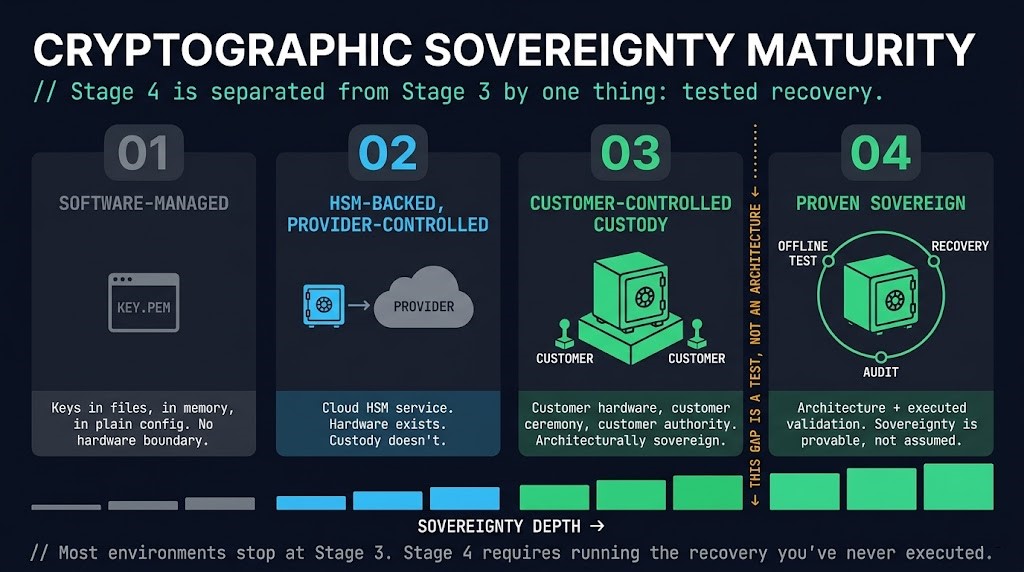
| Stage | State | What Exists | What’s Missing | Sovereignty Test |
|---|---|---|---|---|
| 1 | Software-Managed Keys | Encryption deployed; key files in config or secrets manager; basic key rotation | No hardware boundary; keys readable by any process with file or memory access; no custody concept | Search the filesystem for `.pem`, `.key`, `.p12`. Are keys present in plain form? |
| 2 | HSM-Backed, Provider-Controlled | Cloud KMS or BYOK adopted; cloud HSM service in use; keys not present in plaintext outside the module | Provider holds physical custody; firmware authority sits with provider; recovery ceremony provider-dependent; all operations subject to provider authority | Could the provider be compelled to produce key material under jurisdictional order? If yes: not sovereign. |
| 3 | Customer-Controlled Custody | On-premise or colo HSM deployed; customer-led ceremony executed; internal PKI rooted in HSM; local OCSP/CRL infrastructure | MVC not tested for recovery — original ceremony documented but recovery never executed; PQC migration plan not in place; cross-pillar audit gaps | Severance test: can the system operate, recover, and audit without any vendor interaction for 30 days? |
| 4 | Proven Sovereign Cryptographic Trust | All Stage 3 components plus: tested recovery ceremony; rotated quorum personnel; PQC-ready firmware deployed; AI signing surface addressed; quarterly offline drills | Ongoing operational overhead — sovereign HSM custody requires active maintenance, ceremony rotation, and regular testing discipline | All Cryptographic Sovereignty Test questions answered PASS — with executed test results, not assumed capabilities |
Stage 3 and Stage 4 are separated by testing, not architecture. Most organizations that have invested in sovereign HSM custody reach Stage 3. The architecture is correct. The components are deployed. The original ceremony was clean. The gap between Stage 3 and Stage 4 is a single discipline: executed validation. A recovery ceremony that has never been run is an assumption. A PQC migration plan that has never been tested is a marketing assertion. An audit drill that has never been executed is a checkbox. Sovereignty at Stage 4 is provable. Below it, sovereignty is documented.
Hardware Security is the Cryptographic Plane of the Rack2Cloud Sovereignty Control Plane Model. The pages below own the adjacent planes — the physical, management, identity, and data layers that cryptographic sovereignty anchors and protects.
You’ve Read the Architecture.
Now Test Whether Your Cryptographic Plane Actually Holds.
Cloud KMS dependency, external CA chains, OCSP escape, vendor-led ceremony, untested recovery — most cryptographic sovereignty architectures look correct in documentation and surface their failure modes during the first real network isolation event. The triage session validates whether your specific environment passes the Cryptographic Sovereignty Test before a failure event does it for you.
HSM Architecture Audit
Vendor-agnostic review of your cryptographic sovereignty posture — root of trust audit, custody model assessment, key ceremony review, recovery procedure validation, PQC readiness analysis, and AI cryptographic surface review.
- > Cryptographic call path audit — all four layers mapped
- > Custody model assessment — where authority actually sits
- > Key ceremony review — MVC validation
- > Recovery procedure validation — offline drill design
Architecture Playbooks. Every Week.
Field-tested blueprints from real sovereign cryptographic environments — key ceremony post-mortems, vendor lock-in case studies, PQC migration patterns, and the HSM architectures that held under real network isolation.
- > Cryptographic Call Path Audits & Escape Mapping
- > Key Ceremony Design & MVC Validation
- > PQC Migration & Crypto-Agility Patterns
- > AI Cryptographic Sovereignty Case Studies
Zero spam. Unsubscribe anytime.
Architect’s Verdict
The HSM is not a security product. It is the cryptographic substrate every other security control inherits from. Misframing it as a compliance appliance — checking the FIPS 140-3 box, satisfying an auditor, ticking a regulatory requirement — is the most common architectural error in this space. The auditor is satisfied. The sovereignty claim is not earned. The two are different problems and they require different architectures.
Custody versus deployment is the real architectural decision. Where the HSM physically lives is operationally significant; who controls trust operations against it is sovereignty-determining. Two HSMs deployed identically can sit in opposite quadrants of the sovereignty matrix depending on who generated the root, who holds firmware authority, who participates in quorum, and who can execute recovery. Organizations that conflate deployment with custody build sovereign-looking infrastructure that fails sovereign-acting tests.
If cryptographic recovery has never been tested offline, sovereignty is assumed, not proven. The Stage 3 to Stage 4 gap in the maturity model is not architectural — it is a discipline gap. The original ceremony was clean. The recovery ceremony has never been executed. The PQC migration is documented but untested. The cross-pillar dependencies have never been audited end-to-end. Each gap is a single test away from being closed. This is the same discipline gap that separates documented ransomware survival plans from ones that hold under real pressure. None of them get closed without the test being run. The cryptographic plane is where sovereignty originates or where it quietly fails. Build it to be tested, not just to be deployed.
Frequently Asked Questions
Q: Is FIPS 140-3 validation the same as cryptographic sovereignty?
A: No. FIPS 140-3 validates cryptographic module behavior — the algorithms, the random number generator, the tamper detection mechanisms. It validates nothing about custody, sovereignty, deployment topology, or who holds the keys. A FIPS 140-3 Level 3 module operated by an external provider is FIPS-validated and not sovereign. FIPS validation is a baseline requirement for serious cryptographic infrastructure; cryptographic sovereignty is a separate architectural property that depends on custody, deployment, and operational authority — none of which FIPS validates.
Q: Does Cloud HSM provide sovereign cryptographic custody?
A: It depends on the custody model, not the deployment label. A Cloud HSM service where the provider holds physical custody, manages firmware updates, controls the recovery ceremony, and could be compelled by jurisdictional order to produce key material is not sovereign — regardless of whether keys were customer-generated. A Cloud HSM service with full customer custody (BYOK with documented customer-led ceremony, customer-controlled firmware authority, vendor-independent recovery) is partially sovereign but still has provider operational dependency at the deployment layer. Full cryptographic sovereignty requires customer custody plus customer-controlled deployment.
Q: What does PQC-ready actually mean for an HSM?
A: It depends on the vendor’s specific claim. NIST has finalized CRYSTALS-Kyber, CRYSTALS-Dilithium, and SPHINCS+ as post-quantum standards. PQC-ready can mean: NIST-finalized algorithms are implemented in firmware today (operational), firmware is field-upgradeable to PQC when the vendor releases an update (future capability), or hybrid signatures combining classical and PQC algorithms are supported (migration-period capability). The differences are significant. Verify which specific claim the vendor is making and whether the implementation is shipping or planned. For environments where data sensitivity windows exceed hardware lifecycle, FPGA-based crypto-agility is the architectural answer — algorithm changes during operational lifetime without hardware replacement.
Q: How is HSM-backed key custody different from BYOK?
A: BYOK (Bring Your Own Key) delivers customer-supplied key material into a provider-controlled trust boundary. The key originated with you. The hardware that uses it, the operations performed against it, and the audit trail covering it are all provider operational authority. HSM-backed key custody with customer-controlled deployment means the key was generated inside customer-controlled hardware, has never left that hardware, and every operation against it executes under customer authority. BYOK is a key origin pattern. Customer HSM custody is an authority pattern. They are not equivalent — BYOK in a provider HSM is operationally simpler and less sovereign than customer HSM custody.
Q: What is the Minimum Viable Ceremony?
A: The Minimum Viable Ceremony (MVC) is the floor for sovereign cryptographic initialization — the four operations that must be possible without external authority for sovereignty claims to be architecturally supportable. They are: generate the root key inside customer-controlled hardware with customer entropy and no vendor presence; establish quorum from customer personnel only with no vendor support engineers in quorum positions; issue first intermediate CA without external cross-signing for compatibility; document and execute the recovery ceremony at least once under realistic conditions. Anything beyond MVC is implementation. Anything short of MVC is dependency masquerading as sovereignty.
Q: How does HSM relate to Sovereign Identity?
A: Sovereign identity rests on a cryptographic foundation. The trust assertions that authentication, token issuance, and certificate validation rely on are only as sovereign as the cryptographic material that anchors them. If the root CA private key that signs identity certificates is held by a cloud provider, identity sovereignty inherits the provider dependency at its base — regardless of how local the IdP runs or how clean the JWKS infrastructure is. HSM provides the physical key custody that makes cryptographic sovereignty possible, which in turn makes identity sovereignty possible. Sovereign identity without an HSM-anchored root is an identity system with a cryptographically external trust chain.
Q: What about HSMs for AI infrastructure?
A: AI infrastructure introduces three cryptographic trust requirements that traditional architectures do not have: model release signing (ensuring weights loaded by inference came from the authorized training pipeline), training data provenance (cryptographic attestation of data lineage for regulated workloads), and inference token signing (per-agent signing keys for accountable agentic API calls). HSM-anchored authority is the mechanism by which these assertions become provable rather than claimed. Most AI architectures have not yet addressed any of these surfaces — model signing is treated as MLOps, provenance as data engineering, and per-agent signing is often not addressed at all. They are cryptographic sovereignty concerns that happen to manifest in AI infrastructure.