

Modern Infrastructure
& IaC
Architecture Learning Path
Infrastructure that declares itself. Pipelines that enforce authority. Control planes you actually own.
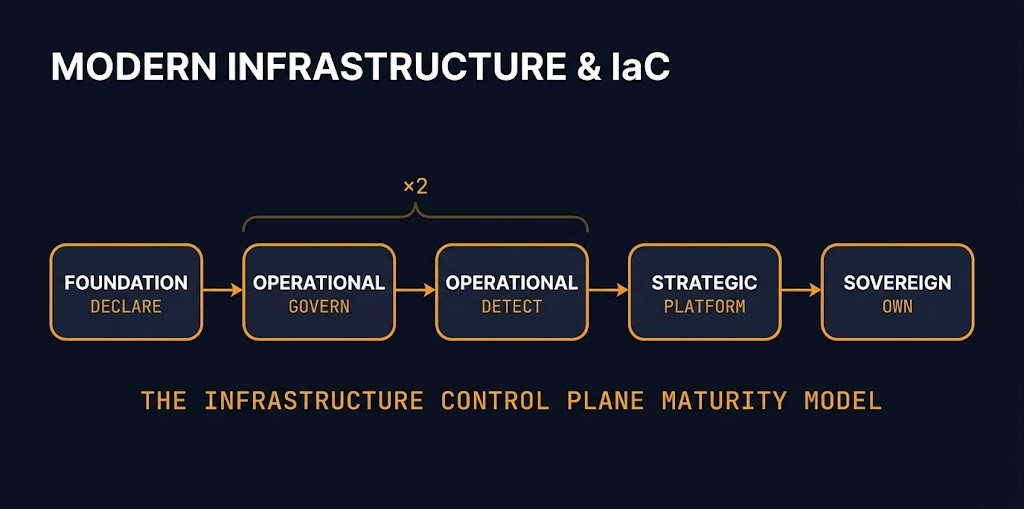
Modern infrastructure is a governance architecture — five maturity stages from declarative foundations to sovereign control plane ownership.
>_ IaC Is Not a Deployment Tool. It Is an Authority System.
Most teams adopt Infrastructure as Code as an automation framework and discover later that it was always a governance system. The operational problem is not deployment speed — it is maintaining authoritative control over infrastructure that continues changing after deployment completes.
The failure modes that bring teams to this path are always the same: infrastructure that drifted from its declared state, control planes that multiplied without governance, and automation that became the authority nobody intended to give it.
Modern infrastructure architecture is ultimately the engineering discipline of preserving control plane integrity under continuous operational change.
This modern infrastructure IaC learning path sequences the architectural decisions required to build, operate, and govern declarative infrastructure at enterprise scale. The question is never whether infrastructure should be declared — it is whether the declaration is trusted, current, and authoritative. Most organizations running IaC in production have answered the first question. Very few have answered the second and third.
The gap between “we have Terraform” and “our infrastructure state is authoritative” is where most modern infrastructure programs stall. Pipelines exist. Modules are written. Engineers apply plans. And the environment continues to drift, control planes continue to multiply, and the gap between declared state and operational reality continues to grow. Infrastructure as Code was never a deployment optimization — it was a governance commitment. The teams that realize this early design for control plane integrity from the start. The teams that realize it late spend their operational capacity reconciling what their pipelines believe with what production has become.
This path sequences that transition. Five architecture maturity stages move from declarative mechanics through GitOps governance, authority drift and infrastructure integrity, platform engineering and control plane design, and finally to sovereign infrastructure — the architectural state where the organization owns its control planes completely and operates without dependency on external authority. Each stage builds on the governance architecture established in the previous one. The stages are not independent topics — they are a single continuous argument about what it means to keep modern infrastructure deterministic under real operational conditions.
The posts in this path are written for senior infrastructure architects and platform engineers who have already moved past tooling decisions and are working through the harder governance questions. The path does not explain what Terraform is. It explains why Terraform state lies to you, why your pipeline is not your only control plane, and why the infrastructure governance problem compounds at the exact rate your engineering organization grows.
>_ Why Modern Infrastructure Broke Traditional Operations
Infrastructure stopped being configured manually the moment control planes became programmable. The operational problem is no longer deployment speed — it is authority drift, ownership fragmentation, and declarative systems losing alignment with reality.
This Domain Path exists to sequence the architectural decisions required to keep modern infrastructure deterministic at scale.
What This Path Is Not
- Not certification prep — no exam objectives, no flashcard sequences
- Not vendor training — no preferred platforms, no product tutorials
- Not beginner tutorials — foundational mechanics are covered, not hand-held
- Not feature documentation — the focus is tradeoffs, failure domains, and operational consequence
>_ Estimated Reading Depth
| Scope | Coverage | Estimated Time |
|---|---|---|
| Core Governance Sequence | Declaration, drift, and detection fundamentals — Stages 1, 2, and 3 | ~3–4 hr |
| Full Domain Path | All five stages in sequence — declarative foundations through sovereign control plane ownership | ~8–10 hr |
| Full Path + Authority Layer Series | Full path including The Authority Layer series on infrastructure governance and control plane design | ~11–13 hr |
>_ Where to Enter This Path
Not every reader starts at Foundation. Start at the stage that matches your current operational context.
| Audience | Recommended Entry | Reason |
|---|---|---|
| Engineers building their first IaC pipeline or evaluating Terraform vs OpenTofu | Stage 1 — Foundation | Declarative mechanics and tooling strategy are the prerequisite for every governance decision above |
| Platform engineers operating IaC at scale with CI/CD pipelines in production | Stage 2 — Operational | GitOps governance and declarative operations are the first architectural gap most pipeline operators encounter |
| Architects dealing with infrastructure drift, state file gaps, or uncontrolled console changes | Stage 3 — Operational | Authority drift is the central operational problem of declarative infrastructure — this stage addresses it directly |
| Platform teams building internal developer platforms or multi-team infrastructure governance | Stage 4 — Strategic | Platform engineering and control plane design are the decisions that determine whether IaC governance scales across organizational boundaries |
| Architects accountable for infrastructure portability, regulatory compliance, or full control plane ownership | Stage 5 — Sovereign | Sovereign infrastructure is the terminal state of mature IaC governance — the point at which the organization owns its control planes without dependency on external authority |
>_ The Architecture Maturity Spine
This Domain Path uses four of the five Architecture Maturity Levels. The Resilient level is not present because the infrastructure governance arc — from declaration through sovereignty — reaches its terminal state at Sovereign without requiring a failure-domain survivability stage. Two stages run at Operational because the operational depth of declarative infrastructure splits cleanly between GitOps governance and drift detection — distinct problem classes that warrant separate treatment.
| Level | Positioning | Architectural Goal |
|---|---|---|
| Foundation | Core principles and architectural mechanics | Understand declarative infrastructure mechanics, tooling tradeoffs, and the governance commitment IaC creates |
| Operational | Day-2 operations and scalable execution | Operate declarative systems at scale — GitOps governance, drift detection, and authority preservation under continuous change |
| Strategic | Optimization, governance, and economics | Design infrastructure as an internal platform — control plane boundaries, policy architecture, and multi-team governance |
| Sovereign | Portability, control, and operational independence | Own the control plane completely — bare metal orchestration, autonomous operations, and infrastructure independent of external authority |
This Domain Path uses four levels: Foundation → Operational (×2) → Strategic → Sovereign. Resilient level not used — the governance arc reaches terminal state at Sovereign.
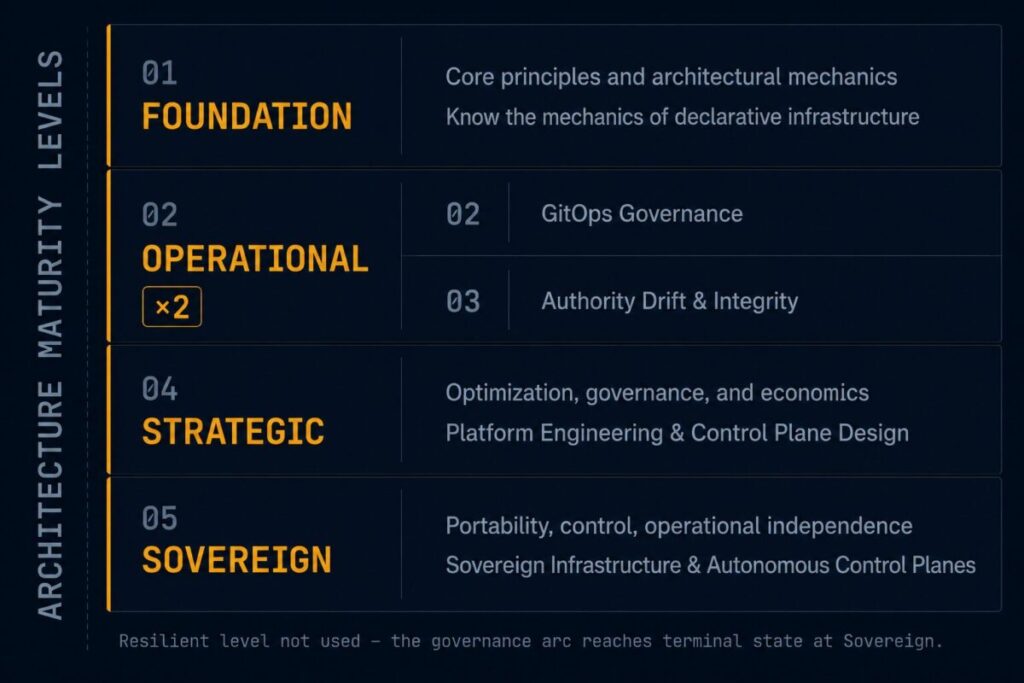
>_ Modern Infrastructure & IaC Learning Path — Reading Sequence
The reading sequence follows the maturity spine — each stage builds on the governance architecture established before it. The path traces a single continuous argument: declaration creates the authority claim, governance preserves it, drift detection defends it, platform engineering extends it across organizational boundaries, and sovereign infrastructure makes it permanent.
Declarative Infrastructure Foundations
IaC is a governance commitment before it is a deployment tool. This stage covers the architectural mechanics of declarative infrastructure — what it means for infrastructure state to be declared, why the Terraform vs OpenTofu decision is a control plane choice rather than a feature comparison, and what the governance contract looks like when IaC is treated as the authoritative system it was always intended to be. The decisions made at this stage define the authority surface every subsequent stage defends.
Declarative Operations & GitOps Governance
Git is not a documentation system — it is an authority system. This stage covers what GitOps governance actually requires: the CI/CD pipeline as the declared control plane, the CLI as the execution boundary, and the operational discipline that keeps declarative systems aligned with the infrastructure they govern. The central question here is not how to use GitOps — it is whether the pipeline is actually the only control plane, or whether parallel execution authorities are accumulating silently alongside it.
Authority Drift & Infrastructure Integrity
The central operational problem of declarative infrastructure is not deployment. It is maintaining authority over systems that continue changing after deployment completes. Drift is not a tooling failure — it is evidence that multiple control planes still exist. This stage covers the architecture of drift detection, Terraform state integrity, the three drift origin categories, and the governance telemetry required to know whether uncontrolled authority is persisting in your environment undetected. The Sovereign Drift Auditor runs as the applied tooling complement to this stage.
>_ The Operational → Strategic Transition
Early-stage IaC focuses on deployment consistency. Mature infrastructure organizations eventually discover the harder problem: governing infrastructure as an internal platform with lifecycle ownership, policy boundaries, upgrade sequencing, and operational contracts. Platform engineering emerges when infrastructure stops being a deployment pipeline and becomes an organizational control plane.
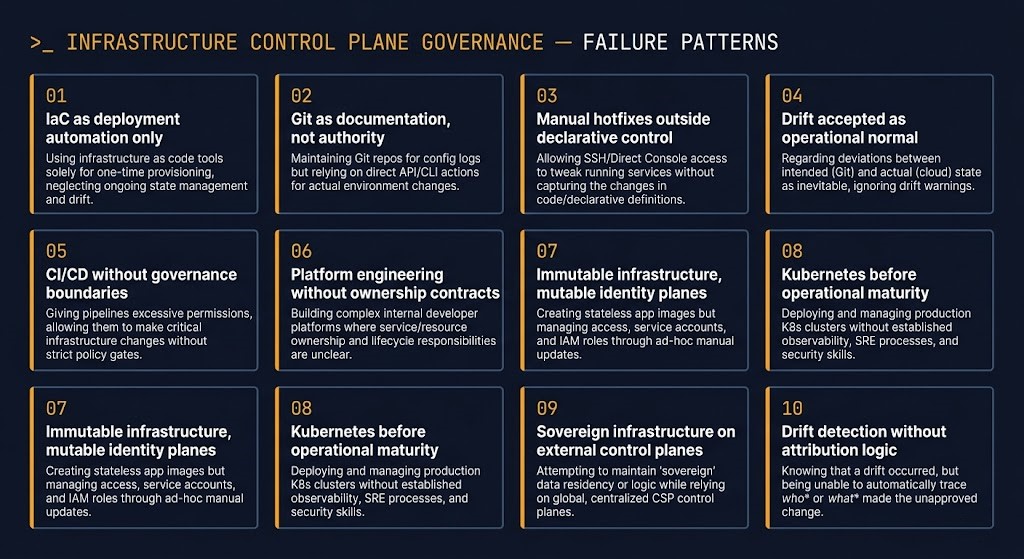
>_ Infrastructure Control Plane Governance — Failure Patterns
Platform Engineering & Control Plane Design
Infrastructure governance at scale requires treating the control plane as a product — with ownership boundaries, policy contracts, lifecycle obligations, and upgrade sequencing that span multiple teams. Platform engineering is not the adoption of a tool set. It is the architectural decision to make infrastructure an internal platform with explicit operational contracts. This stage covers the control plane design decisions that make governance durable across organizational growth — and the agentic AI problem that is redefining what “control plane ownership” means as autonomous systems acquire execution authority.
Sovereign Infrastructure & Autonomous Control Planes
Mature IaC governance eventually becomes a sovereignty question: does the organization own its control planes completely, or does operational independence remain contingent on external provider decisions, licensing changes, or platform availability?
Sovereign infrastructure is the architectural state where the organization owns its execution environment without dependency on external authority. Bare metal orchestration is one path to that state — the decisions covered in this stage extend from physical infrastructure control through networking isolation and private cloud sovereignty. This stage is the terminal point of the maturity spine: the governance architecture established in Stages 1–4 becomes permanent when the control plane itself is owned, not leased.
>_ Deterministic Infrastructure Tools
>_ Where Do You Go From Here
>_ Continue Your Architecture Reading Sequence
Five Domains. One Maturity Framework.
The Modern Infrastructure & IaC learning path is one of five structured reading sequences across the Rack2Cloud platform. Each path follows the same maturity spine — applied to the operational realities of its domain.
>_ Frequently Asked Questions
Q: What is the Modern Infrastructure & IaC Learning Path?
A: The modern infrastructure IaC learning path is a maturity-guided reading sequence for enterprise infrastructure architects and platform engineers — from declarative infrastructure foundations through GitOps governance, drift detection, platform engineering, and sovereign infrastructure control. It sequences published analysis by governance depth and operational consequence, not by vendor platform or certification objective. The path uses four Architecture Maturity Levels: Foundation, Operational, Strategic, and Sovereign.
Q: What makes this path different from a Terraform or GitOps certification track?
A: Certification tracks sequence content to cover exam objectives and tool mechanics. This path sequences content to cover the architectural decisions that determine whether IaC governance actually works under real operational conditions — drift origin categories, control plane authority gaps, platform engineering ownership contracts, and the sovereignty decisions that make infrastructure independence durable. The path does not explain what Terraform is. It explains why Terraform state lies to you and why your pipeline is not your only control plane.
Q: Do I need to know Terraform before starting this path?
A: Stage 1 covers declarative infrastructure mechanics and the Terraform vs OpenTofu decision as a control plane choice — it assumes familiarity with IaC concepts but not deep Terraform expertise. If you are building your first pipeline, Stage 1 is the correct entry point. If you are already operating Terraform at scale and dealing with state management and drift, Stage 2 or Stage 3 is a more productive entry. The path does not teach Terraform syntax — it covers the governance architecture that makes declarative infrastructure authoritative.
Q: How does this path handle the OpenTofu vs Terraform split?
A: The OpenTofu vs Terraform decision is covered in Stage 1 as a control plane migration choice, not a license change. The path treats the BSL change as the event that forced an explicit governance decision most teams had been deferring — which tool owns your state, which ecosystem governs your provider coverage, and what the migration architecture actually requires. The Terraform Feature Lag Tracker and OpenTofu Readiness Bridge tools provide the applied tooling complement for teams actively working through that transition.
Q: Why does infrastructure drift happen even with IaC in place?
A: Drift happens because IaC declares authority over infrastructure but cannot prevent other execution authorities from acting on it simultaneously. Incidents produce manual console changes. Kubernetes controllers reconcile toward their own desired state. Cloud providers mutate managed service defaults. AI remediation tooling makes autonomous changes. None of these require a human to bypass the pipeline — they are system-origin and provider-origin drift categories that pipeline enforcement cannot address. The Drift Origin Model in Stage 3 maps these three categories and the detection architecture each requires.
Q: What is the relationship between platform engineering and GitOps?
A: GitOps is the operational discipline of using Git as the authoritative source for infrastructure state, with pipelines enforcing that authority continuously. Platform engineering is the architectural decision to treat infrastructure itself as an internal product — with ownership contracts, policy boundaries, lifecycle obligations, and governance that spans multiple teams. GitOps is a Stage 2 practice. Platform engineering is a Stage 4 architectural decision. The difference is scope: GitOps governs deployment consistency; platform engineering governs the control plane as an organizational system. Stage 4 covers what happens when GitOps governance has to scale across team boundaries and product ownership becomes the operative constraint.
Q: When does platform engineering become necessary rather than premature?
A: Platform engineering becomes necessary when the cost of inconsistent infrastructure governance across teams exceeds the cost of building and maintaining an internal platform. In practice, the signals are: multiple teams making independent IaC decisions that create incompatible state; drift that cannot be attributed because ownership is unclear; upgrade cycles that require coordinating changes across team boundaries without a formal contract; and policy enforcement gaps that accumulate because no single team owns the governance surface. Platform engineering is premature when a single team can govern the full IaC surface without coordination overhead. It is necessary when they cannot.
Q: What does ‘sovereign infrastructure’ mean in the context of IaC governance?
A: Sovereign infrastructure is the architectural state where the organization owns its control planes completely — compute, networking, identity, and orchestration — without operational dependency on external provider decisions, licensing changes, or platform availability. In the context of IaC governance, sovereignty means the declarative authority your IaC exercises is not contingent on a provider’s API availability, a vendor’s licensing terms, or an external platform’s continued operation. Stage 5 covers the decisions — bare metal orchestration, private cloud sovereignty, and networking isolation — that make that independence real rather than aspirational.
Q: How does drift detection connect to security posture?
A: Drift is the observable signal that infrastructure exists in a state your IaC doesn’t describe and your team doesn’t fully know. Undetected drift creates security exposure in two ways: configuration drift can introduce misconfigurations that widen attack surface without triggering any alert, and structural drift — resources created outside IaC scope — represents infrastructure your security posture was never designed to cover. Drift detection is governance telemetry: it tells you whether uncontrolled execution authority is persisting in your environment. The same detection architecture that catches governance drift catches security-relevant configuration changes. Stage 3 covers the detection architecture that makes both visible.