

DATA PROTECTION & RESILIENCY ARCHITECTURE LEARNING PATH
SURVIVABILITY ENGINEERING UNDER ADVERSARIAL CONDITIONS.
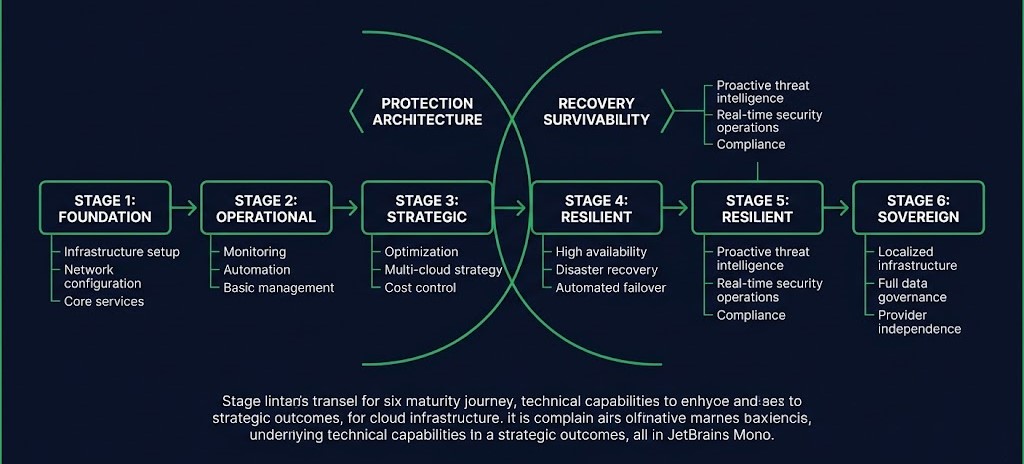
>_ Recovery Time Is an Architecture Output — Not a Vendor Feature
Most resiliency failures are not backup failures. They are dependency, orchestration, identity, and recovery-sequencing failures that surface under pressure. Recovery time is a design output — engineered into infrastructure before the incident, not negotiated with a vendor after it.
Most infrastructure teams design for backup completion. Very few design for organizational survivability during recovery.
This data protection resiliency learning path is a maturity-guided reading sequence for enterprise infrastructure engineers — from backup mechanics and restore fidelity through ransomware survival architecture and operational governance. It sequences published analysis by failure-domain depth and operational consequence, not by vendor platform or certification objective.
The path is organized around two distinct maturity arcs. The first three stages cover protection architecture: the mechanics of backup, the control plane models of recovery platforms, and the isolation and integrity decisions that determine how much of your environment remains trustworthy under attack. The second three stages shift into recovery survivability engineering — the operational reality of recovery under adversarial conditions, where modern recovery architecture increasingly fails at the identity and dependency layer before storage recovery even begins, and where RTO is the measure of everything you forgot to architect.
What This Path Is Not
- Not certification prep — no exam objectives, no flashcard sequences
- Not vendor training — no preferred platforms, no product tutorials
- Not beginner tutorials — foundational mechanics are covered, not hand-held
- Not feature documentation — the focus is tradeoffs, failure domains, and operational consequence
>_ Estimated Reading Depth
| Scope | Coverage | Estimated Time |
|---|---|---|
| Essential Recovery Sequence | Core protection and recovery architecture progression — Stages 1, 2, and 4 | ~4–5 hr |
| Full Domain Path | All six stages in sequence — full resiliency, ransomware survival, and recovery governance | ~11–13 hr |
| Full Path + Recovery Engineering Series | Full path including advanced failover engineering and degradation-pattern analysis | ~14–16 hr |
>_ Where to Enter This Path
Not every reader starts at Foundation. Start at the stage that matches your current operational context.
| Audience | Recommended Entry | Reason |
|---|---|---|
| Infrastructure engineers new to backup architecture | Stage 1 — Foundation | Backup mechanics and restore fidelity are prerequisites for every architectural decision above |
| Platform architects operating existing backup platforms | Stage 2 — Operational | Control plane tradeoffs and failure models are the first architectural decision gap most operators face |
| Architects hardening against ransomware | Stage 3 — Strategic | Isolation and integrity architecture are the decisions most architects underestimate until after an event |
| Teams that have survived an incident or are planning ransomware response | Stage 4 — Resilient | Adversarial survival architecture starts with understanding why most recovery architectures fail under pressure |
| DR and failover architects | Stage 5 — Resilient | RTO and RPO as design outputs, not procurement metrics — the core failover engineering sequence |
| Architects accountable for governance, assurance, and recovery SLA | Stage 6 — Sovereign | Recovery assurance and operational governance as the terminal state of mature resiliency architecture |
>_ The Architecture Maturity Spine
This Domain Path uses all five Architecture Maturity Levels — the only Domain Path on the platform that does. Two stages run at Resilient because the survivability arc between ransomware response and operational failover design is deep enough to warrant the separation.
| Level | Positioning | Architectural Goal |
|---|---|---|
| Foundation | Core principles and architectural mechanics | Understand backup mechanics, restore fidelity, and true cost modeling |
| Operational | Day-2 operations and scalable execution | Select and operate recovery control planes under failure conditions |
| Strategic | Optimization, governance, and economics | Engineer isolation, integrity, and adversarial vault separation |
| Resilient | Failure-domain reduction and survivability | Survive ransomware and operational failure under adversarial conditions |
| Sovereign | Portability, control, and operational independence | Govern recovery assurance and prevent operational drift from silently degrading SLA |
This Domain Path uses all five levels: Foundation → Operational → Strategic → Resilient → Sovereign. Two stages run at Resilient.
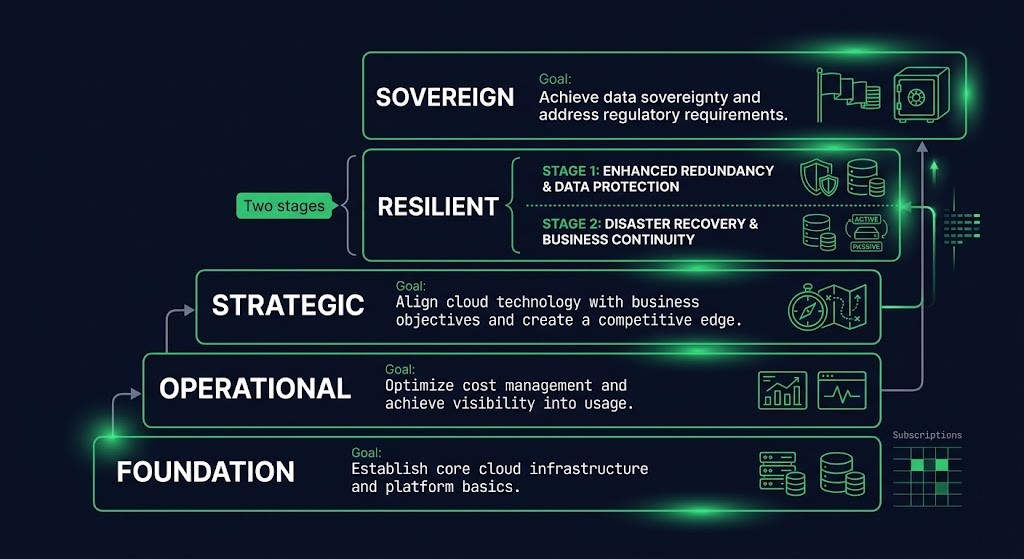
>_ Data Protection Resiliency Learning Path — Reading Sequence
The reading sequence follows the maturity spine — each stage builds architecturally on the decisions established before it. The path divides into two arcs: protection architecture (Stages 1–3) and recovery survivability (Stages 4–6). Every architectural decision in the second arc depends on the foundation work of the first.
Backup Architecture Foundations
Backup mechanics, data path integrity, restore fidelity, and true cost modeling — the operational vocabulary every decision in Stages 2–6 depends on. Backup without a verified restore path is not backup. That principle runs as a connective thread through the entire sequence.
Recovery Platform Architecture
Veeam, Rubrik, Commvault, and Cohesity analyzed as control plane models — their failure modes, scale architecture, and immutability mechanics. Platform selection is a governance decision, not a feature comparison. How a platform fails under adversarial conditions determines whether you can recover from it.
Isolation & Recovery Integrity Architecture
Modern recovery architecture increasingly fails at the identity and dependency layer before storage recovery even begins. Object lock alone is not isolation. Connected “air gaps” are not air gaps. The architectural decisions in this stage determine how much of your recovery environment remains trustworthy when the attacker already knows your environment — and when identity-plane compromise precedes every other failure.
>_ The Two Architecture Arcs
The first three stages of this path cover protection architecture — backup mechanics, control plane selection, and isolation design. The next three stages shift into recovery survivability engineering: the operational reality of recovery under adversarial conditions, where identity planes fail before storage recovery begins and RTO is the measure of everything you forgot to architect.
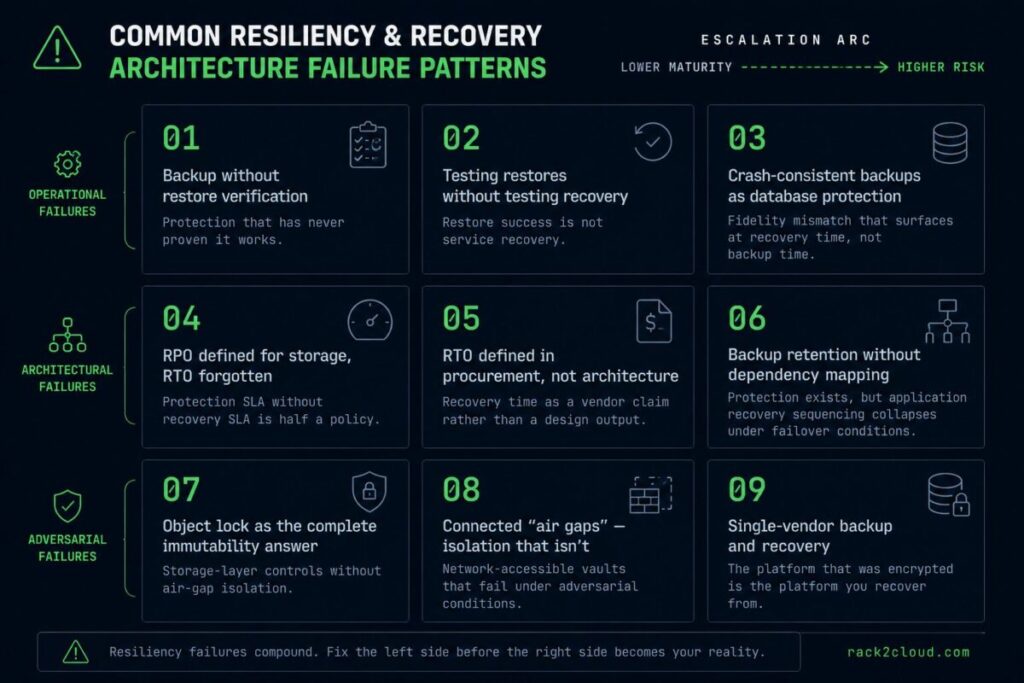
>_ Common Resiliency & Recovery Architecture Failure Patterns
Ransomware Survival Architecture
Ransomware survival is not a backup configuration problem — it is an architectural problem spanning isolation design, dependency mapping, recovery sequencing, and operational readiness under adversarial conditions. Modern ransomware recovery increasingly fails at the identity layer long before storage recovery begins. This stage covers the decisions that determine whether your recovery architecture holds when the attacker has already enumerated it.
Disaster Recovery & Failover Architecture
RTO, RPO, and RTA as infrastructure design drivers — not procurement commitments. Failover architecture is a systems engineering problem: retry behavior, recovery sequencing, service degradation modeling, and the operational reality that recovery doesn’t end when the restore completes. The Recovery Engineering Series runs through this stage as an applied reading sequence for engineers who need to understand how real recovery events unfold.
Recovery Assurance & Operational Governance
Mature recovery architecture eventually becomes a governance problem: ensuring that operational drift, dependency sprawl, identity changes, and undocumented infrastructure evolution do not silently invalidate recovery assumptions over time.
Recovery assurance is the terminal state of mature resiliency architecture — the point at which governance, drift detection, and observability confirm that recovery capability is what you designed it to be. Not what you tested once and assumed stayed intact. This stage covers the decisions that make recovery architecture durable, auditable, and operationally honest over time. Anchor framework, live: Recovery Evidence Boundary (#167) — the point at which recovery evidence exists but no authority structurally independent from the team that produced it has standing to reject the claim it makes.
>_ Deterministic Infrastructure Tools
>_ Where Do You Go From Here
>_ Continue Your Architecture Reading Sequence
Five Domains. One Maturity Framework.
The Data Protection Resiliency learning path is one of five structured reading sequences across the Rack2Cloud platform. Each path follows the same maturity spine — applied to the operational realities of its domain.
>_ Frequently Asked Questions
Q: What is the Data Protection Resiliency Learning Path?
A: The data protection resiliency learning path is a maturity-guided reading sequence for enterprise infrastructure engineers covering backup architecture foundations, recovery platform architecture, isolation and recovery integrity design, ransomware survival architecture, disaster recovery and failover engineering, and recovery assurance governance. It sequences published analysis by failure-domain depth and operational consequence — not by vendor platform or certification objective. The path uses all five Architecture Maturity Levels: Foundation, Operational, Strategic, Resilient, and Sovereign.
Q: How is this different from vendor backup certification training or DR runbook documentation?
A: Certification training sequences content to cover exam objectives. DR runbooks cover execution procedures. This path sequences content to cover the architectural decisions that determine whether recovery succeeds under adversarial conditions — failure domain design, recovery sequencing, blast-radius modeling, identity-plane dependencies, and operational governance. The goal is architectural judgment under pressure, not credential or runbook familiarity.
Q: What is the difference between backup architecture and recovery architecture?
A: Backup architecture covers how data is captured, retained, and protected — the mechanics of the protection side. Recovery architecture covers how services, applications, and dependencies are restored to operational state — the mechanics of the survivability side. Most organizations have backup architecture. Far fewer have recovery architecture. The gap between them is where most resiliency failures originate. This path covers both, in sequence, because the recovery architecture decisions depend entirely on the protection architecture decisions established before them.
Q: Why does this path use two Resilient stages?
A: The survivability arc between ransomware response architecture and disaster recovery failover design is operationally and architecturally deep enough to warrant the separation. Stage 4 covers adversarial survival — the decisions that determine whether your recovery environment holds when an attacker has already enumerated it. Stage 5 covers disaster recovery and failover engineering — the systems-level design of retry behavior, recovery sequencing, and degradation modeling. These are related but distinct problem classes. Merging them into a single stage would compress the most operationally critical content on the path.
Q: What does “recovery assurance” mean and how does it differ from DR testing?
A: DR testing validates that a specific recovery procedure works at a point in time. Recovery assurance governs whether the recovery capability you designed remains valid over time — accounting for infrastructure drift, dependency changes, identity evolution, and undocumented configuration changes that silently invalidate recovery assumptions. DR testing is an event. Recovery assurance is an ongoing operational governance posture. Stage 6 covers the architecture decisions that make recovery capability durable, auditable, and operationally honest.
Q: Where should architects focused on ransomware response enter the path?
A: Ransomware-focused architects should enter at Stage 3 — Isolation & Recovery Integrity Architecture — not Stage 4. Stage 3 covers the adversarial isolation and vault separation decisions that determine whether your recovery environment is trustworthy before the incident. Stage 4 covers survival architecture assuming those decisions have been made. Entering at Stage 4 without the Stage 3 foundation is the architectural equivalent of designing failover without designing what you’re failing over to.
Q: How does the Recovery Engineering Series connect to this path?
A: The Recovery Engineering Series — four posts covering retry storms, incident recovery process, continuity cascades, and degradation patterns — runs through Stage 5 as an applied reading sequence. It represents the operational complement to the architectural content in Stages 4 and 5: the same failure modes analyzed from a practitioner execution perspective. Readers following the Full Path + Recovery Engineering Series depth will cover the broadest survivability engineering sequence on the platform.