

MODERN VIRTUALIZATION LEARNING PATH
THE DETERMINISTIC FOUNDATION OF SOVEREIGN INFRASTRUCTURE.
Why Modern Virtualization Still Matters
Modern virtualization is the control boundary beneath private cloud and sovereign compute.
This path teaches you how to design it for performance predictability, fault isolation, and economic efficiency.
No vendor bias. No abstraction theater. Only infrastructure physics.
Who This Path Is Designed For
To master this domain, you must move beyond the “Administrator” role and into the “Architect” mindset.
- Infrastructure Engineers: Transitioning from operational ticket resolution to architectural authority and lifecycle ownership.
- Cloud & Platform Architects: Seeking to understand the “ground-truth” physics beneath the cloud abstraction for regulated, highly utilized, or latency-sensitive workloads.
- Sovereign & Regulated IT Leaders: Designing environments where the hypervisor is the ultimate, non-negotiable boundary for data residency and compliance.
The Four Phases of Virtualization Mastery
Phase 1: Hypervisor Architecture & Economic Gravity
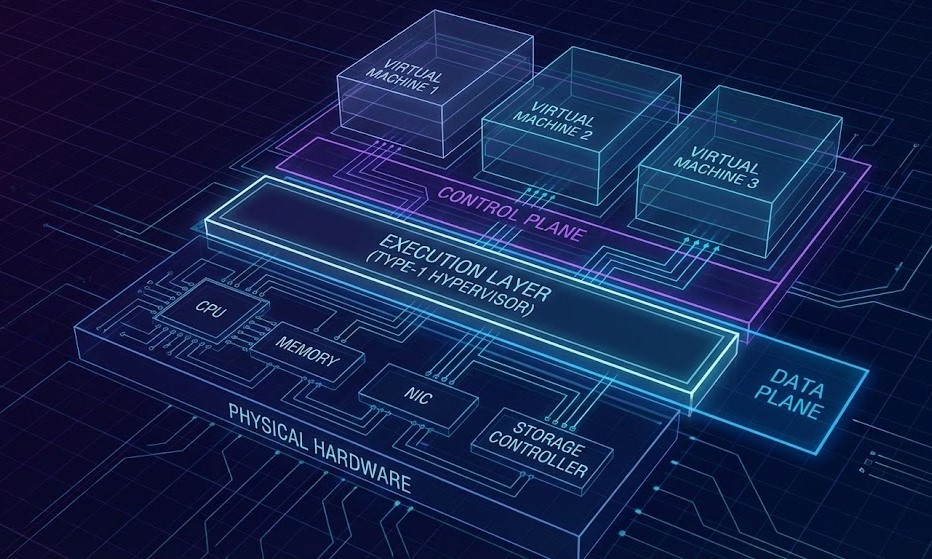
Virtualization begins at the execution layer. Architects must understand:
- Type-1 scheduling mechanics
- VM exit cost behavior
- Hardware acceleration (VT-x / AMD-V)
- Control plane placement models
- Core-based licensing impact
Architectural Deep Dives:
>_ Engineering Action: Model your exact Broadcom VVF/VCF transition exposure and calculate your hardware density limits using the VMware Core Calculator.
Phase 2: Compute & Memory Determinism
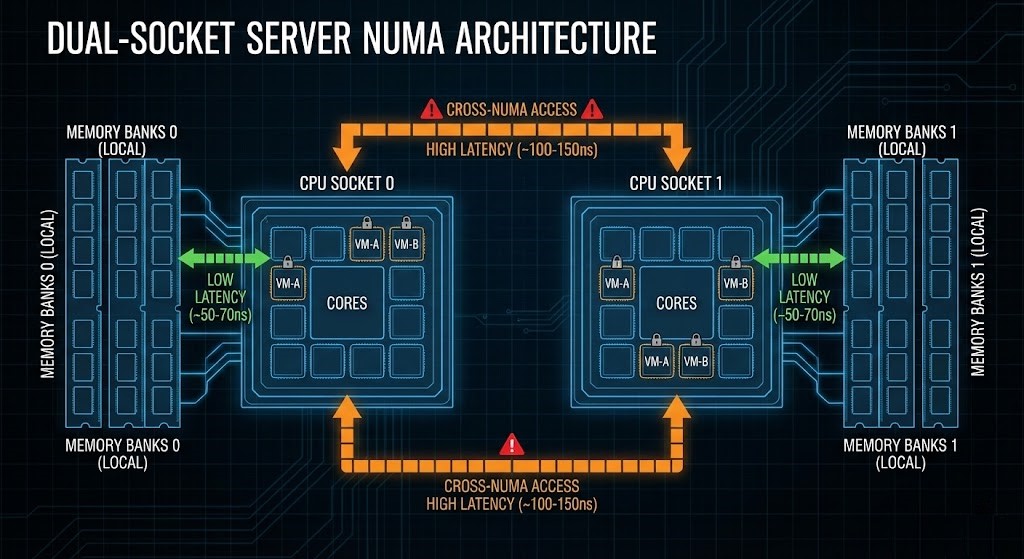
Virtualization fails at the memory controller. Architects must design for:
- NUMA locality
- CPU ready-time thresholds
- Memory ballooning vs. reservation models
- Oversubscription risk modeling
- Hardware affinity & pinning
Architectural Deep Dives:
Determinism Diagnostic Framework Before moving to production, validate the following:
- Is vCPU aligned to physical cores?
- Are NUMA boundaries respected?
- Is ready-time consistently under 5%?
- Is memory contention measurable under stress?
Phase 3: Distributed Systems Under Stress
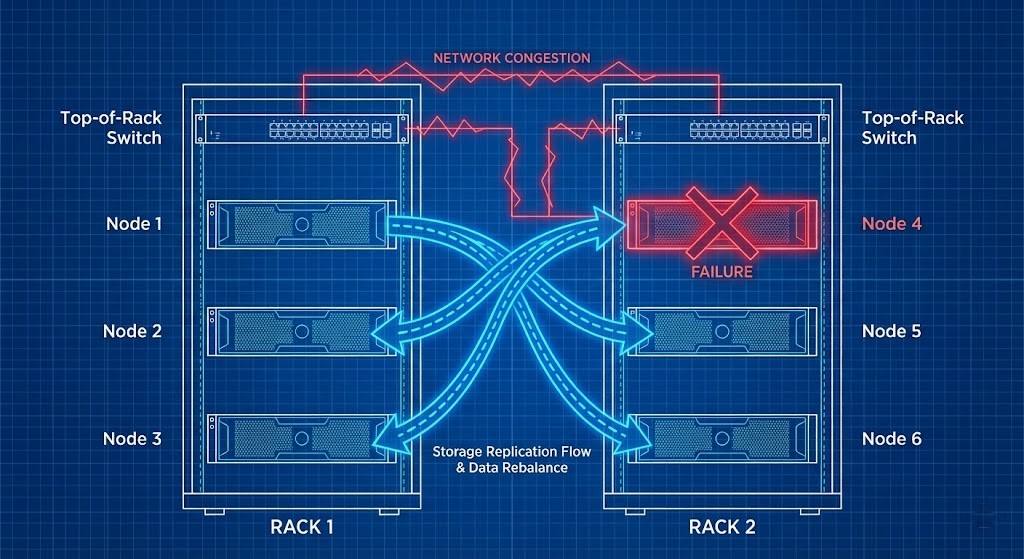
Architects must model failure before it happens.
Storage Physics
- Replication vs. Erasure Coding tradeoffs
- Write amplification impact
- Rebuild time under node failure
- Network saturation during rebuild
Architectural Deep Dives:
Network Fabric Logic
- East-West vs. North-South traffic
- Microsegmentation overhead
- Latency budgets in stretched clusters
- Uplink oversubscription ratios
Failure Modeling Design for:
- Node failure
- Rack failure
- Top-of-Rack switch loss
- Storage disk loss
>_ Engineering Action: Validate your East-West latency budgets and stretched cluster resilience with our Metro Latency Monitor.
Phase 4: Day-2 Operational Determinism
The true test of an architecture is “Upgrade Day.” Phase 4 focuses on designing environments that evolve without maintenance windows or heroics.
- Rolling upgrades and atomic cluster updates
- Firmware drift and hardware compatibility logic
- Lifecycle orchestration and blast radius containment
Architectural Deep Dives:
- The CVM Tax
- The Day-2 Reality of Nutanix AHV
- The Nutanix Migration Stutter: Why AHV Cutovers Freeze High-IO Workloads
>_ Engineering Action: Before migrating workloads or changing hypervisors, execute an automated hardware and snapshot readiness check using the HCI Migration Advisor.
Vendor Implementations Through an Architectural Lens
| Platform | Control Plane Model | Economics | Operational Gravity | Ideal Use Case |
|---|---|---|---|---|
| vSphere | Centralized | Core-based scaling impact | Mature ecosystem | Enterprise standardization |
| AHV | Distributed | Bundled economics | Integrated lifecycle | HCI environments |
| Proxmox | Open model | Minimal licensing | DIY operational ownership | Sovereign / air-gapped |
Canonical Engineering Resources
- VMware: VMware Configuration Maximums Tool
- Nutanix: The Nutanix Bible
- Proxmox: Proxmox VE Documentation Index
Continue the Path
Virtualization is the execution layer. Mastery requires integration with adjacent domains:
Frequently Asked Questions
Q: Is this path beginner-friendly?
A: No, this path assumes basic familiarity with virtualization concepts. It is designed for engineers ready to move into architectural responsibility.
Q: Is this vendor-neutral?
A: Yes, we use vendors as examples of architectural implementations, but the underlying physics remain the same across all platforms.
Q: How does this connect to Data Protection?
A: Virtualization is the primary source of data. You should Explore Data Protection & Resiliency to master backup, immutability, and ransomware containment within these virtual fabrics.
DETERMINISTIC VIRTUALIZATION AUDIT
Virtualization is the last layer you fully control before abstraction removes visibility. Stop guessing at your blast radius and licensing exposure. Run your environment through our deterministic calculators to validate your architecture.
LAUNCH THE ENGINEERING WORKBENCH