

VIRTUALIZATION ARCHITECTURE
COST CONTROL. WORKLOAD PORTABILITY. PLATFORM SOVEREIGNTY.
Virtualization is the foundation layer that determines how every workload runs, where it can move, and what it will cost to operate for the next five years.
For two decades, that decision was simple. You bought VMware, you ran ESXi, and the ecosystem built around it. That era ended when Broadcom completed its VMware acquisition and converted a capital infrastructure decision into a recurring subscription event that you cannot renegotiate from a position of strength.
The architects who understand this are not asking “which hypervisor is cheapest.” They are asking which platform fits their workload physics, their team’s operational capability, and their five-year infrastructure trajectory — and then executing that decision before the next renewal cycle forces it for them.
This page maps the full architectural landscape. The Broadcom Exit Strategy is the execution layer for teams already in motion. This is the strategic layer for teams building the decision.
The Hypervisor Is No Longer a Default
Platform lock-in used to be a feature. Broadcom made it visible.
For years, VMware’s dominance was self-reinforcing. The tooling ecosystem, the certifications, the operational muscle memory — all of it created switching costs that kept organisations on vSphere long after alternatives had matured. That was rational. The perpetual licensing model meant the sunk cost was real but the ongoing exposure was bounded.
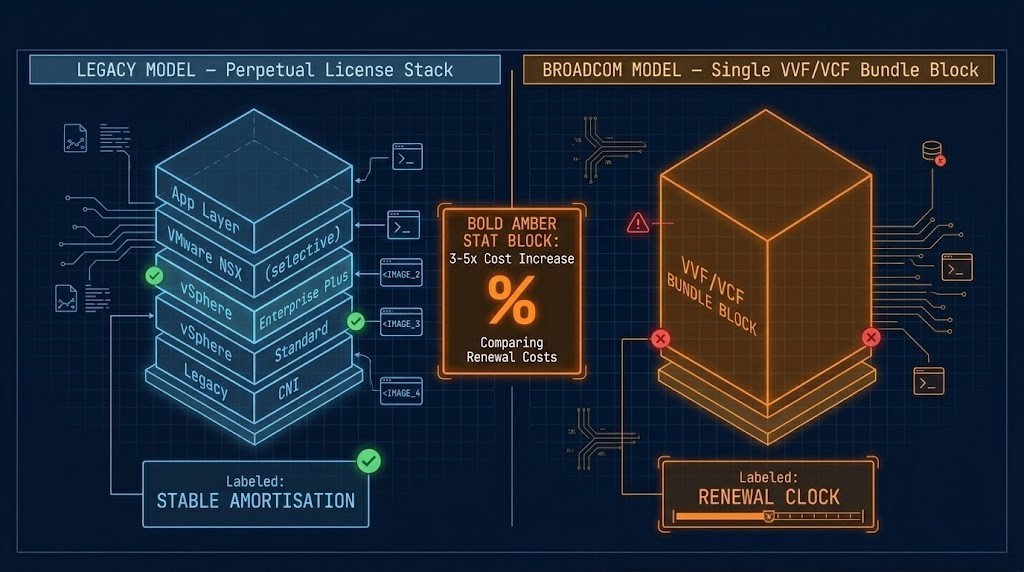
Broadcom’s acquisition restructured that equation permanently. The transition from perpetual licensing to mandatory VVF and VCF subscription bundles eliminated the stable amortisation model that justified lock-in tolerance. Organisations that expected to carry their existing infrastructure investment for another three to five years are now on a renewal clock controlled by a vendor with no competitive pressure to moderate pricing.
The result is not a vendor dispute. It is an architecture problem. Every organisation still running VMware is now carrying an unmodelled financial exposure that compounds at renewal. The exit is not optional — it is a question of timing and execution quality.
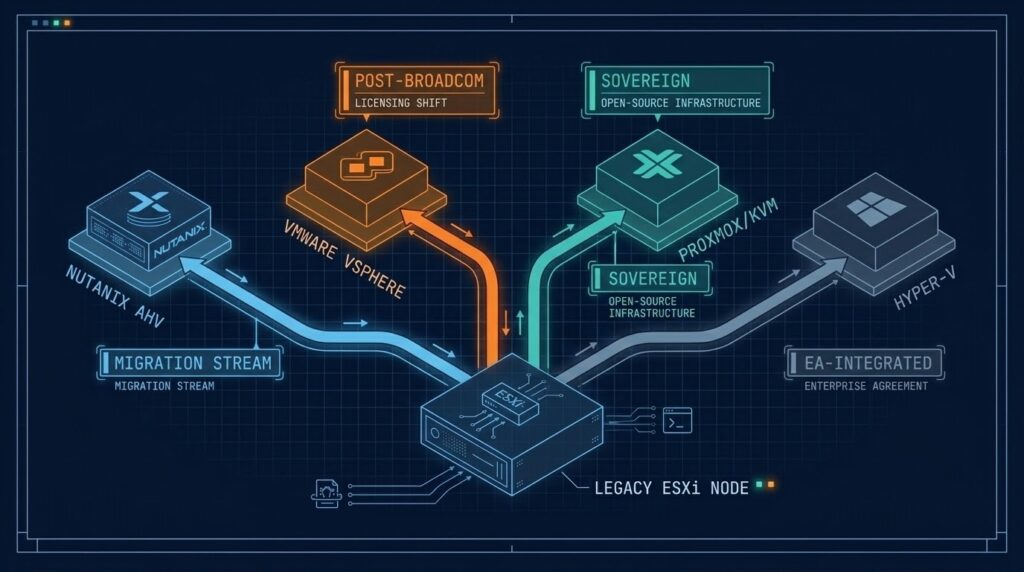
Beyond cost, the Broadcom event accelerated something that was already happening: the maturation of alternatives. Nutanix AHV has closed the enterprise gap. Proxmox VE with Ceph is a genuinely competitive architecture for engineering-led organisations. Microsoft Hyper-V retains relevance for organisations already inside a Microsoft Enterprise Agreement. The market has alternatives that did not exist at enterprise scale five years ago.
→ The Broadcom Exit Strategy: Full Migration Architecture → Post-Broadcom Migration Series
The Physics Every Hypervisor Obeys
Platform changes. Physics doesn’t.
Every hypervisor — regardless of vendor, licensing model, or architecture philosophy — operates within the same physical constraints. Understanding these fundamentals is what separates platform selection from platform gambling.
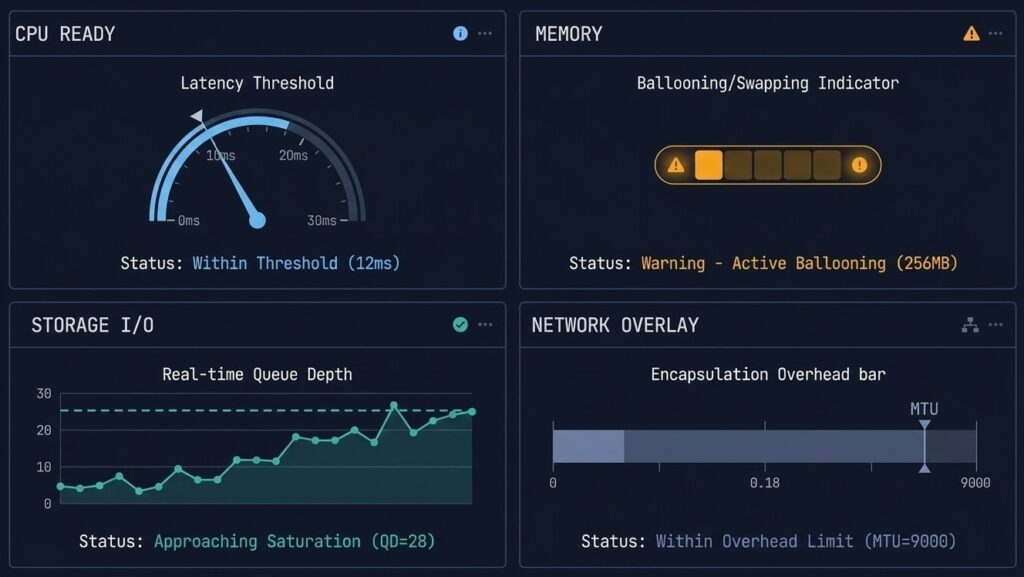
| Resource | Signal to Monitor | Why It Matters |
|---|---|---|
| CPU Scheduling | CPU Ready time | Measures how long a VM waits for physical cores. High Ready time is a leading indicator of architectural collapse — not an application problem |
| Memory Management | Ballooning / Swapping | Memory cannot be compressed without penalty. Ballooning is a correction signal. Swapping is a failure state. Both indicate over-commitment you haven’t modelled |
| Storage I/O | Queue depth / Latency | Latency at the storage layer surfaces as application instability. Queue depth saturation under migration load is where production incidents happen |
| Network Virtualisation | Overlay encapsulation overhead | Every overlay network carries an encapsulation tax. On high-throughput workloads, MTU mismatches and overlay overhead accumulate into measurable latency |
Every platform optimises these physics differently. AHV embeds the storage and networking layer into the hypervisor fabric. vSphere separates them into licensable components. Proxmox gives you direct kernel access and full control over how each layer is tuned. Hyper-V inherits Windows kernel scheduling behaviour with its own trade-off profile.
The platform you choose determines how much of this tuning is exposed to you — and how much is abstracted away at the cost of flexibility.
→ CPU Ready vs CPU Wait: Why Your Cluster Looks Fine but Feels Slow → Resource Pooling Physics
The Virtualization Stack (Most Comparisons Miss This)
Hypervisors are one layer. The stack is what you actually operate.
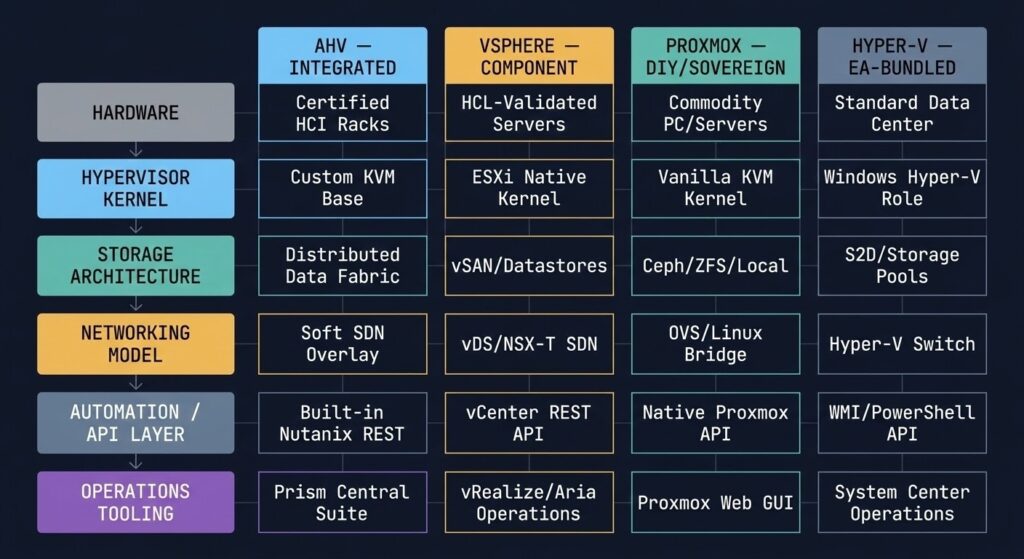
Most platform comparisons compare hypervisors. That is the wrong unit of analysis. What you are actually selecting is a complete operational stack — and the hypervisor is only the middle layer of it.
Hardware
    ↓
Hypervisor kernel
    ↓
Storage architecture
    ↓
Networking model
    ↓
Automation / API layer
    ↓
Operations & Day 2 tooling
Every layer in this stack has a cost, a complexity profile, and a dependency on the layers above and below it. When you change the hypervisor, you are not making a single decision — you are making six decisions simultaneously.
The questions that actually determine platform fit:
- Does the storage architecture converge with the hypervisor, or is it a separately licensed and operated layer?
- Does the networking model require a proprietary overlay (NSX, AHV Flow) or can it run on open standards?
- Does the automation layer expose a mature API, or is Day 2 operations a manual process?
- What does the operations tooling cost — in licensing, in engineering time, and in the skills required to run it?
Nutanix AHV is an integrated stack decision. vSphere is a component stack decision. Proxmox is a build-your-own-stack decision. Hyper-V is a Microsoft-ecosystem stack decision. None of these is universally correct. All of them have a workload profile where they are the right answer.
Three Platforms. Three Architectural Philosophies.
There is no universal answer. There is only the right architecture for your workload physics.
NUTANIX AHV → INTEGRATED STACK
For organisations running dense, production-critical workloads that require storage convergence, enterprise support SLAs, and a managed migration path, Nutanix AHV is the architecturally cleanest VMware replacement available today.
AHV’s hypervisor is embedded in the Nutanix stack — the scheduler, storage fabric, and networking layer operate as a unified system. This matters for workloads that demand P99 latency predictability without a separately licensed and operated storage tier. The CVM architecture handles storage I/O at the node level, eliminating the network-attached storage bottleneck that plagues disaggregated architectures under heavy write loads.
The commercial position has shifted significantly. Broadcom’s pricing has made Nutanix an easier budget conversation at every tier than it was 18 months ago. The execution physics still require careful modelling — CVM tax, scheduler translation from DRS to AHV’s policy engine, and RBAC mapping from vCenter to Prism are where migrations stall, not at the hypervisor conversion layer.
Best fit for:
Organisations already running Nutanix hardware, teams requiring enterprise support continuity, environments with mixed workload density needing storage convergence, and regulated industries requiring auditable infrastructure controls.
→ Nutanix AHV Architecture Deep DivePROXMOX / KVM → SOVEREIGN INFRASTRUCTURE
Proxmox VE with Ceph is not a budget compromise. For organisations with the engineering capability to operate it, it is a genuinely superior architecture from a sovereignty and cost physics standpoint. No per-socket licensing fees. No renewal negotiation. The infrastructure cost is the hardware cost, and the operational cost is the engineering investment — both of which you control.
The honest trade-off is operational complexity and team capability requirements. Ceph demands careful cluster sizing, replication factor modelling, and rebuild traffic planning. Teams that have operated at this layer before will find Proxmox liberating. Teams that haven’t will face a steep operational ramp that carries its own production risk.
Best fit for:
Engineering-led organisations with strong Linux operational capability, environments where 5-year TCO is the primary infrastructure constraint, sovereign or air-gapped infrastructure requirements, and teams that are explicitly choosing to own the full stack.
→ Proxmox & KVM Architecture Deep DiveVMWARE VSPHERE → HIGH-COST, HIGH-ECOSYSTEM
vSphere remains a technically mature platform with the deepest enterprise ecosystem in the market. The operational muscle memory, third-party tooling integrations, certification depth, and support infrastructure built around it over two decades are genuinely valuable — and genuinely expensive to rebuild on an alternative stack.
The architectural problem is not vSphere. It is the Broadcom commercial model layered on top of it. For organisations where switching costs exceed the Broadcom premium — complex NSX environments, deep vRealize integrations, regulated environments with validated configurations — staying on vSphere while building a migration runway is a defensible short-term position. It is not a long-term infrastructure strategy. It is a managed deferral with a clear exit timeline.
Best fit for:
Large enterprises with deep NSX or vRealize dependencies, organisations mid-contract with modelled switching costs exceeding current subscription exposure, and regulated environments requiring re-certification on any platform change.
HYPER-V → EA-INTEGRATED VIRTUALISATION
Hyper-V is not the primary choice for greenfield infrastructure architecture in 2026. It is, however, a relevant platform for a specific organizational profile: enterprises already operating under a Microsoft Enterprise Agreement where Hyper-V licensing is included, and where the workload footprint is Windows-centric, internal-facing, and not requiring the I/O performance characteristics of a purpose-built HCI stack.
Hyper-V’s integration with Windows Server, Active Directory, System Center, and Azure Arc makes it genuinely efficient for SMB infrastructure, internal tooling environments, development and test workloads, and edge deployments where Nutanix or Proxmox operational overhead isn’t justified. It is not the right answer for production-critical, high-density, or storage-convergence workloads.
Best fit for:
Organizations with active Microsoft EA coverage, Windows-dominant workload environments, SMB infrastructure with limited operational resources, and development or test environments where licensing cost is the primary constraint.
Which Workloads Fit Each Platform?
Platform selection starts with workload classification. Everything else follows.
| Workload Type | Best Fit | Avoid |
|---|---|---|
| Enterprise Tier-1 apps (ERP, databases, financials) | Nutanix AHV / vSphere | Proxmox (if no Ceph expertise) |
| Cost-sensitive general workloads | Proxmox / KVM | vSphere (licensing overhead) |
| High-density virtualisation with storage convergence | Nutanix AHV | Hyper-V |
| Stateless / bursty / cloud-native-ready | Public cloud exit ramp | Any on-prem hypervisor |
| Windows-centric internal workloads | Hyper-V (with EA) / AHV | Proxmox (operational overhead) |
| Edge deployments / remote office | AHV / Proxmox | vSphere (licensing cost at scale) |
| Sovereign / air-gapped environments | Proxmox / KVM | Any proprietary stack |
| Regulated industries (finance, healthcare, government) | Nutanix AHV / vSphere | Proxmox (without enterprise support) |
| Development and test environments | Proxmox / Hyper-V | AHV (cost justified for prod only) |
| High-throughput storage workloads | Nutanix AHV | Any disaggregated storage model |
The discipline here is honest classification before platform selection. Most migration failures happen because organizations select a platform for their best workloads and then migrate everything to it — including workloads it was never designed to run.
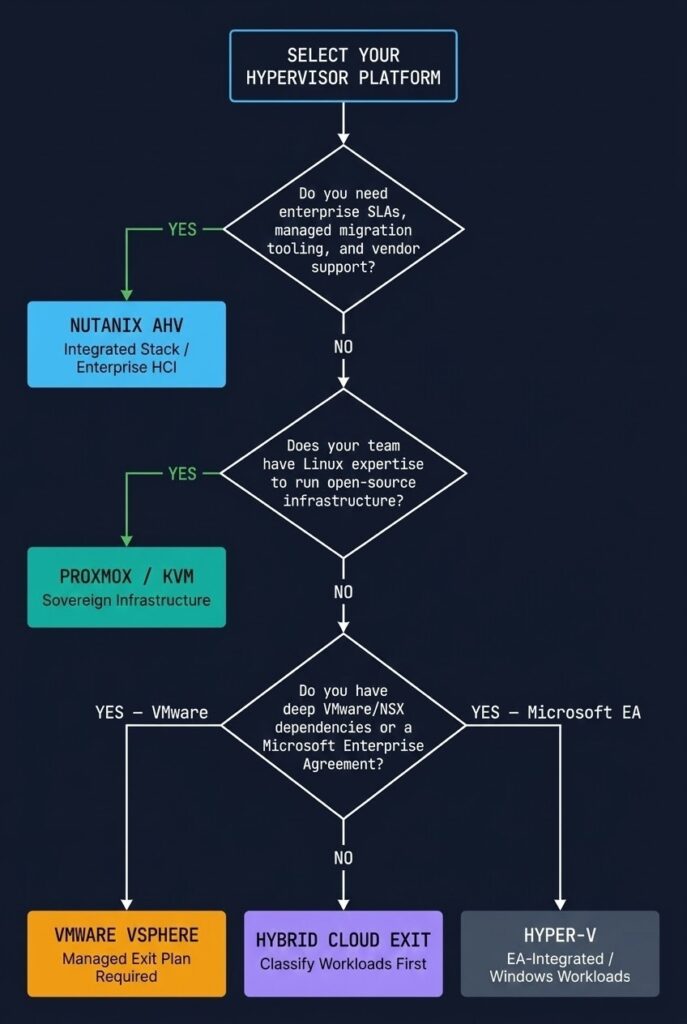
The Decision Framework
Three questions that eliminate the wrong answers fast.
| Question | If Yes → | If No → |
|---|---|---|
| Does your team have the operational capability to run an open-source stack without enterprise support? | Proxmox/KVM is architecturally viable | AHV or vSphere — Proxmox without operational maturity creates a different risk exposure |
| Do you require enterprise support SLAs, managed migration tooling, and auditable infrastructure controls? | Nutanix AHV is the path | Evaluate Proxmox or Hyper-V depending on workload profile |
| Are 30%+ of your workloads stateless, bursty, or already cloud-compatible? | Model a hybrid cloud exit ramp | On-prem hypervisor replacement is the right architectural frame |
| Is your workload footprint Windows-centric and covered under a Microsoft Enterprise Agreement? | Hyper-V is worth modelling | Adds operational complexity without a licensing benefit |
Most environments will land on a hybrid answer — some workloads to AHV, some to Proxmox where the team has the capability, and a defined subset to cloud. The discipline is in workload classification, not in picking a single platform for the entire estate.
Migration Reality
A platform decision without a migration model is an incomplete decision.
Choosing a target hypervisor is the first decision. Understanding how you get from your current state to that target — without a production incident — is the decision that determines whether the migration succeeds.
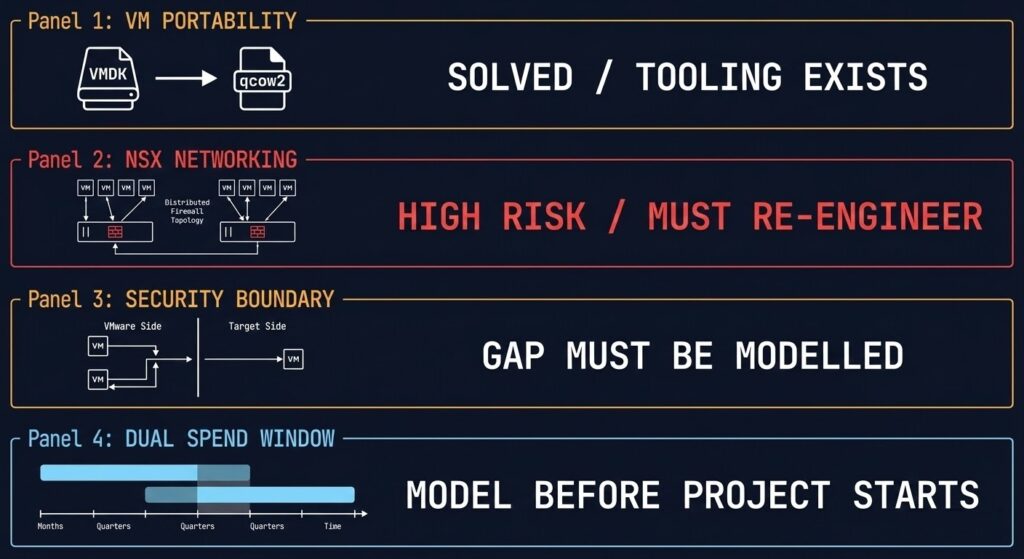
Every hypervisor uses a different disk format, virtual hardware model, and driver set. VMDK-to-qcow2 conversion is a solved problem — the tooling exists. What isn’t solved automatically is application-layer coupling, network dependency mapping, and stateful storage relationships that don’t survive a naive lift-and-shift.
NSX environments carry the highest migration risk. The distributed firewall ruleset, logical switching topology, and micro-segmentation policies built on NSX are not portable artifacts — they must be re-engineered on the target platform. Every VM conversion tool handles compute and storage reasonably well. Networking is where migrations stall.
Running workloads across VMware and the target platform simultaneously creates a window where your east-west security model is partially enforced on one platform and partially on another. This gap must be explicitly modelled before the first workload moves, not discovered during the migration window.
VMware subscriptions running in parallel with new platform acquisition costs is not a rounding error — it is a budget line that needs explicit modelling before the project starts. Organisations that treat it as a rounding error find it in their Q3 review. The migration window must be modelled, not discovered.
The Broadcom Exit Strategy: Full Migration Physics → Post-Broadcom Series: Technical Execution Layer → Detecting Manual Console Drift: Infrastructure Drift Detection
WHERE DO YOU GO FROM HERE?
The virtualization decision is the architectural frame. The pages below are the execution layers — pick the path that matches your environment.
You’ve Compared the Platforms.
Now Choose Your Path.
AHV, vSphere, Proxmox, Hyper-V — the comparison is clear. The harder question is what the right path looks like for your specific environment, team capability, and budget constraints. That conversation is where architecture decisions actually get made.
Platform Selection Audit
Vendor-agnostic review across AHV, vSphere, Proxmox, and Hyper-V for your specific workload profile, team capability, and 5-year cost model. No preferred platform. The right answer for your environment — not the right answer in general.
- > Workload classification and platform fit
- > 5-year TCO model across platform options
- > Team capability and operational gap assessment
- > Platform recommendation with migration runway
Architecture Playbooks. Every Week.
Field-tested blueprints covering every platform this page compares — AHV migration physics, Proxmox production patterns, vSphere exit strategies, and HCI architecture decisions from real enterprise environments. No vendor marketing. Just the architecture depth your team needs.
- > Virtualization & Migration Physics
- > HCI Platform Analysis & Comparisons
- > Broadcom Exit Strategy Updates
- > Real Failure-Mode Case Studies
Zero spam. Unsubscribe anytime.
Frequently Asked Questions
Q: Is VMware still worth it after Broadcom?
A: For organisations with deep NSX integrations, complex vRealize dependencies, or regulatory environments requiring re-certification on any platform change, staying on vSphere while building a migration runway is a defensible short-term position. It is not a long-term infrastructure strategy. The Broadcom commercial model has structurally changed the five-year TCO calculation — the exit is a question of timing and execution quality, not whether.
Q: Is Nutanix AHV really free?
A: AHV is included in Nutanix licensing — there is no separate hypervisor license. However, the Nutanix stack itself carries a licensing cost. The value proposition is that you get a fully integrated HCI stack (hypervisor, storage fabric, networking) under a single commercial model, without paying separately for vSphere, vSAN, and NSX. The comparison is not AHV vs. vSphere alone — it is the full Nutanix stack vs. the full VMware stack.
Q: Is Proxmox enterprise ready?
A: Yes, with the right team. Proxmox VE is production-grade infrastructure running in large-scale enterprise environments globally. The honest qualification is operational maturity — Ceph storage requires careful sizing and operational discipline, and the absence of vendor-managed support means your team carries the operational burden. For engineering-led organisations with strong Linux capability, it is a genuinely superior architecture. For teams without that capability, it introduces operational risk that should not be underestimated.
Q: Can you migrate VMware VMs to another hypervisor without downtime?
A: Cold migration (downtime required) is straightforward across all major hypervisors using standard conversion tooling. Live migration with zero downtime requires Layer-2 network extension between source and target platforms — HCX for vSphere-to-AHV paths, and custom L2 bridge configurations for Proxmox targets. The compute and storage conversion is a solved problem. Networking continuity and application-layer dependency mapping are where migrations introduce production risk.
Q: Where does Hyper-V fit in 2026?
A: Hyper-V remains relevant for a specific profile: Windows-centric environments, organisations with active Microsoft Enterprise Agreements where Hyper-V licensing is included, and SMB or internal tooling workloads where the operational overhead of Nutanix or Proxmox isn’t justified. It is not a competitive choice for greenfield enterprise infrastructure or high-density production workloads. Its value is in the EA economics and Windows ecosystem integration, not in raw hypervisor capability.