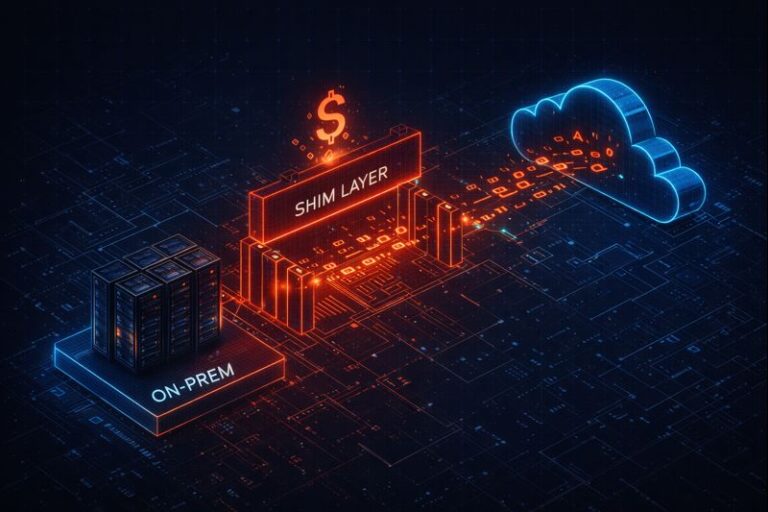


The OpenTofu Transition: How to Break “Vendor Lock” Without Breaking Production
The Ransom Note (Trigger)
I remember the exact moment I realized my Infrastructure as Code (IaC) wasn’t mine anymore. It wasn’t the initial Business Source License (BSL) announcement—that was just legal noise for the lawyers. No, it was a quiet Tuesday morning when a junior DevOps engineer pinged me: “Hey, the pipeline is failing on the import command. Says we need a Business Tier subscription to manage state for these resources.”
I stared at the console logs. A core utility—import—effectively gated behind a paywall in the managed service? Or maybe it was the subtle shift in the documentation, suggesting that using the CLI for automation without the enterprise cloud harness was “deprecated behavior.”
For twenty-five years, I’ve watched vendors execute the “Open Core” pincer maneuver. They hook you with the free binary, let you build your entire castle on their foundation, and then, once the cement dries, they change the locks. We saw it with Oracle in the early 2000s. We saw it with VMware (Broadcom is just the executioner; the sentence was passed years ago). And now, we are seeing it with Terraform.
This isn’t about “Open Source ideology.” I don’t wear a tuxedo penguin shirt to work. This is about survival. When your deployment tool becomes a rent-seeking entity, your infrastructure is no longer an asset; it’s a hostage.
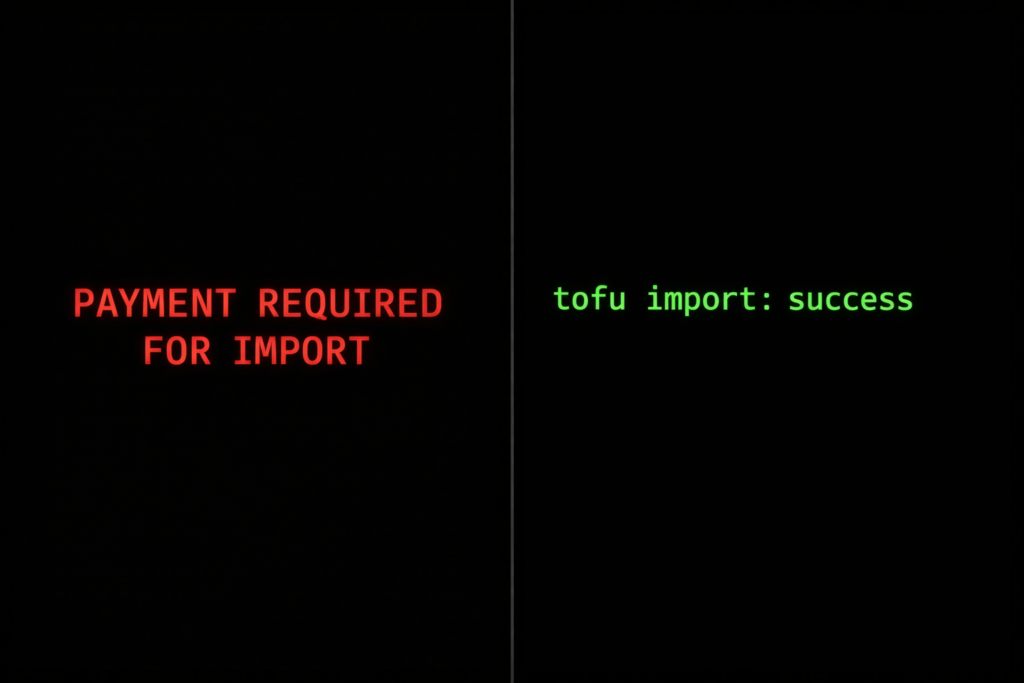
Caption: The difference between a tool that works for you and a tool that works for shareholders.
Autopsy: The “Vendor Lock” Physics
Why did we stay so long? Inertia. In IT, inertia is the strongest force in the universe, stronger than gravity or the CEO’s ego.
We told ourselves, “It’s just a binary. I run it locally. Who cares what the license says?” That was the lie. The reality is that the Terraform binary is useless without the ecosystem—the Registry.
The Registry is the supply chain. When HashiCorp changed the license, they didn’t just change the terms for the binary; they poisoned the well for anyone trying to build a competitive wrapper. But more importantly, they introduced Divergence Risk.
I built our internal Terraform Feature Lag Tracker specifically to monitor this split. I wanted to know: Is the proprietary version getting better features, or just gatekeeping features?
The data from the Lag Tracker was damning. While the proprietary fork focused on “Cloud Control” features—GUI dashboards, drift detection that requires a SaaS login, and policy sentinels that bill by the hour—the OpenTofu fork started shipping things engineers actually need.
The “IOPS Blender” of IaC
Just like mixing random writes in storage kills performance, mixing licensing incentives kills innovation. HashiCorp needs to sell you a cloud platform. Their incentive is to make the CLI just painful enough that you swipe the corporate Amex for TFC (Terraform Cloud).
OpenTofu’s incentive is singular: Make the CLI rock solid.
We saw this with State Encryption. For five years, the community begged for native state encryption. “Please,” we said, “we are storing secrets in plain text JSON. This is a compliance nightmare.”
- Vendor Response: “Buy our Enterprise Vault integration.”
- OpenTofu Response: “Here is client-side state encryption in the 1.7 release. Free.”
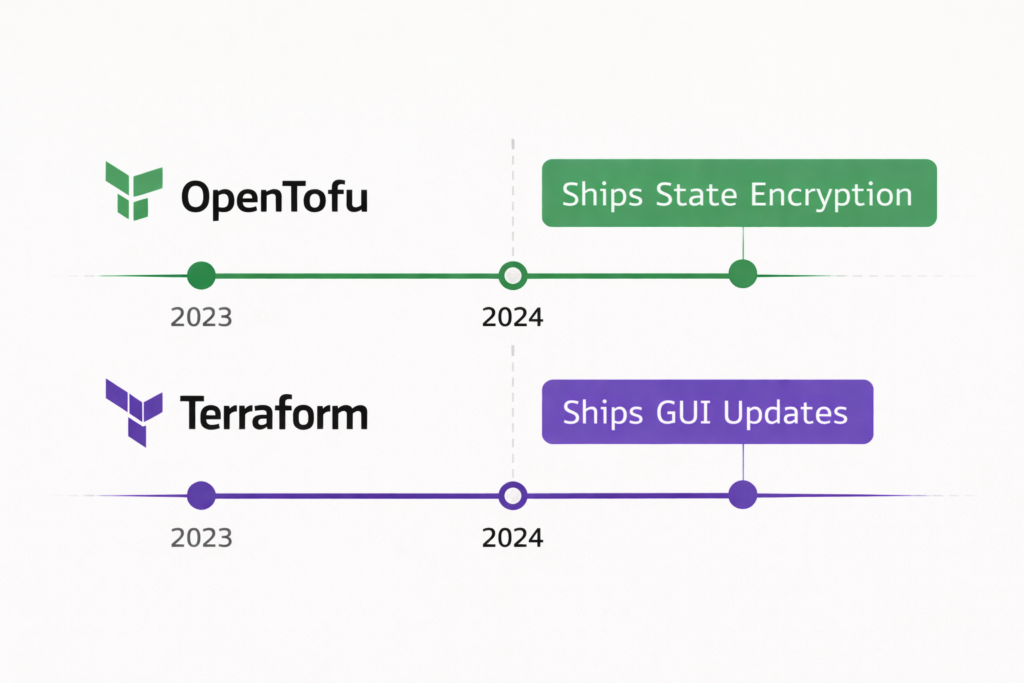
Caption: The Lag Tracker reveals the truth: Commercial tools prioritize billing features; Open tools prioritize engineering features.
Engineering The Jailbreak (Without Nuke-and-Pave)
So, you’re convinced. The renewal quote came in, or you just hate being told what you can’t do with your own code. How do you leave without destroying production?
I’ve migrated three environments this month. Here is the field-tested protocol.
Phase 1: The Registry Scrub (The Pre-Flight)
Before you even touch the binary, you need to sanitize your code. The biggest risk isn’t the binary; it’s the provider block. If you have hardcoded references that rely on proprietary registry behaviors, you will break.
We need to explicitly define our providers to ensure they pull from the OpenTofu registry (which mirrors the main registry but guarantees availability).
WARNING: Once you run
tofu applywith this block, there is no going back. Terraform CLI cannot read this state file anymore. This is a one-way door. Commit.
The Audit Script:
Bash
#!/bin/bash
# SCAN: Find hardcoded registry references that might break
# WARNING: Run this in read-only mode first.

grep -r "registry.terraform.io" . --include="*.tf" | while read -r line ; do
    echo "[ALERT] Hardcoded upstream registry found: $line"
    echo "       Refactor to use implicit provider lookup or local mirrors."
done
Phase 2: The Binary Swap & State Encryption
This is the scary part. The terraform.tfstate file is the holy grail. If you corrupt it, you are manually importing 5,000 AWS resources.
The Golden Rule: Back. It. Up.
I don’t trust S3 versioning alone. I pull a local copy before the init.
Bash
# 1. Pull the current state
terraform state pull > pre_migration_backup.tfstate

# 2. Initialize OpenTofu (This downloads providers from the Open registry)
tofu init -upgrade

# 3. The "Dry Run"
tofu plan
If tofu plan returns “No changes,” pop the champagne. But usually, it won’t. You’ll see “Provider hash mismatch.” This is normal. The lock file (.terraform.lock.hcl) is signed by the old binary.
The Fix: Delete the lock file and re-init.
rm .terraform.lock.hcl && tofu init
Now, the killer feature: Encryption.
If you are running sensitive workloads (and you are), enable this immediately. It encrypts the state file at rest and in transit, meaning even if someone dumps your S3 bucket, they get garbage bytes, not your RDS passwords.
Add this to your terraform block (now tofu block):
Terraform
terraform {
  encryption {
    key_provider "pbkdf2" "my_passphrase" {
      passphrase = "correct-horse-battery-staple" # Use a variable in prod!
    }

    method "aes_gcm" "my_method" {
      keys = key_provider.pbkdf2.my_passphrase
    }

    state {
      method = method.aes_gcm.my_method
      enforced = true
    }
  }
}
Note: Do not hardcode passphrases. Inject them via TOFU_VAR_passphrase in your CI pipeline.
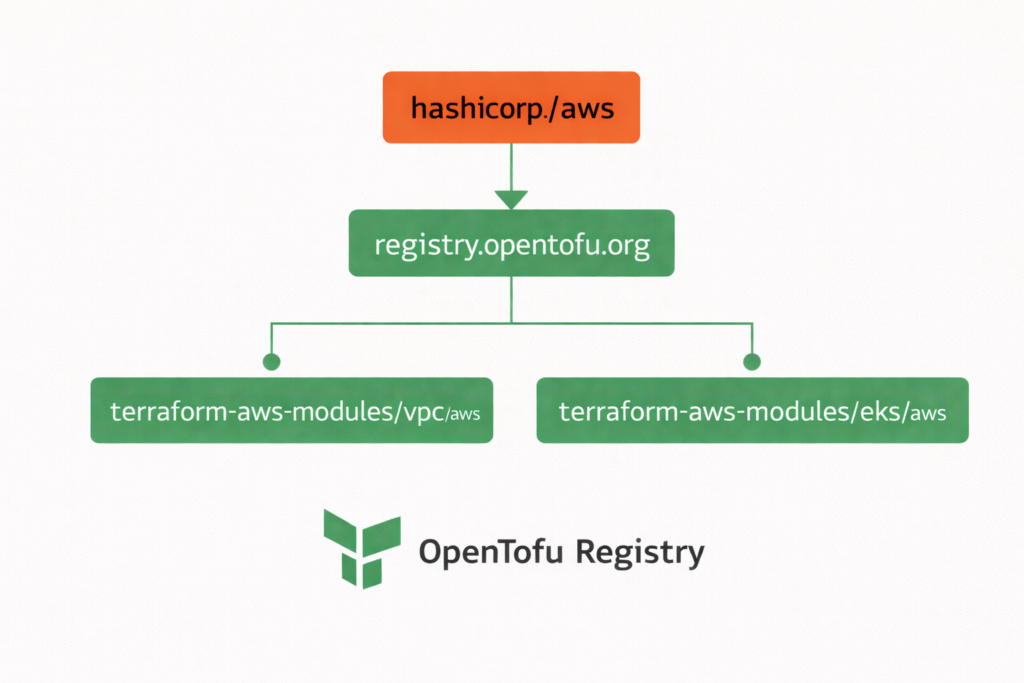
Caption: Breaking the chain: How OpenTofu redirects provider requests to keep your supply chain free.
Phase 3: The CI/CD Refactor
Your local laptop is easy. The CI/CD pipeline is where migrations die.
If you are using GitHub Actions, you are likely using the hashicorp/setup-terraform action. This action is maintained by the vendor. Do you trust them not to break compatibility with the fork? I don’t.
Switch to the OpenTofu setup action.
Legacy (Risky):
YAML
- uses: hashicorp/setup-terraform@v3
  with:
    terraform_version: 1.6.0
New (Safe):
YAML
- uses: opentofu/setup-opentofu@v1
  with:
    tofu_version: 1.7.0
I modeled this in our Cloud ROI Estimator. Even if I bill my time at $200/hr, the refactor cost $8,000. The Business Tier forced upgrade was $45,000/year. The ROI is positive before the second invoice hits.
Trade-off Grid: The Hard Truth
| Feature | Proprietary Terraform | OpenTofu | The Architect’s Take |
| State Encryption | Enterprise/Cloud Only | Free / Native | Mandatory for FinServ/HealthCare. |
| Registry | The Original | Mirrored | Tofu’s mirror is robust, but there is a non-zero risk of a “cat and mouse” game if upstream changes APIs. |
| Support | Official Vendor | Community / Spacelift / Env0 | Vendor support is usually Tier 1 reading a script. Community support is usually the guy who wrote the code. |
| Testing | terraform test | tofu test | Functionally identical for now. |
Architect’s Verdict
I’ve stopped waiting for vendors to “do the right thing.” They have fiduciary duties to shareholders, not to your uptime.
The split is permanent. The Terraform Feature Lag Tracker shows the gap widening every week. Staying on legacy Terraform now is a conscious decision to pay for features you used to get for free, and to ignore security features (like encryption) that you desperately need.
If you are building a new platform today, use OpenTofu. If you are on legacy, plan the exit. It’s easier to jump off the train now while it’s slowing down than when it’s careening off the cliff.
My 3 Heuristics for the Transition:
- The Registry Rule: If a tool requires a specific URL to function, it is not a tool; it is a service. Proxy everything.
- The Encryption Standard: If your IaC state is cleartext, you have already failed the audit. Move to the tool that encrypts by default.
- The Divergence Threshold: Watch the Lag Tracker. When the proprietary tool introduces a breaking change that only benefits their SaaS offering, fork immediately.
Additional Resources
Editorial Integrity & Security Protocol
This technical deep-dive adheres to the Rack2Cloud Deterministic Integrity Standard. All benchmarks and security audits are derived from zero-trust validation protocols within our isolated lab environments. No vendor influence.

R.M.
Senior Solutions Architect with 25+ years of experience in HCI, cloud strategy, and data resilience. As the lead behind Rack2Cloud, I focus on lab-verified guidance for complex enterprise transitions. View Credentials →
Get the Playbooks Vendors Won’t Publish
Field-tested blueprints for migration, HCI, sovereign infrastructure, and AI architecture. Real failure-mode analysis. No marketing filler. Delivered weekly.
Select your infrastructure paths. Receive field-tested blueprints direct to your inbox.
- > Virtualization & Migration Physics
- > Cloud Strategy & Egress Math
- > Data Protection & RTO Reality
- > AI Infrastructure & GPU Fabric
Zero spam. Includes The Dispatch weekly drop.
Need Architectural Guidance?
Unbiased infrastructure audit for your migration, cloud strategy, or HCI transition.
>_ Request Triage Session