

Think Like an Architect: The Field Guide to Cloud Egress and Data Gravity
Cloud egress pricing is one of the most misunderstood cost drivers in enterprise architecture — and one of the most expensive to discover late. When you’re designing for Day 2 operations, you quickly realize that data isn’t just heavy—it’s expensive to move. I’ve seen countless “cloud-native” projects hit a wall during the scaling phase because the architect assumed egress was a flat overhead. It isn’t. It’s a variable tax that scales with your success.
To build like an engineer, you need to understand the nuances of how the “Big Three” handle the exit of every byte. Here is the deep-dive technical breakdown of the egress philosophies for AWS, GCP, and Azure.
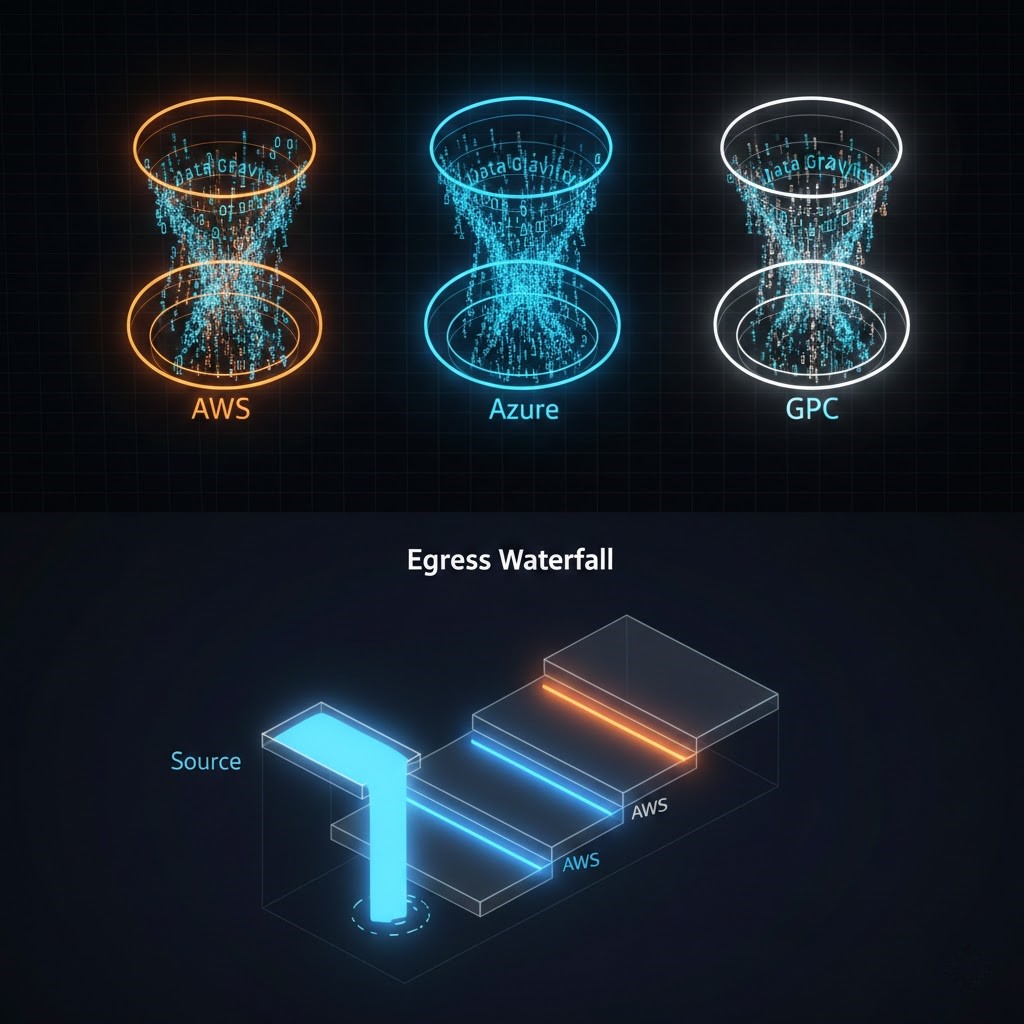
Data Gravity: Why Egress Isn’t Just a Pricing Problem
Data gravity is the principle that data accumulates mass over time — and like physical mass, it resists movement. Every gigabyte you store in a cloud region attracts compute, applications, and dependent services. The longer your data lives in a region, the more infrastructure orbits it, and the more expensive egress becomes — not just in dollars, but in architectural complexity.
This is the trap most cloud cost conversations miss. Egress pricing is the symptom. Data gravity is the disease. A workload optimised for Day 1 performance — placing compute close to data for latency reasons — can become a Day 2 financial liability as that data accumulates and the cost of moving it compounds. The architectural mechanics behind this — how latency, throughput constraints, and provider SLAs interact with egress cost — are covered in depth in Physics of Data Egress
Understanding how AWS, GCP, and Azure price egress is only half the equation. The other half is understanding what organisational and architectural decisions created the gravity well in the first place — and whether your architecture has a realistic exit path if that provider changes its pricing model.
The comparison table above shows average rates — but your actual exposure depends on your volume tier, routing preference, and inter-AZ traffic pattern. The Cloud Egress Calculator models your specific workload across all three providers and surfaces the real monthly cost before it appears on an invoice.
→ Model My Egress ExposureThe Deep Dive: Cloud Egress Pricing Philosophies
1. AWS: The Volume-Heavy Waterfall
AWS S3 egress pricing is the industry benchmark. Their model is built on the “more you move, the less you pay” principle, but the tiers are wide.
- Technical Nuance: AWS recently increased the “Free Tier” to 100 GB/month for internet egress. For an enterprise architect, this is a rounding error, but it’s a vital “free trial” for PoCs.
- The “Squeeze” Tier: The 100GB to 10TB range is the most expensive ($0.09/GB). Most mid-market architectures live here and suffer the highest margins.
- Architect’s Tip: If you are nearing 150TB, you must push for the $0.05/GB tier. This is where “Cloud Adjacent” storage (like Equinix or Pure Storage) starts to become more cost-effective than native S3.
2. GCP: The Network Service Tier Strategy
Google Cloud doesn’t just look at volume; they look at routing paths. This is a frequent “gotcha” for architects moving from AWS.
- Standard vs. Premium: Our Egress Calculator models the Standard Tier (routing over the public internet). However, GCP often defaults to the Premium Tier (routing over Google’s private global backbone), which can add a significant premium.
- The Flat-Tier Trap: GCP’s egress usually starts higher ($0.12/GB for the first 10TB) and doesn’t drop as aggressively as AWS.
- The Decision: Choose GCP if your data needs to reach global users with the lowest latency (Premium Tier), but avoid it for bulk, non-time-sensitive migrations unless you’re using the Standard Tier.
3. Azure: The “Zone & Global Network” Model
Azure is the “wild card.” Their pricing is competitive on the surface but contains complex geographical dependencies.
- The Routing Preference: Like GCP, Azure offers “Routing Preference.” Choosing ISP Routing (Cold Potato) is cheaper as it offloads traffic to the internet immediately. Microsoft Global Network (Hot Potato) keeps it on their fiber longer for a fee.
- The Inter-AZ “Zone Tax“: Azure is particularly aggressive with billing for data moving between Availability Zones in the same region. At $0.01/GB, high-availability clusters that sync data constantly can generate “phantom” egress bills that rival internet egress.
- Integration Advantage: Azure often waives or reduces egress for customers moving data into Azure from other clouds during a migration phase—a leverage point every SE should use during negotiations.
Azure’s negotiation leverage during migration phases is a real advantage — but it only holds if your landing zone architecture is designed to use it. AWS Control Tower vs Azure Landing Zone covers how these governance frameworks affect your long-term cost and lock-in position.
The Decision Framework: Side-by-Side Comparison
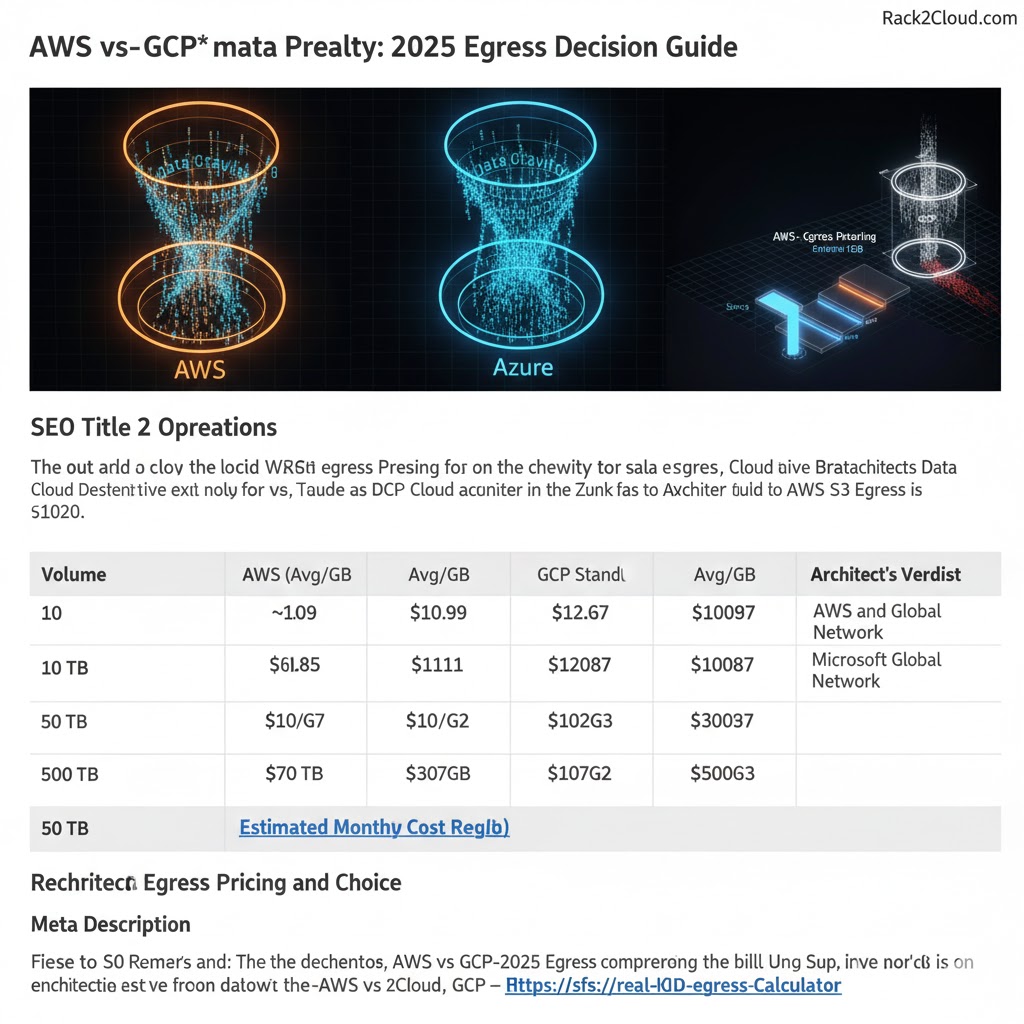
Estimated Monthly Internet Egress (US-East Regions)
| Volume | AWS (Avg/GB) | GCP Standard (Avg/GB) | Azure (Avg/GB) | Architect’s Verdict |
| 10 TB | ~$0.09 | ~$0.12 | ~$0.087 | Azure wins on raw price; GCP is for latency. |
| 50 TB | ~$0.085 | ~$0.11 | ~$0.083 | AWS and Azure converge. |
| 500 TB | ~$0.05 | ~$0.08 | ~$0.05 | Redesign time. Move to private peering. |
Key Takeaways
- The $0.09 Benchmark is Dead: While often cited as the “standard” rate, actual costs vary by up to 40% depending on routing preferences and volume tiers.
- Azure is the “Zone Tax” King: Azure often has lower internet egress rates but compensates with aggressive “Inter-AZ” (Availability Zone) billing that can catch SEs off guard.
- GCP Charges for Quality: Google is the only provider that explicitly lets you choose between a “Standard” (Public Internet) and “Premium” (Google Fiber) routing path, with costs to match.
- Volume is Your Only Leverage: All three providers use a “waterfall” model; if you aren’t hitting the 50TB+ tiers, you are paying the maximum retail margin
Architect’s Verdict
Egress is not just a line item on a cloud bill; it’s a fundamental architectural constraint. If you’re mapping the broader decision framework for cloud platform selection, the Cloud Architecture Learning Path covers provider decision models, cost governance, and multi-cloud architecture patterns. As Solutions Engineers and Cloud Architects, our job isn’t just to build; it’s to build sustainably. Understanding the nuanced, tiered pricing models of AWS, GCP, and Azure is critical to preventing budget overruns and designing truly optimized multi-cloud or hybrid solutions. Use tools like the Rack2Cloud Egress Calculator to quantify these costs upfront, empowering you to make informed decisions and build with confidence.
Additional Resources
Editorial Integrity & Security Protocol
This technical deep-dive adheres to the Rack2Cloud Deterministic Integrity Standard. All benchmarks and security audits are derived from zero-trust validation protocols within our isolated lab environments. No vendor influence.

R.M.
Senior Solutions Architect with 25+ years of experience in HCI, cloud strategy, and data resilience. As the lead behind Rack2Cloud, I focus on lab-verified guidance for complex enterprise transitions. View Credentials →
Get the Playbooks Vendors Won’t Publish
Choose the architecture problems you care about. Get field-tested playbooks and frameworks delivered to your inbox.
- > AI Infrastructure & Inference Economics
- > Cloud Strategy & Hidden Cost Models
- > Virtualization & Deterministic Migration
- > Kubernetes, IaC & Modern Infrastructure
- > Data Protection & Recovery Engineering
Zero spam. Includes The Dispatch weekly drop.
Need Architectural Guidance?
Independent review before major infrastructure decisions.
- > Validate assumptions
- > Identify hidden dependencies
- > Quantify migration risk
- > Challenge vendor narratives
Triage · Advisory · Fractional · Direct Hire