

Deterministic IaC Pipelines: Turning Terraform Plans into Signed Contracts Between Security and Operations
Deterministic IaC pipelines are the difference between infrastructure you can prove and infrastructure you can only hope is correct.
I’ve spent the better part of two decades watching Infrastructure as Code (IaC) evolve. I remember the days of “shaky Bash scripts” held together by hope and cron jobs, and I’ve watched us graduate to “sophisticated Terraform modules.” But here is the hard truth that usually only hits you during a post-mortem: A Terraform apply is not a guarantee of state; it is merely a request.
I still have nightmares about a 2 a.m. incident back in 2019. A “minor” security group change—approved by a junior dev and rubber-stamped by a sleepy lead—passed through a loose CI/CD pipeline. The pipeline turned green. It said “Success.” But in reality, that change inadvertently exposed a production RDS instance to the entire public internet. We were compromised for six hours before anyone noticed.
That night, I realized something critical: Unless your pipeline acts as a legally binding, cryptographically signed contract between your Security and Operations teams, you aren’t doing IaC. You’re just gambling with automation at scale. True determinism isn’t just about getting the same output twice; it’s about ensuring that what you approve is exactly what gets deployed, with zero variance, zero drift, and zero surprises.
The Anatomy of Deterministic IaC Pipelines
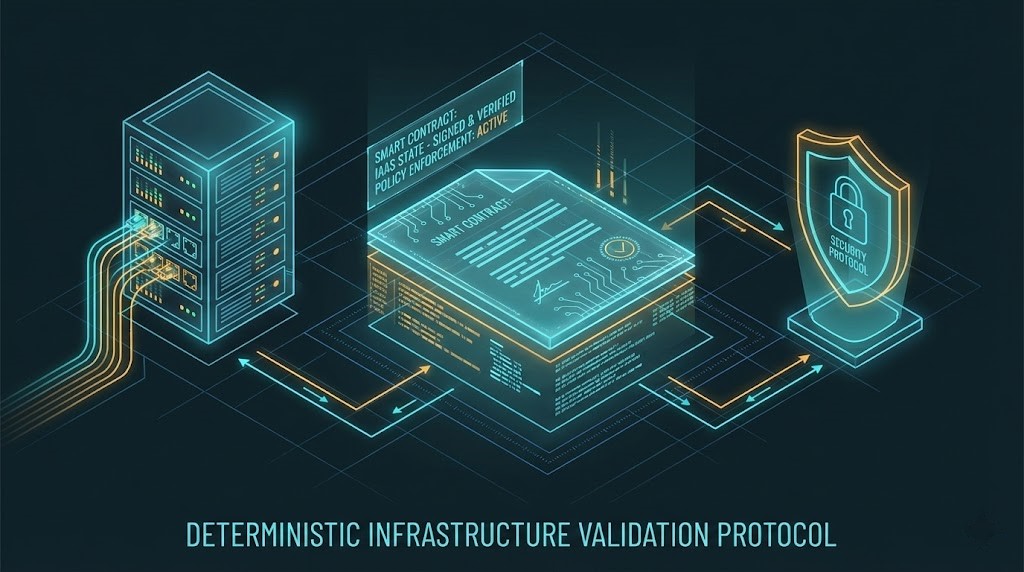
In a standard “leaky” pipeline, an engineer commits code, a runner executes plan, and then apply. The gap between those steps is where the devil resides. Deterministic IaC pipelines treat the binary plan file as an immutable artifact. It doesn’t just run code; it interrogates it.
Decision Framework: Selecting Your Validation Logic
I often get asked, “Why not just use the native tools?” Here is how I break down the decision when I’m architecting a new platform:
| Feature | Open Policy Agent (Rego) | HashiCorp Sentinel | Cloud-Native (AWS Config/Azure Policy) |
| Ecosystem | Universal (K8s, IaC, HTTP) | Terraform/Vault Exclusive | Cloud Specific |
| Enforcement | Pre-computation (Shift Left) | Runtime (During Plan) | Post-deployment (Reactive) |
| Licensing | Open Source (Apache 2.0) | Paid (Terraform Enterprise) | Usage-based |
| Best For | Multi-cloud complexity | Pure HashiCorp shops | Compliance-heavy public cloud |
My Take: If you are building for the next decade, choose OPA for your deterministic IaC pipelines. It is the only way to maintain a single source of truth for policies across your Nutanix clusters, your Kubernetes namespaces, and your public cloud footprint simultaneously.
Day 2 Operations: Preventing “State Rot” & Sovereign Drift
The most common failure I see in mature organizations running deterministic IaC pipelines is “State Rot.” This happens when the terraform.tfstate deviates from the actual hardware or cloud API reality. But in 2026, we have two new, far more dangerous problems: Sovereign Drift and Licensing Liability.
If your automation works perfectly but deploys a workload to a non-sovereign region, you’ve broken the law. If it scales your cluster beyond your paid entitlements, you’ve broken the budget.
To combat this, your pipeline must enforce Strict Plan Integrity using the right tools for the job:
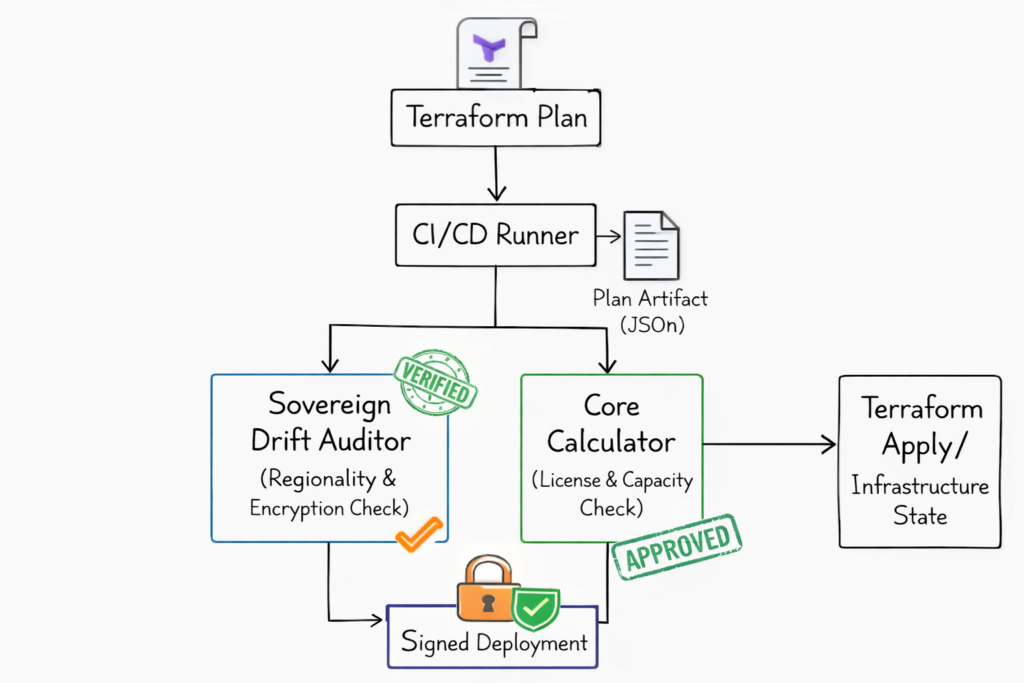
- Sovereign Compliance (The “Lawyer” Check):I strictly enforce a “Sovereignty Gate” using the Sovereign Drift Auditor v1. This tool ingests your plan.json and instantly flags any provider regions that violate data residency requirements or storage volumes lacking AES-256 encryption. It’s an automated auditor that works faster than any human ever could.
- Financial Guardrails (The “CFO” Check):Before you hit apply, you need to know if you can afford the deploy. I configure pipelines to cross-check the plan against the VMware Core Calculator. If your Terraform code tries to spin up a node count that exceeds the 320 billable cores defined in your VMware Renewal Estimator strategy, the pipeline fails. No “True-Up” surprises allowed.
- Network Logic (The “Security” Check): If you are re-platforming from VMware to Nutanix, you cannot afford to manually rebuild your micro-segmentation policies. Use the NSX-T Translator to deterministically map your existing NSX-T distributed firewall rules directly into Nutanix Flow categories. This ensures the security posture you signed off on in VMware is exactly the one you inherit in Nutanix—zero drift, zero “lost” rules.
The FinOps Angle: CapEx vs. OpEx
Building a deterministic pipeline has a higher initial CapEx (engineering hours to write Rego policies and configure the Sovereign Drift Auditor). However, the OpEx savings are astronomical. I’ve seen teams reduce “remediation toil” by 60% after implementing automated plan signing. You stop paying for senior architects to troubleshoot “why this VPC is different from the other one” and start paying them to build new features.
Counterpoint: Does Determinism Kill Agility?
I hear this constantly from developers: “Strict pipelines slow down my hotfixes.”
My response is simple: A hotfix that bypasses your deterministic IaC pipelines are just a “hot-break” waiting to happen. If your pipeline is too slow to handle an emergency, the problem isn’t the determinism; it’s your architecture.
If you’re still running a monolithic state file for your entire production environment, stop. Break your state files into smaller, decoupled units. Refer to our Hypervisor Alternatives Guide to see how modular architecture scales better across different stacks. Speed comes from modularity, not from cutting corners on safety.
Architect’s Verdict
Infrastructure is no longer about racking servers; it is about managing the integrity of state. If your security team has to “audit” your infrastructure after it’s built, you’ve already lost. The audit should happen inside the pipeline, triggered by the code commit, validated by the Sovereign Drift Auditor, and sealed with a digital signature.
Think Like an Architect: Design the system so that it is impossible to deploy an unverified change.
Signing and policy-gating the plan protects the integrity of what gets deployed. It says nothing about whether the pipeline enforcing that signature can rebuild itself after the environment it runs in is gone — that’s a separate boundary, covered in Infrastructure Pipeline Survivability Boundary (Framework #164).
Build Like an Engineer: Use OPA, OIDC, and immutable plan artifacts to enforce that design.
Additional Resources:
View 1 more resource
Editorial Integrity & Security Protocol
This technical deep-dive adheres to the Rack2Cloud Deterministic Integrity Standard. All benchmarks and security audits are derived from zero-trust validation protocols within our isolated lab environments. No vendor influence.

R.M.
Senior Solutions Architect with 25+ years of experience in HCI, cloud strategy, and data resilience. As the lead behind Rack2Cloud, I focus on lab-verified guidance for complex enterprise transitions. View Credentials →
Get the Playbooks Vendors Won’t Publish
Field-tested blueprints for migration, HCI, sovereign infrastructure, and AI architecture. Real failure-mode analysis. No marketing filler. Delivered weekly.
Select your infrastructure paths. Receive field-tested blueprints direct to your inbox.
- > Virtualization & Migration Physics
- > Cloud Strategy & Egress Math
- > Data Protection & RTO Reality
- > AI Infrastructure & GPU Fabric
Zero spam. Includes The Dispatch weekly drop.
Architecture Audit Services
Fixed-scope audits for Zero-Trust Azure, VMware migration readiness, and recovery posture — no discovery call required to start.
>_ View Audit Services>_Related Posts
Your Kubernetes Cluster Isn’t Out of CPU — The Scheduler Is Stuck
Compute Tier 1 Authority Cascades to ➔ >_ Architect’s Brief 60-second read before you commit to the full post · Full post: 9 min Generating brief… [Storage] [Network] 🚨 Failure Signature Detected Grafana shows cluster CPU utilization is under 50%, but pods are stuck in Pending. Events show: 0/10 nodes are available: 10 Insufficient cpu….
Your Identity System Is Your Biggest Single Point of Failure
Part 2 of the Rack2Cloud’s Cloud Fragility Series >_ Cloud Fragility Series 01 Multi-Cloud Cascading Failure Risks 02 Your Identity System Is Your Biggest Single Point of Failure [CURRENT] 03 Vendor Lock-In Happens Through Networking — Not APIs 04 Your Cloud Bill Quietly Increased in 2026 — Here’s Where the Money Is Actually Going >_…
Your Identity Provider Was Never Your Spend Boundary
Every enterprise cloud governance program assumes a spend boundary sits somewhere between identity and money — a checkpoint that catches compromised access before it becomes compromised spend. It doesn’t exist. Not as a distinct control. Not as a separate policy layer. Not anywhere in the architecture most organizations have actually built. >_ Architect’s Brief 60-second…
Your Identity Controls Passed. Your Authorization Chain Failed.
A credential chain functioned exactly as it was designed to. No firewall failed. No exploit executed. No malware bypassed a control. A red team walked past physical and social barriers using nothing more exotic than a plausible pretext, and came out the other side holding network admin credentials — issued correctly, authorized correctly, working exactly…
Your DR Test Passed. The Assumptions Didn’t.
DR plan failure rarely happens where you tested. It happens at the assumptions the exercise never reached — the dependencies that weren’t in scope, the runbook written for last year’s architecture, the authority chain nobody tested at 2am.
Your Cloud Provider Is Not Your HA Strategy
A Tactical Playbook for Architecting, Testing, and Automating Real Multi-Cloud & Multi-Region Resilience We’ve previously explored why cloud SLAs fail as guarantees in our deep dive, Cloud SLA Failure & Resilience Strategy. This article focuses on how to survive those failures in practice — architecturally, operationally, and financially. >_ Architect’s Brief 60-second read before you…