

Exposing Dark Matter: PowerShell Script to Find All Untagged Resources
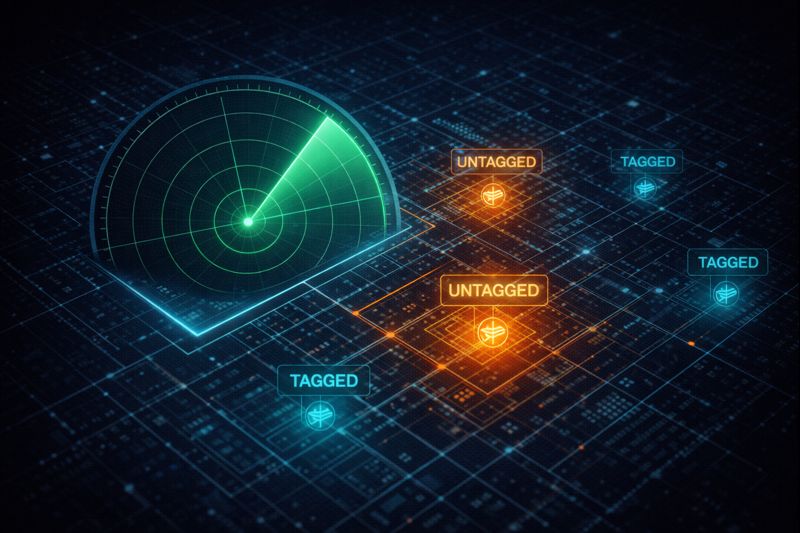
An Azure untagged resources script is the flashlight you need before you go anywhere near enforcement mode. I’ve walked into too many “cloud migrations” where the client thinks they’re running lean, only to find $12k a month in “Dark Matter” — resources floating in the periphery with no owner, no tag, and no purpose. If you don’t have a tag, you don’t exist in the eyes of the finance department, yet you’re still on the invoice.
Before you enable Azure Policy in enforcement mode, you need to audit the damage first. Running enforcement against an unaudited estate means policy will block new resources while the existing dark matter keeps billing. This script gives you the full picture before you pull the trigger.
The tagging governance pattern this feeds into is covered in Azure Management Groups vs. Subscriptions: Where Policy Lives — the audit script and the enforcement layer are two steps of the same workflow.
The Azure Untagged Resources Script: The “Dark Matter” Finder
This script is deliberately lightweight. It doesn’t just look for “missing tags” — it looks for resources where the tag object is null or completely empty. The distinction matters: a resource with an empty tag block passes some tooling checks but is still invisible to cost attribution.
PowerShell
# Get all subscriptions you have access to
$subs = Get-AzSubscription

$results = foreach ($sub in $subs) {
    Set-AzContext -SubscriptionId $sub.Id -Force | Out-Null
    Write-Host "Scanning Subscription: $($sub.Name)" -ForegroundColor Cyan

    # Fetch resources where tags are null or empty
    Get-AzResource | Where-Object { $_.Tags -eq $null -or $_.Tags.Count -eq 0 } | Select-Object `
        @{Name="SubscriptionName"; Expression={$sub.Name}},
        Name,
        ResourceType,
        ResourceGroupName,
        Location
}

# Output to GridView for quick inspection or CSV for the boss
$results | Out-GridView
$results | Export-Csv -Path "./UntaggedResources_Jan2026.csv" -NoTypeInformation

Write-Host "Audit Complete. Found $($results.Count) untagged resources." -ForegroundColor Yellow
How to Run
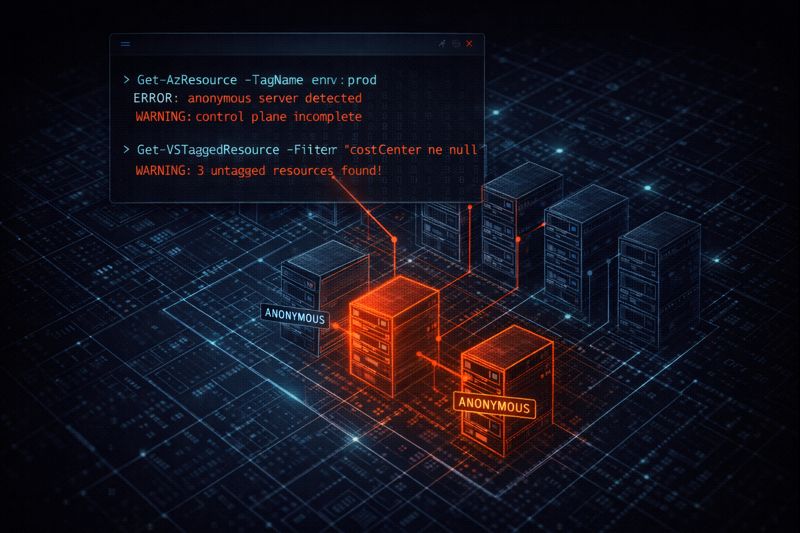
- Open Azure Cloud Shell (PowerShell) or your local terminal.
- If local, ensure you’ve run
Connect-AzAccount. - Copy-paste the block.
- Check the
UntaggedResources_Jan2026.csvfile in your root directory.
Note: The date format in the export filename has been updated from the hardcoded Jan2026 to $(Get-Date -Format 'yyyy-MM') — this makes the script reusable without editing before each run.
Decision Framework: Audit vs. Remediation
Running the Azure untagged resources script is step one. What you do with the output depends on where your estate sits in the governance lifecycle.
| Action | When to use | OpEx Cost | Risk Level |
| Manual Audit (This Script) | Initial cleanup phase / Brownfield. | High (Labor intensive). | Zero. |
| Azure Resource Graph | At scale (>100 subscriptions). | Low. | Zero. |
| Auto-Tagging (Policy) | Day 2 Operations / Greenfileld. | Lowest (Automated). | Medium (Logic errors). |
The Resource Graph path scales beyond what this script handles. For estates running hundreds of subscriptions, the Kusto query approach in Azure Resource Graph Explorer is significantly faster — the Microsoft Docs link in Additional Resources covers the query syntax. For estates still in brownfield cleanup mode, this script is the right first pass before you commit to a policy-based remediation strategy.
The connection to Terraform is direct — if you’re using default_tags in your AzureRM provider and hitting Policy Deny errors on creation, the untagged resources audit tells you what already exists that your new tagging policy will conflict with. See Terraform Azure Tagging Error: Policy Deny & Unsupported Resources Fixed for the fix.
The Financial Reality: The OpEx Trap
Every untagged resource is a leak. Deterministic cloud management requires 100% attribution. If you can’t tell me who owns a Premium SSD v2 disk, that disk should be snapshotted and killed. This is the core principle behind the Infrastructure decisions backed by deterministic tooling.
I once saw a “hidden” testing environment in East US that sat untagged for 14 months. Total cost? $22,000. That’s not a rounding error — that’s a senior engineer’s bonus.
The math scales ugly. At $12k/month in dark matter across a mid-sized enterprise, that’s $144k annually in unattributed spend. Finance can’t challenge a cost center it can’t see, which means the waste compounds quietly until someone runs a script like this one. For the broader FinOps framing, Cloud Cost Is Now an Architectural Constraint covers what attribution failure costs at the organizational level.
Once you have your CSV, the next step is deciding whether to enforce tags via policy at the Management Group level — the full governance hierarchy for that decision lives in Azure Management Groups vs. Subscriptions: Where Policy Lives.
Architect’s Verdict
Run this Azure untagged resources script before you do anything else with Azure Policy enforcement. Brownfield estates are full of resources that will immediately fail enforcement gates — the audit gives you the remediation backlog so you can clean house before policy blocks new deployments.
The workflow is: audit with this script → triage the CSV → apply inline tags to critical resources → enforce at the Management Group level for greenfield going forward. Don’t skip the audit phase. Enforcement without inventory is how you end up blocking your own pipelines.
Additional Resources
Editorial Integrity & Security Protocol
This technical deep-dive adheres to the Rack2Cloud Deterministic Integrity Standard. All benchmarks and security audits are derived from zero-trust validation protocols within our isolated lab environments. No vendor influence.

R.M.
Senior Solutions Architect with 25+ years of experience in HCI, cloud strategy, and data resilience. As the lead behind Rack2Cloud, I focus on lab-verified guidance for complex enterprise transitions. View Credentials →
Get the Playbooks Vendors Won’t Publish
Field-tested blueprints for migration, HCI, sovereign infrastructure, and AI architecture. Real failure-mode analysis. No marketing filler. Delivered weekly.
Select your infrastructure paths. Receive field-tested blueprints direct to your inbox.
- > Virtualization & Migration Physics
- > Cloud Strategy & Egress Math
- > Data Protection & RTO Reality
- > AI Infrastructure & GPU Fabric
Zero spam. Includes The Dispatch weekly drop.
Architecture Audit Services
Fixed-scope audits for Zero-Trust Azure, VMware migration readiness, and recovery posture — no discovery call required to start.
>_ View Audit Services>_Related Posts
Your Kubernetes Cluster Isn’t Out of CPU — The Scheduler Is Stuck
Compute Tier 1 Authority Cascades to ➔ >_ Architect’s Brief 60-second read before you commit to the full post · Full post: 9 min Generating brief… [Storage] [Network] 🚨 Failure Signature Detected Grafana shows cluster CPU utilization is under 50%, but pods are stuck in Pending. Events show: 0/10 nodes are available: 10 Insufficient cpu….
Your Identity System Is Your Biggest Single Point of Failure
Part 2 of the Rack2Cloud’s Cloud Fragility Series >_ Cloud Fragility Series 01 Multi-Cloud Cascading Failure Risks 02 Your Identity System Is Your Biggest Single Point of Failure [CURRENT] 03 Vendor Lock-In Happens Through Networking — Not APIs 04 Your Cloud Bill Quietly Increased in 2026 — Here’s Where the Money Is Actually Going >_…
Your Identity Provider Was Never Your Spend Boundary
Every enterprise cloud governance program assumes a spend boundary sits somewhere between identity and money — a checkpoint that catches compromised access before it becomes compromised spend. It doesn’t exist. Not as a distinct control. Not as a separate policy layer. Not anywhere in the architecture most organizations have actually built. >_ Architect’s Brief 60-second…
Your Identity Controls Passed. Your Authorization Chain Failed.
A credential chain functioned exactly as it was designed to. No firewall failed. No exploit executed. No malware bypassed a control. A red team walked past physical and social barriers using nothing more exotic than a plausible pretext, and came out the other side holding network admin credentials — issued correctly, authorized correctly, working exactly…
Your DR Test Passed. The Assumptions Didn’t.
DR plan failure rarely happens where you tested. It happens at the assumptions the exercise never reached — the dependencies that weren’t in scope, the runbook written for last year’s architecture, the authority chain nobody tested at 2am.
Your Cloud Provider Is Not Your HA Strategy
A Tactical Playbook for Architecting, Testing, and Automating Real Multi-Cloud & Multi-Region Resilience We’ve previously explored why cloud SLAs fail as guarantees in our deep dive, Cloud SLA Failure & Resilience Strategy. This article focuses on how to survive those failures in practice — architecturally, operationally, and financially. >_ Architect’s Brief 60-second read before you…