

Terraform Is Not Infrastructure as Code — It’s Infrastructure as State: Here’s the Real Model
The biggest lie we tell junior engineers is that Terraform is a compiler. We hand them a .tf file and say, “This is the infrastructure.”
It isn’t.
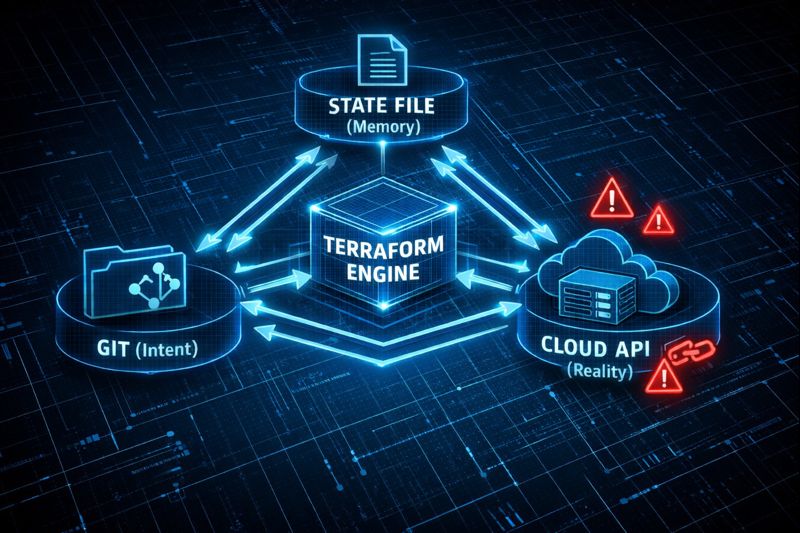
If Terraform were truly “Infrastructure as Code,” then the code would be the source of truth. But anyone who has operated a real cloud environment — especially one with multiple teams, incident pressure, and legacy systems — knows that the code is only Intent. The state file is Memory. And the cloud API is Reality. This is the infrastructure as state model, and it changes how you should operate every Terraform-managed environment.
The first time I saw a clean Git repo, a green pipeline, and a production VPC that looked like it had been through three different admins and a fire drill, I stopped calling Terraform “Infrastructure as Code.” The code said the security group was locked down. The state file said it was locked down. But the AWS console showed a rogue 0.0.0.0/0 rule added by a desperate developer at 2 AM.
Terraform didn’t fail. It just didn’t know.
Terraform isn’t a compiler. It’s a state engine that accepts code as input. If you don’t treat state as a first-class system, you’re not managing infrastructure — you’re writing fiction in HCL.
Terraform Is an Infrastructure State Machine, Not a Compiler
Terraform builds a directed acyclic graph (DAG) by comparing what it remembers (state) with what you want (code). Only after that does it check the cloud. Most teams operate on a flawed two-way mental model:
Git ↔ Cloud
They assume that if they change Git and push, the cloud updates accordingly. In reality, there’s a massive, fragile middle layer:
Git (Intent) ↔ State (Memory) ↔ Cloud API (Reality)
That middle layer — the state file — is what actually controls the operation. Terraform cannot see anything it doesn’t track in state. This is where most teams get burned.
I once audited a client that believed their tagging policies were “enforced in IaC.” In reality, half their EC2 fleet had been created via ClickOps years before Terraform was adopted. Those resources were never imported. The HCL looked beautiful. The policies looked compliant. But Terraform simply ignored those resources — because they didn’t exist in state.
The result? $15,000/month in untagged, unallocated spend that “Infrastructure as Code” couldn’t see.
Infrastructure as State: The Three-Way Integrity Model
If you want deterministic infrastructure, you need to operate on a three-way integrity model:
- Git ↔ State: Does your intent match Terraform’s memory?
- State ↔ Cloud: Does Terraform’s memory match reality?
- Git ↔ Cloud: Only meaningful if the other two are clean.
A signed plan is only a valid contract if the underlying state reflects reality at the time it was generated. If you skip State ↔ Cloud reconciliation — by disabling refresh or ignoring drift — your pipeline is flying blind. terraform plan by default checks Git ↔ State. It does not guarantee State ↔ Cloud unless you explicitly enforce refresh and drift detection.
The CI/CD pipeline is the real control surface here — not the IaC tool. The Infrastructure as a Software Asset post covers why the pipeline design determines your actual governance posture, not the HCL.
Drift Handling: Stop Treating Code as the Source of Truth
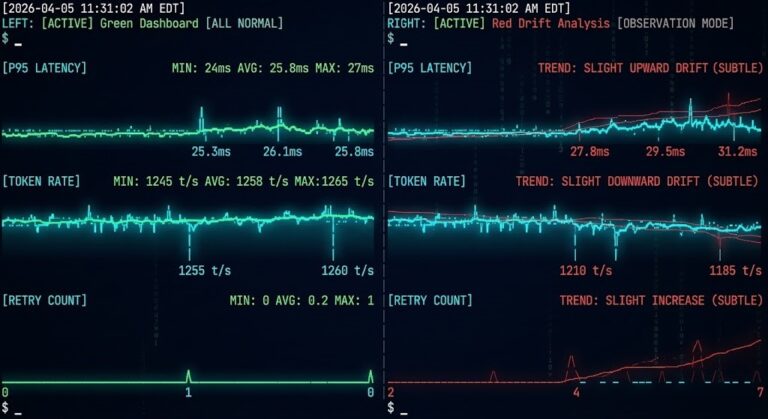
Drift is not an error. It’s operational reality. The moment you deploy, entropy begins. Senior architects don’t treat drift as a cleanup task — they treat it as a first-class governance signal.
Operational Strategy: Containment Before Migration
When drift is detected, don’t immediately rush to “fix the code.” Start with state-first triage:
- Refresh-only plan:
terraform plan -refresh-only -detailed-exitcode - Decision gate:
- Import: Valid resource, missing from state.
- Recreate: Configuration drift, let Terraform overwrite.
- Ignore: Legacy brownfield, explicitly document and tag.
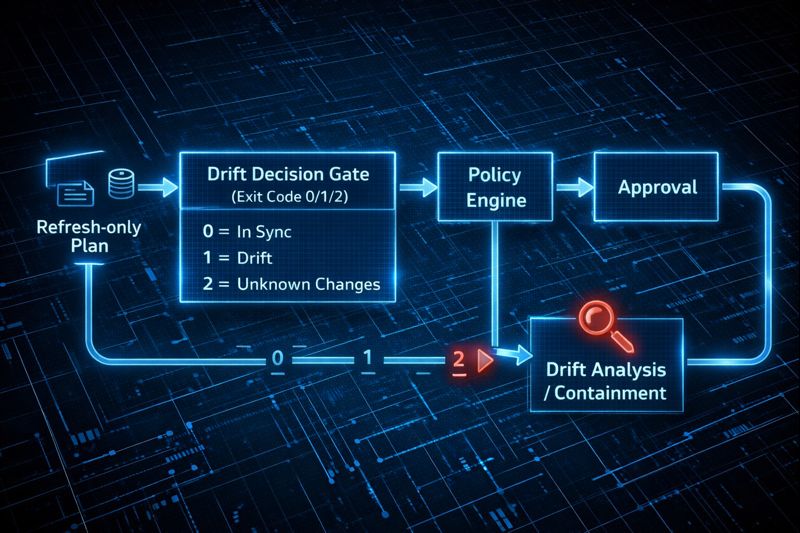
This turns terraform plan from a deployment step into a governance radar. The Configuration Drift: Enforcing Infrastructure Immutability post covers the enforcement model for keeping state honest across environments.
Architect’s Note: Stop using exit code 0 for everything. In our pipelines, exit code 2 triggers a dedicated Drift Analysis branch. It’s not a failed build — it’s a policy alert.
Policy as Code Only Works If Your State Is Honest
We love tools like OPA, Sentinel, and AI policy agents. But here’s the uncomfortable truth: policy engines evaluate plans and state — not the raw cloud.
If your state is stale or incomplete, your policy is enforcing rules against a partial universe. I’ve seen CIS-aligned Terraform policies proudly enforced in pipelines while a legacy subnet with global access sailed underneath — because it never existed in state. The policy agent passed it. Not because it was compliant — but because it was invisible.
To fix this, you need layered guardrails: policy engines that evaluate plans and state, and inventory systems (AWS Config, CSPM) that cross-reference live reality and flag what Terraform can’t see. Policy without state integrity is governance theater.
This is also the core challenge when evaluating an OpenTofu migration — state integrity must be verified before and after the transition, not assumed. The OpenTofu Transition Guide covers the state migration mechanics in depth. The OpenTofu Enterprise Adoption post covers the governance and organizational readiness model.
Where the CISO and CFO Get Nervous: Phantom Infrastructure
This isn’t just an engineering problem — it’s a risk and finance problem.
- Security risk: Unmanaged security groups are one of the easiest entry points for attackers. Drift creates an attack surface you don’t even know exists.
- FinOps risk: You cannot optimize what isn’t in your state file. Ghost resources break cost attribution, destroy TCO models, and inflate OpEx without accountability.
- Compliance risk: State blind spots hide non-compliant architectures — data residency violations, segmentation failures, or shadow networks — especially dangerous in regulated or sovereign environments.
Drift tolerance is not an engineer convenience. It’s a governance decision. The Terraform Feature Lag Tracker on the Engineering Toolkit can help surface provider version gaps that introduce state divergence between Terraform and OpenTofu environments.
Runbooks for a State-First Terraform Practice
If you want to move from “Terraform as scripting” to “Terraform as engineering,” adopt these patterns.
1. State Lifecycle Design
Never use local state. Ever. Use remote backends with locking (S3 + DynamoDB, GCS, Azure Storage). Apply stricter IAM to state storage than to production accounts. The state file holds the keys to the kingdom.
2. Workspace & Repo Topology
Align state files with blast radius, not convenience. Never mix prod and dev in the same state. One corrupted state file should cost you a microservice — not an entire region.
3. Drift SLAs
Define how quickly drift must be investigated in prod vs non-prod. Treat drift as an incident class, not a backlog item.
4. Change Contract Enforcement
Every apply must use a saved plan (-out=tfplan). Hash and sign the plan. Never apply a fresh calculation in prod — only a reviewed contract.
Terraform Usage Models: State-First vs. Code-Only
| Dimension | Code-Only Mental Model | State-First Mental Model |
| Source of Truth | Git repo is assumed to be everything | Git + Accurate Remote State + Live API |
| Drift Detection | Best-effort, manual plan runs | Automated -refresh-only -detailed-exitcode gates |
| Policy Enforcement | HCL and modules only | Plans, State, and Drift outputs |
| Phantom Infra Risk | High — legacy and ClickOps invisible | Managed — import/ignore decisions documented |
| Who Gets Paged | Individual engineer (often ignored) | Platform team via defined Drift SLAs |
Architect’s Verdict
Terraform is not lying to you. You’re lying to yourself if you think code is reality.
Terraform is an infrastructure memory engine. If you treat its memory with the same rigor you treat your code — versioning it, protecting it, validating it against reality — you get deterministic infrastructure. If you don’t, you get a green pipeline, a clean repo, and a production environment that looks like it’s been through three different admins and a fire drill.
If you’re running Terraform today with local state or no drift detection: You don’t have infrastructure as state. You have infrastructure as hope. Start with remote backends and drift SLAs before anything else.
If you’re evaluating an OpenTofu migration: State integrity is the migration. The binary swap is trivial. The state file audit, provider inventory, and workspace reconciliation are where migrations fail. The OpenTofu Transition Guide covers the state migration mechanics in detail.
If you’re presenting this model to leadership: The phantom infrastructure problem is a finance and compliance problem before it’s an engineering problem. $15,000/month in invisible spend, a legacy subnet outside your policy enforcement — these are CISO and CFO conversations, not sprint backlog items.
The Terraform & IaC pillar is the full reference for IaC architecture on rack2cloud. The Modern Infrastructure & IaC pillar covers the broader architecture context. Modern Infrastructure — Maturity Stage 1 — Declarative Infrastructure is the upstream qualifying test this entire model assumes has already been passed: whether this specific piece of infrastructure earned the right to become code in the first place, before state, drift, or governance become the concern.
Additional Resources
View 3 more resources
Editorial Integrity & Security Protocol
This technical deep-dive adheres to the Rack2Cloud Deterministic Integrity Standard. All benchmarks and security audits are derived from zero-trust validation protocols within our isolated lab environments. No vendor influence.

R.M.
Senior Solutions Architect with 25+ years of experience in HCI, cloud strategy, and data resilience. As the lead behind Rack2Cloud, I focus on lab-verified guidance for complex enterprise transitions. View Credentials →
Get the Playbooks Vendors Won’t Publish
Field-tested blueprints for migration, HCI, sovereign infrastructure, and AI architecture. Real failure-mode analysis. No marketing filler. Delivered weekly.
Select your infrastructure paths. Receive field-tested blueprints direct to your inbox.
- > Virtualization & Migration Physics
- > Cloud Strategy & Egress Math
- > Data Protection & RTO Reality
- > AI Infrastructure & GPU Fabric
Zero spam. Includes The Dispatch weekly drop.
Architecture Audit Services
Fixed-scope audits for Zero-Trust Azure, VMware migration readiness, and recovery posture — no discovery call required to start.
>_ View Audit Services>_Related Posts
Your Monitoring Didn’t Miss the Incident. It Was Never Designed to See It.
I’ve watched observability vs monitoring play out as a live incident more times than I can count. >_ Architect’s Brief 60-second read before you commit to the full post · Full post: 10 min Generating brief… The dashboard was green. The on-call engineer was not paged. The monitoring system did exactly what it was designed…
Your Kubernetes Cluster Isn’t Out of CPU — The Scheduler Is Stuck
Compute Tier 1 Authority Cascades to ➔ >_ Architect’s Brief 60-second read before you commit to the full post · Full post: 9 min Generating brief… [Storage] [Network] 🚨 Failure Signature Detected Grafana shows cluster CPU utilization is under 50%, but pods are stuck in Pending. Events show: 0/10 nodes are available: 10 Insufficient cpu….
Your Identity System Is Your Biggest Single Point of Failure
Part 2 of the Rack2Cloud’s Cloud Fragility Series >_ Cloud Fragility Series 01 Multi-Cloud Cascading Failure Risks 02 Your Identity System Is Your Biggest Single Point of Failure [CURRENT] 03 Vendor Lock-In Happens Through Networking — Not APIs 04 Your Cloud Bill Quietly Increased in 2026 — Here’s Where the Money Is Actually Going >_…
Your Identity Provider Was Never Your Spend Boundary
Every enterprise cloud governance program assumes a spend boundary sits somewhere between identity and money — a checkpoint that catches compromised access before it becomes compromised spend. It doesn’t exist. Not as a distinct control. Not as a separate policy layer. Not anywhere in the architecture most organizations have actually built. >_ Architect’s Brief 60-second…
Your Identity Controls Passed. Your Authorization Chain Failed.
A credential chain functioned exactly as it was designed to. No firewall failed. No exploit executed. No malware bypassed a control. A red team walked past physical and social barriers using nothing more exotic than a plausible pretext, and came out the other side holding network admin credentials — issued correctly, authorized correctly, working exactly…
Your DR Test Passed. The Assumptions Didn’t.
DR plan failure rarely happens where you tested. It happens at the assumptions the exercise never reached — the dependencies that weren’t in scope, the runbook written for last year’s architecture, the authority chain nobody tested at 2am.