

Azure Landing Zone vs. AWS Control Tower: The Architect’s Deep Dive
Same Destination, Different Vehicles
By now, the concept of a “Landing Zone” is well understood in the enterprise. It is the pre-configured, secure, and scalable foundation upon which workloads are deployed. It’s the antidote to the “wild west” of unmanaged cloud accounts and subscriptions.
For Solution Engineers and Architects working in multi-cloud environments, simply knowing that both AWS and Azure offer a landing zone solution isn’t enough. The fundamental differences in how they are architected, deployed, and managed have massive downstream implications for operational overhead, flexibility, and security posture.
AWS Control Tower is a managed service that acts as an opinionated orchestrator. Azure Landing Zones (specifically the Enterprise-Scale architecture) is a prescriptive architecture and methodology implemented via infrastructure as code.
This deep dive explores the mechanics beneath both approaches. For a structured progression covering the full cloud governance stack — from landing zone design through policy enforcement and Day-2 drift management — see the Cloud Architecture Learning Path.
What is the Equivalent?
For engineers moving from AWS to Azure, the direct equivalent to AWS Control Tower is the Azure Landing Zone (Enterprise-Scale) architecture.
While they share the same goal—automating a secure, governed multi-account environment—they achieve it differently:
- AWS Control Tower is a managed service (an orchestrator) that you “turn on.”
- Azure Landing Zone is a modular architecture (a blueprint) that you “deploy.”
Think of AWS Control Tower as a guarded highway — fast, strict rules, limited deviation. Azure Landing Zone is a city plan — customizable, but requires construction expertise to execute correctly.
1. The Core Philosophy: Service vs. Architecture
The most critical distinction lies in how the providers deliver the solution.
AWS Control Tower: The Prescriptive Service
Control Tower is a product you “turn on.” It is highly opinionated, aimed at getting customers from zero to a baseline-governed state quickly. It acts as an abstraction layer sitting on top of AWS Organizations, CloudTrail, Config, and IAM Identity Center.
- Pros: Speed of deployment, standardized best practices out-of-the-box, simplified initial experience.
- Cons: Can feel like a black box. Customization outside its prescriptive path often requires add-on frameworks — Customizations for Control Tower (CfCT) or Account Factory for Terraform (AFT) — which increases complexity significantly.
Azure Landing Zone (Enterprise-Scale): The Modular Architecture
Azure doesn’t have a single Control Tower service button. Instead, it provides reference implementations in Bicep and Terraform of the Enterprise-Scale architecture. It’s a blueprint you deploy — and own entirely.
- Pros: Incredibly flexible and modular. Because it’s essentially a complex set of IaC templates, you can modify the architecture to fit exact needs (though deviating from the blueprint requires expertise). It integrates natively with existing Azure DevOps or GitHub workflows.
- Cons: Higher initial learning curve. Requires a strong grasp of core Azure concepts — Management Groups, Policy, RBAC — before deployment.
For teams managing Azure Landing Zone via Terraform, the OpenTofu Readiness Bridge audits your HCL configurations for BSL-divergence and provides migration templates — critical if you’re managing landing zone IaC across a long-lived enterprise codebase.
2. The Skeleton: Hierarchy and Structure
How do we organize the sprawl?
Azure: The Power of Management Groups
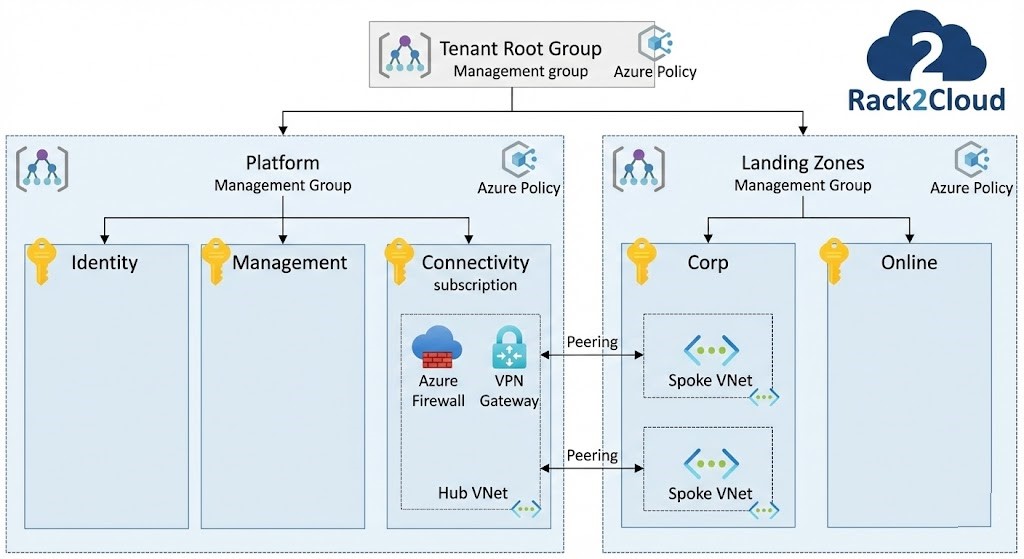
Azure’s structural advantage is the Management Group hierarchy. Unlike AWS Organizations which are often relatively flat, Azure encourages deep nesting designed specifically for policy inheritance.
Azure separates the billing construct (Enterprise Agreement enrollment) from the organizational construct (Management Groups). The ALZ reference architecture dictates a specific hierarchy — Corp vs Online management groups — to apply distinct policies to different workload types. Subscriptions live under these groups and inherit policies automatically.
AWS: Organizations and OUs
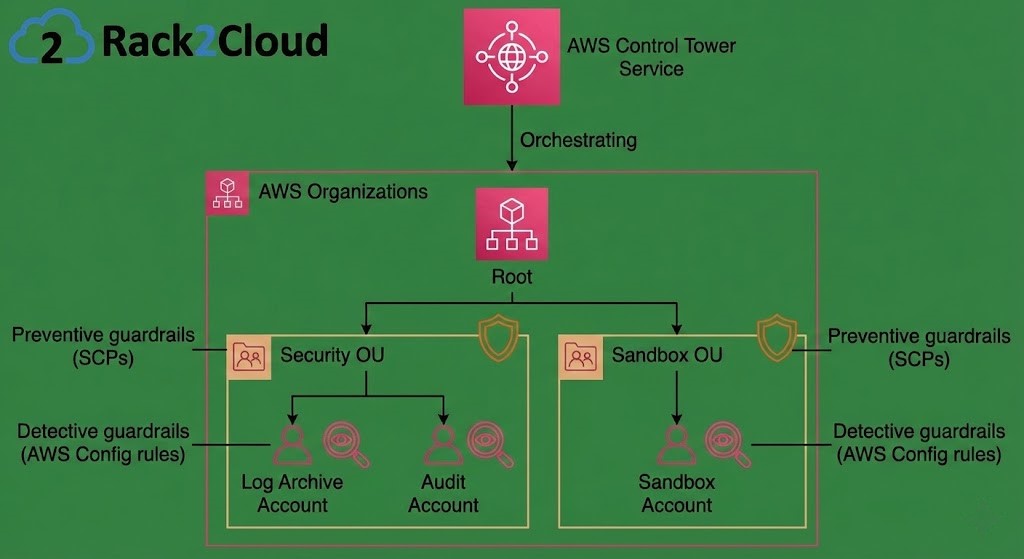
AWS uses AWS Organizations and Organizational Units. Control Tower mandates a specific starting structure: a Security OU (for log archive and audit) and a Sandbox OU.
While OUs can be nested deeply, AWS historically favored flatter structures. Control Tower’s rigidity means you must work within its defined OU structure for enrolled accounts. Moving accounts after the fact — or integrating existing complex organizations — can break Control Tower’s orchestration guardrails in ways that are difficult to recover from cleanly.
3. The Muscles: Governance and Policy Engines
This is where the technical differences become most pronounced — and where the downstream operational consequences are most severe.
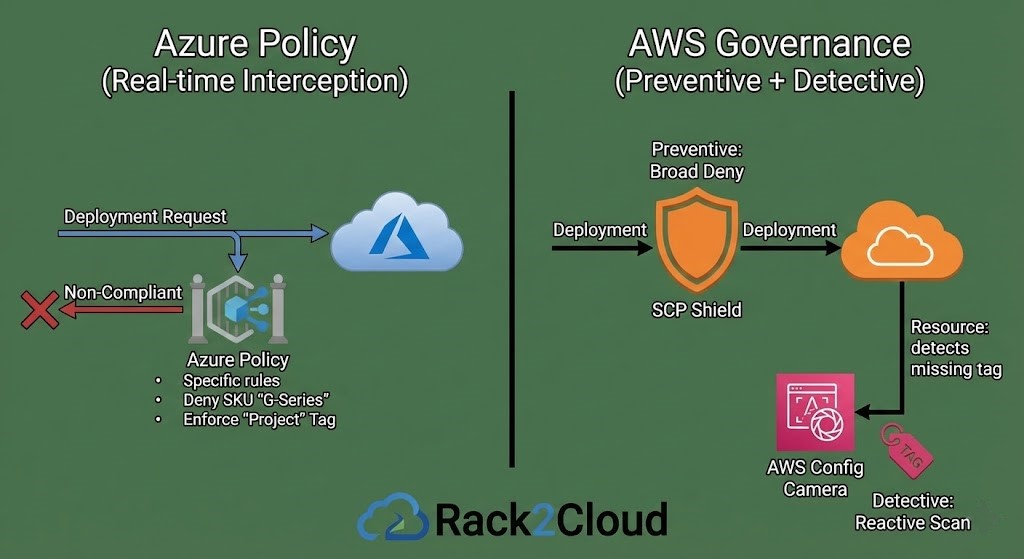
Azure Policy: The Scalpel
Azure Policy is arguably the most powerful governance engine in the public cloud.
It sits directly at the ARM (Azure Resource Manager) API layer. Every request to create or modify a resource passes through Azure Policy first — before the resource exists, not after.
It operates at four enforcement levels:
- Deny: Blocks non-compliant deployments in real-time
- Audit: Flags non-compliant resources without blocking
- Append: Automatically adds required tags or configurations
- DeployIfNotExists: Remediates non-compliant resources automatically
Because policies are applied to Management Groups, a single policy assignment can govern thousands of subscriptions instantly — even retroactively auditing existing resources. For teams enforcing cost center tagging and resource governance at scale, see the Azure Policy: Enforce CostCenter Tag implementation guide.
AWS Control Tower: The Shield and The Camera (SCPs & Config)
AWS uses a two-pronged approach that is generally less granular but effective for broad-stroke governance.
Service Control Policies (SCPs) — The Shield: Preventive guardrails that act as permission boundaries on AWS accounts. Excellent for broad denials — deny access to unregistered regions, deny deleting CloudTrail logs. However, SCPs are coarse. An SCP cannot enforce a specific tag value on an EC2 instance — it can only deny RunInstances if tags are missing entirely.
AWS Config — The Camera: Detective guardrails that monitor resources after deployment. If someone deploys a non-compliant S3 bucket, Config detects the drift and alerts — or triggers a Lambda for remediation. There is inherent latency between deployment and detection.
The Architect’s Takeaway: Azure Policy prevents bad configurations from ever existing, with high granularity. AWS relies on broad preventive blocks combined with reactive detection for fine-grained issues. Neither is wrong — they reflect fundamentally different operational philosophies.
For teams managing infrastructure drift across either platform via Terraform or OpenTofu, the Sovereign Drift Auditor audits your terraform plan.json for non-sovereign drift and unencrypted storage — surfacing compliance gaps before they reach production.
4. The Nervous System: Networking Integration
Azure Landing Zone
Networking is deeply integrated into the ALZ architecture. The accelerators assume a Hub-and-Spoke model and natively orchestrate the deployment of the Hub VNet, Azure Firewall, VPN Gateways, and ExpressRoute connections. Azure Virtual WAN (vWAN) is strongly pushed for large-scale global deployments, making transit routing dramatically simpler at enterprise scale.
For a deeper breakdown of Azure Private Endpoint architecture — which sits within the Landing Zone network boundary — see the Azure Private Endpoint Auditor Breakdown and the Azure PE Checker tool for detecting recursive DNS loops and subnet exhaustion
AWS Control Tower
Control Tower’s native networking is basic. It provisions VPCs in new accounts based on simple parameters but does not natively orchestrate complex transit networking like AWS Transit Gateway out of the box. Building a true Hub-and-Spoke in AWS requires add-ons like AFT or custom automation to handle Transit Gateway attachments and routing tables as new accounts are vended.
| Feature | Azure Landing Zone (Enterprise-Scale) | AWS Control Tower |
| Delivery Mechanism | Prescriptive Architecture (IaC blueprints) | Managed Service (Opinionated Orchestrator) |
| Primary Hierarchy | Management Groups (Deep nesting, inheritance focus) | AWS Organizations & OUs (Rigid initial structure) |
| Primary Policy Engine | Azure Policy (Granular, API-layer interception, real-time deny/remediate) | SCPs (Coarse preventive boundaries) & AWS Config (Reactive, granular detection) |
| Networking | Native Hub-and-Spoke / vWAN orchestration | Basic VPC provisioning. Complex transit usually requires add-ons (AFT/CfCT). |
| Customization | High (Modify the IaC directly) | Medium/Low (Requires extensions like CfCT or AFT) |
| Day-2 Operations | Managed via code (GitOps flow) | Managed via Console or Service Catalog (drift detection provided by service) |
5. Day-2 Operations: Where the Real Costs Live
Initial deployment complexity is a one-time cost. Day-2 operational overhead is permanent.
Azure Landing Zone Day-2
Managed via code. Changes flow through a GitOps pipeline — pull request, review, apply. Policy drift is detected automatically. The architecture assumes IaC maturity and rewards teams that have it. For teams using Terraform to manage the full lifecycle, the Terraform Feature Lag Tracker surfaces delays between Azure API releases and Terraform provider support — preventing the “provider doesn’t support this yet” surprise mid-sprint.
AWS Control Tower Day-2
Managed primarily via console or Service Catalog with drift detection provided by the service itself. Lower IaC maturity required, but customization debt accumulates quickly as organizational complexity grows beyond Control Tower’s native guardrails.
For a full framework covering IaC governance, drift management, and policy-as-code across both platforms, see the Modern Infrastructure & IaC Learning Path.
Conclusion: Positioning Strategy
Avoid declaring one better than the other. They are fundamentally different approaches suited to different organizational DNA.
Position Azure Landing Zone when the customer:
- Needs highly granular, real-time policy enforcement — strict regulatory industries, sovereign cloud requirements
- Has strong IaC maturity and wants to manage governance via GitOps
- Requires complex, deeply nested hierarchies that map to their business structure
- Is already heavily invested in the Microsoft ecosystem — Entra ID integration is seamless
Position AWS Control Tower when the customer:
- Wants the fastest path to a baseline, best-practice multi-account environment
- Prefers a managed service approach over maintaining complex IaC blueprints
- Is comfortable with AWS’s rigid initial structures and extending via add-on frameworks
- Needs broad-brush guardrails initially and will mature into fine-grained Config rules later
Both lead to the same destination: a governed cloud. The choice defines the operational journey to get there — and the long-term cost of maintaining it. To explore how sovereign and compliance constraints further shape this decision, see the Sovereign Infrastructure Strategy Guide.
Additional Resources
For deeper technical context on the concepts covered in this guide:
Editorial Integrity & Security Protocol
This technical deep-dive adheres to the Rack2Cloud Deterministic Integrity Standard. All benchmarks and security audits are derived from zero-trust validation protocols within our isolated lab environments. No vendor influence.

R.M.
Senior Solutions Architect with 25+ years of experience in HCI, cloud strategy, and data resilience. As the lead behind Rack2Cloud, I focus on lab-verified guidance for complex enterprise transitions. View Credentials →
Get the Playbooks Vendors Won’t Publish
Field-tested blueprints for migration, HCI, sovereign infrastructure, and AI architecture. Real failure-mode analysis. No marketing filler. Delivered weekly.
Select your infrastructure paths. Receive field-tested blueprints direct to your inbox.
- > Virtualization & Migration Physics
- > Cloud Strategy & Egress Math
- > Data Protection & RTO Reality
- > AI Infrastructure & GPU Fabric
Zero spam. Includes The Dispatch weekly drop.
Need Architectural Guidance?
Unbiased infrastructure audit for your migration, cloud strategy, or HCI transition.
>_ Request Triage Session