

The Shim Tax: The Hidden Engineering Costs of Hybrid Cloud
I recently audited a client’s AWS bill that had spiraled out of control. They hadn’t spun up massive new GPU clusters. They hadn’t doubled their user base. What they had done was connect a legacy on-prem reporting tool to an S3 bucket, assuming “Hybrid Cloud” meant the best of both worlds. Instead, they were hit with what I call “The Shim Tax.”
The Shim Tax is the cost of architectural friction. It’s the invisible line item composed of API requests, egress fees, and latency buffers required to make two disparate environments talk.
We’ve already discussed the strategic “Why” in Workloads That Should Never Leave the Cloud and the “When” in our guide on Cloud Repatriation. Today, we are going to look at the raw math. If you don’t calculate the Shim Tax, your hybrid architecture is already bankrupt.

The Egress & API Trap: Why “Cheap” Storage Isn’t Cheap
Marketing decks love to compare the cost of S3 Glacier Deep Archive ($0.00099/GB) to on-prem SANs. It looks like a landslide victory for the cloud. But engineers know that storage isn’t static—it breathes.
If you use cloud storage as an active tier for on-prem apps, you trigger the Shim Tax.
War Story: The $50k “Consistency Check”
I once saw a backup admin point an on-prem verification tool at a cloud archive. The tool didn’t move much data, but it scanned file headers to ensure integrity. It issued 10 million GET requests in 48 hours. At roughly $0.005 per 1,000 requests, they spent hundreds of dollars just to check files they didn’t even move.
But the real killer is Egress.
- The Math: Pulling 50TB of restore data can cost $4,500+ in pure network fees.
- The Fix: Before you commit to a “Cloud Tiering” strategy, run your numbers through our Universal Cloud Restore Calculator. It models the actual cost of recovery, including the hidden API tax that most TCO calculators conveniently ignore.
The IOPS Illusion: Performance per Dollar
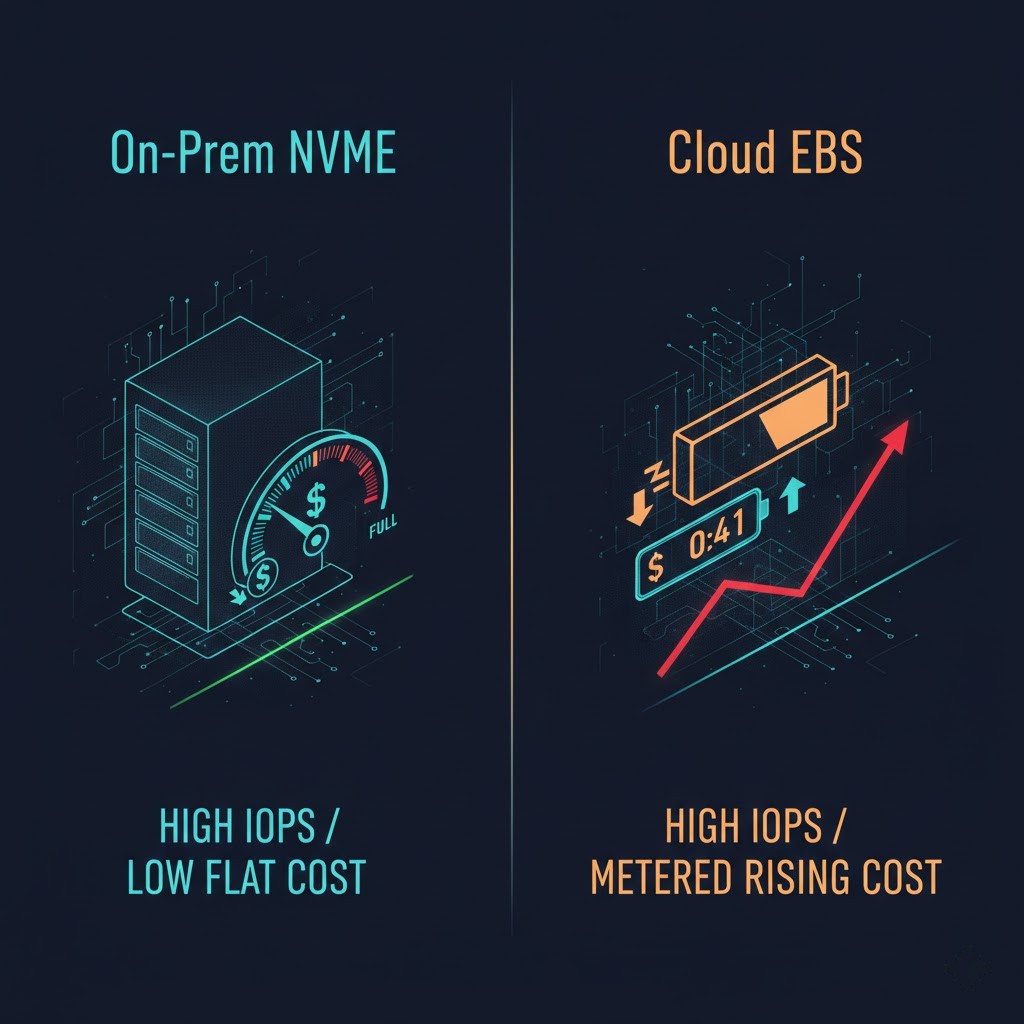
In the cloud, IOPS (Input/Output Operations Per Second) are a metered luxury. On-prem, they are a sunk cost asset.
- On-Prem: You buy a set of NVMe drives for a Nutanix or vSAN node. You pay once (CapEx), and you get 500,000 IOPS available 24/7/365 at no marginal cost.
- Cloud: You provision an AWS
io2 Block Expressvolume. You pay for provisioned IOPS every single month.
I’ve seen databases repatriated simply because the cloud bill for high-throughput storage was 10x the cost of the compute itself. If your workload is “Gravity Heavy” (requires low latency and high IOPS), the cloud premium destroys the value proposition. We break this down further in our analysis of Workloads That Should Never Leave the Cloud.
The Automation “Feature Lag” Tax
We assume the cloud is always “bleeding edge,” but your tooling often isn’t. When AWS releases a new feature, there is often a delay before the Terraform/OpenTofu provider supports it.
- The Gap: This “Feature Lag” forces teams to write custom scripts (Shims) to bridge the gap between IaC and the console.
- The Cost: These scripts are brittle, unmaintained, and eventually break during upgrades.
We built the Terraform Feature Lag Tracker to visualize this delay. If your architecture relies on features that your automation can’t natively support yet, you are paying a tax in engineering hours to maintain the shim.
The “Reserved Instance” Handcuff
Cloud finance teams love Reserved Instances (RIs) because they lower the monthly bill. Architects hate them because they freeze architecture.
- The Reality: Committing to a 3-year RI on an
m6g.xlargesaves 40%, but it locks you into that instance family. If a better, cheaper architecture emerges next year, you can’t move without financial penalty. - The Compliance Drift: Worse, if data sovereignty laws change (like the EU’s Sovereign Cloud initiatives), you might be legally required to move data that is financially locked in a US region. Use our Sovereign Drift Auditor to check if your committed instances are at risk of compliance drift.
For a deeper dive on how to model this decision, refer to our framework on Cloud Repatriation.
Architect’s Verdict: Do the Math, Then Decide
Hybrid cloud is powerful, but it is not a default setting. It is an expensive bridge that should be crossed only when the value on the other side exceeds the toll.
- If the workload is elastic and global? Pay the tax.
- If the workload is static, heavy, or sensitive? Repatriate.
Don’t let “Cloud First” be an excuse for “Math Last.” Use the Cloud ROI Estimator to find your break-even point.
Additional Resources
Editorial Integrity & Security Protocol
This technical deep-dive adheres to the Rack2Cloud Deterministic Integrity Standard. All benchmarks and security audits are derived from zero-trust validation protocols within our isolated lab environments. No vendor influence.

R.M.
Senior Solutions Architect with 25+ years of experience in HCI, cloud strategy, and data resilience. As the lead behind Rack2Cloud, I focus on lab-verified guidance for complex enterprise transitions. View Credentials →
Get the Playbooks Vendors Won’t Publish
Choose the architecture problems you care about. Get field-tested playbooks and frameworks delivered to your inbox.
- > AI Infrastructure & Inference Economics
- > Cloud Strategy & Hidden Cost Models
- > Virtualization & Deterministic Migration
- > Kubernetes, IaC & Modern Infrastructure
- > Data Protection & Recovery Engineering
Zero spam. Includes The Dispatch weekly drop.
Need Architectural Guidance?
Independent review before major infrastructure decisions.
- > Validate assumptions
- > Identify hidden dependencies
- > Quantify migration risk
- > Challenge vendor narratives
Triage · Advisory · Fractional · Direct Hire