

The Day-2 Reality of Nutanix AHV: An Architectural Deep Dive
In the current landscape of Cloud Strategy, Nutanix AHV has transitioned from a niche alternative to the primary destination for enterprise “Broadcom Exits“. However, bridging the Complexity Gap requires moving beyond basic deployment. TThis guide is a foundational component of our Modern Virtualization Learning Path. To build a resilient Virtualization Architecture, an architect must master the non-deterministic variables that emerge during Day-2 production life.
CVM Mechanics: The Distributed Brain
The Controller VM (CVM) is the fundamental unit of the Nutanix Distributed Storage Fabric (DSF). Unlike traditional SANs with dual controllers, Nutanix scales storage logic linearly by placing a CVM on every node.
The Stargate I/O Path
Every write request from a Guest VM (GVM) is handled by the Stargate process within the local CVM.
The Physics of Data Locality
Data Locality is what allows Nutanix to outperform traditional SANs in high-density Modern Infrastructure.
Curator and Data Migration
When a VM is moved via ADS (Acropolis Dynamic Scheduling), it is “compute-local” but “storage-remote”.
- Remote Reads: The GVM must read its data over the network from the original node, which introduces latency.
- The Curator Process: On Day-2, the Curator background service identifies these remote blocks and moves them to the local node’s SSD tier.
- Strategic Impact: For high-performance databases, architects must monitor the “Data Locality” percentage in Prism. If locality drops below 95%, it indicates excessive VM movement or a bottleneck in the Curator scan cycles. Understanding Resource Pooling Physics is critical here to differentiate between simple motion and actual CPU/RAM contention.
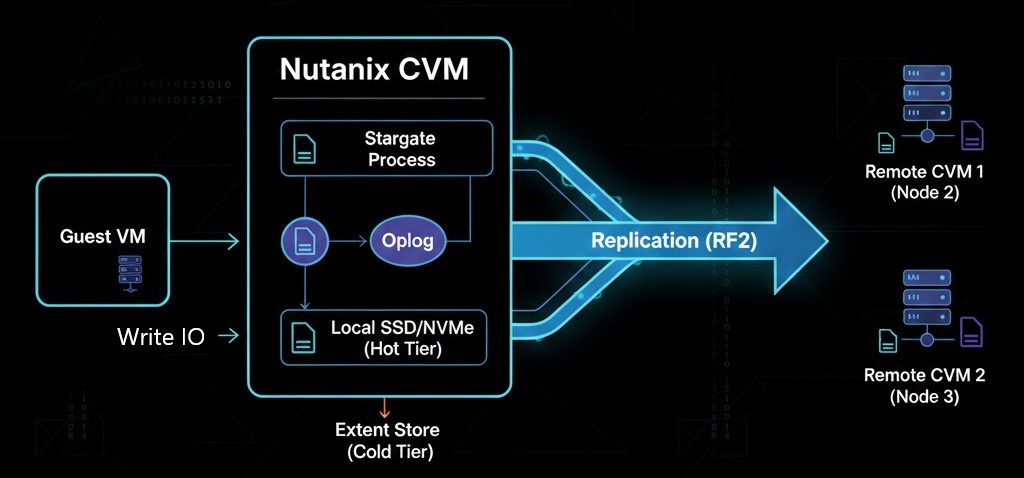
Image 1: Nutanix AHV Stargate I/O Path Flowchart showing GVM write replication to RF2 nodes.
vSphere to AHV: The Migration Logic
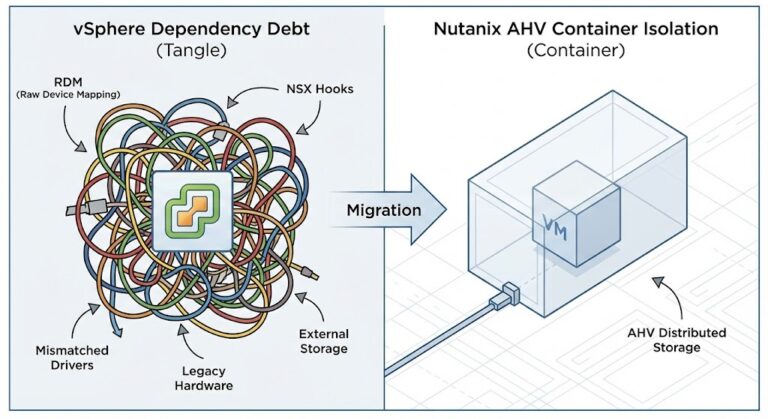
Migrating from VMware is not a simple “V2V” conversion; it is an architectural translation.
The VirtIO and NGT Requirement
Migrating from VMware is not a simple “V2V” conversion; it is an architectural translation detailed in our vSphere to AHV Migration Strategy.
- The VirtIO Gap: Without these drivers, a migrated VM will fail to boot or fall back to slow IDE emulation.
- NGT (Nutanix Guest Tools): Beyond drivers, NGT enables VSS-based backups and cross-hypervisor disaster recovery.
- Migration Tooling: Utilizing the Nutanix Move appliance is recommended, but architects must manually audit the “Snapshot Chain” of migrated VMs to prevent “orphaned” vmdk files from bloating the new container.
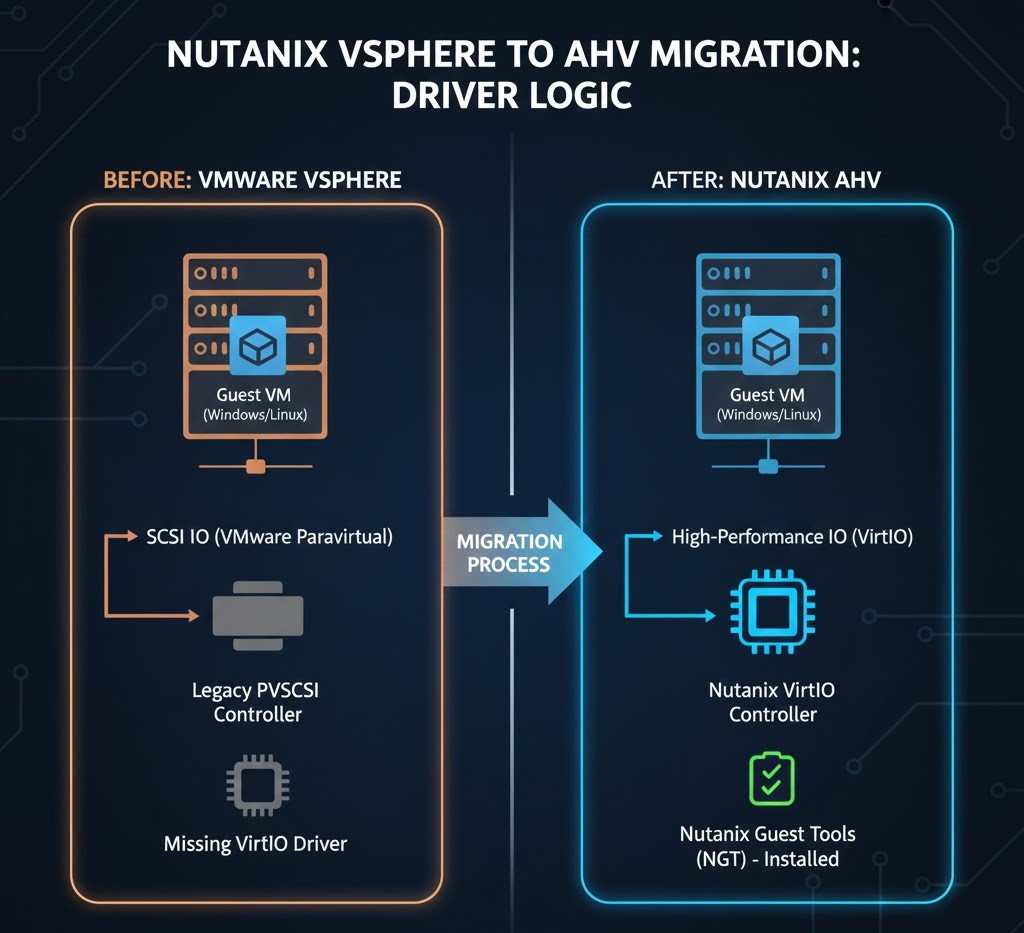
Image 2: VMware Paravirtual SCSI vs Nutanix VirtIO driver logic comparison for Broadcom exit migrations.
Lifecycle Management (LCM) and Firmware Integrity
One-click upgrades are the goal, but Firmware Integrity is the prerequisite.
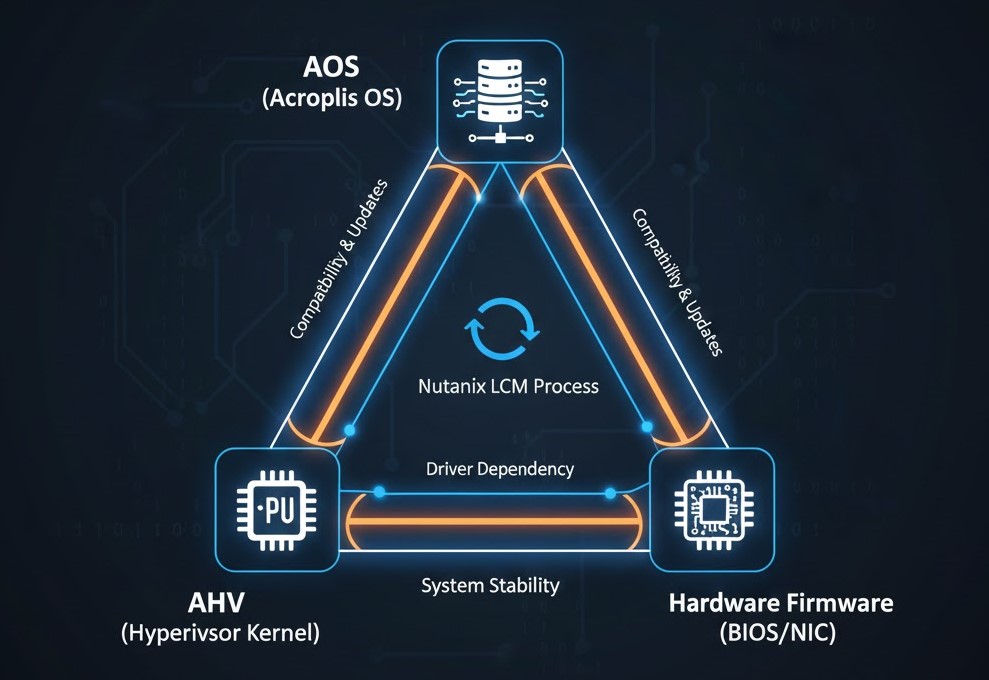
The AOS/AHV/BIOS Triangle
In a Day-2 environment, you are managing three distinct but intertwined software layers:
- AOS (Acropolis OS): The storage intelligence.
- AHV: The hypervisor kernel.
- Firmware: Physical BIOS, NIC, and HBA drivers.
LCM Pre-Checks: Nutanix LCM is highly deterministic, but it relies on the NCC (Nutanix Cluster Check). Always run a full NCC health check 24 hours before an upgrade to ensure there are no “silent” disk failures that could cause a cluster to hang during node reboots.
Architect’s Warning: Never initiate an AOS upgrade while a Curator full-scan is in progress—this is a Day-2 trap that can artificially extend maintenance windows and impact performance.
AHV Data Protection & Cyber Resilience
In our Data Protection Architecture, virtualization and recovery are inseparable.
Redirect-on-Write (ROW) Snapshots
AHV uses ROW snapshots, which differ significantly from VMware’s “Copy-on-Write”.
- No Performance Penalty: ROW snapshots do not create “delta chains” that slow down I/O. This allows architects to take snapshots every 15 minutes for critical apps like SQL or AI Infrastructure workloads without degrading performance.
- Protection Domains vs. Nutanix Mine: While native snapshots are excellent for local recovery, Day-2 operations demand an off-site copy to an immutable repository. Remember, Immutability is Not a Feature; it is a survival necessity for ransomware resilience.
Architect’s Verdict:
Nutanix AHV is the foundation of a Sovereign Cloud. By mastering CVM mechanics, data locality, and the rigors of LCM, you bridge the Complexity Gap and transition from implementer to architect.
Next Step: To further expand your estate, explore our guide on Modern Infrastructure & IaC to learn how to automate these Day-2 tasks using OpenTofu and Ansible.
Additional Resources

R.M.
Senior Solutions Architect with 25+ years of experience in HCI, cloud strategy, and data resilience. As the lead behind Rack2Cloud, I focus on lab-verified guidance for complex enterprise transitions. View Credentials →
Editorial Integrity & Security Protocol
This technical deep-dive adheres to the Rack2Cloud Deterministic Integrity Standard. All benchmarks and security audits are derived from zero-trust validation protocols within our isolated lab environments. No vendor influence.
This architectural deep-dive contains affiliate links to hardware and software tools validated in our lab. If you make a purchase through these links, we may earn a commission at no additional cost to you. This support allows us to maintain our independent testing environment and continue producing ad-free strategic research. See our Full Policy.