

BROADCOM EXIT STRATEGY
Deterministic Migration. Fiscal Sovereignty.
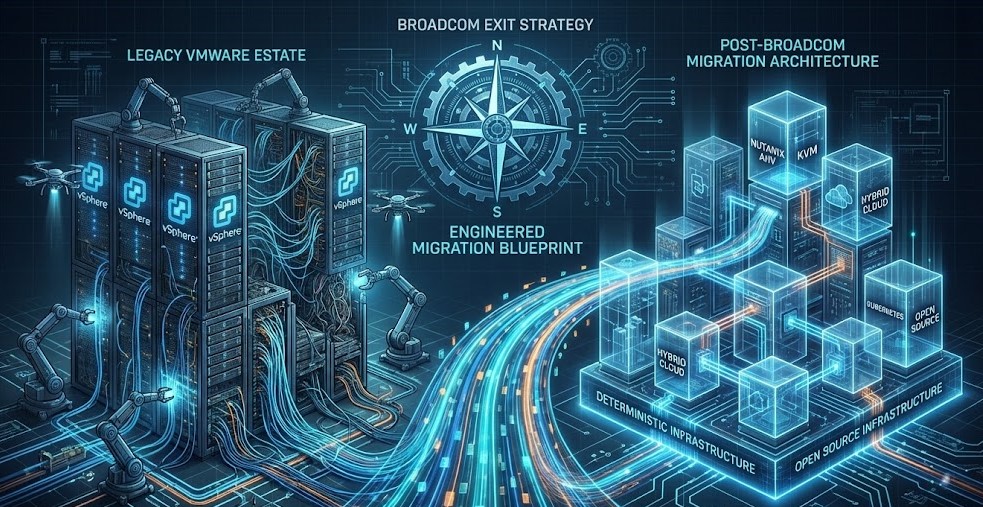
The shift from perpetual licensing to mandatory subscription models has forced a fundamental re-evaluation of the data center. A Broadcom exit strategy is no longer just a cost-saving measure; it is a strict risk management necessity.
As part of our broader Virtualization Architecture framework, this pillar page serves as the definitive engineering blueprint for dismantling your VMware operations. We are moving past the licensing panic and focusing entirely on the physics of the migration.
Table of Contents
- Module 1: Strategic Market Shift
- Module 2: The Physics – Licensing & Core Density
- Module 3: Risk Assessment – The Perpetual vs. Subscription Gap
- Module 4: Migration Networking & IP Continuity
- Module 5: Security Integrity During Transition
- Module 6: Observability – Mapping the Inventory
- Module 7: Lifecycle Planning – The Migration Window
- Module 8: Hybrid Cloud Exit Ramps
- Module 9: Final Decision Matrix
- Frequently Asked Questions (FAQ)
- Series Resources & Next Steps
Module 1: Strategic Market Shift
The shift from perpetual licensing to mandatory subscription models has forced a fundamental re-evaluation of virtualization integrity.
The consolidation of VMware product bundles into tiers like VMware Cloud Foundation (VCF) has exponentially increased the “vTax” for standard enterprise environments.
Before tearing down your existing clusters, you must baseline your current operational state. Our VMware vSphere ESXi Architecture: Performance & Security Guide details the legacy abstractions you are leaving behind. Breaking free from this ecosystem allows you to regain hardware independence, ensuring you are never locked into a single vendor’s commercial roadmap again.
Module 2: The Physics – Licensing & Core Density
Migration physics are dictated by the move from CPU-based to Core-based licensing models.
Broadcom’s subscription model aggressively penalizes low-density servers with high core counts. To maintain cost efficiency, your migration plan must mandate a hardware refresh or a brutal consolidation exercise. Moving to high-density HCI or deterministic KVM stacks provides a linear cost-to-performance ratio, but it requires you to understand the new overhead.
Read the architectural deep dive: Sizing for the CVM: The HCI Controller Tax.
Module 3: Risk Assessment – The Perpetual vs. Subscription Gap
Understanding the financial shift requires a deep audit of your current perpetual license entitlements.
Broadcom has transitioned the portfolio into bundled subscription tiers that establish a high “minimum spend” threshold. This breaks the math for smaller footprint deployments. The loss of standard Support and Subscription (SnS) renewals means architects must perform a site-wide audit to identify which edge and ROBO clusters are no longer fiscally viable to operate under vSphere.
Module 4: Migration Networking & IP Continuity
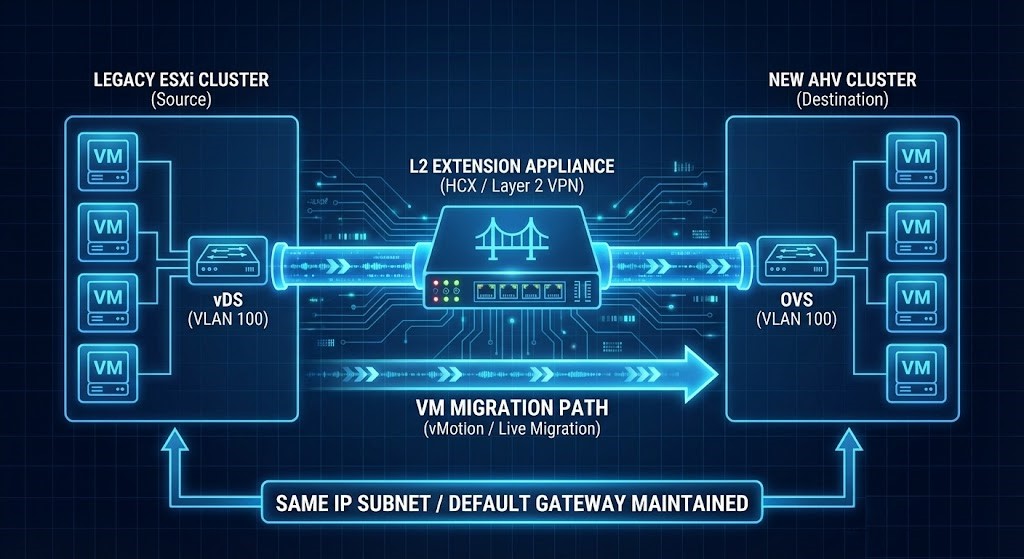
The single highest-risk technical hurdle in an exit strategy is maintaining networking consistency across disparate hypervisors.
To ensure a seamless transition without re-architecting your entire routing table, you must plan for Layer-2 extension or automated IP re-addressing. When utilizing V2V (Virtual-to-Virtual) migration appliances, retaining legacy MAC addresses is critical to prevent ARP table poisoning and DHCP lease chaos. Verify your destination vSwitch logic before you move a single packet.
Module 5: Security Integrity During Transition
Workload migration must be treated as a high-threat event. A “lift and shift” that breaks your security posture is a failed migration.
Maintaining virtualization integrity requires rigorous verification of the underlying hardware root of trust. You must ensure that encrypted guest VMs remain bootable by correctly translating vTPM keys to the new host environment. Security policies previously enforced at the ESXi kernel level must be explicitly re-mapped to your new hypervisor’s native tools.
Module 6: Observability – Mapping the Inventory
Successful exits depend on deterministic observability. You must map complex application dependencies before you sever the old environment.
Identify every inter-dependency between your virtual machines and proprietary VMware APIs. If your disaster recovery relies heavily on vMotion automation or Site Recovery Manager (SRM), recognize that those exact workflows do not exist natively in KVM or AHV.
Engineering Action: Establish a rigid performance baseline using the HCI Migration Advisor to validate snapshot depth, hardware compatibility, and CPU headroom before executing the cutover.
Module 7: Lifecycle Planning – The Migration Window
The “Migration Window” is the volatile period between your VMware contract expiration and your new platform’s go-live date.
To avoid extortive “Bridge Contracts,” execute a Rolling Migration strategy. Stand up a pilot cluster on the new hardware while keeping the legacy environment operational. Move non-critical workloads first to validate the I/O path and storage latency. If you don’t validate your cutover I/O, you will cause storage queues to collapse on the new platform.
Read the engineering fix: The Nutanix Migration Stutter: Solving I/O Cutover.
Module 8: Hybrid Cloud Exit Ramps
For many organizations, a Broadcom exit is the catalyst for moving workloads entirely to public cloud providers.
If on-premises HCI is not the target, migrating to native cloud instances removes the hypervisor management burden entirely. However, this demands significant refactoring if your applications rely on legacy virtual hardware versions. The “Middle Path” is deploying a hybrid solution that guarantees a consistent management plane across local and cloud boundaries.
Module 9: Final Decision Matrix
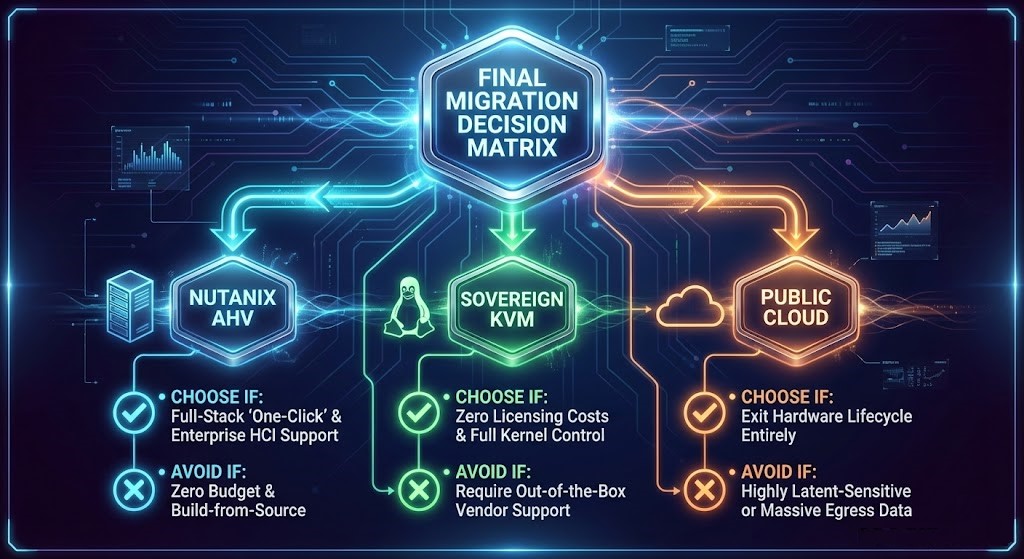
When selecting your destination stack, align your engineering talent with the platform architecture. For an in-depth breakdown of the leading enterprise alternative, review our Nutanix AHV Architecture Guide.
Frequently Asked Questions (FAQ)
Q: What are the biggest risks of a Broadcom exit strategy?
A: The primary risk is operational friction during the “Data Motion” phase. Moving massive volumes of VM data can trigger temporary downtime or high latency if I/O isn’t throttled correctly. A staged, validated migration is mandatory.
Q: Can I maintain hypervisor integrity verification during migration?
A: Yes. By utilizing migration tooling that supports “pre-flight” checksums, you ensure integrity remains intact. Verify that your destination hypervisor natively supports vTPM and Secure Boot to maintain your compliance status and Root of Trust.
Series Resources & Next Steps:
This pillar page is the strategic foundation. To execute the engineering, track our progress through the execution thread mechanics and policy frameworks in the hubs below:
- Canonical Hub: Modern Virtualization Learning Path
- External Context: Review the Broadcom acquisition transition details to understand the licensing shift.
- Vendor Reference: Review Terraform’s Infrastructure as Code principles to codify your new environment.
VIRTUALIZATION HUB
Focus on Architectural Integrity and Hardware Abstraction. Master the fundamental principles of hypervisor security, vTPM, and workload isolation.
NUTANIX AHV
Focus on Data Locality and the Distributed Fabric. Master the architecture of the Nutanix Acropolis hypervisor for operational simplicity and linear scale.
VMWARE VSPHERE
Focus on Monolithic Kernel Performance. Master the industry standard ESXi hypervisor for high-density enterprise environments and deterministic control.
ALTERNATE STACKS
Focus on Open-Source Sovereignty. Master KVM, Proxmox, and Linux-based hypervisors for teams eliminating proprietary lock-in and core-based licensing.
NEED AN ARCHITECTURE REVIEW?
Whether you are evaluating VCF licensing or planning a broad exit to Nutanix, our expert architects provide vendor-neutral audits and design sessions.
BOOK A DESIGN SESSION