

The Nutanix Migration Stutter: Why AHV Cutovers Freeze High-IO Workloads
Infrastructure migration is not a compute event. It is a storage convergence event.
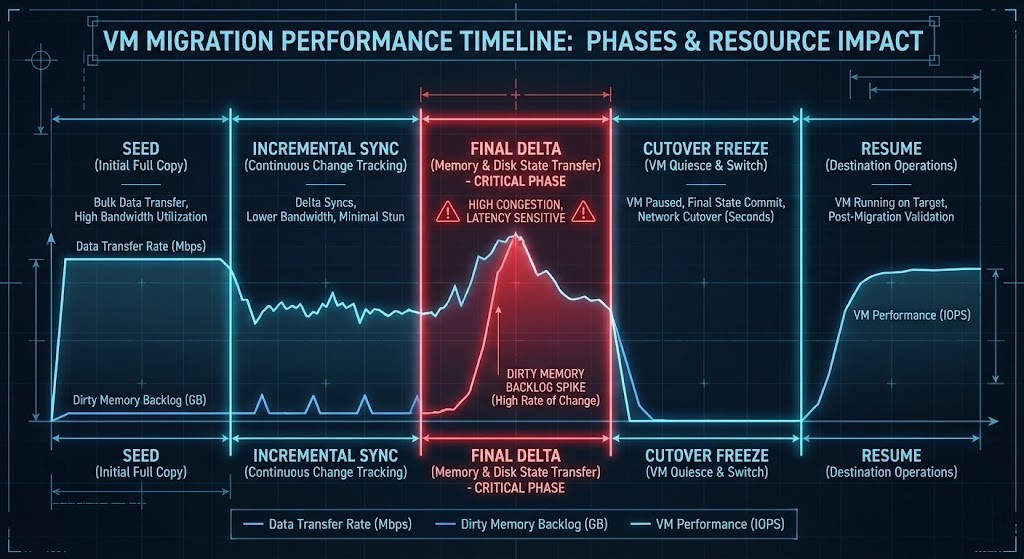
Most migration failures are not network failures. They occur during the final delta sync, when the system must quiesce writes, replicate dirty memory pages, finalize metadata, and flip compute ownership. On AHV, this is where the “stutter” appears.
Why This Feels Different Than ESXi
Architects moving from VMware often expect a “vMotion-like” experience, but the underlying physics differ. ESXi environments often offload storage differently with less CVM-style mediation and different memory convergence characteristics. Relying on historical tuning habits from the ESXi world is often what leads to the “stutter” on Nutanix.
For architects weighing whether AHV’s operational model is the right target platform at all — before hitting migration physics — the Nutanix vs VMware vs Hyper-V comparison framework covers the platform-selection question this stutter analysis assumes is already answered.
The Hidden Physics of the Final Cutover
Unlike vMotion’s aggressive pre-copy algorithm, Nutanix Move encounters unique “gravity” during the final phase. If a database heartbeat threshold is less than 3 seconds, even a brief I/O freeze triggers a catastrophic failover.
1. The Dirty Page Problem
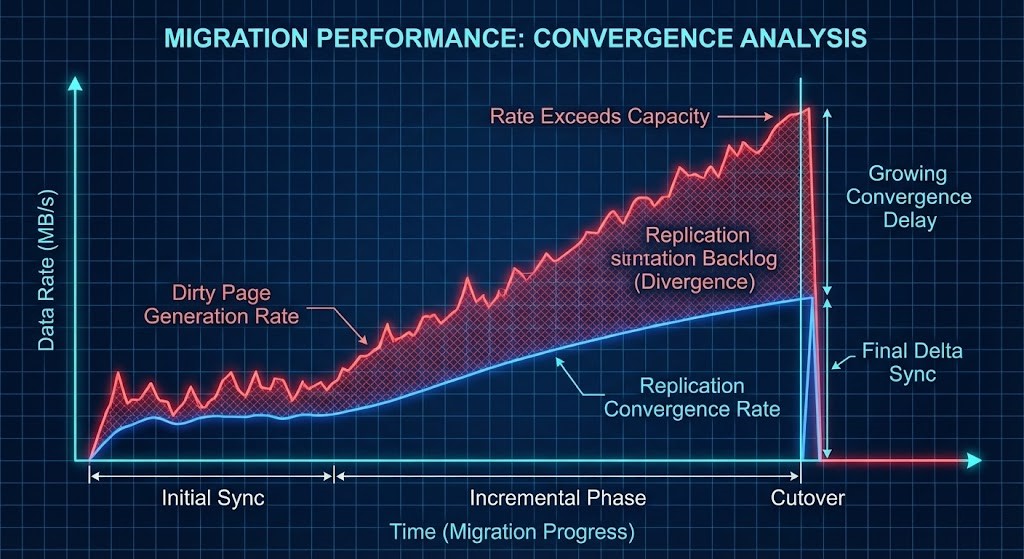
In high-transaction VMs—SQL log writers, Oracle redo logs, or high-IOPS file servers—the memory dirty rate often exceeds the rate at which Move can converge the delta.
- The Result: The final switchover must absorb a massive backlog of changes.
- The Mechanism: This is driven by application write bursts, log flush amplification, storage replication overhead, and intense metadata sync pressure.
This entire failure mode is a property of continuous-replication migration specifically — it requires a live delta sync converging toward a moving target. Array-offload zero-copy paths don’t converge a delta at all; they repoint metadata to the existing blocks and boot from there. Nutanix Zero-Copy Migration Removes Data Movement. It Doesn’t Remove Migration Risk. covers the tradeoff: no dirty-page problem, no CVM replication contention during transfer — and no forced verification pass in their place, either.
2. The Real Bottleneck: CVM Contention
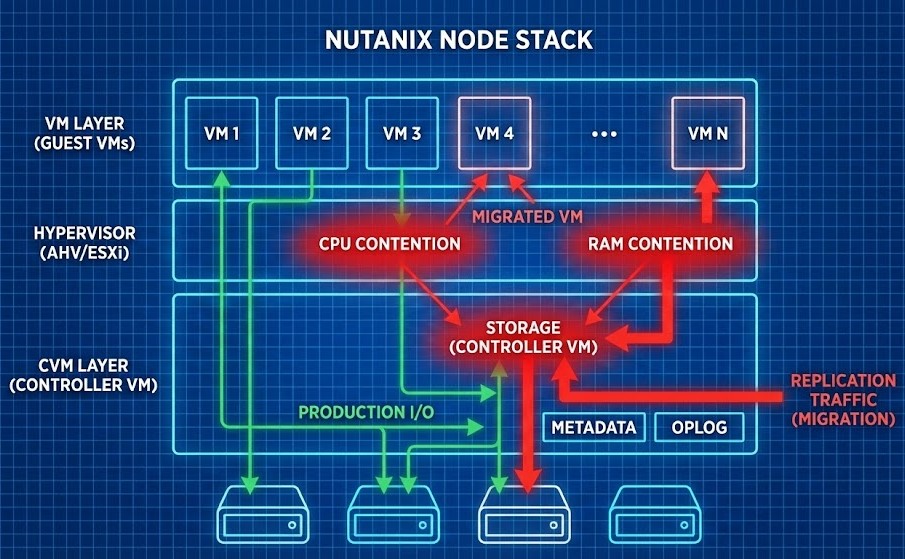
The Controller VM (CVM) does not “pause” for migration; it compounds the workload. During migration, the CVM is not only ingesting replication traffic—it is also reconciling metadata, maintaining replication topology, and servicing existing production I/O. If CVM RAM is undersized or CPU contention exists, storage latency explodes.
The Deterministic Fix Blueprint
1️⃣ Temporarily Lift Container QoS
Remove I/O caps and allow maximum ingest throughput. This prevents artificial throttling during final convergence.
2️⃣ Pre-Inject VirtIO Drivers
Injecting current VirtIO drivers reduces re-discovery latency and avoids post-cutover I/O stalls.
3️⃣ CVM Resource Reservation Boost
Increase CVM RAM allocation and pin vCPUs to physical cores to avoid oversubscription during the migration window.
4️⃣ The Quiet Window Strategy
Reduce dirty page churn by pausing heavy batch jobs and reducing log shipping bursts.
Pre-Migration Risk Checklist
Before you hit “Cutover,” measure these signals. If they are out of spec, you are at risk for a stutter:
Master the Knowledge Loop
This analysis is a core module within our virtualization architecture series. To ensure your environment is tuned and secured for these bursts, explore our related guides:
Infrastructure migration is not a mobility event. It is a convergence event.
If dirty memory outpaces storage reconciliation, the stutter is not a bug. It is physics. Master the convergence layer, and the cutover becomes deterministic.
Additional Resources
Editorial Integrity & Security Protocol
This technical deep-dive adheres to the Rack2Cloud Deterministic Integrity Standard. All benchmarks and security audits are derived from zero-trust validation protocols within our isolated lab environments. No vendor influence.

R.M.
Senior Solutions Architect with 25+ years of experience in HCI, cloud strategy, and data resilience. As the lead behind Rack2Cloud, I focus on lab-verified guidance for complex enterprise transitions. View Credentials →
Get the Playbooks Vendors Won’t Publish
Choose the architecture problems you care about. Get field-tested playbooks and frameworks delivered to your inbox.
- > AI Infrastructure & Inference Economics
- > Cloud Strategy & Hidden Cost Models
- > Virtualization & Deterministic Migration
- > Kubernetes, IaC & Modern Infrastructure
- > Data Protection & Recovery Engineering
Zero spam. Includes The Dispatch weekly drop.
Need Architectural Guidance?
Independent review before major infrastructure decisions.
- > Validate assumptions
- > Identify hidden dependencies
- > Quantify migration risk
- > Challenge vendor narratives
Triage · Advisory · Fractional · Direct Hire