

Migration Path Authorization: Who Approves the VDDK-Free Route?
DirectPath removes the VDDK requirement for ESXi-to-AHV migrations, not the need for privileged vCenter access. Five parts of a record decide who approves the route.
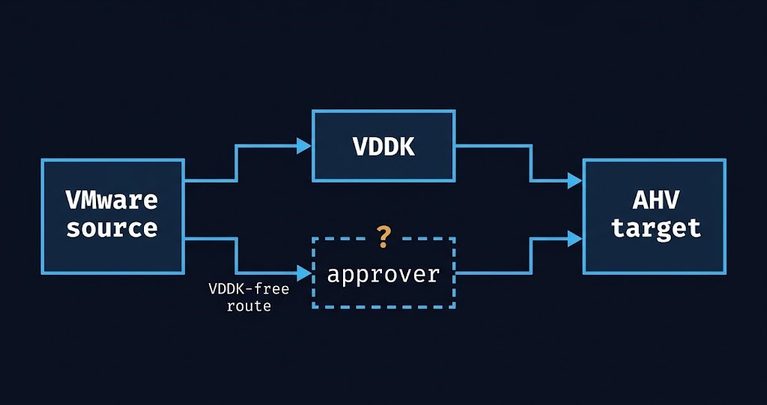
DirectPath removes the VDDK requirement for ESXi-to-AHV migrations, not the need for privileged vCenter access. Five parts of a record decide who approves the route.
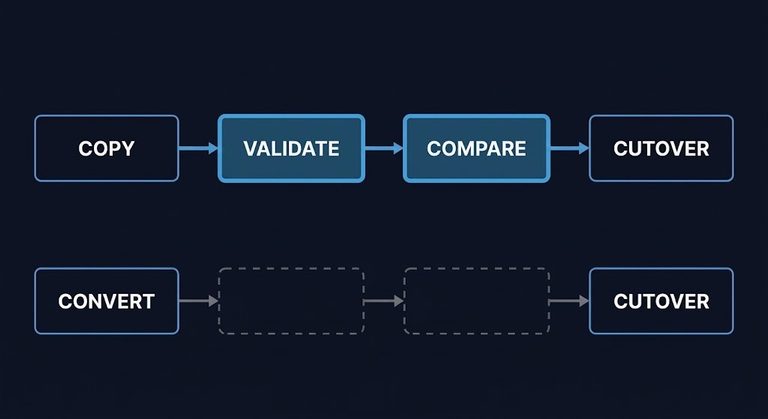
Zero-copy migration removes one of the most time-consuming parts of a VMware migration: moving the data itself. What it does not remove are the identity, dependency, survivability, and verification risks that still determine whether the migration actually succeeds — and conflating the two is how a genuine engineering improvement gets sold as a safety feature…
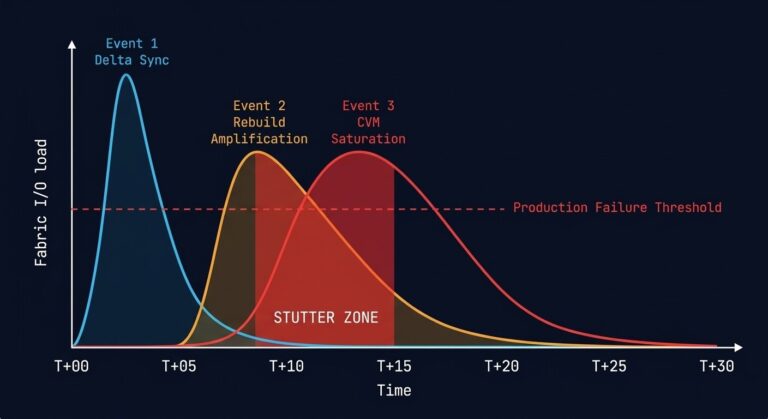
>_ The Post-Broadcom Migration Series Complete — Part 1 — Execution Physics Beyond the VMDK: Translating Execution Physics from ESXi to AHV Complete — Part 2 — Resource Contention The Controller Tax: Modeling Hyperconverged Resource Contention ▶ Part 3 — High-I/O Cutover (You Are Here) Migration Stutter: Handling High-I/O Cutovers Without Data Loss Complete —…
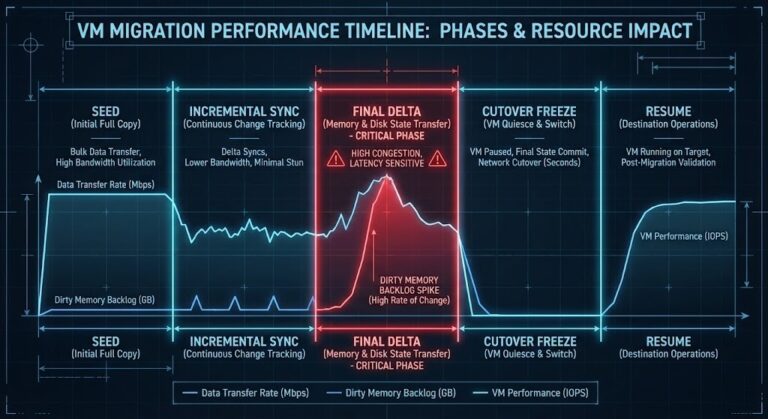
Infrastructure migration is not a compute event. It is a storage convergence event. Most migration failures are not network failures. They occur during the final delta sync, when the system must quiesce writes, replicate dirty memory pages, finalize metadata, and flip compute ownership. On AHV, this is where the “stutter” appears. Why This Feels Different…
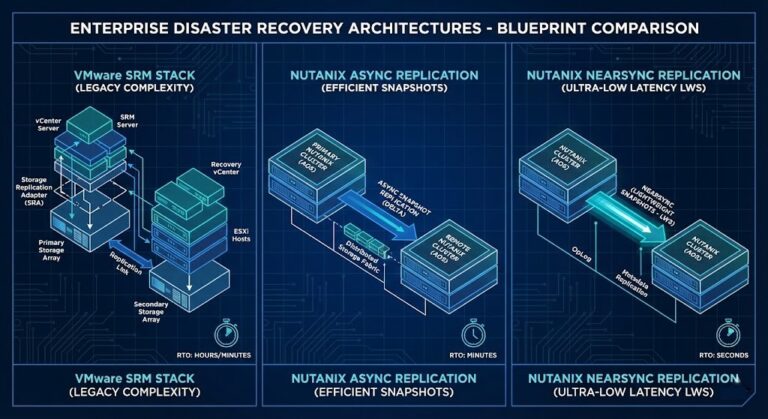
Latency is physics. Complexity is a choice. And for ten years, VMware SRM made us choose pain. SRM is supposed to be the “gold standard,” but under the hood it is a brittle house of cards built on Storage Replication Adapters (SRAs), placeholder VMs, and hope. If the Java process on your storage array doesn’t…

The Post-Broadcom Reality: Keeping the SAN Nutanix compute only nodes with external storage represent a fundamental shift in how enterprises can exit VMware without abandoning their existing storage investments. The premise of Hyperconverged Infrastructure was to kill the Storage Area Network in favor of distributed, direct-attached storage — one vendor, one platform, one throat to…