

The Unholy Trinity: Cisco, Pure, and Nutanix Just Broke the HCI Tax (But Read the Fine Print)
Disaggregated HCI architecture is what happens when the industry finally admits that the HCI tax is real and starts engineering around it. We spent the last decade falling in love with Hyperconverged Infrastructure. It promised simplicity, and it delivered. But it came with a quiet economic penalty that vendors glossed over.
The HCI Tax: The rigid coupling of Compute and Storage.
If your SQL cluster hits 90% CPU but has 80TB of empty disk, you still have to buy a new node. If your VDI environment fills its storage but CPU is idle, you still have to buy a new node. The Controller Tax: Modeling Hyperconverged Resource Contention post covers exactly how this overhead compounds in high-density clusters.
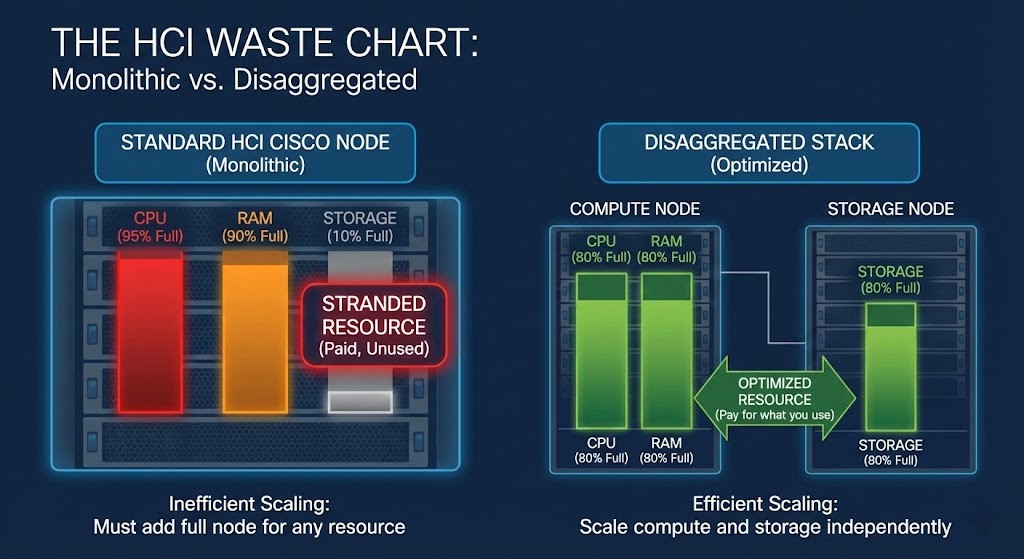
The Math of Waste: Consider a standard HCI node (Nutanix NX-series or equivalent UCS). Packed with dual CPUs, massive RAM, and a full load of NVMe drives. If you only needed the storage capacity, you just lit budget on fire buying CPU and RAM you didn’t need. This isn’t just inefficiency — it’s structural waste.
The Fix: The new disaggregated HCI architecture breaks this coupling without breaking the HCI experience:
- Need Storage? Buy a Pure FlashArray blade — dedicated storage only.
- Need Compute? Buy a Cisco UCS compute blade — no storage overhead.
- Management? Still 100% Prism.
The Kill Shot: Control Plane Convergence
The moment I draw this topology on a whiteboard — Cisco servers connected to a Pure Storage array — every architect in the room rolls their eyes. “Congratulations,” they say. “You just reinvented 2005. I thought we killed SANs to escape zoning hell.”
They are half-right. The hardware topology is 3-tier. But the Control Plane is pure HCI.
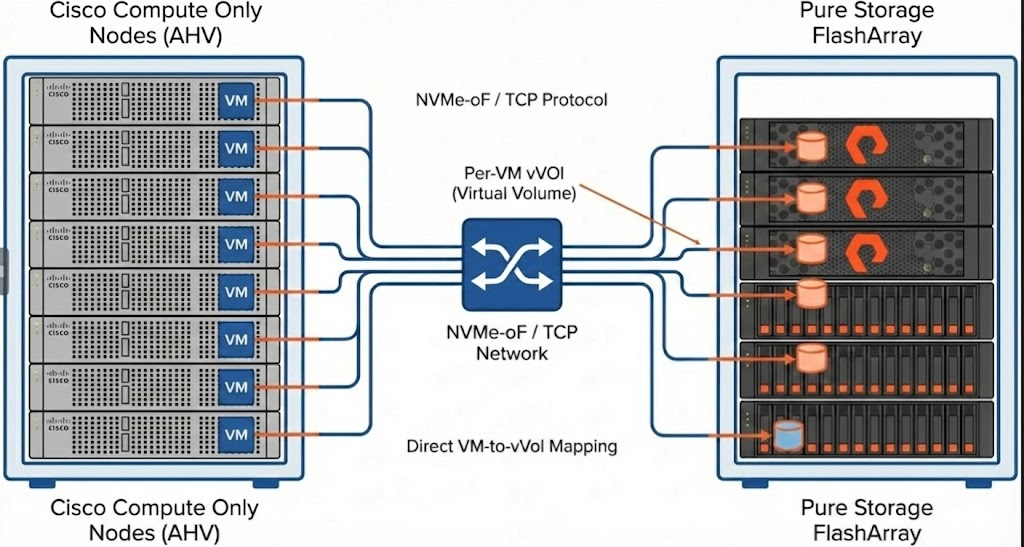
1. The “Under the Hood” View (The Wiring)
This disaggregated HCI architecture abandons LUNs in favor of Virtual Volumes (vVols) running over an NVMe-oF/TCP fabric. The Cisco nodes connect directly to the Pure Array, where individual VMs are mapped to individual vVols.
2. The Operator View (The Magic)
While the wiring looks complex, you never touch it. Nutanix Prism acts as the abstraction layer. When you click “Create VM,” Prism uses APIs to configure the Pure array automatically. You don’t zone switches. You don’t mask LUNs. You just manage VMs.
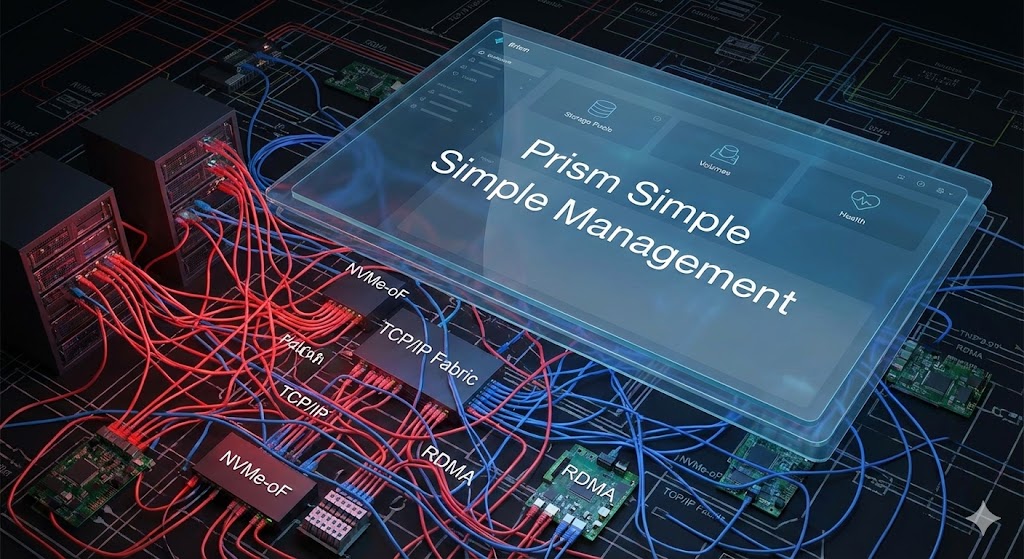
It feels like HCI to the operator because Prism handles the API calls, but it scales like 3-tier for the CFO because the hardware is separate. This is the same control plane abstraction philosophy covered in The Storage Handshake is Dead: Why HCI Redefines the Rules.
Disaggregated HCI Architecture: The Fine Print
Before you rush to buy this, you need to know the physics. This is not a “plug and play” solution for every environment. It is a narrow, validated path.
1. The “Pure //X Only” Handcuff
This integration relies entirely on NVMe over TCP.
- Supported: Pure FlashArray //X (and //XL).
- NOT Supported: FlashArray //C, //E, or older //M models.
- NOT Supported: iSCSI or Fibre Channel fallback.
If you have a legacy Pure array you wanted to repurpose — tough luck. This is a performance-first architecture and it demands modern metal.
2. The Cisco UCS Lock-In
This is a “Cisco Validated Design” (CVD). It doesn’t run on just “any server.”
- Supported: UCS X-Series and select UCS C-Series (M6/M7) models validated for NVMe/TCP offload and Fabric Interconnect integration.
- NOT Supported: Legacy B-Series blades or older M5 rack servers.
- Why? It requires specific NIC offloads for NVMe/TCP to perform like local storage.
3. The Re-Foundation Reality (The Big One)
This is the detail that gets people fired. You cannot take an existing Nutanix HCI cluster running local disks and “just add” a FlashArray to it. The architecture is fundamentally different.
- Requirement: No in-place conversion.
- Process: There is no supported in-place conversion path. Practically, this means evacuating workloads and re-foundation of the cluster as compute-only nodes.
- Impact: If you thought this was a simple Tuesday afternoon upgrade, you are looking at a massive migration project. The Migration Stutter: Handling High-I/O Cutovers Without Data Loss post covers exactly the cutover risk this introduces.
The economics here — buying compute and storage independently instead of eating the HCI tax on both — is one axis of a broader pattern. Workloads are also diverging on refresh lifecycle, storage authority, and failure tolerance, not just cost. Each axis argues for separation on its own terms — the economics case made here doesn’t automatically extend to a GPU refresh cycle or a stateful Kubernetes storage class.
The Licensing War: Nutanix vs. Broadcom vs. Proxmox
The hardware is interesting, but the Licensing is where the real war is being fought. This stack is a direct response to the “Broadcom Tax.”
1. The Nutanix Play (NCI-C)
Nutanix introduced NCI-C (Nutanix Cloud Infrastructure – Compute) licensing.
- The Logic: Since you aren’t using Nutanix’s software-defined storage (AOS) to manage local disks, why should you pay for it?
- The Win: You pay a lower license cost per core because the storage heavy lifting is offloaded to Pure. You are paying Nutanix strictly for the Hypervisor (AHV) and the Management Plane (Prism).
For context on where Nutanix licensing sits post-Broadcom acquisition disruption, see Nutanix vs VMware: The Post-Broadcom Decision Framework.
2. The Broadcom/VMware Trap
Compare this to VMware Cloud Foundation (VCF).
- The Trap: Broadcom often bundles vSAN entitlements into VCF whether you use them or not. Even if you run external storage, you are often paying a “per-core” price that assumes full-stack value.
- The Result: You pay the “HCI Tax” in licensing, even if you run 3-tier hardware.
The VMware licensing cost modeling tool at VMware Licensing Cost Model lets you quantify exactly what that bundled vSAN entitlement is costing you.
3. The Proxmox “DIY” Foil
Then there is the Proxmox angle.
- The Reality: Proxmox allows this same disaggregation (Compute Nodes + External Ceph/NFS/iSCSI) for zero license cost.
- The Trade-off: You lose the “Single Pane of Glass.” In the Nutanix/Pure stack, Prism manages the storage. In Proxmox, you are managing Proxmox for compute and your Storage Array interface separately.
- The Verdict: Nutanix + Pure is the “Enterprise” version of Proxmox freedom. You pay for the integration so you don’t have to be the integrator.
Architect’s Verdict: Who Is This Disaggregated HCI Architecture For?
This architecture is not for everyone. It is a scalpel, not a Swiss Army Knife.
Use This Archetype If:
- ✅ You are a “Greenfield” Deployment: You are building a new cluster and have the budget for Pure //X and UCS M7.
- ✅ You have “Lopsided” Workloads: Massive SQL databases (High Storage / Low Compute) or heavy VDI (High Compute / Low Storage).
- ✅ You are exiting VMware: You want the simplicity of vCenter (Prism) but are tired of the vTax, and you trust Cisco hardware.
Stay Away If:
- ❌ You have existing Nutanix Clusters: The re-foundation effort will destroy your ROI unless you are doing a hardware refresh anyway.
- ❌ You use “Cheap and Deep” Storage: If you need FlashArray //C or //E economics, this integration doesn’t support it yet.
- ❌ You are a small shop: If you have 3 nodes, just buy standard HCI. The complexity of NVMe/TCP networking isn’t worth it until you hit scale.
We broke the HCI Tax, but we didn’t break the laws of physics. You still have to manage a network fabric, buy a storage array, and pay for licenses. But for the first time in a decade, you can finally choose which tax you want to pay.
Additional Resources
View 1 more resource
Editorial Integrity & Security Protocol
This technical deep-dive adheres to the Rack2Cloud Deterministic Integrity Standard. All benchmarks and security audits are derived from zero-trust validation protocols within our isolated lab environments. No vendor influence.

R.M.
Senior Solutions Architect with 25+ years of experience in HCI, cloud strategy, and data resilience. As the lead behind Rack2Cloud, I focus on lab-verified guidance for complex enterprise transitions. View Credentials →
Get the Playbooks Vendors Won’t Publish
Choose the architecture problems you care about. Get field-tested playbooks and frameworks delivered to your inbox.
- > AI Infrastructure & Inference Economics
- > Cloud Strategy & Hidden Cost Models
- > Virtualization & Deterministic Migration
- > Kubernetes, IaC & Modern Infrastructure
- > Data Protection & Recovery Engineering
Zero spam. Includes The Dispatch weekly drop.
Need Architectural Guidance?
Independent review before major infrastructure decisions.
- > Validate assumptions
- > Identify hidden dependencies
- > Quantify migration risk
- > Challenge vendor narratives
Triage · Advisory · Fractional · Direct Hire