

Veeam + Securiti AI vs. Rubrik + Bedrock: The AI-Driven Data Resilience Decision Guide
If you’ve been in the trenches as long as I have, you remember when backup was just “insurance”—a tape sitting in a truck on its way to Iron Mountain. Those days are dead. Today, backup is your last line of defense against ransomware, and more importantly, it is becoming the primary index for Data Security Posture Management (DSPM) detailed in the Data Protection Strategy guide.
We are witnessing a massive consolidation trend. On one side, we have the Veeam and Securiti.ai convergence, focusing on deep data classification and compliance visibility. On the other, Rubrik is leveraging Amazon Bedrock and Copilot to operationalize recovery through generative AI.
For the Cloud Architect, this isn’t just about picking a vendor; it’s about deciding on a philosophy: Do you want to secure the data’s content (Veeam/Securiti) or accelerate the data’s recovery operation (Rubrik/Bedrock)?

The Decision Framework: How to Choose?
Don’t just look at the logo. Look at your operational bottleneck.
Before committing to either platform, model your actual storage footprint, retention costs, and TCO exposure with these deterministic tools.
Scenario A: The “Compliance-Heavy” Hybrid Enterprise
Choose the Veeam + Securiti.ai approach if:
- Data Sovereignty is King: You manage a sprawling hybrid environment (Nutanix on-prem, AWS, Azure) and need a unified “Data Command Center” to track PII across borders.
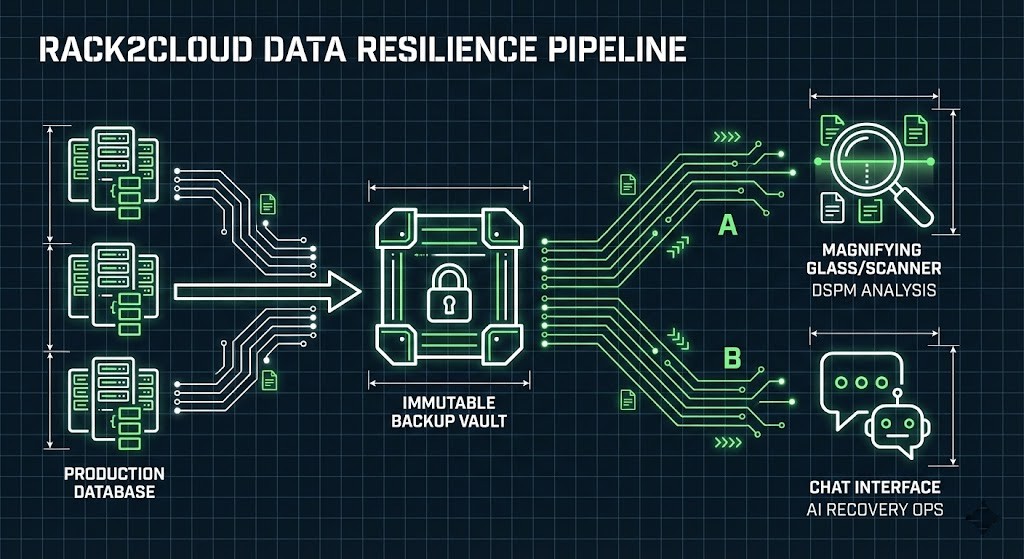
- Scanning Impact Concerns: You cannot afford to run heavy DSPM crawlers on production databases. You prefer scanning the backup copy (offline) to classify sensitive data.
- The Need: You need to answer, “Where is every credit card number stored across my 500 TB estate?” before you even think about recovery.
Scenario B: The “Cyber-Recovery” First Cloud Native
Choose the Rubrik + Amazon Bedrock approach if:
- MTTR is the KPI: Your SOC and IOps teams are siloed. You need a bridge where a Level 1 analyst can ask, “Show me all objects affected by the CVE-2025-X variant and recommend a clean recovery point,” without needing deep backup expertise.
- AWS Centricity: Your data gravity is already heavy in AWS. Leveraging Bedrock for threat hunting within your snapshots minimizes egress and latency.
- The Need: You view backup as an active cyber-response tool, not just a passive repository.
Architecture & Feature Comparison
| Feature | Veeam + Securiti.ai (The Governance Play) | Rubrik + Bedrock (The Operational Play) |
| Core Philosophy | Know your Data. Deep classification, unified policy enforcement, and shadow IT discovery. | Recover your Data. Generative AI to automate recovery workflows and threat hunting. |
| Integration Point | Integration usually happens at the repository level (scanning backup files) or API level for policy mapping. | Integration is native to the SaaS control plane (Rubrik Security Cloud) leveraging LLMs for query/response. |
| “Shadow AI” Defense | High. Focuses on preventing sensitive data from feeding unauthorized AI models. | Medium. Focuses on using AI to protect data, rather than governing the AI data pipeline itself. |
| User Interface | Dashboard-centric. Heatmaps of risk and compliance drift. | Conversational. Chat-based interaction (Rubrik Ruby/Copilot) for remediation. |
| Primary User | CISO, Compliance Officer, Lead Architect. | SOC Analyst, Backup Admin, Incident Responder. |
The Cost Analysis: CapEx vs. OpEx Implications
This is where the engineering enthusiasm usually meets the CFO’s spreadsheet.
1. The Hidden Cost of AI Queries (Rubrik)
Rubrik’s integration with LLMs (Bedrock) often shifts the cost model. While the SaaS platform simplifies management, be wary of consumption-based pricing for AI features.
- Watch out for: “Premium” Security Cloud tiers. Standard licensing may not include the Generative AI capabilities.
- OpEx Risk: If your SOC team uses the AI assistant for daily reporting rather than just emergency recovery, your API/Token costs (or tiered subscription costs) can creep up.
- Tool Tip: Before you commit to long-term retention on cloud storage to support these AI models, use our Rubrik CloudOut Early Deletion Calculator to understand your penalty exposure if you need to move data.
2. The Infrastructure Tax of Scanning (Veeam)
Veeam’s approach is often more infrastructure-heavy (CapEx or IaaS OpEx).
- Compute Requirements: To run Securiti.ai scans against petabytes of backup data, you need “Proxy” compute power. This isn’t magic; it costs CPU cycles.
- Licensing: Veeam Universal Licensing (VUL) is straightforward, but DSPM usually comes as a separate add-on or a partnership SKU.
- OpEx Advantage: You generally don’t pay per “question asked” (unlike some GenAI models), but you pay per “TB scanned.”
Additional Resources
Editorial Integrity & Security Protocol
This technical deep-dive adheres to the Rack2Cloud Deterministic Integrity Standard. All benchmarks and security audits are derived from zero-trust validation protocols within our isolated lab environments. No vendor influence.

R.M.
Senior Solutions Architect with 25+ years of experience in HCI, cloud strategy, and data resilience. As the lead behind Rack2Cloud, I focus on lab-verified guidance for complex enterprise transitions. View Credentials →
Get the Playbooks Vendors Won’t Publish
Field-tested blueprints for migration, HCI, sovereign infrastructure, and AI architecture. Real failure-mode analysis. No marketing filler. Delivered weekly.
Select your infrastructure paths. Receive field-tested blueprints direct to your inbox.
- > Virtualization & Migration Physics
- > Cloud Strategy & Egress Math
- > Data Protection & RTO Reality
- > AI Infrastructure & GPU Fabric
Zero spam. Includes The Dispatch weekly drop.
Need Architectural Guidance?
Unbiased infrastructure audit for your migration, cloud strategy, or HCI transition.
>_ Request Triage Session