

Cloud Idle Resource Analyzer
Identify idle infrastructure patterns across compute, storage, and Kubernetes — with architecture-aware interpretation of what your environment behavior reveals about your operating model.
Most cloud cost tools stop at resource enumeration. They find unattached disks, flag low-CPU instances, and return a savings estimate. That output answers the wrong question. The number matters less than the pattern that produced it.
Idle infrastructure is not primarily a cost problem. It is a signal about how an environment was built, how ownership was structured, and how governance was — or was not — applied as the environment scaled. A zombie instance is not a mistake; it is evidence of an environment where workload lifecycle was never operationalized. Snapshot sprawl is not an oversight; it is the residue of retention policies that were never written. Kubernetes cluster proliferation is not a capacity decision; it is the output of teams that provisioned independently without platform-level governance to contain it.
The Cloud Idle Resource Analyzer is built on that distinction. It takes your environment profile and idle resource patterns as inputs and returns an architectural interpretation of what that combination reveals about your operating model — not a savings estimate.
This diagnostic classifies idle capacity after it exists — governance drift, fragmentation, coexistence-era sizing. The Capacity You Paid For But Never Used asks the same question one step earlier: whether the original commitment decision priced the possibility of ending up here at all, before any of these four patterns had a chance to form. Phantom Capacity goes back one step earlier still — whether the reservation feeding that commitment decision was ever validated as real demand before it entered the planning system at all.
What the Analyzer Surfaces
01 — ENVIRONMENT PROFILE
Cloud providers, monthly spend band, team size, Kubernetes usage, GPU workloads, multi-region deployment, and DR environment. These inputs establish the structural context that weights the diagnostic output.
02 — IDLE RESOURCE MATRIX
Three domains: compute (low-CPU VMs, zombie instances, always-on dev/test, oversized instance types), storage (unattached disks, stale snapshots, cold data in hot tiers, DR replication overhead), and Kubernetes (idle namespaces, cluster sprawl, orphaned PVs, over-requested resources). Select all patterns present in your environment.
03 — ARCHITECTURAL INTERPRETATION
The diagnostic maps your input combination to one or more of four architectural patterns — deterministically, not through AI inference. The output names the operating model behavior behind the idle state, not just the idle state itself.
04 — INFRASTRUCTURE EFFICIENCY MATURITY SCORE
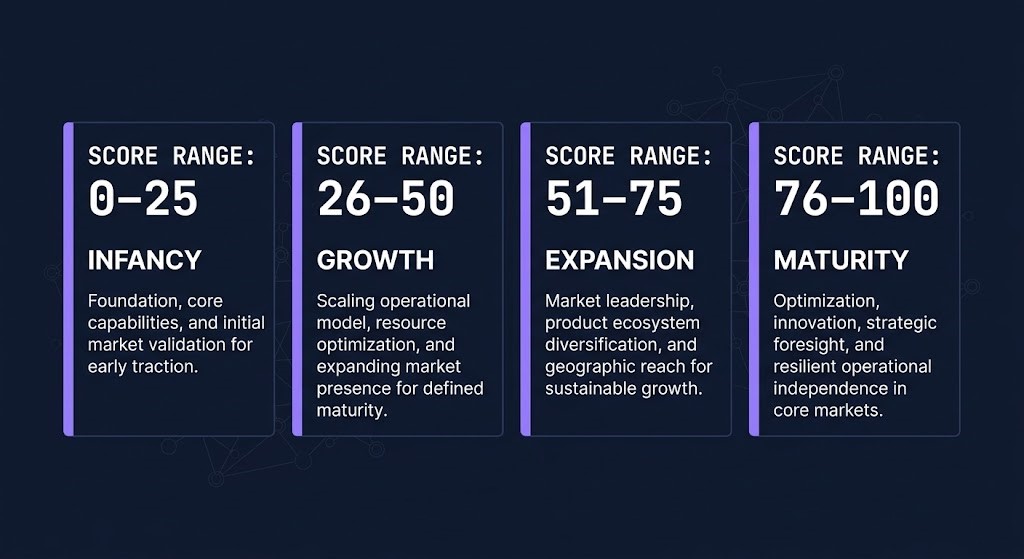
A weighted 0–100 score derived from environment complexity, idle pattern density, governance signals, and team capacity relative to footprint. Maps to four maturity stages: Reactive Cloud Operations, Managed Coexistence, Operationally Governed, and Adaptive Cloud Governance.
05 — REMEDIATION PRIORITIES
Blended output across four categories: Immediate Operational Waste, Governance Gap, Structural Inefficiency, and Modernization Debt. Priorities are weighted by architectural impact, not cost magnitude. The output is actionable at the infrastructure team level without requiring executive sign-off to begin.
The Four Interpretation Patterns
The diagnostic fires deterministically based on input combinations. Multiple patterns can activate simultaneously; the output surfaces the top three in relevance order.
INTERPRETATION PATTERNS
- Coexistence-Era Overprovisioning — VMware and public cloud running in parallel, with virtualization-era sizing assumptions carried into cloud-billed infrastructure. DR duplication and oversized compute are primary indicators.
- Platform Fragmentation — Resource inefficiency driven by organizational structure rather than workload demand. Kubernetes cluster sprawl, multi-cloud without unified governance, and team-level provisioning decisions without platform oversight.
- Governance Drift — Idle accumulation that reflects the absence of lifecycle enforcement rather than temporary elasticity. Zombie instances, always-on dev/test, unattached disks, and snapshot sprawl appear together.
- AI Capacity Persistence — GPU allocation that remains active beyond workload demand. Persistent inference endpoints, always-on staging clusters, and training infrastructure that is not shut down between runs.
Infrastructure Efficiency Maturity
The maturity score is not a performance grade. It reflects how much structural and governance work has been done to prevent idle-state accumulation — not how well the infrastructure performs under load.
| Score | Stage | Characteristic |
|---|---|---|
| 0–25 | Reactive Cloud Operations | Idle resources accumulate without detection. Cost visibility limited to billing surprises. Lifecycle management performed manually when noticed. |
| 26–50 | Managed Coexistence | Hybrid infrastructure with partial cost visibility. Governance frameworks designed for on-premises operations, not yet adapted for cloud economics. |
| 51–75 | Operationally Governed | Core cost governance controls in place. Idle detection systematic for primary workloads. Structural inefficiencies remain in coexistence zones and Kubernetes. |
| 76–100 | Adaptive Cloud Governance | Automated lifecycle enforcement. Predictable cost behavior. Architecture prevents idle-state accumulation rather than cleaning it up after the fact. |
Cloud Idle Resource Analyzer: Key Features
- Deterministic Pattern Detection: Four architectural interpretation patterns fire based on input combinations — no AI inference, no probabilistic scoring. The output is reproducible and auditable. Same inputs produce the same architectural interpretation every time.
- Three-Domain Idle Resource Matrix: Compute, storage, and Kubernetes are assessed independently with domain-specific insight text. Each domain surfaces the architectural behavior behind the idle state, not just a list of affected resources.
- Infrastructure Efficiency Maturity Score: A 0–100 score weighted across twelve input variables — environment complexity, idle pattern density, governance signals, and team capacity relative to footprint. Maps to four named maturity stages that align with the rack2cloud architecture framework.
- Blended Remediation Priorities: Output spans four categories — Immediate Operational Waste, Governance Gap, Structural Inefficiency, and Modernization Debt — weighted by architectural impact. Priorities are actionable at the infrastructure team level without executive escalation to begin.
- Client-Side Only: No data leaves the browser. No telemetry, no server-side logging, no account required. The diagnostic runs entirely in the local browser session against your inputs.
THE DIAGNOSTIC SURFACES THE PATTERN.
A REVIEW MAPS IT TO YOUR ENVIRONMENT.
Idle infrastructure patterns compound. A maturity score names the stage — it does not resolve the governance gap or the structural debt that produced it. A cost architecture review translates the diagnostic output into a sequenced action plan against your actual environment.
Cost Architecture Review
Structured review of your cloud cost posture against your environment profile and idle state findings.
- > Idle pattern mapping to governance gaps
- > Coexistence-era sizing audit
- > Kubernetes cost density assessment
- > Sequenced remediation roadmap
Architecture Playbooks. Field-Tested Blueprints.
Cloud cost governance, coexistence-era remediation, and platform consolidation patterns — delivered as field-tested operational blueprints.
- > Cloud cost governance frameworks
- > Kubernetes platform consolidation
- > Coexistence-era exit patterns
- > Lifecycle governance blueprints
Zero spam. Unsubscribe anytime.
Frequently Asked Questions
Q: What does the Cloud Idle Resource Analyzer actually measure?
A: The analyzer takes your environment profile and selected idle resource patterns as inputs and returns an architectural interpretation of what that combination reveals about your operating model. It does not connect to your cloud environment, read billing data, or require any telemetry. The output is a deterministic pattern match — the same inputs produce the same architectural interpretation every run.
Q: How is this different from a FinOps tool or cloud cost calculator?
A: FinOps tools and cost calculators quantify waste in dollar terms. This tool identifies the architectural and organizational behaviors that produce waste — governance drift, platform fragmentation, coexistence-era sizing assumptions, AI capacity persistence. The diagnostic output is designed for infrastructure architects making structural decisions, not finance teams managing spend categories.
Q: What cloud environments does the analyzer cover?
A: The environment profile covers AWS, Azure, GCP, VMware, Nutanix, and on-premises bare metal. The idle resource matrix covers compute, storage, and Kubernetes patterns that are common across all of these environments. GPU and AI workload patterns are included in the environment profile and influence the AI Capacity Persistence interpretation pattern.
Q: Is any data sent to a server or stored after the diagnostic runs?
A: No. The diagnostic runs entirely in the local browser session. No data is transmitted to any server, no telemetry is collected, no account is required, and nothing persists after the browser tab is closed. The logic is client-side JavaScript executed against your inputs.
🔒 Privacy Architecture: No cookies. No tracking pixels. No server-side database.
This logic runs entirely in your local browser session.