

Egress Audit Framework: How to Find Unbounded Movement Paths
Every unbounded egress path is an architectural permission boundary that was never intentionally designed.
That framing matters because it changes what you’re actually looking for. The conventional approach treats egress as a billing problem — costs go up, FinOps investigates, the dashboard shows a spike, someone gets asked to reduce spend. That sequence consistently fails to find the underlying problem because it starts at the wrong layer. FinOps can classify spend. It cannot classify architectural intent.
The paths that generate unbounded egress — cross-AZ replication, observability pipeline exports, public API routing, CDN origin pull, backup movement — are all movement the architecture explicitly permits. The architecture normalized the movement before finance noticed the spend. An egress audit framework that treats those paths as cost anomalies will document the bill. One that treats them as ungoverned movement paths will find the architecture decisions that need to change.
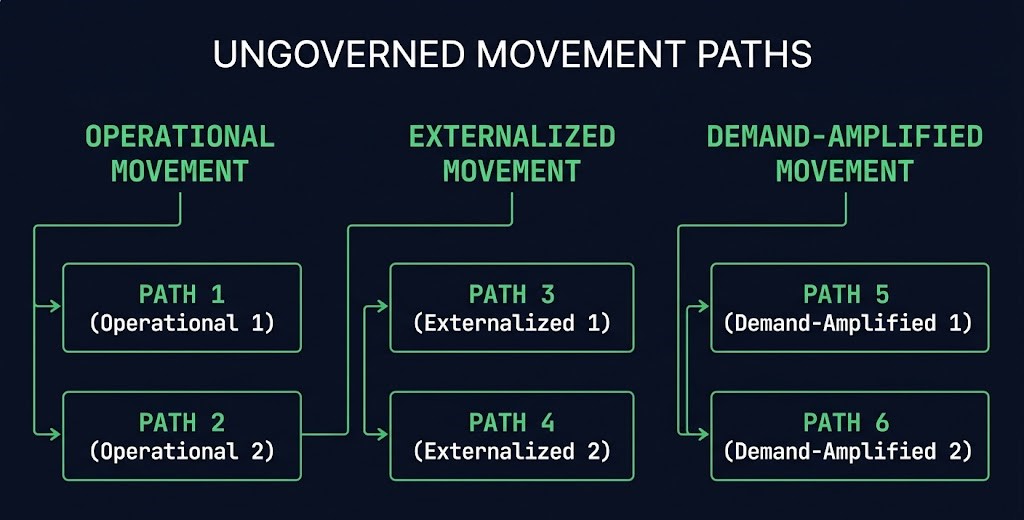
This post is the latter. The six ungoverned movement path categories, the detection logic for each, and the four-phase Movement Authority Audit that structures the review.
Why Egress Audits Fail Before They Start
The standard egress audit starts with the cloud cost console. It finds the expensive line items. It asks which team owns the cost center. It produces a list of suggestions.
That approach has a structural flaw: cost consoles show you the bill. They do not show you whether the architectural path generating the bill should exist at all. Those are different questions with different answers and different people responsible for them.
The distinction matters most when the expensive path is entirely intentional. A team shipping full-fidelity telemetry to a SaaS observability platform may be doing exactly what the architecture requires — the question is whether the volume ceiling on that path was ever defined. A service making external API calls over public internet may be following the integration pattern that was deployed two years ago — the question is whether a private endpoint was ever evaluated. In neither case does the cost dashboard surface the architectural question. It only surfaces the number.
The second failure mode is instrumentation. Egress audits routinely fail because the data sources required to trace movement paths to their architectural cause are either missing, untagged, or misconfigured. Flow logs disabled. Cost allocation tags absent. CDN access logs not retained. When those sources are missing, the audit produces findings at the billing layer only — which means the only action available is throttling spend without understanding the path.
The correct starting point for an egress audit framework is not the cost console. It is an instrumentation check — confirming the data sources exist before attempting to trace paths.
>_ SILENT EGRESS
Movement the architecture does not surface operationally because it is considered platform-normal. Nobody audits it because nobody perceives it as a decision.
- East-west service mesh chatter between AZs
- Managed database replication across zones
- Telemetry export to SaaS observability platforms
- NAT traversal for services that could use VPC endpoints
- Cross-region sync on object storage with no retention policy
Silent egress is the category most egress audits miss entirely because the cloud platform itself normalizes its visibility. Managed services generate it as a side effect of operating. Observability stacks require it. Service meshes produce it as a consequence of their topology. None of it appears as an alert. None of it generates a dashboard anomaly. It compounds steadily in the background until a quarterly cost review surfaces the total.
The significance of silent egress is not the cost in isolation. It is what it represents: movement the architecture implicitly permitted without ever explicitly governing. Once a pattern is normalized at the platform layer, it stops being visible as an architectural decision.
The Six Ungoverned Movement Categories
Not all egress paths have the same origin or the same closure pattern. The six categories below span three movement types — operational movement generated by platform behavior, externalized movement driven by integration design, and demand-amplified movement produced by traffic patterns. Understanding which type a path belongs to determines both the detection method and who owns the fix.
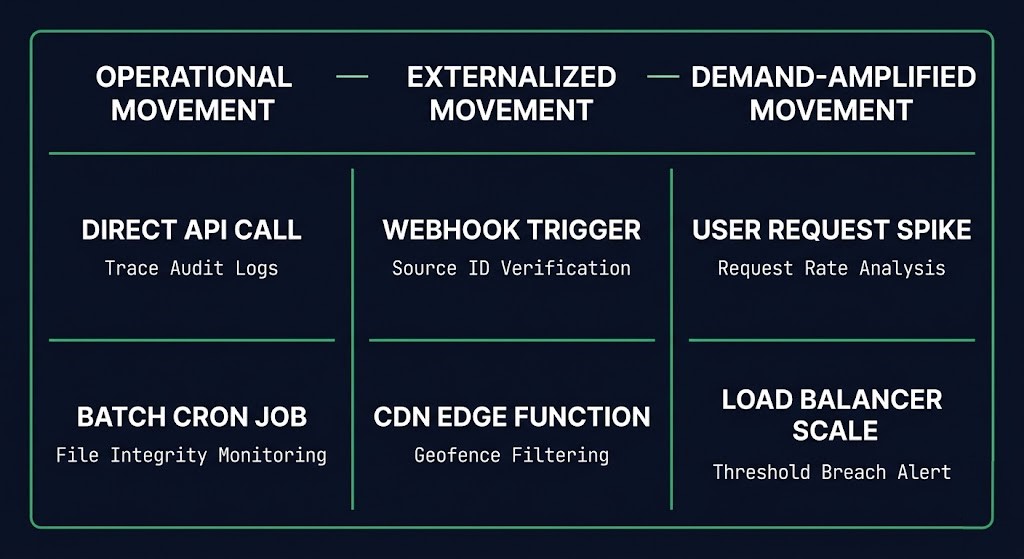
Operational Movement
Cross-AZ Data Movement
Cross-AZ traffic is the most pervasive ungoverned movement path in cloud-native environments and the one most consistently underestimated. Most architects know it exists. Almost none have measured its actual contribution to the egress bill in their environment.
The root cause is topology blindness. Most teams architect for service placement — which availability zone a workload runs in, which subnet it occupies, which region it’s deployed to. Very few architect for traffic locality — whether the traffic patterns those placements generate actually stay within the zone boundaries that make the architecture cost-coherent. The result is that east-west replication, service mesh sidecar chatter, logging pipelines, and database read replicas all silently cross AZ boundaries as a consequence of placement decisions that never considered traffic cost.
Detection: VPC flow logs filtered by source and destination subnet CIDR, correlated with cost allocation tags by AZ. The cost explorer AZ transfer line item shows the total; flow logs show you which services are generating it.
Cross-Region Replication and Backup Movement
Replication and backup traffic that crosses regional boundaries accumulates against data volume trajectories that were scoped at initial architecture design and never re-baselined. A backup policy written for a 10TB protected dataset at Year 1 does not automatically adjust when that dataset reaches 80TB at Year 3. The movement path was intentional. The volume ceiling was never defined. Data protection architecture requires explicit re-baselining at regular intervals — not because the path is wrong, but because ungoverned growth makes it unbounded.
Detection: Cloud cost explorer filtered by transfer type and destination region, cross-referenced against backup job transfer logs. The gap between the original replication scope and the current actual transfer volume is the finding.
Externalized Movement
Internet-Bound API Traffic
Services routing to external endpoints over the public internet when private endpoints or VPC service endpoints are available represent one of the cleanest closure opportunities in an egress audit. The path exists, it works, and it has been working — which is exactly why it persists. Default public routing becomes permanent architecture surprisingly fast, particularly for SaaS integrations, webhooks, observability export, auth federation, and AI inference APIs. The integration was built when the private endpoint option was not evaluated, and it has been running correctly ever since.
The Cloud Egress Costs Architecture post covers this in detail — the architectural patterns that systematically produce internet-bound traffic where private routing was available. Detection here is straightforward: VPC flow log destination analysis for traffic leaving the VPC boundary to public IP ranges owned by services that offer private endpoint options.
Logging and Observability Pipeline Drain
The observability stack has quietly become a hidden data export architecture. High-cardinality telemetry, full-fidelity distributed tracing, SIEM duplication, and long-retention SaaS pipelines are all movement paths that were designed by the engineering team based on what they needed to see — and none of them were sized against a cost ceiling. The path is correct. The volume is ungoverned.
This is the single largest ungounded movement path in mature cloud-native environments, and it is the least likely to appear in a cost review because it sits in the “observability” budget line, not the “egress” line. Detection requires correlating egress cost by destination autonomous system number against known observability vendor IP ranges — a step that requires flow log data with sufficient granularity to resolve destination AS.
Demand-Amplified Movement
CDN Origin Pull Patterns
CDN egress is demand-amplified movement — the volume is a function of cache miss rate, which is a function of cache configuration decisions that may have been made years ago against different traffic patterns. Dynamic content incorrectly classified as cacheable, cache TTLs set too short for the actual request cadence, or origin responses that include cache-defeating headers all produce excess origin pull that compounds with traffic growth.
Detection: CDN access logs for origin request rate versus cache hit ratio. A cache hit ratio below ~85% on content that should be cacheable is the threshold worth investigating. The finding is usually a configuration decision, not an architecture change.
Backup and Replication Egress
This category overlaps with cross-region movement above but deserves separate treatment because the closure mechanism is different. Where cross-region replication is an architecture decision, backup egress volume is often a scheduling and retention decision — full backup frequency, retention period depth, cross-tier copy counts — that has drifted from its original sizing. The Recovery Readiness Assessment routinely surfaces backup egress as the highest-volume finding in environments that have not re-examined their protection policies against current dataset sizes.
Running the Audit — The Movement Authority Audit
The Movement Authority Audit is a four-phase sequence. The phases are not parallel. Instrumentation must precede detection; detection must precede remediation; remediation without ownership produces findings that drift back into the bill within one fiscal quarter.
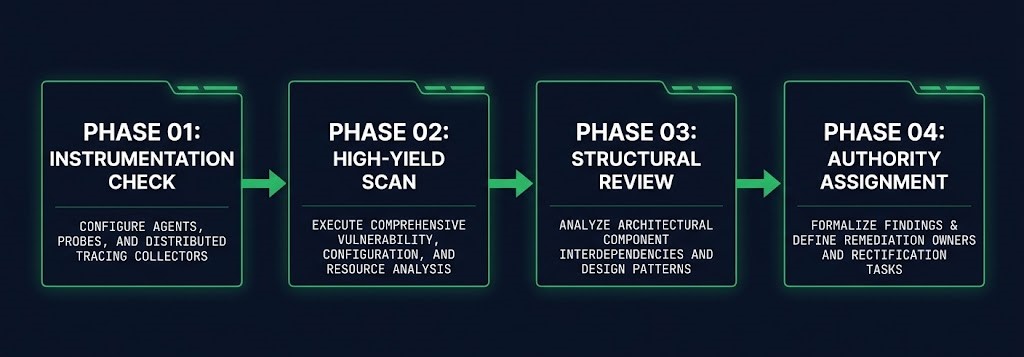
01 — INSTRUMENTATION CHECK
Confirm the data sources exist before attempting to trace paths. VPC flow logs enabled and retained. Cost allocation tags applied at the resource level by AZ and service. CDN access logs retained with sufficient lookback window. Backup job transfer logs accessible. If any of these are absent, the audit produces billing-layer findings only — which constrains every subsequent phase to symptom documentation rather than root cause identification.
02 — HIGH-YIELD SCAN
Cross-AZ movement and observability pipeline drain first. These two categories account for the majority of ungoverned egress findings in cloud-native environments and are the most likely to surface immediately actionable findings. Run the detection method for each, establish a baseline volume, and document the source service and destination. Do not attempt closure in this phase.
03 — STRUCTURAL REVIEW
Internet-bound API routing, regional replication topology, CDN origin pull patterns, and backup egress baseline. These categories require architectural review rather than log analysis alone — they involve placement decisions, integration design, and protection policy that may need to be re-examined against current requirements, not just measured. This phase takes longer and produces findings that are architectural, not operational.
04 — AUTHORITY ASSIGNMENT
Every movement path must have a governing authority. Not a cost center. Not a team name. An authority — a person or function that can answer five questions: Who approved this path? Who owns its cost? Who defines acceptable volume? Who can close it? Who re-baselines it when the dataset grows? Findings without answers to those five questions will regenerate. The path will persist. The bill will return.
The authority assignment phase is where most egress audits fail to produce durable outcomes. The finding gets documented. A ticket gets opened. The team reduces the volume. The underlying path remains open. Within two quarters, the pattern re-establishes because the architecture still permits it and nobody owns the decision to change that. This is the same ownership topology failure that drives the Cloud Bill Is Your Real Org Chart argument — spend without authority is ungoverned by definition, regardless of how many times the number gets addressed.
The Three Finding Types
Not all egress findings close the same way. Before assigning remediation work, classify each finding into one of three types — because the team responsible, the timeline, and the architectural change required are different for each.
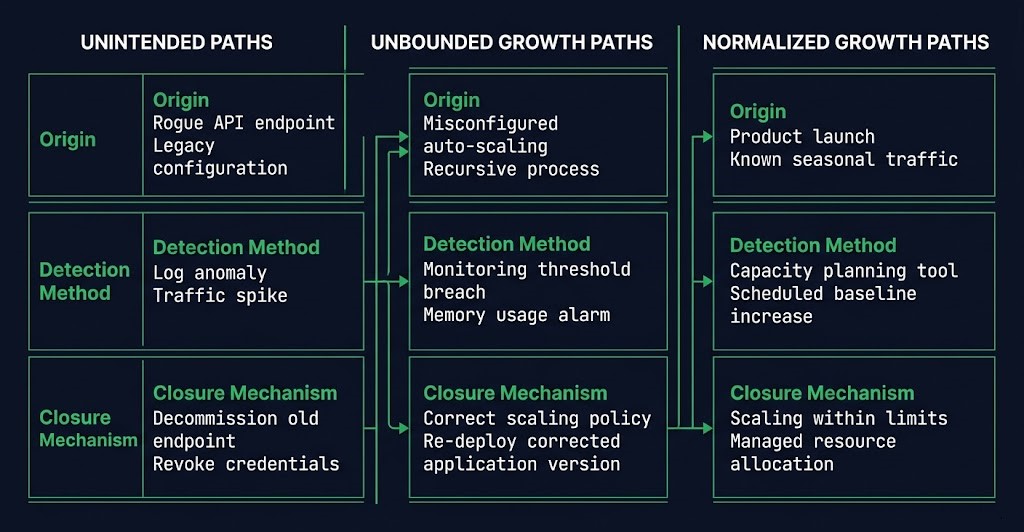
Unintended Paths
Traffic flowing over a path the architecture never consciously chose. An API call routing over the public internet when a VPC endpoint exists. A service replicating cross-AZ because its subnet placement was inherited from a previous deployment pattern. An observability agent exporting to a cloud region the team does not actively use. These close with routing fixes and configuration changes. The team that deployed the service owns the change. Timeline: days to weeks.
Unbounded Growth Paths
Paths that were intentional and correct at the time of design, but have no volume ceiling and have grown without constraint. Full-fidelity telemetry export. SIEM data duplication. Backup replication sized against Year 1 data volumes. The path is not wrong — the absence of a defined governance boundary is wrong. These close with sampling policies, data tiering decisions, retention caps, and explicit re-baselining. The team that owns the integration owns the ceiling decision. Timeline: weeks to a quarter.
Normalized Growth Paths
The most architecturally significant finding type. Movement that the platform has normalized to the point where no single team perceives it as a decision that needs governing. Cross-AZ traffic generated by a service mesh that was deployed as infrastructure. Cross-region sync on object storage that was enabled by default. Database replication patterns inherited from the original deployment. These are not configuration mistakes or uncontrolled growth — they are architectural acceptance patterns that have become invisible. Closure requires architectural review, not just configuration change. The Sovereign Networking and Control Plane Isolation architecture covers the governance model for exactly this class of problem: movement authority defined at the architecture layer, not discovered after the fact through billing analysis.
What Happens When Nobody Owns the Path
The consequence of ungoverned movement paths is not a bill. The bill is the symptom. The consequence is architectural drift — the gradual accumulation of movement patterns that the organization has implicitly accepted but never explicitly governed.
When nobody owns a movement path, several things happen in sequence. First, the path persists regardless of audit findings, because there is no authority to close it. Second, the volume grows unconstrained, because there is no authority to define a ceiling. Third, the pattern gets replicated — new services follow the same integration pattern because it exists and works. Fourth, the path becomes load-bearing — something starts depending on the movement semantics, making it harder to close even after it’s identified.
By the time a normalized growth path surfaces as a cost finding, it has usually been load-bearing for long enough that closing it requires an architectural change, not a configuration change. The cost is no longer the problem. The architecture is.
This is the same structural failure the Cost Authority Inversion framework describes at the organizational layer — costs that exist because the authority to govern them was never assigned, not because the decisions were wrong. An egress audit that produces findings without producing authority assignments has not completed the audit. It has documented the symptom.
The Cloud Egress Calculator can model the cost impact of specific path closures against your actual transfer volumes — useful for prioritizing which findings to address first when multiple ungoverned paths are active simultaneously.
Architect’s Verdict
An egress audit framework that starts at the billing layer will find expensive paths. One that starts at the architectural layer will find ungoverned ones. Those are not the same set, and the closure mechanisms are entirely different.
The three finding types — unintended paths, unbounded growth paths, and normalized growth paths — require different owners, different timelines, and different architectural changes. Treating all three as cost reduction tasks produces the same findings quarter after quarter because the underlying permission boundaries never get addressed.
The same shape shows up one layer over, in identity rather than network traffic. Identity Directories Have Become An Unmonitored Intelligence Source finds an unclassified movement path of its own — bulk reads against an identity directory, ungoverned for the same reason silent egress is: the platform normalized it before anyone drew a boundary around it.
Architectures do not accidentally move data. They permit data movement through accumulated design decisions — placement choices, integration defaults, protection policies, and observability configurations — that seemed individually reasonable and were collectively never governed. The Movement Authority Audit is not a cost exercise. It is an inventory of every architectural boundary you forgot to draw.
- Confirm instrumentation exists before the audit starts — missing flow logs mean billing-layer findings only
- Classify every finding as unintended, unbounded growth, or normalized before assigning remediation
- Assign governing authority to every open path — team name is not the same as authority
- Re-baseline backup and replication egress against current dataset volume, not original design scope
- Start with the cost console — it shows the bill, not the architectural permission boundary
- Treat all egress findings as cost reduction tasks — normalized growth paths require architectural changes
- Close a finding without assigning authority — the path will regenerate within two quarters
- Treat platform-normalized movement as outside audit scope — silent egress is where most volume hides
Additional Resources
View 1 more resource
Editorial Integrity & Security Protocol
This technical deep-dive adheres to the Rack2Cloud Deterministic Integrity Standard. All benchmarks and security audits are derived from zero-trust validation protocols within our isolated lab environments. No vendor influence.

R.M.
Senior Solutions Architect with 25+ years of experience in HCI, cloud strategy, and data resilience. As the lead behind Rack2Cloud, I focus on lab-verified guidance for complex enterprise transitions. View Credentials →
Get the Playbooks Vendors Won’t Publish
Choose the architecture problems you care about. Get field-tested playbooks and frameworks delivered to your inbox.
- > AI Infrastructure & Inference Economics
- > Cloud Strategy & Hidden Cost Models
- > Virtualization & Deterministic Migration
- > Kubernetes, IaC & Modern Infrastructure
- > Data Protection & Recovery Engineering
Zero spam. Includes The Dispatch weekly drop.
Need Architectural Guidance?
Independent review before major infrastructure decisions.
- > Validate assumptions
- > Identify hidden dependencies
- > Quantify migration risk
- > Challenge vendor narratives
Triage · Advisory · Fractional · Direct Hire