

Nutanix vs VMware vs Hyper‑V: How to Build a Fair Comparison as a Solutions Engineer
The virtualization market has experienced a seismic shift. For fifteen years, the answer to “Which hypervisor should we use?” was almost automatically “VMware vSphere.” It was the default, the gold standard, the safe bet.
Then came Broadcom.
Today, Solutions Engineers and architects are facing an unprecedented wave of customers demanding alternatives. The questions have shifted from technical feature checklists to existential business concerns: How do we escape skyrocketing renewal costs? How do we simplify operations without losing enterprise features? Is “good enough” virtualization acceptable if it saves us millions?
Your job isn’t just to evaluate products — it is to be a trusted advisor. To do that, you must articulate a fair comparison between the three remaining titans: Nutanix AHV, VMware vSphere, and Microsoft Hyper-V. For the full decision framework including migration execution and Day-2 operations, see the Modern Virtualization Learning Path.
A fair comparison does not mean treating them as equals. It means accurately representing their architectural philosophies, operational realities, and total cost of ownership in the context of specific organizational constraints.
The Landscape: Three Different Philosophies
These three platforms represent fundamentally different reactions to the market shift caused by Broadcom’s acquisition of VMware — and different answers to the question of where infrastructure value actually lives in 2026.
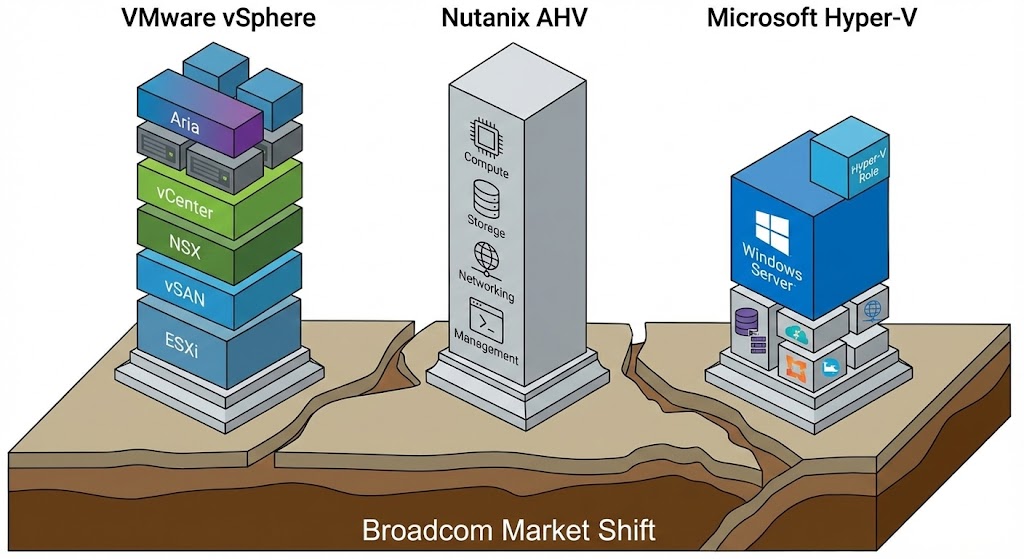
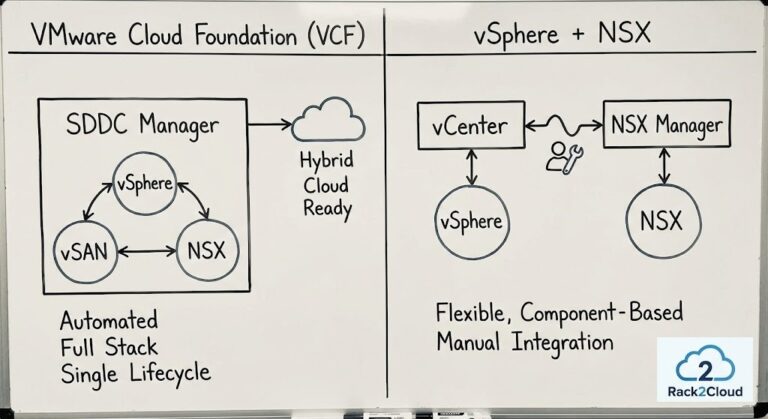
- VMware vSphere (The Best-of-Breed Stack): A highly mature collection of specialized products — ESXi, vCenter, vSAN, NSX — that must be integrated, licensed, and upgraded carefully. Maximum feature depth, maximum operational complexity.
- Nutanix AHV (The Cloud Platform): A hyperconverged approach where the hypervisor is an invisible feature of the storage and management platform, designed for operational simplicity at the cost of ecosystem breadth.
- Microsoft Hyper-V (The OS Feature): A mature hypervisor that is essentially a role within Windows Server, relying heavily on the surrounding Microsoft ecosystem for management, monitoring, and HA.
These aren’t just technical differences — they reflect different answers to the question of where you want operational complexity to live. Before evaluating features, decide which failure mode your organization fears most.
The Incumbent: VMware vSphere (ESXi)
To be fair, you must acknowledge that VMware is an incredible piece of technology. It defined the modern datacenter.
| Architectural Strengths | Operational Constraints |
| Feature Richness: Unmatched depth in DRS, vMotion, and HA tuning. | Complexity at Scale: Managing vCenter, PSCs, vSAN, and NSX requires dedicated specialists (See: vCenter Control Plane Optimization). |
| Ecosystem & Talent: Every backup, monitoring, and security vendor integrates with VMware first. | The “Tax”: The hypervisor adds significant overhead, and Broadcom’s VVF/VCF licensing bundles are now a board-level financial concern. |
The SE Narrative:
“VMware is the Ferrari. If you are a Formula 1 driver on a closed track and budget is no object, it’s unbeatable. But ask yourself: Are you driving F1, or are you just trying to get groceries? And more importantly, can you afford the new insurance premiums Broadcom is charging just to keep it in the garage?”
The control plane complexity that comes with that Ferrari is real and measurable. The JVM heap starvation, database I/O bottlenecks, and API session limits that degrade vCenter performance under automation load are documented in detail in the vCenter Control Plane Optimization guide — and they represent operational overhead that compounds with every Broadcom renewal cycle.
Before presenting any VMware renewal scenario to leadership, model the exact core exposure using the VMware Core Calculator. Broadcom’s per-core audit teams are stricter than VMware’s ever were — and a 128-core EPYC socket will cost 4x what a socket-based renewal estimate suggested.
The Challenger: Nutanix AHV
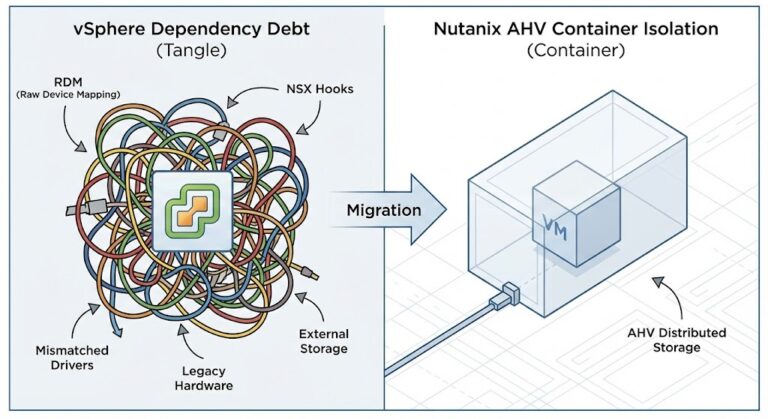
Nutanix AHV is based on open-source KVM but heavily customized to integrate seamlessly with the Nutanix Distributed Storage Fabric. The hypervisor is not a product you buy — it is a capability included in the platform you operate.
| Architectural Strengths | Operational Constraints |
| Simplicity: Managed entirely through Prism. No separate “vCenter” equivalent. 1-Click upgrades for the entire stack. | Ecosystem Gaps: While major vendors support AHV, some niche third-party tools still strictly require VMware APIs. |
| Zero Hypervisor Tax: AHV is included at no additional cost. Performance density is often higher due to data locality (See: Nutanix AHV vs. vSAN 8 ESA I/O Benchmark). | HCI-Centric: AHV is designed exclusively for the Nutanix architecture; it is not deployed as a standalone hypervisor on legacy 3-tier SANs. |
The SE Narrative:
“AHV isn’t just a cheaper ESXi. It’s a different operational model. It removes the hypervisor as something you have to manage, patch, and license separately. It turns virtualization into a utility, allowing your team to stop managing infrastructure and start managing applications.”
The performance density advantage of AHV over vSAN under real-world write saturation is not theoretical — it is measurable. The sawtooth vs plateau behavior under concurrent I/O load directly affects VDI session quality and database commit latency. See the Nutanix AHV vs vSAN 8 ESA Saturation Benchmark for the lab data on identical hardware.
For the Day-2 operational model differences — CVM resource management, Prism-based management, and the specific tuning levers that don’t exist in the ESXi paradigm — see the Nutanix AHV Day-2 Operations guide.
And for organizations considering Nutanix but concerned about abandoning existing Pure Storage or Dell PowerFlex investments, the disaggregated compute-only architecture covered in Breaking the HCI Silo provides a migration path that doesn’t require forklift storage replacement.
The Commodity: Microsoft Hyper-V
Hyper-V is often already present in customer environments because they own Windows Server Datacenter licenses. The acquisition cost appears to be zero — which is where the analysis usually stops prematurely.
| Architectural Strengths | Operational Constraints |
| “Free” Licensing: If hosts are licensed with Windows Datacenter to run Windows VMs, the Hyper-V host role incurs no extra cost. | Management Nightmare: Managing Hyper-V at scale requires SCVMM—which is notoriously complex, heavy, and expensive to maintain. |
| Windows Integration: A natural fit for shops that are 100% Microsoft (Azure, AD, System Center). | The “OS Tax”: The host OS must be patched and maintained like any other Windows Server, increasing the attack surface and operational overhead. |
The SE Narrative:
“Hyper-V is ‘free’ like a puppy is free. The initial acquisition cost is zero — but the care and feeding: patching the host OS, wrestling with SCVMM, managing clustered shared volumes — is a massive operational burden that often outweighs the licensing savings within 18 months.”
The Fourth Option: Proxmox VE
No fair 2026 comparison omits Proxmox. Since Broadcom’s acquisition, Proxmox has moved from homelab curiosity to legitimate enterprise consideration — particularly for mid-market organizations with strong Linux expertise and limited vendor support requirements.
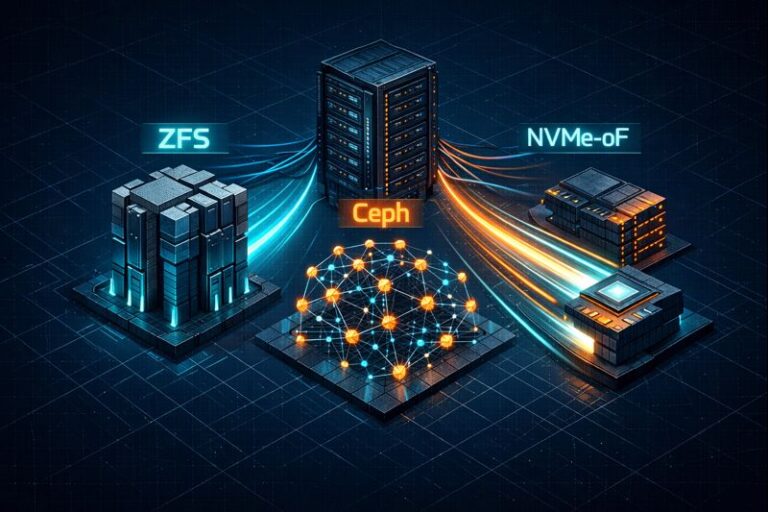
Proxmox VE is Debian-based KVM with a mature web UI, built-in clustering via Corosync, and native ZFS and Ceph storage integration. The licensing cost is effectively zero for the community edition. The operational cost is real — it requires engineers who understand Linux at the kernel level, not just the management console.
For the complete operational migration framework — VirtIO injection for Windows VMs, network segmentation to prevent Corosync fencing, and the Clonezilla vs native import decision — see the Proxmox vs VMware 2026: The Engineer’s Migration Playbook.
The SE Whiteboard Strategy: Visualizing the Choice
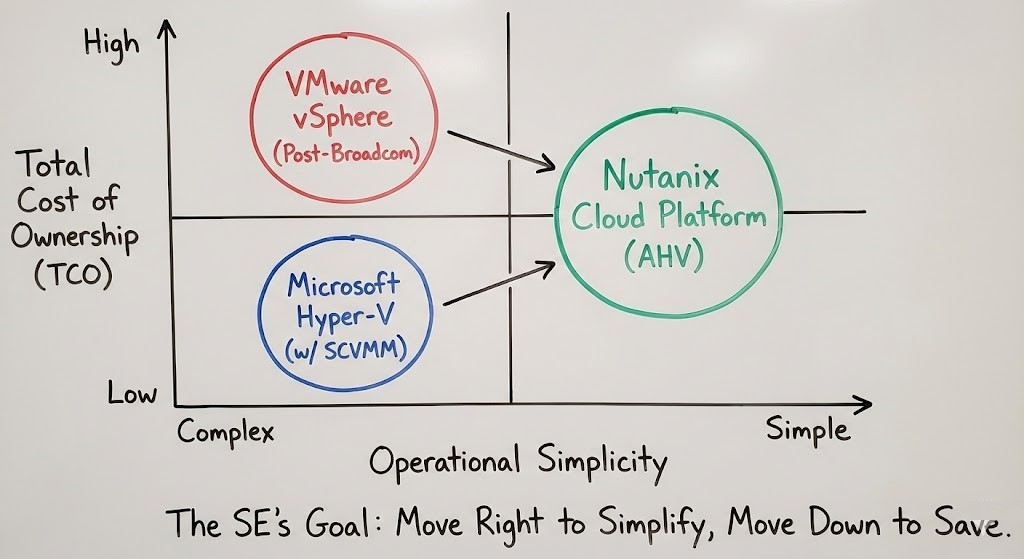
When you are at a whiteboard with a customer, do not list features. Visualize business outcomes. The most effective SE conversation shifts from feature comparison to plotting Total Cost of Ownership vs Operational Complexity.
Draw a standard graph. Y-Axis: TCO (High to Low). X-Axis: Operational Simplicity (Complex to Simple).
- Plot VMware top-left (High Cost, High Complexity): “Here is where you are today. Great features, but massive Broadcom costs and complex stack management.”
- Plot Hyper-V bottom-left (Lower License Cost, High Complexity): “You can move here to save on licensing — but you traded license cost for operational pain managing SCVMM and OS patches.”
- Plot Proxmox bottom-left (Near-zero License Cost, High Complexity): “Maximum cost reduction, but you own every layer. This requires senior Linux engineering staff.”
- Plot Nutanix AHV middle-right (Optimized Cost, High Simplicity): “This is the strategic pivot. The hypervisor is included, management is unified, and the operational model removes the infrastructure team from the critical path.”
The whiteboard conversation wins because it forces the customer to articulate which axis matters more to their organization — and in most post-Broadcom conversations, both axes are moving in the wrong direction simultaneously.
The Architect’s Verdict
A fair comparison in the post-Broadcom era acknowledges a simple truth: the hypervisor is now a commodity. The value is no longer in the virtualization engine itself — it is in the management platform, the operational model, and the total cost of ownership over a 5-year horizon.
- Choose VMware if your organization requires niche VMware integrations, advanced NSX microsegmentation, and has the budget and specialist staff to absorb both the licensing increase and the operational complexity
- Choose Hyper-V if you have a strict Microsoft-only policy, existing Windows Server Datacenter licensing, and high tolerance for SCVMM management complexity
- Choose Proxmox if you have strong Linux engineering staff, limited vendor support requirements, and maximum cost reduction is the primary constraint
- Choose Nutanix AHV if you are seeking to reduce TCO, escape vendor lock-in, radically simplify on-premises operations, and need a platform with enterprise support backing the decision
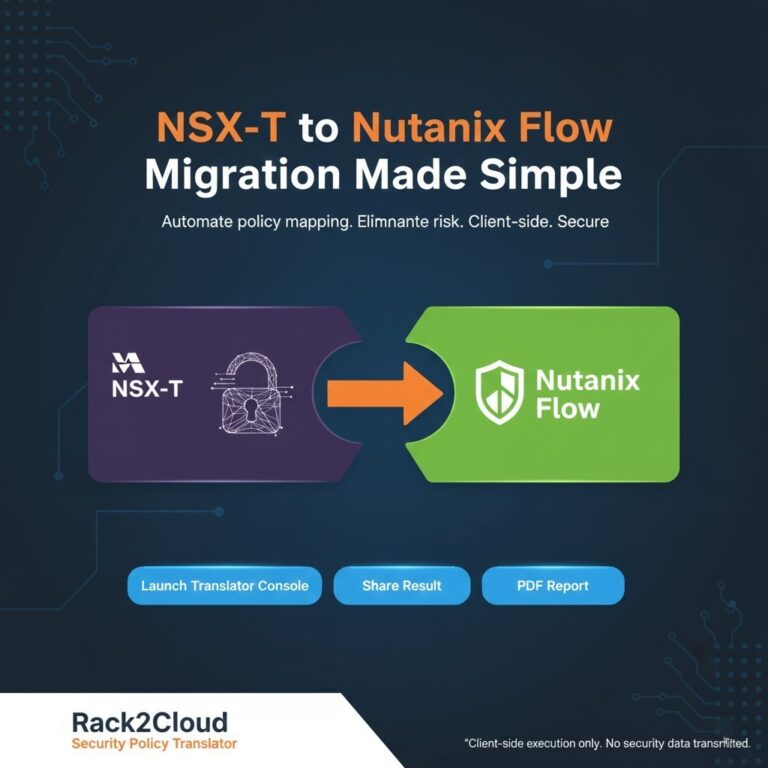
For the complete NSX microsegmentation decision — specifically whether VMware Cloud Foundation’s NSX bundle justifies the licensing premium over Nutanix Flow — see the NSX-T to Nutanix Flow Migration Guide.
For the complete structured path — from hypervisor evaluation through migration execution through Day-2 operational stabilization — the Modern Virtualization Learning Path maps every decision point with deterministic tools at each stage.
Additional Resources
Editorial Integrity & Security Protocol
This technical deep-dive adheres to the Rack2Cloud Deterministic Integrity Standard. All benchmarks and security audits are derived from zero-trust validation protocols within our isolated lab environments. No vendor influence.

R.M.
Senior Solutions Architect with 25+ years of experience in HCI, cloud strategy, and data resilience. As the lead behind Rack2Cloud, I focus on lab-verified guidance for complex enterprise transitions. View Credentials →
Get the Playbooks Vendors Won’t Publish
Field-tested blueprints for migration, HCI, sovereign infrastructure, and AI architecture. Real failure-mode analysis. No marketing filler. Delivered weekly.
Select your infrastructure paths. Receive field-tested blueprints direct to your inbox.
- > Virtualization & Migration Physics
- > Cloud Strategy & Egress Math
- > Data Protection & RTO Reality
- > AI Infrastructure & GPU Fabric
Zero spam. Includes The Dispatch weekly drop.
Need Architectural Guidance?
Unbiased infrastructure audit for your migration, cloud strategy, or HCI transition.
>_ Request Triage Session