
The GKE “Zombie” Feature: Why gcloud Hides What the API Knows
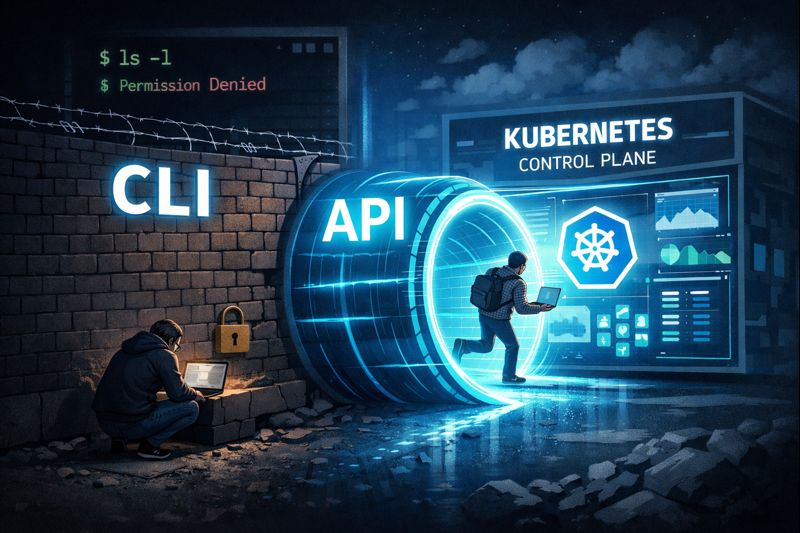
When a Kubernetes founder tells you that you might be wrong about a platform limitation, you don’t argue with them. You open a terminal and try to break something.
This week, following my autopsy of a GKE IP Exhaustion Outage, I entered a debate with Tim Hockin (thockin), one of the original creators of Kubernetes. The contention was simple: is the GKE Service CIDR in GKE Standard truly immutable, or does the managed control plane just pretend it is?
Vendor documentation says “No.” The CLI says “Error.” But the architectural intuition says, “Upstream Kubernetes can do this, so why can’t GKE?”
I spent the morning in the lab proving that sometimes, the “impossible” is just “hidden.” This is the story of a Zombie Feature — a capability that is alive in the kernel but dead in the dashboard — and why knowing the difference between a technical block and a tooling block can save your architecture during an outage.
The Decision Framework: Tooling Trust Levels
As architects, we often treat the vendor CLI — gcloud, aws, az — as the single source of truth. This is a mistake. When debugging edge cases or resource constraints, you must decide which layer of the stack to interrogate.
| Tooling Layer | Trust Level | Best Use Case | The Trap |
| Vendor Console (GUI) | Low | Quick visualization, billing checks. | Hides 80% of configuration options to “simplify” UX. |
| Vendor CLI (gcloud) | Medium | Day 1 provisioning, standard CRUD ops. | Enforces guardrails that may not exist in the engine. |
| Native API (kubectl) | High | Debugging, state validation, granular edits. | Shows raw state, including “unsupported” or beta objects. |
Architect’s Rule: When the CLI says “No,” but the upstream docs say “Yes,” always verify with the Native API.
This pattern appears across every major cloud provider — GKE Service CIDR constraints, AWS VPC subnet limits, Azure NSG rule caps. The CLI enforces opinionated guardrails that frequently don’t reflect actual API capability. For the broader GKE IP exhaustion context that triggered this investigation, see Client’s GKE Cluster Ate Their VPC: The Class E Rescue.
The Experiment: The Thockin Challenge
To test the theory, I spun up a disposable GKE Standard cluster (1.31+) and attempted to force-feed it a new GKE Service CIDR range. The goal was to expand the Service network without rebuilding the cluster — a critical requirement during a live outage.
Test 1: The Front Door (gcloud)
The Google Cloud CLI is the curated path. It applies the “safe” defaults Google wants you to use. I attempted to update the cluster using standard secondary range flags.
gcloud container clusters update $CLUSTER_NAME \
    --update-service-secondary-range="new-service-range=10.99.0.0/20"
The result: unrecognized arguments.
The CLI didn’t just fail — it gaslighted me. It threw an error claiming the argument doesn’t exist. If you were an engineer troubleshooting an outage at 3 AM, this is where you would stop. You would assume the platform physically cannot support the request.
Test 2: The Back Door (kubectl)
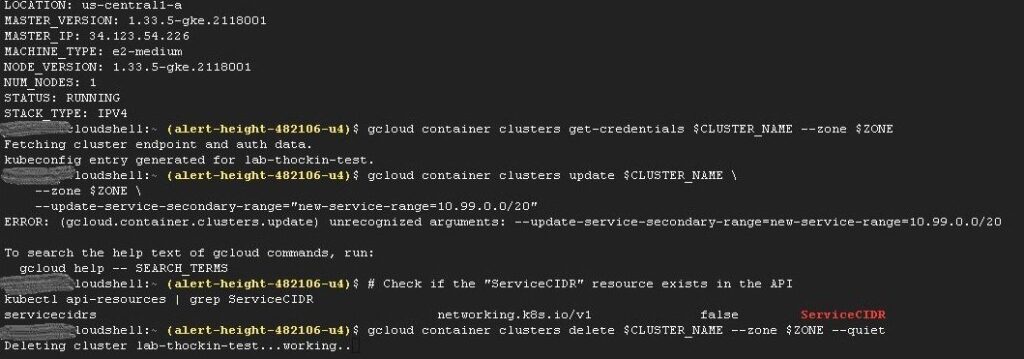
If the CLI is the menu, the API is the kitchen. I bypassed the vendor tooling and queried the API server directly to see if it recognized the upstream ServiceCIDR resource.
kubectl api-resources | grep ServiceCIDR
The result:
NAME           APIGROUP                 NAMESPACED   KIND
servicecidrs   networking.k8s.io/v1     false        ServiceCIDR
The resource is right there. It is false (cluster-scoped), it is v1 (stable), and the API server is actively listening for it. The feature isn’t missing — the door handle is just removed.
Operational Cost Analysis: OpEx Impact
We often talk about cloud costs in terms of licensing and compute, but the hidden killer is Operational Expense during downtime. In the outage that sparked this research, we faced a rebuild vs. repair decision.
- Scenario A — Trust the CLI: The CLI says we can’t add IPs. We must rebuild the cluster. Cost: 4 Engineers × 12 Hours + business downtime = high OpEx.
- Scenario B — Trust the API: The API reveals a path to patch the configuration. Cost: 1 Architect × 2 Hours + zero downtime = low OpEx.
Knowing that ServiceCIDR exists in the API changes the risk calculation entirely. Even if patching it is “unsupported” by Google Support, having the option to fix it in a crisis is a powerful architectural lever. To avoid getting trapped by these vendor limitations, the Engineering Toolkit has tools designed specifically to audit your environments before the outage hits.
The broader pattern of Kubernetes Day 2 failures — where the platform appears healthy but a hidden constraint is the real cause — is covered in Kubernetes Day-2 Incidents: 5 Real-World Failures.
Architect’s Verdict
Would I cowboy-engineer a manual API patch for GKE Service CIDR in a production cluster on a Tuesday afternoon? No — that creates drift between your Terraform state and the actual cluster state, and drift is a governance problem that compounds. The infrastructure as state model explains exactly why.
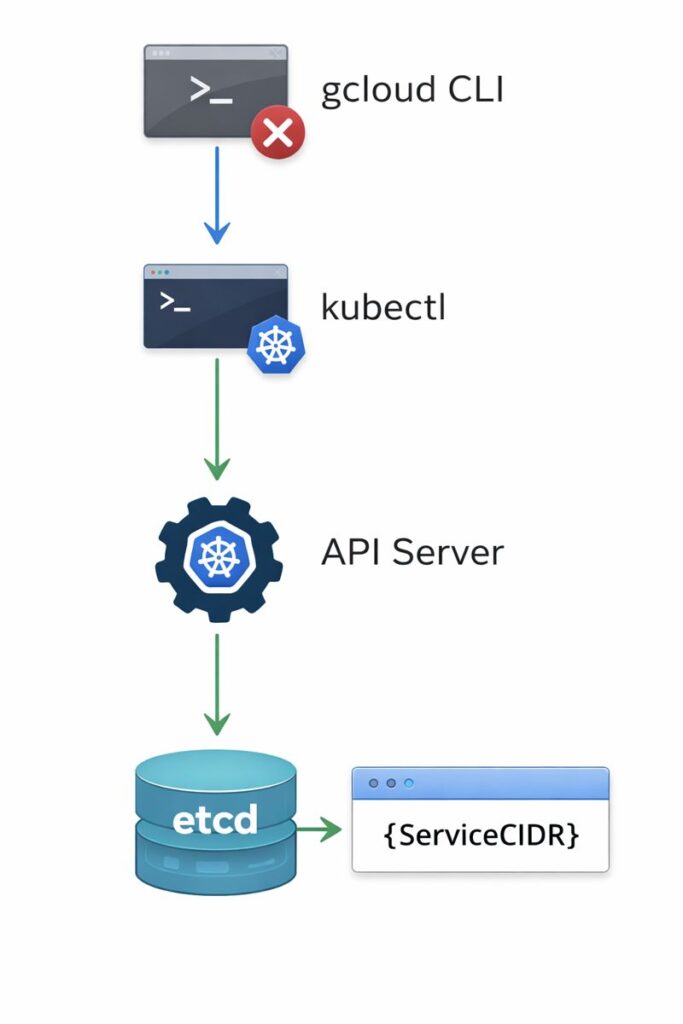
However, during a P0 outage, the rules change. Knowing the difference between a Technical Block (the kernel can’t do it) and a Tooling Block (the CLI won’t let you) is what separates a Senior Engineer from a Staff Architect.
If you’re running GKE Standard and haven’t audited your Service CIDR headroom: do it before you need to. The IP exhaustion failure mode is well-documented, and the remediation options narrow significantly once you’re in a live outage. The GKE IP Exhaustion triage post covers the math and the Class E rescue path.
If you’re designing a new GKE cluster: plan your Service CIDR with 3x headroom from day one. The /20 default sounds generous until you’re running 200+ services across multiple namespaces. Changing it later is the conversation this post is about.
If you’re troubleshooting any cloud platform constraint: always interrogate the API before accepting the CLI’s answer as a hard limit. The CLI enforces opinionated guardrails — the API reflects actual capability. Treat them as different tools with different trust levels, as the table above shows.
Special thanks to Tim Hockin for sending me down this rabbit hole.
The Kubernetes Cluster Orchestration pillar is the full reference for GKE and Kubernetes architecture on rack2cloud.
Additional Resources
View 1 more resource
Editorial Integrity & Security Protocol
This technical deep-dive adheres to the Rack2Cloud Deterministic Integrity Standard. All benchmarks and security audits are derived from zero-trust validation protocols within our isolated lab environments. No vendor influence.

R.M.
Senior Solutions Architect with 25+ years of experience in HCI, cloud strategy, and data resilience. As the lead behind Rack2Cloud, I focus on lab-verified guidance for complex enterprise transitions. View Credentials →
Get the Playbooks Vendors Won’t Publish
Field-tested blueprints for migration, HCI, sovereign infrastructure, and AI architecture. Real failure-mode analysis. No marketing filler. Delivered weekly.
Select your infrastructure paths. Receive field-tested blueprints direct to your inbox.
- > Virtualization & Migration Physics
- > Cloud Strategy & Egress Math
- > Data Protection & RTO Reality
- > AI Infrastructure & GPU Fabric
Zero spam. Includes The Dispatch weekly drop.
Architecture Audit Services
Fixed-scope audits for Zero-Trust Azure, VMware migration readiness, and recovery posture — no discovery call required to start.
>_ View Audit Services>_Related Posts
Your Monitoring Didn’t Miss the Incident. It Was Never Designed to See It.
I’ve watched observability vs monitoring play out as a live incident more times than I can count. >_ Architect’s Brief 60-second read before you commit to the full post · Full post: 10 min Generating brief… The dashboard was green. The on-call engineer was not paged. The monitoring system did exactly what it was designed…
Your Kubernetes Cluster Isn’t Out of CPU — The Scheduler Is Stuck
Compute Tier 1 Authority Cascades to ➔ >_ Architect’s Brief 60-second read before you commit to the full post · Full post: 9 min Generating brief… [Storage] [Network] 🚨 Failure Signature Detected Grafana shows cluster CPU utilization is under 50%, but pods are stuck in Pending. Events show: 0/10 nodes are available: 10 Insufficient cpu….
Your Identity System Is Your Biggest Single Point of Failure
Part 2 of the Rack2Cloud’s Cloud Fragility Series >_ Cloud Fragility Series 01 Multi-Cloud Cascading Failure Risks 02 Your Identity System Is Your Biggest Single Point of Failure [CURRENT] 03 Vendor Lock-In Happens Through Networking — Not APIs 04 Your Cloud Bill Quietly Increased in 2026 — Here’s Where the Money Is Actually Going >_…
Your Identity Provider Was Never Your Spend Boundary
Every enterprise cloud governance program assumes a spend boundary sits somewhere between identity and money — a checkpoint that catches compromised access before it becomes compromised spend. It doesn’t exist. Not as a distinct control. Not as a separate policy layer. Not anywhere in the architecture most organizations have actually built. >_ Architect’s Brief 60-second…
Your Identity Controls Passed. Your Authorization Chain Failed.
A credential chain functioned exactly as it was designed to. No firewall failed. No exploit executed. No malware bypassed a control. A red team walked past physical and social barriers using nothing more exotic than a plausible pretext, and came out the other side holding network admin credentials — issued correctly, authorized correctly, working exactly…
Your DR Test Passed. The Assumptions Didn’t.
DR plan failure rarely happens where you tested. It happens at the assumptions the exercise never reached — the dependencies that weren’t in scope, the runbook written for last year’s architecture, the authority chain nobody tested at 2am.