

March 31 Isn’t a Deadline. It’s a Forced Architecture Decision.
March 31 has passed. Broadcom’s VCSP termination completed on schedule — no EU interim measures were granted, and the European Commission confirmed only that the CISPE antitrust complaint is being assessed under standard procedures. The forced architecture decision this post mapped is now in execution for thousands of affected organizations. Existing customer contracts with terminated VCSPs continue to run through their current commitment terms, but the expansion and renewal window is closed. The regulatory challenge continues — CISPE’s complaint is active, a parallel EU General Court appeal on the original VMware acquisition approval is pending, and German industry group Voice e.V. filed a similar complaint in May 2025 — but none of that changes the immediate planning horizon. If your workloads are on a terminated VCSP, the migration clock is running against your contract expiry, not a regulatory outcome.
Broadcom doesn’t call it a termination. They call it a simplification.
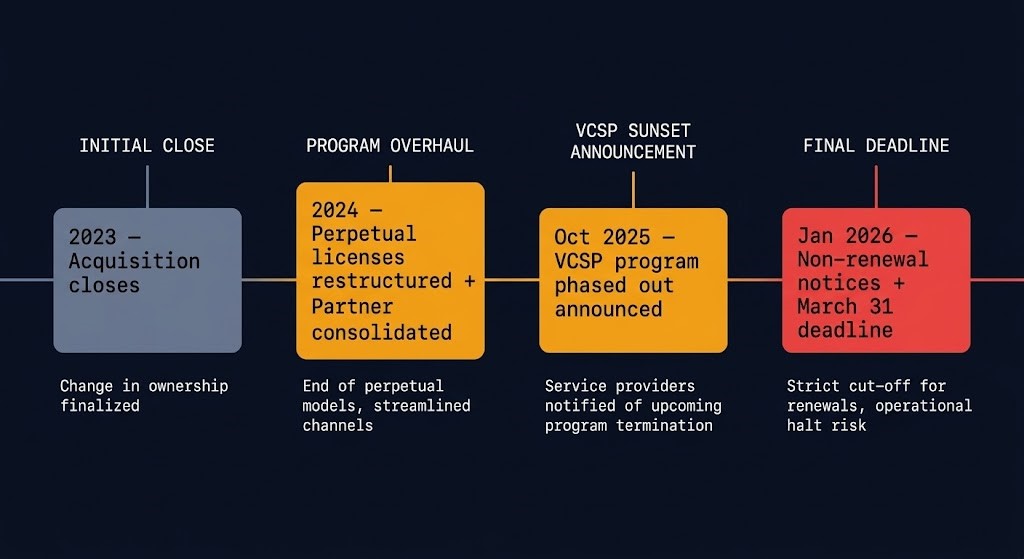
The VMware VCSP termination became official on January 26, 2026, when formal non-renewal notices went out to VMware Cloud Service Provider partners across the US and Europe. Contracts not renewed. The Advantage Partner Program for VCSPs: closed. The White Label model for the European Economic Area: ended. Hundreds of cloud service providers — some with ten or fifteen years of VMware partnership history — received the same form email telling them they had until March 31 to close any open opportunities.
Broadcom retained an invite-only group of authorized VCSPs. Reportedly nineteen US providers out of thousands. The rest were told to wind down.
The industry called it what it is. TechRadar ran the headline: “A bulldozer named Broadcom.” CISPE — the Cloud Infrastructure Service Providers of Europe — described it as forced consolidation. Broadcom described it as meeting “evolving customer requirements.”
The architecture question nobody is asking loudly enough: if your workloads are running through one of the terminated VCSPs, March 31 isn’t a partner program change. It is a forced architecture decision. And the window to make it deliberately rather than reactively is closing. For the full virtualization platform context this decision sits inside, the Virtualization Architecture pillar covers the platform landscape from vSphere through AHV, Proxmox, and beyond.
The VMware VCSP Termination — What the Program Was and What Just Ended
The VCSP program allowed cloud service providers to deliver VMware-based infrastructure services — compute, storage, networking, disaster recovery — to their customers under the VMware licensing umbrella. For smaller enterprises and mid-market organizations, VCSPs were often the practical path to enterprise-grade VMware infrastructure without the capital expenditure of building it themselves.
That model is now structurally broken for the majority of providers who offered it.
Non-renewing VCSPs can service existing contracts through their current commitment term. They cannot take new customers, cannot expand existing deployments beyond what’s coterminous with their active Broadcom commitment, and cannot sign agreements that extend beyond March 31. The customer base sitting on VCSP-delivered VMware infrastructure is not immediately displaced — but they are sitting on a platform that cannot grow, cannot be extended, and is being managed by a provider whose VMware partnership is in terminal wind-down.
That is not a stable architecture. It is a countdown.
The VMware VCSP Termination — What the Program Was and What Just Ended
The VCSP program allowed cloud service providers to deliver VMware-based infrastructure services — compute, storage, networking, disaster recovery — to their customers under the VMware licensing umbrella. For smaller enterprises and mid-market organizations, VCSPs were often the practical path to enterprise-grade VMware infrastructure without the capital expenditure of building it themselves.
That model is now structurally broken for the majority of providers who offered it.
Non-renewing VCSPs can service existing contracts through their current commitment term. They cannot take new customers, cannot expand existing deployments beyond what’s coterminous with their active Broadcom commitment, and cannot sign agreements that extend beyond March 31. The customer base sitting on VCSP-delivered VMware infrastructure is not immediately displaced — but they are sitting on a platform that cannot grow, cannot be extended, and is being managed by a provider whose VMware partnership is in terminal wind-down.
What the VMware VCSP Termination Means for Your Architecture
1. Your provider’s urgency is not your urgency — but it should be.
Terminated VCSPs are under pressure to transition their customer base. Some will push toward retained VCSP partners as Broadcom’s FAQ suggests. Some will recommend migration paths that serve their own transition economics rather than your architecture. The organizations that come out of this well are the ones that own the migration decision rather than inheriting the one their provider made under duress.
2. Broadcom’s consolidation is a pricing signal, not just a channel signal.
The invite-only VCSP model concentrates VMware cloud delivery into a small number of authorized providers who are deeply committed to the VMware Cloud Foundation stack. Fewer providers means less competitive pressure on pricing. The organizations moving to retained VCSPs are not moving to a stable equilibrium — they are moving into a smaller, less competitive market where Broadcom has significantly more pricing leverage. This is the same dynamic that drove the enterprise licensing restructuring in 2024. The channel version is playing out now.
3. Your contract term is not your planning horizon.
Existing VCSP commitments run to their natural expiry. That gives affected customers a runway — but runway is not a strategy. A workload still running on terminated-VCSP-delivered VMware infrastructure twelve months from now is a workload that has been deferred rather than decided. The architecture decision doesn’t get easier with time. The optionality only decreases.
4. This is not an isolated event.
The VCSP termination is the latest in a consistent pattern. Perpetual licenses restructured. Partner programs consolidated. Pricing models rewritten. Each move has followed the same logic: reduce the distribution surface, increase the dependency concentration, extract more value from a captive install base. The organizations still treating each Broadcom announcement as a discrete event rather than a directional signal are going to keep being surprised. The direction has been consistent since the acquisition closed.
Whatever path the decision map leads to, it needs to start from a real number. Know your exact core exposure before the provider conversation happens — and
model what renewal actually costs across three years before committing to any transition timeline.
The Architecture Decision Map
There are three viable paths forward for organizations running workloads through terminated VCSPs. Each has a different risk profile, cost model, and timeline requirement. Understanding which path fits your environment is the actual work the VMware VCSP termination is forcing — not the paperwork.
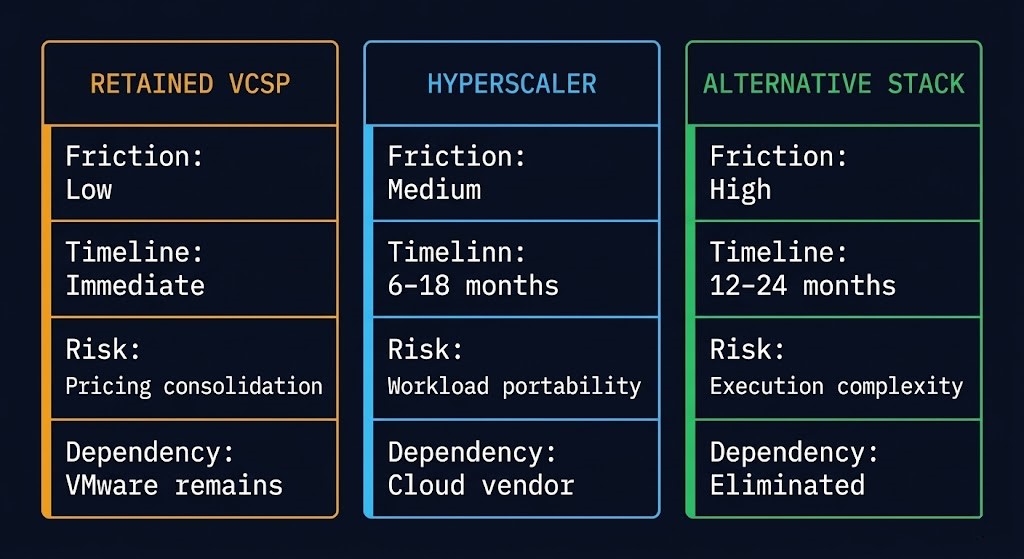
Path 1 — Migrate to a Retained VCSP
The lowest friction short-term option. Broadcom’s FAQ explicitly directs customers this way. The migration is largely operational — moving existing VMware workloads from one VMware environment to another — and the architecture doesn’t change materially. The risk is the pricing dynamic described above: you are moving into a smaller, less competitive market, and the next licensing restructuring will have fewer escape valves. Appropriate for organizations with VMware dependencies that are not addressable in a 12–24 month window and need operational continuity now.
Path 2 — Migrate to a Hyperscaler
AWS, Azure, or GCP — with or without VMware Cloud on the destination. For organizations whose workloads are cloud-portable and whose teams have the skills to execute the migration, this is the path that exits the VMware dependency entirely. The economics depend heavily on workload profile: variable, bursty workloads favor cloud economics; steady-state, high-utilization workloads require the break-even analysis before committing. The Post-Broadcom migration series covers the execution physics of this decision in detail — the VMDK translation problem, the controller tax, and the policy migration challenges that most hyperscaler migration guides don’t address.
Path 3 — Alternative Stack
Nutanix AHV, Proxmox, or a KVM-based platform — on-premises or in a colocation facility. For organizations with predictable workload profiles, data sovereignty requirements, or economics that favor owned infrastructure, the alternative hypervisor path eliminates the VMware dependency at the platform level rather than moving it to a different provider. This path requires the most upfront architectural work — including managing high-I/O cutover windows — but produces the most durable outcome. The dependency on Broadcom’s licensing decisions ends at migration completion rather than being deferred to the next contract cycle.
Worth noting for any organization landing on Path 3 specifically: Proxmox’s own platform investment has moved since this post was first written. Proxmox’s Arm64 Bet Runs On Lifecycle Parity, Not A Feature Release covers Proxmox VE 9.2’s decision to fund full lifecycle parity on Arm64 — the deliberate, years-in-advance version of the same optionality argument this post makes for organizations forced to decide under a Broadcom deadline. The distinction matters at diligence time: a Path 3 destination that was already investing in architectural optionality before it was forced to is a different bet than one making the alternative-stack case reactively.
No path is universally correct. The right answer is a function of your workload profile, your team’s execution capability, your existing contracts, and your tolerance for the pricing risk that staying in the VMware ecosystem now carries.
What to Do Before March 31
The deadline is in 13 days. The useful actions in that window are not about completing a migration — that timeline is not realistic for most organizations. They are about making sure the decision that follows March 31 is yours to make, not your provider’s.
Audit your VCSP exposure. Know which workloads are running through affected providers, what the contract terms are, and when they expire. If you don’t have this mapped, you don’t have a planning horizon — you have a surprise waiting.
Separate the contract runway from the architecture runway. Your existing VCSP commitment may run another 12 or 24 months. That is operational continuity, not strategic stability. Use the contract runway to execute a deliberate architecture decision, not to defer it.
Request clarity from your provider. Specifically: are they a retained VCSP or a terminated one? What is their recommended transition path, and what is the economic basis for that recommendation? A provider recommending a specific migration path has interests in that recommendation. Understanding those interests is part of the architecture decision.
Start the workload assessment. Not the migration — the assessment. Which workloads have hard VMware dependencies? Which are cloud-portable? Which are candidates for alternative hypervisors? The answer to those questions determines which path is viable, and the assessment takes time that the migration itself does not give you.
Architect’s Verdict
Broadcom is not going to reverse the VMware VCSP termination. The consolidation is consistent with every other post-acquisition decision they have made. The pattern is not ambiguous.
March 31 is a forcing function, not a final deadline. Organizations that treat it as a final deadline will scramble reactively when their provider’s contract eventually expires. Organizations that treat it as a forcing function will use the pressure to make an architecture decision that their environment has probably needed for longer than the Broadcom acquisition has been in progress.
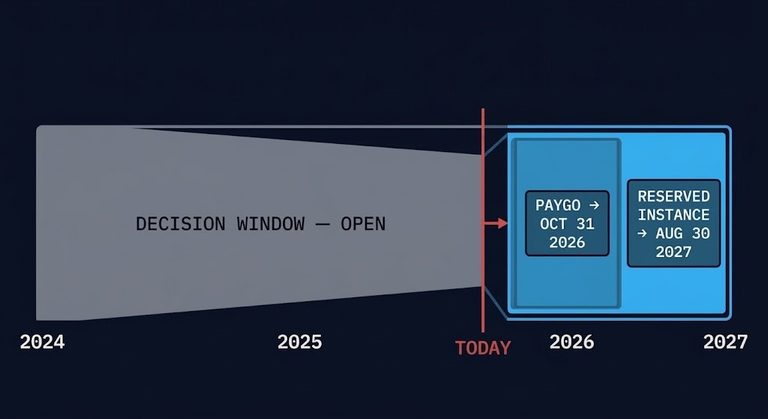
The same forcing-function logic shows up on a different vendor’s calendar entirely. Windows 10 ESU’s October 13, 2026 pricing cliff runs the identical three-path decision — Pay, Migrate, or Replace, in that post’s terms — with the same trap: choosing Pay by default, without the dated exit condition that makes it defensible, is the VCSP-termination “wind down and hope” position wearing a different vendor’s letterhead.
The inverse failure is worth naming too, since it’s easy to confuse with this one from a distance: a deadline that circulated with exactly this urgency and turned out not to be real at all. March 31 was a genuine forcing function — Broadcom’s own non-renewal notice, with a filed contract consequence behind it. The Kubernetes 1.37 containerd deadline had none of that: no vendor notice, no contract consequence, just three secondary sources citing the same changelog and reaching the opposite conclusion from what it actually said. Confusing the two costs an organization twice — once for treating a real deadline as optional, once for treating a manufactured one as real.
The question is not whether to decide. It is whether you decide now, deliberately, with the full option set available — or later, under pressure, with fewer choices and a provider who has already chosen for you.
The series that covers the execution of each path is live. Start there.
The execution physics of migrating off VMware — VMDK translation, controller tax, policy migration, and upgrade architecture. Five parts covering the full decision and execution stack.
Read the Series →Additional Resources
Editorial Integrity & Security Protocol
This technical deep-dive adheres to the Rack2Cloud Deterministic Integrity Standard. All benchmarks and security audits are derived from zero-trust validation protocols within our isolated lab environments. No vendor influence.

R.M.
Senior Solutions Architect with 25+ years of experience in HCI, cloud strategy, and data resilience. As the lead behind Rack2Cloud, I focus on lab-verified guidance for complex enterprise transitions. View Credentials →
Get the Playbooks Vendors Won’t Publish
Field-tested blueprints for migration, HCI, sovereign infrastructure, and AI architecture. Real failure-mode analysis. No marketing filler. Delivered weekly.
Select your infrastructure paths. Receive field-tested blueprints direct to your inbox.
- > Virtualization & Migration Physics
- > Cloud Strategy & Egress Math
- > Data Protection & RTO Reality
- > AI Infrastructure & GPU Fabric
Zero spam. Includes The Dispatch weekly drop.
Architecture Audit Services
Fixed-scope audits for Zero-Trust Azure, VMware migration readiness, and recovery posture — no discovery call required to start.
>_ View Audit Services>_Related Posts
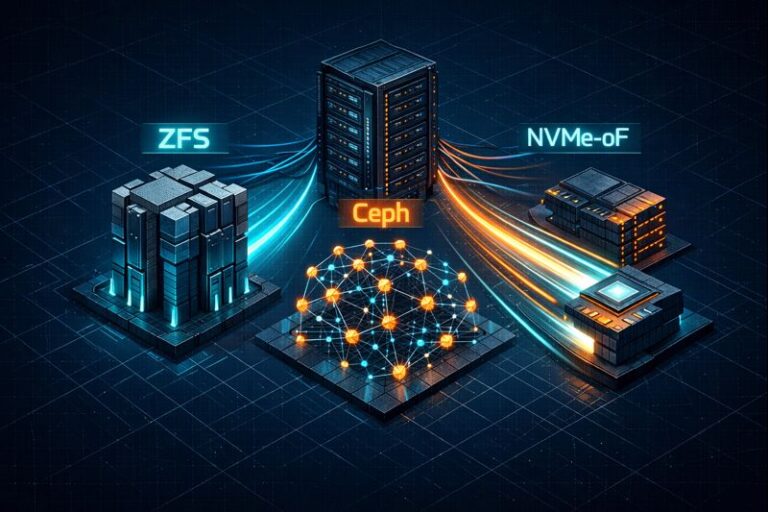
ZFS vs Ceph vs NVMe-oF: Choosing the Right Storage Backend for Modern Virtualization
I still have nightmares about a storage migration I ran back in 2014. >_ Architect’s Brief 60-second read before you commit to the full post · Full post: 7 min Generating brief… We were moving off a monolithic SAN and onto an early “software-defined” storage platform. The sales engineers promised infinite scalability and self-healing magic….
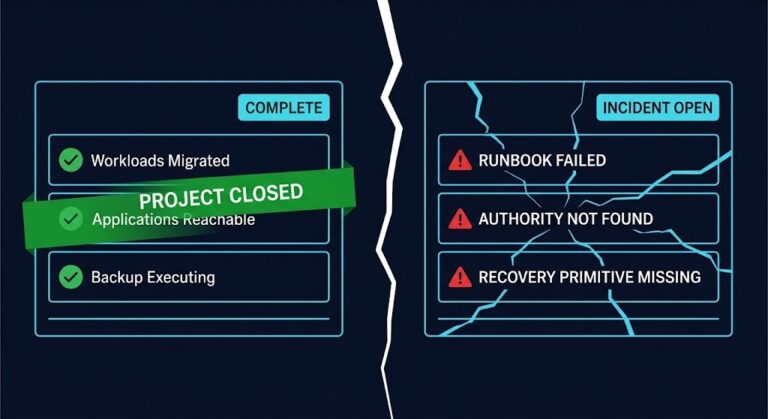
Your VMware Exit Was Successful. The First Incident Will Tell You If That’s True.
VMware exit survivability is the question your migration project never formally scheduled — and the first production incident on the new platform will answer it whether you are ready or not. The cutover completed. The workloads are running. The project closed green. None of that tells you whether the operating model, runbooks, authority structures, and…
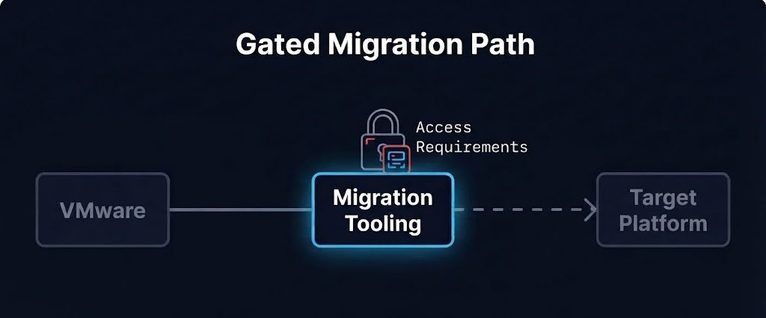
Your VMware Exit Plan Assumed a Tool You Didn’t Control
A VMware exit plan usually treats the migration tooling as a given — something you download, install, and use, not something you have to keep asking permission for. In late August, the public self-service path to the Virtual Disk Development Kit (VDDK) stopped working. No deprecation notice. No public transition announcement. A download path that…
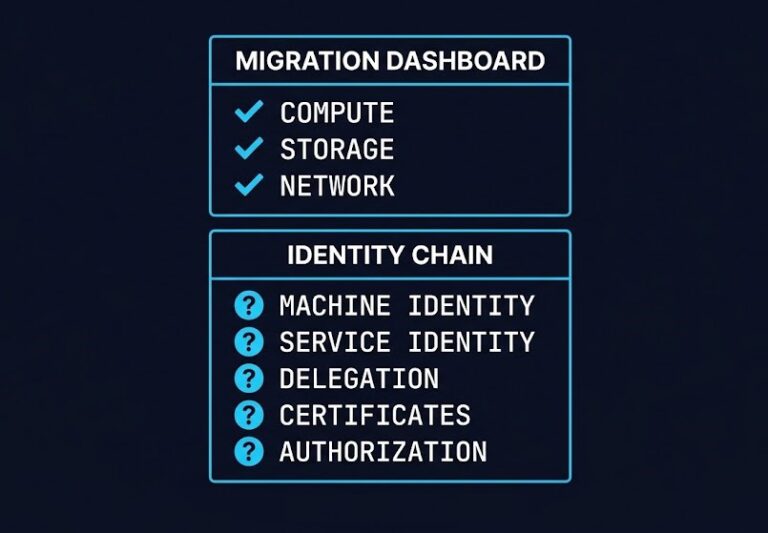
Your Migration Succeeded. The Identity Chain Didn’t.
Identity chain continuity is the thing every migration runbook assumes and almost none of them prove. A migration dashboard can go fully green — compute online, storage attached, network reachable — while the identity chain underneath it is already broken, and nothing in that dashboard will tell you. >_ Architect’s Brief 60-second read before you…
You Had Two Years To Decide On VMware. You Now Have One.
VMware deferral was a defensible posture for organizations that chose it — for the better part of two years, right up until this week, when Microsoft made it structurally impossible to keep pretending “later” was still on the table. >_ Architect’s Brief 60-second read before you commit to the full post · Full post: 9…
Why Most “Cheaper Cloud” Strategies Fail
The organization runs the program. Reserved instances purchased, rightsizing applied, maybe a workload consolidation push across three regions. Spend drops 18%. Leadership calls it a win. >_ Architect’s Brief 60-second read before you commit to the full post · Full post: 9 min Generating brief… Six months later, inter-region data transfer climbs again. Kubernetes clusters…