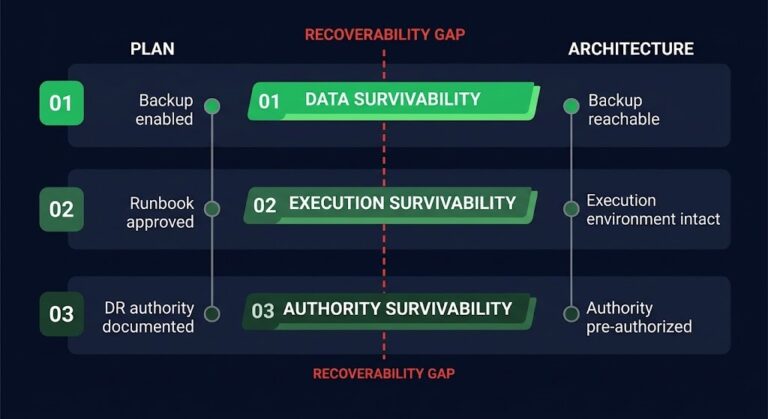


The Configuration Drift Discovery During a Drill

Quarterly recovery drill. Backup job green for four months. Restore executes cleanly — data intact, VM boots, database service starts. The application fails on the first transaction.
Three hours disappear into backup triage before anyone checks the environment.
The backup was not the problem. It never was. This is recovery configuration drift — and it belongs to the same class of data protection failure where the protection plane reports success and the recovery plane produces nothing useful.
What the Drill Was Testing (and What It Wasn’t)
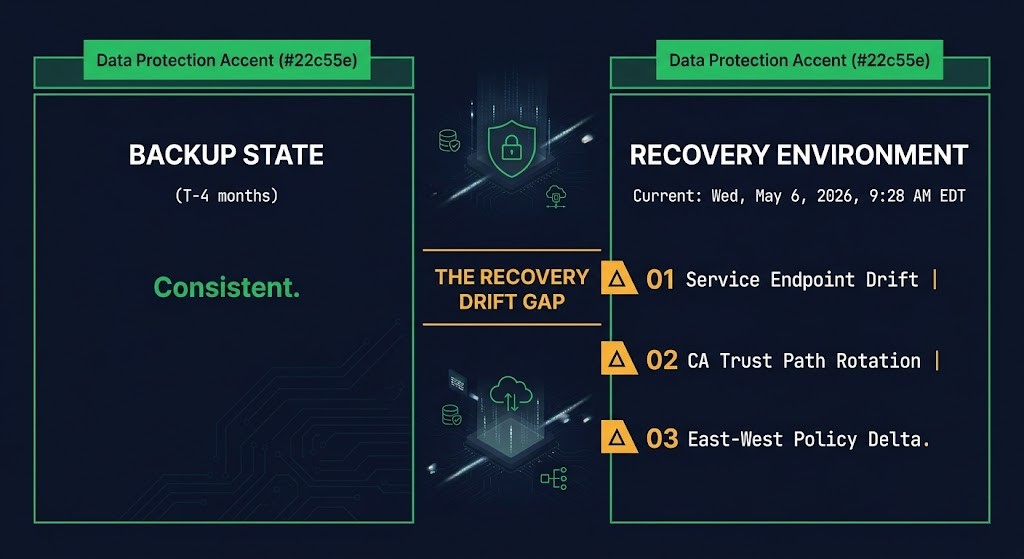
The drill validated backup integrity and restore mechanics — the protection plane. It did not validate environment state — the recovery plane. Four months of silent drift had accumulated between the backup capture point and the recovery target. The backup job reported green throughout. Nothing surfaced the gap until the restore ran into an environment that had moved on.
Three drift vectors accumulated silently over those four months. Each individually invisible. Each fatal at the application layer on restore.
01 — SERVICE ENDPOINT CHANGED
An internal service endpoint was updated — manual change, never committed back to IaC. The recovery config still pointed at the old dependency. The restored application reached out to an endpoint that no longer existed in that form. First transaction failed. The backup had nothing to do with it.
02 — INTERNAL CA TRUST PATH ROTATED
The internal CA trust path had been rotated by an automated process. The config reference was never updated. The restored application could no longer validate upstream auth — certificate chain validation failed silently on the first authenticated call. The backup was application-consistent at the point it was taken. The trust chain it assumed no longer existed.
03 — EAST-WEST NETWORK POLICY TIGHTENED
A security team policy change had tightened east-west traffic rules three months prior. The recovery runbook was never updated to reflect it. The restored application attempted to reach a service dependency on first transaction and hit a policy block. The change was correct. The recovery documentation was not.
None of these were flagged as backup problems. None appeared in backup job logs. All three were invisible until the application ran in a recovery environment that had accumulated three separate departures from the state the backup assumed.
The Recovery Drift Gap
This was a Recovery Drift Gap.
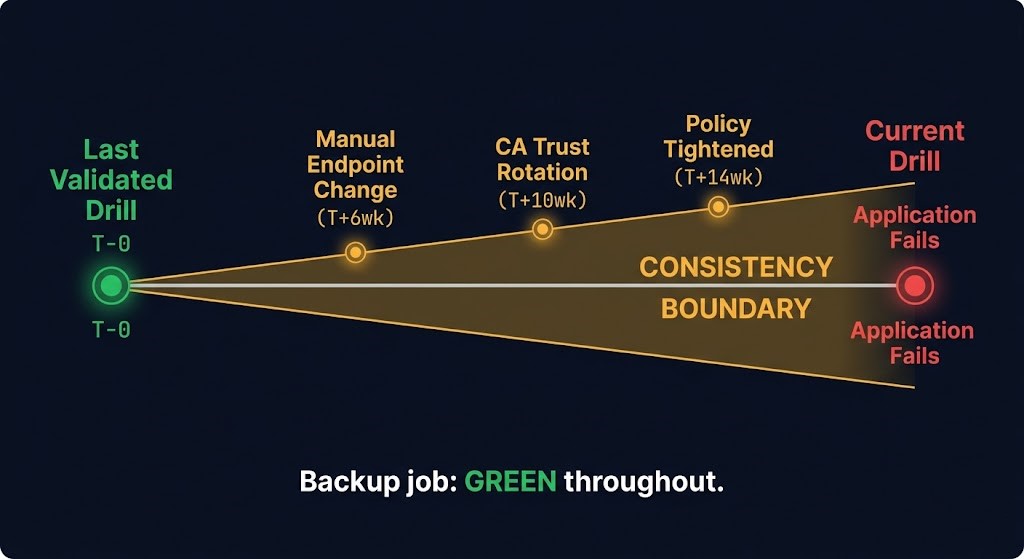
The backup was consistent. The recovery environment was not. The Consistency Boundary is where those two states diverged — the line between what the backup knows and what the environment currently is. In this case, that boundary had been widening for four months across three separate change vectors, none of which had any mechanism to propagate their state into the recovery runbook or the IaC-declared environment.
Every untracked manual change widens the Consistency Boundary. Every automated process that updates configuration without committing it back widens it. Every security policy change that doesn’t propagate to the recovery documentation widens it. The restore path treats the recovery environment as a known quantity. The Recovery Drift Gap is what happens when that assumption has been quietly wrong for months.
The gap does not announce itself. It waits for the drill — or worse, for the incident.
What a Pre-Drill Diff Actually Checks
The standard framing — “run drift detection before a drill” — is correct but not actionable. What actually gets checked in a pre-drill diff is more specific. Configuration drift detection at the IaC layer catches declared-state variance. But the Recovery Drift Gap lives in a wider surface than IaC state alone.
A pre-drill diff that is actually useful checks six things:
PRE-DRILL DIFF — WHAT ACTUALLY GETS CHECKED
- Current service endpoints — do recovery runbook references match what the environment is currently serving?
- Cert chain / trust store paths — has any CA rotation, cert renewal, or trust store update occurred since the last validated drill?
- Security group / ACL / east-west policy deltas — have any policy changes been applied that would block traffic paths the restored application depends on?
- DNS dependencies — do internal resolution paths the restored app will traverse still resolve to the correct targets?
- Secret path references — vault paths, key references, rotation state — does the restored application’s config point at secrets that still exist at those paths?
- Mount / storage path assumptions — anything the application opens on first transaction — are those paths still valid in the recovery environment?
This is not a full environment audit. It is a pre-flight against the specific failure modes that kill restores in well-maintained environments — the ones that have nothing to do with whether the backup completed successfully.
The Transferable Principle
The backup is not the unit of recovery. The backup plus the environment configuration plus the dependency graph is the unit of recovery. A drill that only validates backup integrity has validated one third of that unit — and in environments where backup integrity is mature and reliable, one third is exactly where the coverage ends.
This is the same structural gap documented in RTO and RTA measurement — the declared target assumes the recovery environment is ready. The Recovery Drift Gap is what accumulates when nobody validates that assumption between drills. It is also why ransomware recovery architectures that depend on clean restores fail in practice — the backup survives the attack; the environment configuration that the backup assumes may not. The same drift logic applies to disaster recovery authority — roles change, contacts go stale, approval chains get reorganized. By the time a drill surfaces the configuration gap, the authority gap has often been present just as long. This is the same class of gap the Continuity Execution Boundary (#163) names formally — a technically clean restore that still depends on dependencies and ownership decisions nobody separately validated. Configuration drift is one of the ways that boundary gets crossed silently, and it’s covered directly in Cluster 3 of the Disaster Recovery & Failover Architecture stage.
GM’s eBoost brake system carries a version of the same gap at the hardware layer, currently under NHTSA Engineering Analysis. GM’s documented degradation sequence assumed a spindle-fracture condition tested in one representative dynamic scenario was fully representative of what the fleet would encounter. Field reports are functioning as the drift signal here — not configuration drift in the IaC sense, but the same structural pattern: a designed response validated once, and a gap between that validation and the full range of production conditions that stayed invisible until reports accumulated. GM’s Brake-by-Wire Investigation Is a Verification Story covers the mechanism in full.
One more distinction is worth holding separate from this same family: configuration drift is what happens to a single recovery environment over time. Virtualization Sprawl: When Every Team Owns A Different Infrastructure Reality describes a different failure at a different altitude — not one environment drifting from its own declared state, but multiple platform teams whose definitions of “DR tested” never matched each other in the first place. One team considers a full failover clean enough to call it tested; another calls replication sufficient; a third calls current backups enough. No drift has to occur for that gap to exist — it’s present from day one, between teams, rather than accumulating over time within one team’s environment.
Drift and interference are different failure classes worth keeping separate: a pre-drill diff catches the state that quietly moved since the last drill; adversarial restore testing catches what happens when something is actively moving against the restore while it’s running — credential revocation, control-plane contention, repository denial. A drill can clear the drift check completely and still have never been tested against the second failure class.
Backup integrity tells you the restore can start. It tells you nothing about whether the application can recover — and proving that it did is a distinct artifact most drill designs never produce. That artifact is what restore evidence names directly.
DIAGNOSTIC QUESTION
“When did you last verify the recovery target environment matches the configuration state of what you’re restoring?”
The FN-01 post in this series covered the Declaration Gap in DNS failover — every layer behaving correctly while the system failed operationally. The Recovery Drift Gap is the same failure class at a different layer. The backup mechanics are correct. The environment state is not. The combination produces a restore that completes and an application that doesn’t.
The backup restored exactly as expected. The environment didn’t. Only one of them was being tested.
Architect’s Verdict
Recovery configuration drift is the silent accumulator between every backup and every restore. It doesn’t announce itself. It doesn’t appear in backup job logs. It accumulates in the delta between what the backup assumes the environment looks like and what the environment actually is — and it widens every time a manual change goes untracked, every time an automated process updates config without committing it back, every time a security policy change doesn’t propagate to recovery documentation.
Drills are designed to test backup integrity. That design structurally excludes the failure mode that actually causes restore failures in mature environments — because once backup integrity is reliable, the gap moves somewhere else. It moves into service endpoint references, trust chain assumptions, policy deltas, and secret path state. None of those are backup problems. All of them are recovery problems. Most drill designs never reach them.
The drill that never surfaces a Recovery Drift Gap is either running in a perfectly maintained environment or testing the wrong thing. In most production environments, it is the latter.
Additional Resources
View 5 more resources
Editorial Integrity & Security Protocol
This technical deep-dive adheres to the Rack2Cloud Deterministic Integrity Standard. All benchmarks and security audits are derived from zero-trust validation protocols within our isolated lab environments. No vendor influence.

R.M.
Senior Solutions Architect with 25+ years of experience in HCI, cloud strategy, and data resilience. As the lead behind Rack2Cloud, I focus on lab-verified guidance for complex enterprise transitions. View Credentials →
Get the Playbooks Vendors Won’t Publish
Field-tested blueprints for migration, HCI, sovereign infrastructure, and AI architecture. Real failure-mode analysis. No marketing filler. Delivered weekly.
Select your infrastructure paths. Receive field-tested blueprints direct to your inbox.
- > Virtualization & Migration Physics
- > Cloud Strategy & Egress Math
- > Data Protection & RTO Reality
- > AI Infrastructure & GPU Fabric
Zero spam. Includes The Dispatch weekly drop.
Architecture Audit Services
Fixed-scope audits for Zero-Trust Azure, VMware migration readiness, and recovery posture — no discovery call required to start.
>_ View Audit Services>_Related Posts
Your VMware Exit Was Successful. The First Incident Will Tell You If That’s True.
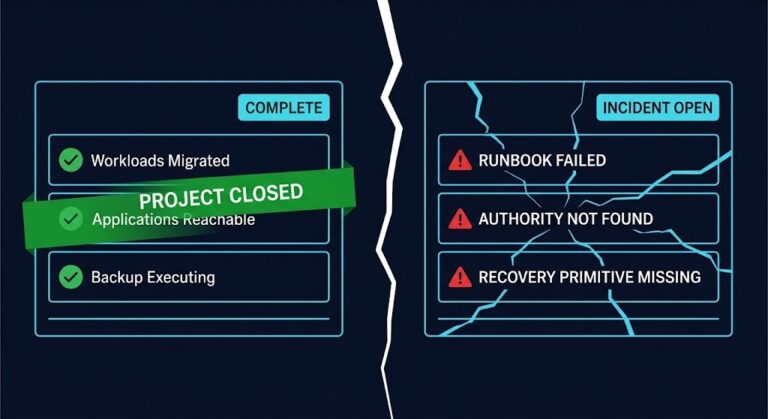
VMware exit survivability is the question your migration project never formally scheduled — and the first production incident on the new platform will answer it whether you are ready or not. The cutover completed. The workloads are running. The project closed green. None of that tells you whether the operating model, runbooks, authority structures, and…
Your Vendor Review Process Never Saw The Real Supplier
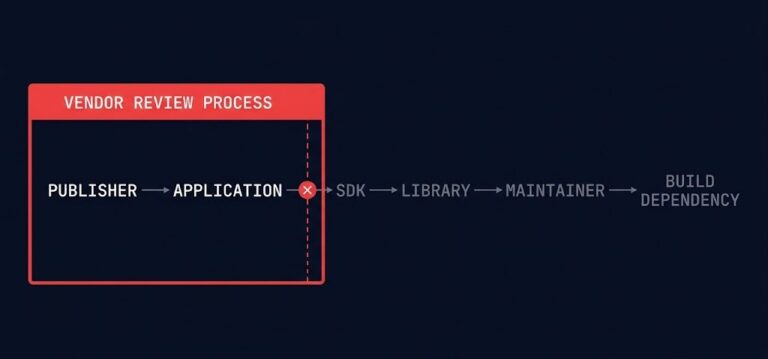
Every vendor review process assumes it’s evaluating a supplier — but a scan finding foreign-origin code embedded in more than one in eight mobile apps used by US military personnel makes the actual assumption visible: organizations review the company they bought from, not the code that arrived inside what they bought. >_ Architect’s Brief 60-second…
Your Recovery Program Has a Recovery Evidence Boundary
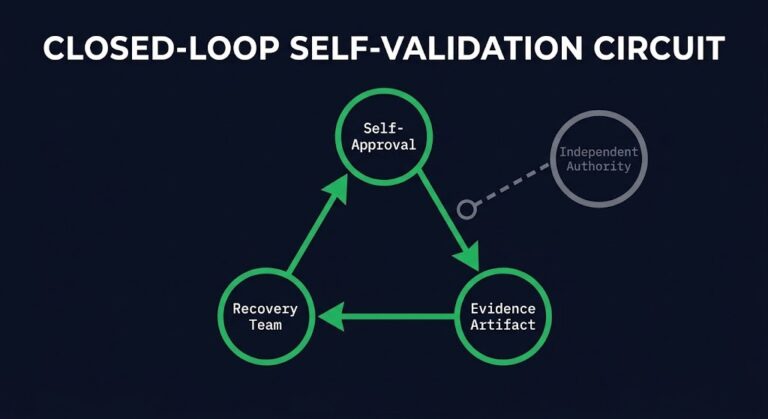
Recovery evidence boundary is the point where a recovery program stops being an engineering question and starts being a governance one — and most organizations cross it without ever finding out, because everything on the way there still looks like success. The backups completed. The DR test passed. The tabletop went well. Somebody wrote a…
Your Recovery Architecture Has A Bus Factor Problem
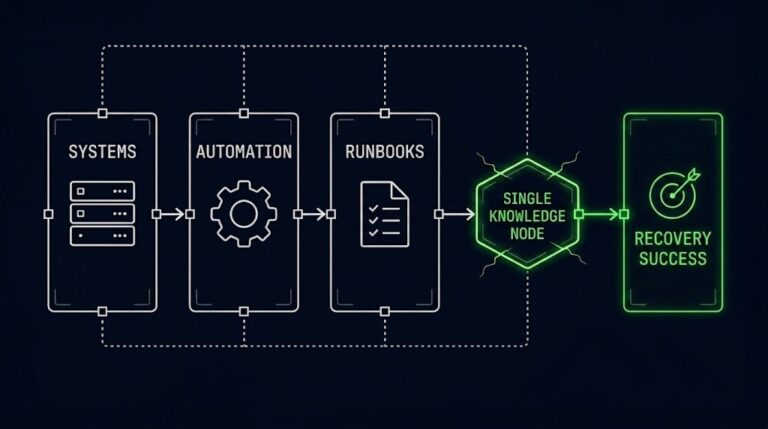
Recovery bus factor is the gap between a recovery plan that has been tested, documented, and signed off — and a recovery plan that can actually be executed when the one or two people who know how to run it aren’t in the room. The recovery program had passed everything that mattered on paper: RTO…
Your Ransomware Recovery Plan Has a Recoverability Gap
The recoverability gap is the structural distance between what your recovery plan assumes and what your infrastructure can actually deliver under failure conditions. Most organizations don’t discover it during planning. They discover it on day three of an incident. >_ Architect’s Brief 60-second read before you commit to the full post · Full post: 13…
Your Ransomware Plan Is Fiction: 5 Recovery Metrics Nutanix, Cohesity, Rubrik & Pure Can’t Hide
Ransomware recovery metrics are the only thing standing between your recovery plan and a PowerPoint. Every vendor demo shows a single VM booting in 60 seconds. Every real ransomware recovery looks like this: the backups are intact, the ransomware is neutralized, the executives are on the bridge — and nothing is coming back online. >_…