

The Architecture of Migration: Why Licensing Isn’t Your Biggest Risk in the Post-Broadcom Era
The industry is currently fixated on the Broadcom/VMware shake-up. Licensing rules are changing, contracts are being torn up, and now CFOs suddenly care about hypervisors. It’s a lot.
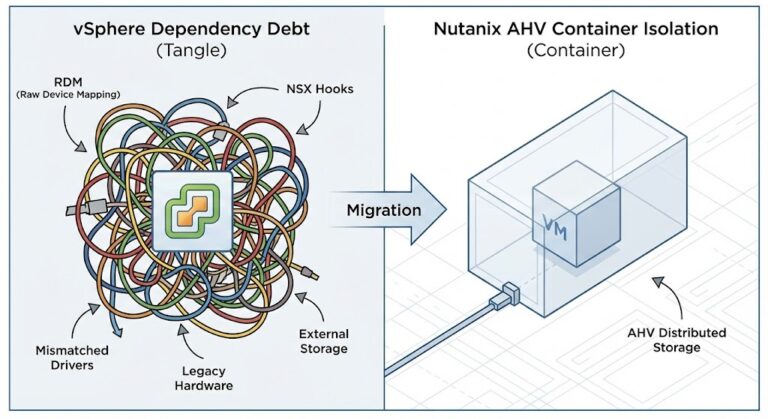
But here’s the thing: licensing isn’t the real risk here. What really puts you in danger is dragging all your old architectural baggage into a new environment.
This entire migration series is anchored in our Virtualization Architecture pillar, where we treat infrastructure as a deterministic system rather than a procurement line item.
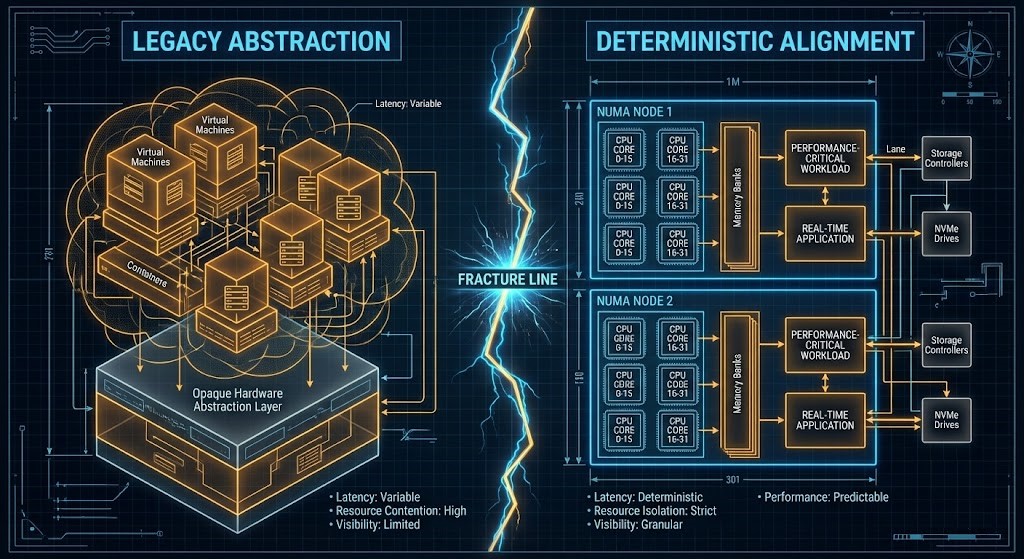
The Wrong Way: Migration as a Budget Problem
Right now, most teams are jumping from VMware to Nutanix, AHV, or KVM purely because of costs. That makes sense. But if you treat this like a procurement exercise—just swapping one bill for another—you’re missing the point. You will end up with the same headaches, just on a different platform.
If your migration is just a “lift-and-shift” that keeps the old problems—oversized VMs, hidden NUMA issues, endless manual operations, and outdated latency assumptions—you aren’t modernizing. You’re just trading vendors.
Migration Changes the Physics
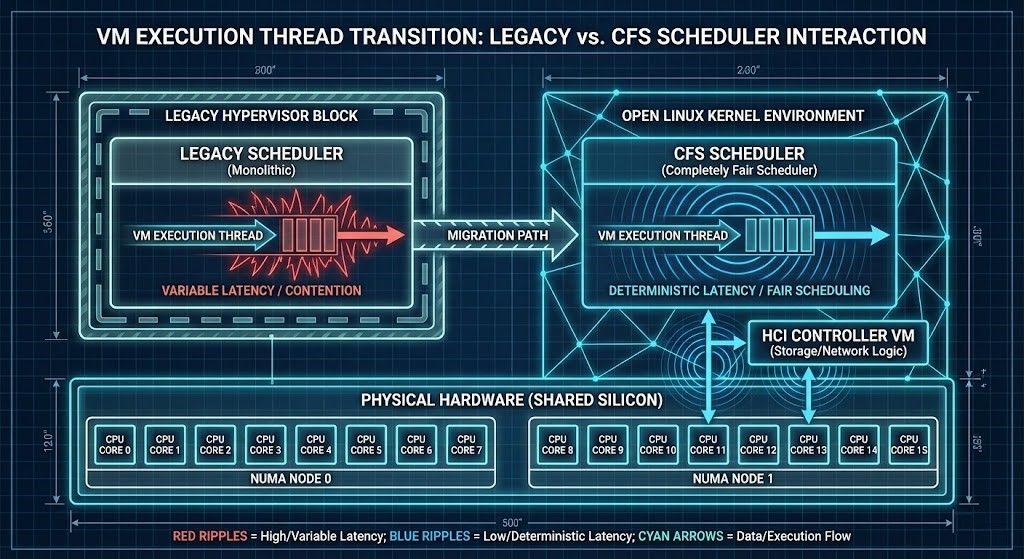
Scheduler semantics change. NUMA locality rules shift. Storage arbitration moves from external arrays to host-resident controllers. When you move workloads, you aren’t just copying files. You are changing the physical reality of how your stack runs:
- How the scheduler handles resources.
- How memory locality behaves.
- How storage paths are arbitrated.
- How failure domains ripple through the system.
Basically, you are rewriting the rules of your environment. On VMware, packing things tightly was rewarded. On AHV or KVM, precise alignment is rewarded.
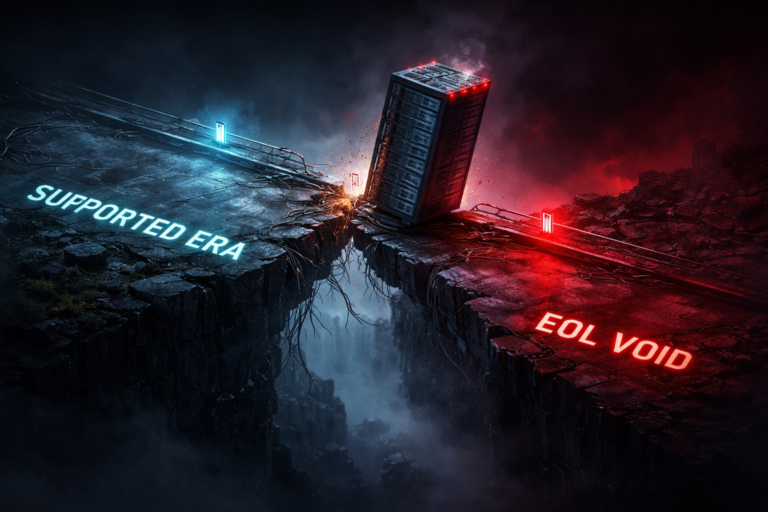
If you cling to old “density” habits, you’ll hit Migration Stutter. Your dashboards might look healthy, but your application latency will drift unpredictably. That isn’t a tooling issue; it’s your architecture fighting the new environment.
The Real Chance: Infrastructure as a Software Asset
A migration is your one real shot to overhaul everything. Most teams won’t take it. They’ll just script around the old ways, drag over clunky runbooks, and rebuild the same snowflake mess. But Broadcom’s acquisition is more than a price problem. It’s a chance to finally treat infrastructure like a versioned, testable, reliable software system.
What does that look like?
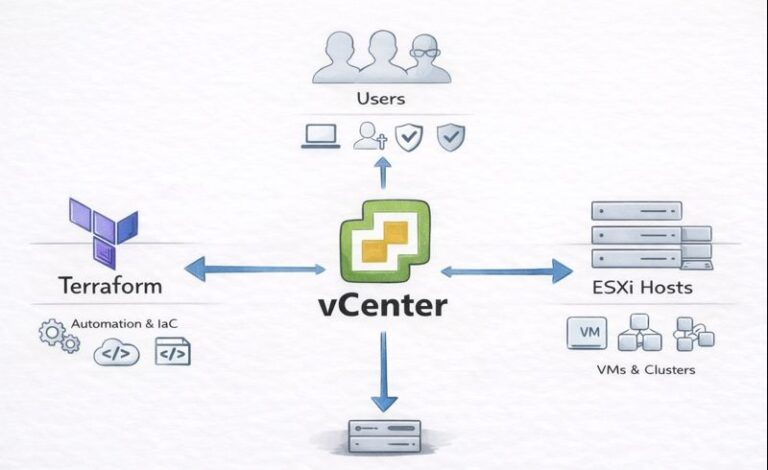
- Codifying intent: Using Terraform to control your topology.
- Proving stability: Testing network RTT before claiming Metro Availability is solid.
- Designing for failure: Building for rolling failures and fast rebuilds.
- Eliminating manual toil: Removing human tinkering from the lifecycle.
- Automating: Swapping reactive firefighting for automated control loops.
Stop babysitting the rack. Start engineering the lifecycle.
This Series: The Post-Broadcom Deterministic Migration
This week on Rack2Cloud, we’re flipping the script. We are reframing migration as an architectural correction. We’re starting with the most overlooked question: What actually changes at the execution level when you move from VMware to AHV? If you get that wrong, nothing else you do will matter. It begins at the execution thread — not the VMDK.
You know the risk of carrying forward architectural debt. Now, we tear down the mechanics. Track the series below as we map the exact physical changes required for a deterministic migration.
Skip the wait. Download the complete Deterministic Migration Playbook (including the Nutanix Metro Cluster Implementation Checklist) and get actionable engineering guides delivered via The Dispatch.
SEND THE BLUEPRINTMigration Isn’t Just a Checklist. It’s a Design Reset.
You are already touching every workload and reviewing every cluster. Don’t waste this moment just chasing a smaller bill. This is your shot to clean out the architectural rot.
Continue the Series
This article is part of our Modern Virtualization Learning Path.
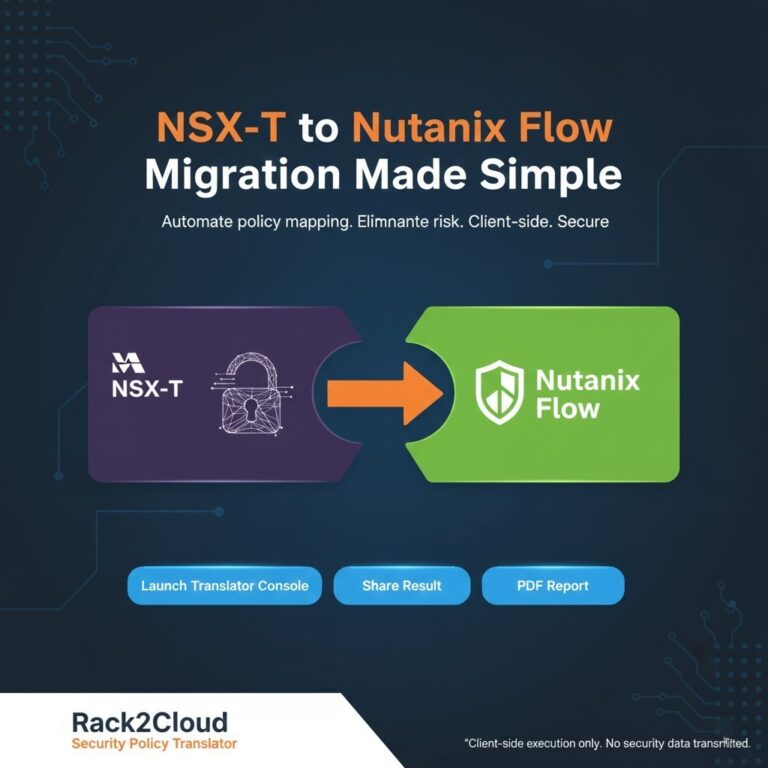
If you are refactoring your datacenter, start with the Learning Path to track our progress through the CVM Controller Tax, Migration Stutter, and policy translation frameworks.
Additional Resources & Industry Context
Editorial Integrity & Security Protocol
This technical deep-dive adheres to the Rack2Cloud Deterministic Integrity Standard. All benchmarks and security audits are derived from zero-trust validation protocols within our isolated lab environments. No vendor influence.

R.M.
Senior Solutions Architect with 25+ years of experience in HCI, cloud strategy, and data resilience. As the lead behind Rack2Cloud, I focus on lab-verified guidance for complex enterprise transitions. View Credentials →
Get the Playbooks Vendors Won’t Publish
Field-tested blueprints for migration, HCI, sovereign infrastructure, and AI architecture. Real failure-mode analysis. No marketing filler. Delivered weekly.
Select your infrastructure paths. Receive field-tested blueprints direct to your inbox.
- > Virtualization & Migration Physics
- > Cloud Strategy & Egress Math
- > Data Protection & RTO Reality
- > AI Infrastructure & GPU Fabric
Zero spam. Includes The Dispatch weekly drop.
Need Architectural Guidance?
Unbiased infrastructure audit for your migration, cloud strategy, or HCI transition.
>_ Request Triage Session