

Proxmox vs Nutanix vs VMware: The Post-Broadcom Constraints No One Explains
The Proxmox vs Nutanix vs VMware decision looks different in 2026 than it did two years ago. Broadcom didn’t just change VMware pricing — it changed the decision model entirely.
This is no longer a feature comparison between hypervisors. Every enterprise infrastructure team re-evaluating their platform right now is working through the same problem, and most of the content available to them doesn’t help: pricing tables that don’t reflect real contract structures, feature matrices that compare capabilities no one actually uses, and migration guides that skip the part where things break.
This post takes a different approach. It’s a constraint problem — not a feature comparison.
Cost constraints. Operational constraints. Capability constraints.
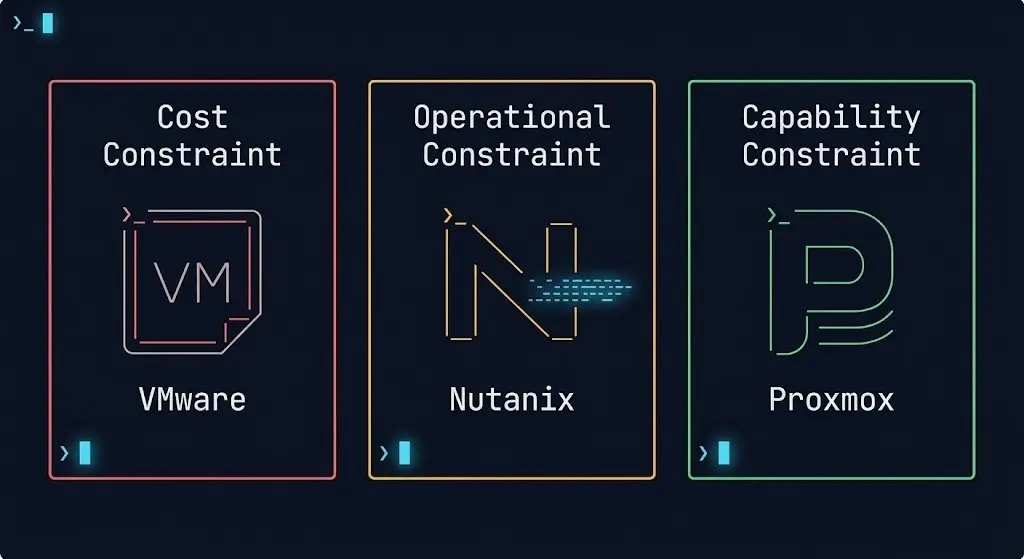
VMware imposes one set. Nutanix imposes another. Proxmox imposes a third. The real question isn’t which platform is better. It’s which set of constraints you’re willing to live with — given your workload profile, your team’s operational depth, and your timeline.
The Constraint Model
Before comparing platforms, the framing matters.
Most hypervisor comparisons evaluate features: vMotion vs AHV Live Migration vs KVM, vSAN vs Nutanix Distributed Storage vs Ceph, NSX vs Nutanix Flow vs Linux bridges. That framing is useful for engineers already committed to a platform. It doesn’t help architects making a platform decision under pressure.
The right framing is constraint-based:
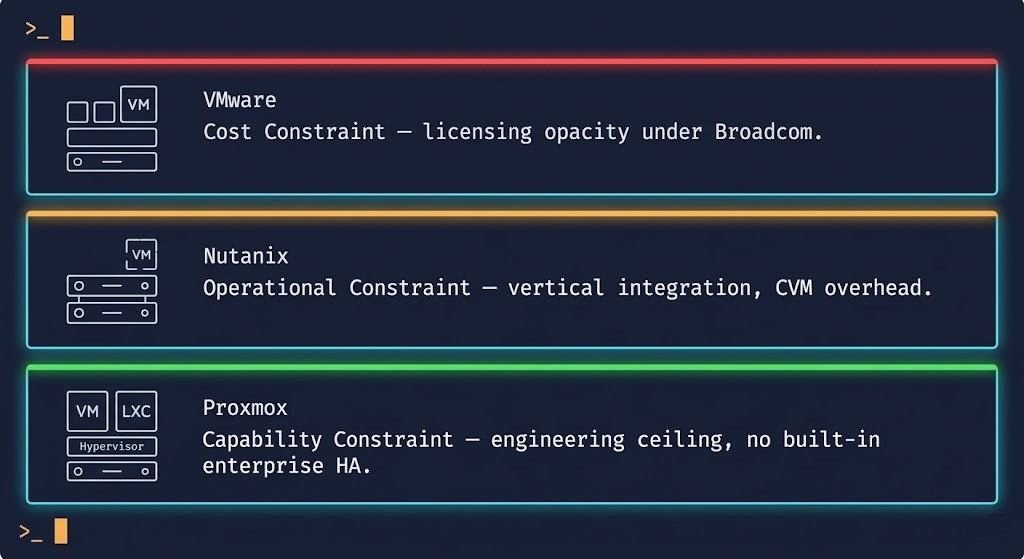
VMware (Broadcom era): Cost constraint is the forcing function. The platform is mature, operationally understood, and deeply integrated into enterprise tooling. The constraint is what you pay — and what you no longer control about what you’ll pay in 18 months.
Nutanix: Operational constraint is the trade. You get a genuinely converged stack, strong Day-2 automation, and a licensing model that isn’t being restructured against you. The constraint is that you’re buying into a vertically integrated system where Nutanix owns the full stack from hypervisor to storage to networking policy.
Proxmox: Capability constraint is the ceiling. The platform is open-source, cost-effective, and genuinely capable for the right workloads. The constraint is that enterprise operational maturity — HA, DR, multi-site replication, support contracts — requires engineering effort that Proxmox doesn’t provide out of the box.
None of these are disqualifying. All of them are real. The decision is which constraint fits your organization’s actual situation.
VMware in the Broadcom Era: The Cost Constraint
VMware is the known quantity. Most enterprise infrastructure teams have years of operational muscle memory on vSphere — troubleshooting, capacity modeling, tooling integrations, backup workflows, DR runbooks. That operational capital is real and it has a cost to replace.
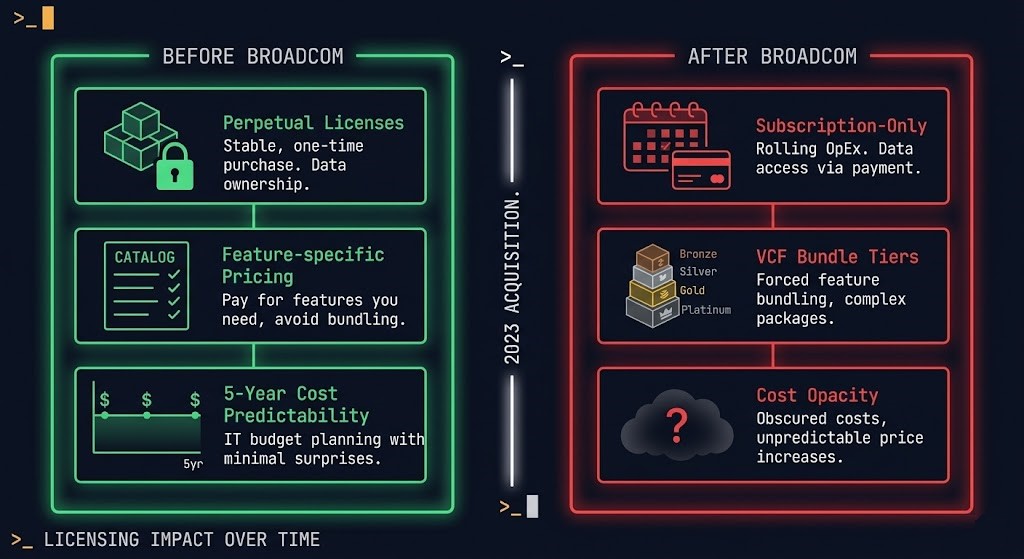
What changed under Broadcom is the pricing model and the contract structure. The move from perpetual licensing to subscription-only, the bundling of features into VCF tiers, and the elimination of perpetual license support have restructured the economics for most enterprise customers. Organizations that were paying for specific features now pay for bundles. Organizations that modeled licensing costs over 3-5 year cycles can no longer model with the same confidence.
The constraint isn’t that VMware is technically inferior. It isn’t. The constraint is that the cost model is now opaque and subject to change in ways that weren’t true before the acquisition. For budget-sensitive organizations or those with large VM estates, that uncertainty is itself an architecture risk.
The Post-Broadcom Series covers the full migration architecture across five parts — including the licensing math and legal context driving enterprise exit timelines.
Nutanix: The Operational Constraint
Nutanix is the most complete alternative to VMware for enterprise workloads. AHV as a hypervisor is production-mature, the Nutanix Distributed Storage Fabric replaces vSAN with a converged storage layer that doesn’t require separate licensing, and Nutanix Flow provides micro-segmentation and network policy that maps reasonably well to NSX-T capabilities — though the architectural model is different.
The operational constraint is what you’re trading into. Nutanix is a vertically integrated stack. The hypervisor, storage, and networking policy layer are designed to work together, and they do — well. But the integration also means that Nutanix controls the full stack. Updates, support, and roadmap decisions flow through a single vendor. That’s a different kind of lock-in than VMware’s licensing lock-in, but it’s still lock-in.
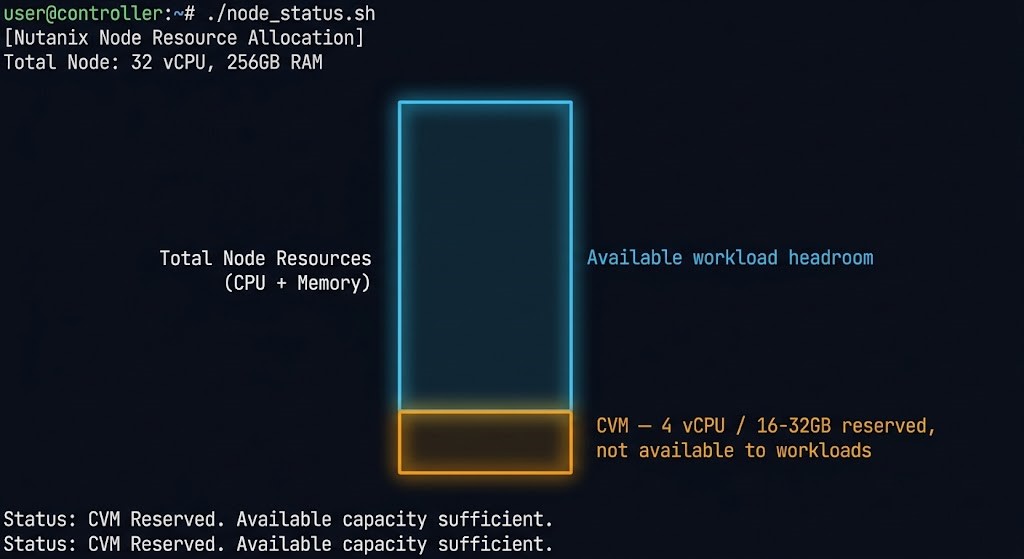
The Controller VM tax is real and worth modeling explicitly before committing. Every Nutanix node runs a Controller VM (CVM) that handles storage I/O for the cluster. The CVM consumes CPU and memory that isn’t available to workloads. On well-sized nodes this is a manageable overhead — typically 4 vCPUs and 16-32GB RAM per node. On undersized nodes or in dense deployments, the CVM tax becomes a performance constraint that shows up as resource contention under load.
The AHV migration path from VMware is well-documented but not frictionless. High-I/O workloads — databases, storage-intensive applications — require careful cutover planning. The migration stutter pattern — where AHV cutovers freeze high-I/O workloads during the transition window — is a real operational risk that the migration tooling doesn’t fully protect against.
Proxmox: The Capability Constraint
Proxmox is the platform that most enterprise comparisons underestimate — and then misapply. The Broadcom exit pressure has sent a wave of organizations toward Proxmox who were attracted by the open-source cost model and the feature surface. Some of those migrations have gone well. Many have discovered the capability constraint the hard way.
Proxmox VE is a genuinely capable hypervisor for the right environment. KVM is the same kernel-based virtualization that powers most major cloud providers’ underlying compute. The management interface is functional. ZFS integration is strong. And for organizations with engineering depth and Linux operational expertise, Proxmox can be configured into a solid private cloud platform.
The capability constraint is what Proxmox doesn’t provide by default: enterprise HA with the operational guardrails VMware and Nutanix provide, production-grade DR, multi-site replication with tested failover semantics, a storage layer that doesn’t require Ceph expertise to operate reliably, and a vendor support structure for regulated environments.
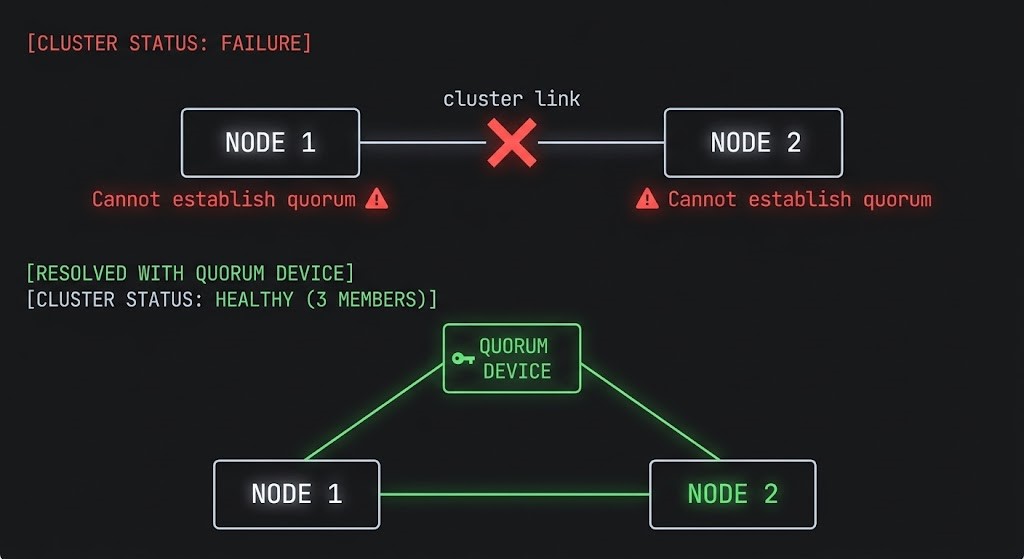
The 2-node quorum problem is the most common Proxmox HA failure mode — organizations that build what looks like a redundant cluster discover that quorum mechanics mean a 2-node cluster isn’t actually HA in the way VMware HA is. Fixing it requires either a third node or a quorum device, which most teams don’t plan for upfront.
The storage layer deserves equal attention. Proxmox’s default local storage is not a shared storage fabric. Ceph integration provides distributed storage, but Ceph has its own operational complexity — it requires a minimum node count to operate safely, separate networks for replication traffic, and engineering expertise to tune correctly. ZFS on local storage is stable and well-understood, but it’s node-local — VMs can’t live-migrate between nodes without shared storage.
The performance modeling comparison between AHV and Proxmox Ceph is worth reading before committing to either path for storage-intensive workloads.
The Proxmox vs VMware Migration Playbook covers the migration path in detail for teams that have already decided.
The Fourth Option: Azure VMware Solution
Proxmox vs Nutanix vs VMware: The Decision Framework
No single platform wins this comparison. The right answer depends on three variables: workload profile, team operational depth, and budget reality.
| Criteria | VMware (Broadcom) | Nutanix AHV | Proxmox VE |
|---|---|---|---|
| Primary constraint | Cost / licensing opacity | Vendor lock-in / CVM overhead | Capability ceiling / engineering overhead |
| Enterprise HA | ✅ Mature, tested | ✅ Mature, tested | ⚠️ Requires engineering |
| DR / Replication | ✅ SRM (licensed) | ✅ Async / NearSync | ⚠️ Manual / third-party |
| Storage model | vSAN (licensed separately) | Nutanix DSF (included) | ZFS local / Ceph (self-managed) |
| Networking policy | NSX-T (licensed separately) | Nutanix Flow (included) | Linux bridges / OVS |
| Operational expertise | VMware admin (widely available) | AHV / Nutanix (growing pool) | Linux / KVM (deep expertise) |
| Licensing model | Subscription (Broadcom) | Subscription (Nutanix) | Open-source / Proxmox GmbH |
| Support model | Vendor (Broadcom) | Vendor (Nutanix) | Community / Proxmox GmbH |
| Best fit | Existing ELA, VMware-dependent tooling | Enterprise migration, HCI-first | Engineering-led, cost-first environments |
Choose VMware if: You have an existing EA that makes economics predictable through the contract term, your team’s operational depth is VMware-specific, and your tooling integrations (backup, monitoring, DR) are VMware-native. Stay, operate efficiently, and plan the migration on your timeline — not Broadcom’s.
Choose Nutanix if: You’re migrating enterprise production workloads and need a converged stack that doesn’t require you to engineer HA, DR, and storage separately. You’re trading VMware’s cost constraint for Nutanix’s operational constraint — but the operational constraint is well-documented and the migration path is proven.
Choose Proxmox if: Your team has Linux and KVM operational depth, your workload profile fits within Proxmox’s capability envelope, and the cost model is a hard constraint. Go in clear-eyed about what you’re building vs what comes with the platform.
What the Migration Path Actually Looks Like
Regardless of destination, the migration path from VMware shares common failure points that are worth planning for explicitly.
Credential and identity migration is almost always underestimated. VMware environments are typically deeply integrated with Active Directory, LDAP, and identity providers. The hypervisor change doesn’t migrate identity — it exposes how much of your operational tooling assumed VMware’s auth model.
Backup workflow continuity is the second common failure point. Most enterprise backup platforms have first-class VMware integration. Nutanix integration is mature but different. Proxmox integration varies significantly by backup vendor. Validate your backup stack against the target platform before committing, not after.
Network policy translation is the third. VMware NSX-T security policies don’t map 1:1 to Nutanix Flow or Linux network policy. The policy translation framework from the Post-Broadcom series covers this in detail — the concepts translate, the syntax doesn’t.
The full Post-Broadcom migration architecture — covering the five-part series from the initial decision through DRS, SRM, NSX, and upgrade physics — is at the Post-Broadcom Series hub.
Architect’s Verdict
There is no winning platform in this comparison. There are only constraints you’ve chosen and constraints you’ve inherited.
VMware’s constraint is cost opacity and licensing risk under Broadcom’s ownership model. Nutanix’s constraint is vertical integration and the CVM overhead you’re paying on every node. Proxmox’s constraint is the capability ceiling you hit when enterprise HA, DR, and storage requirements exceed what the platform provides out of the box.
The organizations making clean migrations are the ones that named their constraint before choosing a platform — not after. They modeled the CVM tax before committing to Nutanix nodes. They tested Proxmox HA failure semantics before declaring it production-ready. They calculated VMware licensing math under the new Broadcom model before assuming the existing contract structure would hold.
The decision framework is simple: identify which constraint fits your organization’s actual operational reality, then build for it explicitly rather than discovering it in production.
Additional Resources
Editorial Integrity & Security Protocol
This technical deep-dive adheres to the Rack2Cloud Deterministic Integrity Standard. All benchmarks and security audits are derived from zero-trust validation protocols within our isolated lab environments. No vendor influence.

R.M.
Senior Solutions Architect with 25+ years of experience in HCI, cloud strategy, and data resilience. As the lead behind Rack2Cloud, I focus on lab-verified guidance for complex enterprise transitions. View Credentials →
Get the Playbooks Vendors Won’t Publish
Field-tested blueprints for migration, HCI, sovereign infrastructure, and AI architecture. Real failure-mode analysis. No marketing filler. Delivered weekly.
Select your infrastructure paths. Receive field-tested blueprints direct to your inbox.
- > Virtualization & Migration Physics
- > Cloud Strategy & Egress Math
- > Data Protection & RTO Reality
- > AI Infrastructure & GPU Fabric
Zero spam. Includes The Dispatch weekly drop.
Need Architectural Guidance?
Unbiased infrastructure audit for your migration, cloud strategy, or HCI transition.
>_ Request Triage Session>_Related Posts
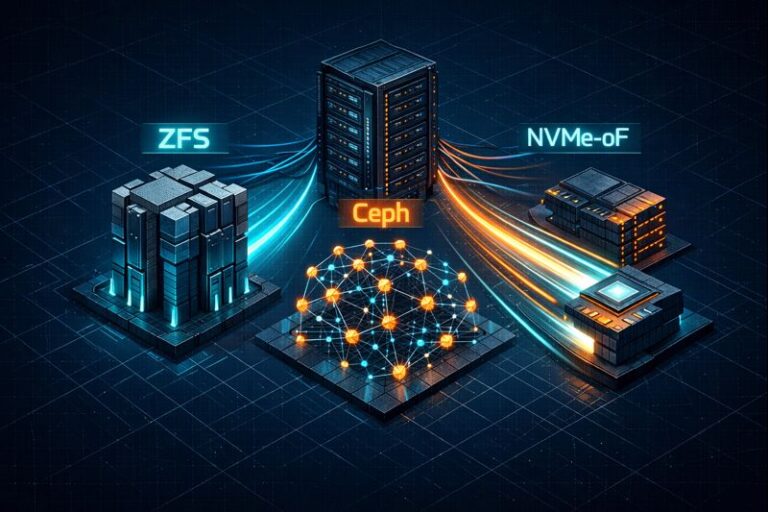
ZFS vs Ceph vs NVMe-oF: Choosing the Right Storage Backend for Modern Virtualization
I still have nightmares about a storage migration I ran back in 2014. >_ Architect’s Brief 60-second read before you commit to the full post ▼ Generating brief… We were moving off a monolithic SAN and onto an early “software-defined” storage platform. The sales engineers promised infinite scalability and self-healing magic. Two weeks in, a…
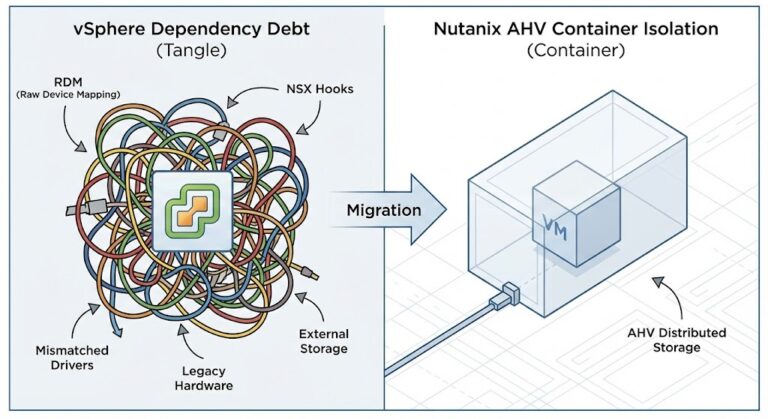
vSphere to AHV Migration Strategy: A Risk-Deterministic Framework for Legacy Workloads
Latency Is Undefeated: The Physics of Migration Failure vSphere estates are hitting Broadcom tax walls in 2026, but licensing isn’t what breaks migrations. Physics does. Across dozens of exits, we’ve seen the same pattern: 70% of migrations stall not because of tooling, but because of RDMs, driver mismatches, and NSX state bleed. What begins as…
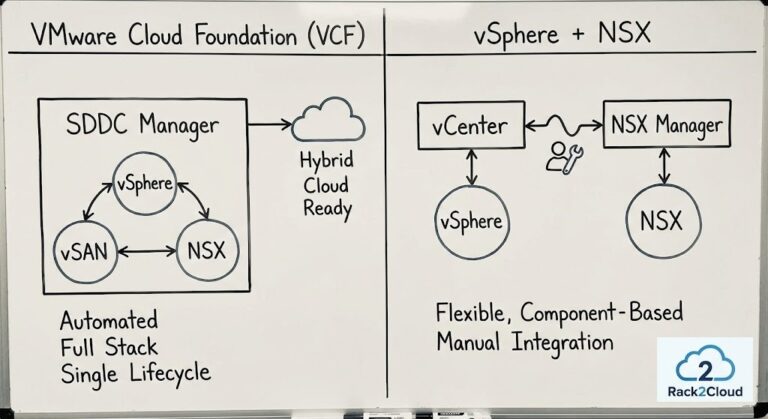
VMware Cloud Foundation vs. vSphere + NSX: A Deep Dive on Positioning for SEs
The VMware Cloud Foundation vs vSphere decision used to be straightforward. VCF was for large enterprises building a full software-defined data center. vSphere was for everyone else. The component model in between — vSphere plus individual add-ons as needed — gave architects the flexibility to match licensing to actual requirements. >_ Architect’s Brief 60-second read…
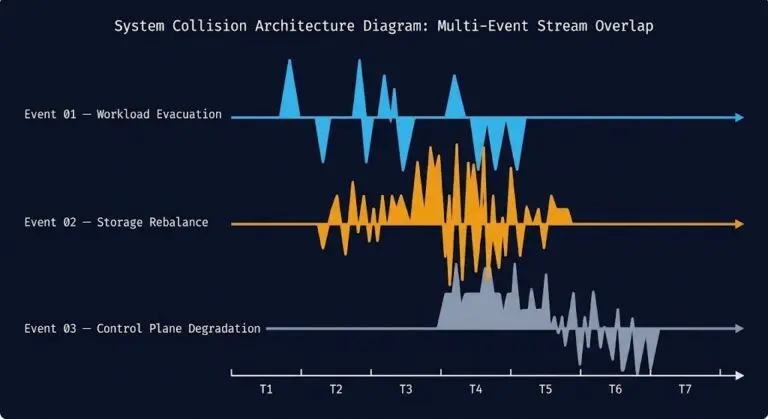
Upgrade Physics: Designing for Rolling Maintenance Without Stopping Production
>_ The Post-Broadcom Migration Series Complete — Part 1 — Execution Physics Beyond the VMDK: Translating Execution Physics from ESXi to AHV >_ Architect’s Brief 60-second read before you commit to the full post ▼ Generating brief… Complete — Part 2 — Resource Contention The Controller Tax: Modeling Hyperconverged Resource Contention Complete — Part 3…
Translating the Stack: A Field Guide to Migrating NSX-T Security to Nutanix Flow
Migrating from NSX-T to Nutanix Flow isn’t a firewall rule export — it’s a philosophy shift from network-centric security to workload-centric identity, and getting that translation wrong creates security holes before Day 1 is over. The most dangerous part of a hypervisor migration isn’t moving the data—it’s moving the logic. In the VMware ecosystem, NSX-T…
The vCenter Control Plane: Optimization, Sizing, and the “Hidden” Java Tax
Most engineers treat the vCenter Server Appliance (VCSA) like a utility — a simple management console that just needs to “be there.” They deploy it using the “Tiny” preset, snapshot it once a month, and then complain when the HTML5 interface takes eight seconds to load or the API times out during a Terraform apply….