

How to Read a Cloud Bill Like an Architect
Cloud bill analysis is one of the most underused diagnostic tools in infrastructure architecture. Most engineers avoid it because it looks like finance. Most architects cannot afford to — because buried in the noise are five recurring signals that expose design decisions, not usage accidents.
Thousands of rows. Hundreds of services. Endless SKU fragments. Most of it is noise.
But buried in that noise are five recurring line items that tell you something much more useful than what you spent last month: they tell you which infrastructure decisions are quietly compounding into structural cost. Call them the Five Architecture Signals — the recurring billing patterns that expose design decisions, not usage accidents.
Engineers ignore the bill because it looks like finance. Architects cannot afford to. It is one of the clearest diagnostics your platform produces.
The cloud bill is not useful because it tells you what you spent. It is useful because it tells you what your architecture keeps paying for.
Cloud Bill Analysis: Reading for Architecture, Not Spend
Cloud bill analysis stops being useful the moment you treat it as accounting. The five signals below are not cost categories. They are architecture pattern recognition — each one pointing back to a decision made before FinOps ever saw the number.
Signal 1: Egress Is a Topology Signal
This is not a networking line item. It is a placement line item.
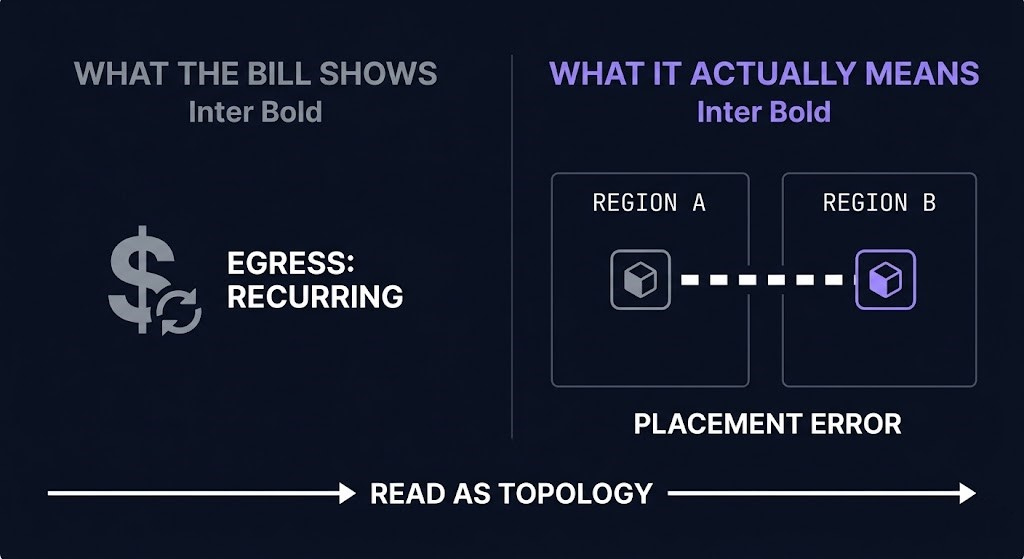
High recurring egress does not mean your team is transferring too much data. It means your services are in the wrong places relative to each other. The data is crossing a boundary it should not need to cross — and it will keep crossing it on every request, every replication cycle, every backup run, until the topology changes.
Look for: cross-region service chatter, cloud-to-cloud dependencies, analytics pipelines pulling data across zone or region boundaries, backup jobs routing through egress paths that were never designed for that volume.
Cloud egress cost is a direct function of architecture, not traffic volume. The exit cost model applies here directly — egress is one of the clearest commitment points where topology decisions become recurring spend. A high egress line item is your platform telling you that something is placed wrong. It will keep telling you until you fix the placement.
Egress is not a transfer problem. It is a topology problem.
For a detailed breakdown of the specific 2026 surcharges driving egress increases — IPv4, NAT Gateway, and cross-AZ traffic — see the 2026 cloud cost analysis.
Signal 2: Idle Compute Is a Demand Modeling Signal
This is not “too many instances.” Idle compute on your bill is a forecasting artifact — the financial residue of a demand model that was wrong at provisioning time.
Look for: reserved instances running below utilization thresholds, autoscaling groups that provision for peak and never scale down cleanly, GPU capacity allocated to workloads that run in bursts but hold resources continuously, baseline compute sized for a load that never materialized.
Your AI cluster is idle 95% of the time is the sharpest current example — but the pattern runs across every compute layer. Idle compute is not utilization waste. It is forecasting debt. The capacity model was wrong before the first instance launched, and the bill is showing you the compounding interest on that decision.
The fix is not rightsizing. Rightsizing is a reporting action applied after the commitment. The fix is demand modeling before provisioning — treating capacity as a design variable, not an operational adjustment.
Signal 3: Storage Tier Drift Is a Retention Signal
Storage cost creep is rarely a storage growth problem. It is almost always a policy drift problem — data aging into the wrong tier, or failing to age at all.
Look for: hot-tier storage holding data that has not been accessed in months, snapshots without expiry enforcement accumulating indefinitely, archive tiers provisioned but never populated because lifecycle rules were never written, duplicated retained objects across regions that were created for a specific purpose and never cleaned up.
Backup architecture is where this shows up most visibly — retention schedules inherited from on-premises defaults and never re-evaluated in a cloud cost context. The data hardening model defines retention as a deliberate design decision. The bill shows you when it became an afterthought.
Storage tier drift is a retention signal. The line item is not telling you that you have too much data. It is telling you that nobody owns the policy that governs where data goes and when it moves.
Signal 4: Managed Service Markup Is an Abstraction Tax
Teams buy managed services to reduce operational load. That is often the correct trade. The bill tells you when the trade stopped being correct — when convenience became a structural margin embedded in every recurring cost line.
Look for: managed Kafka running at a cost premium over self-hosted for a workload that no longer requires the operational simplicity that justified the premium, managed NAT gateways accumulating charges that dwarf the networking traffic they serve, managed observability platforms where the cost of the platform has exceeded the value of the visibility it provides, managed control planes carrying overhead that scales with the platform, not with your workload.
This is not an argument against managed services. Operational simplicity has real value and the abstraction tax is often worth paying. But the bill is the only place where the actual cost of that abstraction becomes visible — and vendor lock-in through the networking and platform layer compounds silently until the bill makes it legible.
The managed service markup line is your platform asking whether the abstraction is still earning its premium.
Signal 5: Snapshot Sprawl Is Policy Drift
Snapshots and backup objects are where governance drift becomes financially visible. Snapshot growth is rarely a storage capacity problem. It is a policy ownership problem — the organizational question of who is responsible for defining, enforcing, and reviewing retention has not been answered.
Look for: no expiry enforcement on snapshot schedules, overlapping backup policies from multiple tools covering the same resources, retention schedules inherited from a compliance template and never reviewed against actual recovery requirements, snapshots created for a migration or test event and never cleaned up.
Recovery architecture defines what you need to keep and for how long. The bill shows you what you are actually keeping. When those two things diverge, the snapshot sprawl line item is the signal. It compounds every cycle until someone owns the policy.
Snapshot sprawl is not an operations problem. It is a governance problem with a billing consequence.
AI consumption pricing is the same failure mode at architecture scale: see Why C-Suite Leaders Struggle With AI Consumption Pricing for what happens when the thing generating the bill is a runtime decision — an agent’s retry logic, a routing default — that no approval process ever reviewed, not a policy default nobody cleaned up.
Architect’s Verdict
The cloud bill is a lagging signal. By the time the spend appears, the architecture decision is already in production. Most of the noise in the bill is just usage — the expected cost of systems doing what they were designed to do.
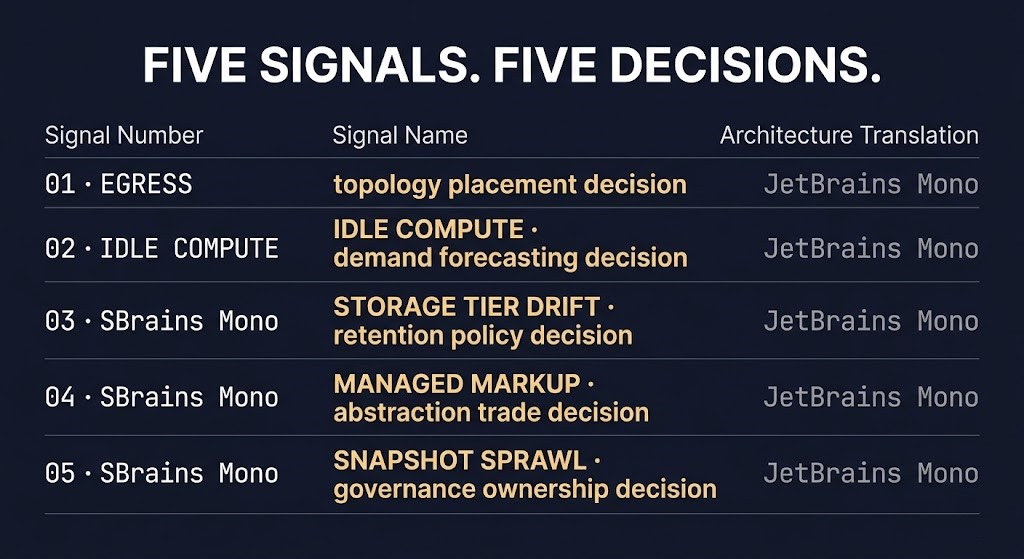
The Five Architecture Signals are different. They recur because the architecture keeps making the same decision. Egress charges come back every month because the topology has not changed. Idle compute accumulates because the demand model has not been corrected. Storage tier drift compounds because the retention policy has not been enforced. Managed service markups persist because the abstraction trade has not been re-evaluated. Snapshot sprawl grows because nobody owns the policy.
Read the bill like a cost report” With: “Treat cloud bill analysis as a cost report and you will find waste. Treat it as a systems diagnostic and you will find design flaws.
The bill does not lie. It speaks in architecture, not accounting. These five signals are your platform telling you what it keeps paying for — and why.
Additional Resources
Editorial Integrity & Security Protocol
This technical deep-dive adheres to the Rack2Cloud Deterministic Integrity Standard. All benchmarks and security audits are derived from zero-trust validation protocols within our isolated lab environments. No vendor influence.

R.M.
Senior Solutions Architect with 25+ years of experience in HCI, cloud strategy, and data resilience. As the lead behind Rack2Cloud, I focus on lab-verified guidance for complex enterprise transitions. View Credentials →
Get the Playbooks Vendors Won’t Publish
Field-tested blueprints for migration, HCI, sovereign infrastructure, and AI architecture. Real failure-mode analysis. No marketing filler. Delivered weekly.
Select your infrastructure paths. Receive field-tested blueprints direct to your inbox.
- > Virtualization & Migration Physics
- > Cloud Strategy & Egress Math
- > Data Protection & RTO Reality
- > AI Infrastructure & GPU Fabric
Zero spam. Includes The Dispatch weekly drop.
Architecture Audit Services
Fixed-scope audits for Zero-Trust Azure, VMware migration readiness, and recovery posture — no discovery call required to start.
>_ View Audit Services>_Related Posts
Your Monitoring Didn’t Miss the Incident. It Was Never Designed to See It.
I’ve watched observability vs monitoring play out as a live incident more times than I can count. >_ Architect’s Brief 60-second read before you commit to the full post · Full post: 10 min Generating brief… The dashboard was green. The on-call engineer was not paged. The monitoring system did exactly what it was designed…
Your Kubernetes Cluster Isn’t Out of CPU — The Scheduler Is Stuck
Compute Tier 1 Authority Cascades to ➔ >_ Architect’s Brief 60-second read before you commit to the full post · Full post: 9 min Generating brief… [Storage] [Network] 🚨 Failure Signature Detected Grafana shows cluster CPU utilization is under 50%, but pods are stuck in Pending. Events show: 0/10 nodes are available: 10 Insufficient cpu….
Your Identity System Is Your Biggest Single Point of Failure
Part 2 of the Rack2Cloud’s Cloud Fragility Series >_ Cloud Fragility Series 01 Multi-Cloud Cascading Failure Risks 02 Your Identity System Is Your Biggest Single Point of Failure [CURRENT] 03 Vendor Lock-In Happens Through Networking — Not APIs 04 Your Cloud Bill Quietly Increased in 2026 — Here’s Where the Money Is Actually Going >_…
Your Identity Provider Was Never Your Spend Boundary
Every enterprise cloud governance program assumes a spend boundary sits somewhere between identity and money — a checkpoint that catches compromised access before it becomes compromised spend. It doesn’t exist. Not as a distinct control. Not as a separate policy layer. Not anywhere in the architecture most organizations have actually built. >_ Architect’s Brief 60-second…
Your Identity Controls Passed. Your Authorization Chain Failed.
A credential chain functioned exactly as it was designed to. No firewall failed. No exploit executed. No malware bypassed a control. A red team walked past physical and social barriers using nothing more exotic than a plausible pretext, and came out the other side holding network admin credentials — issued correctly, authorized correctly, working exactly…
Your DR Test Passed. The Assumptions Didn’t.
DR plan failure rarely happens where you tested. It happens at the assumptions the exercise never reached — the dependencies that weren’t in scope, the runbook written for last year’s architecture, the authority chain nobody tested at 2am.