

Cost Visibility Is Not Cost Control

Cost visibility tells you what your architecture costs. Cost control determines whether that architecture should have existed in the first place.
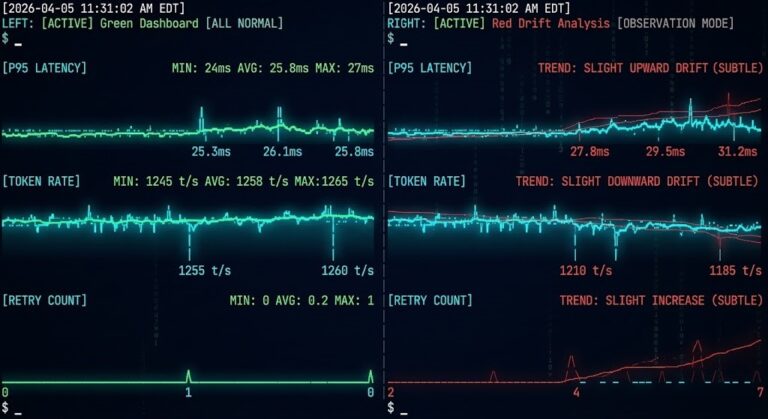
These are not the same discipline. Most organizations treat them as if they are — and the FinOps data proves they have been doing so for years without fixing the underlying problem.
The State of FinOps 2026 report found that 98% of organizations are now actively managing AI spend. Tooling investment has increased. Executive ownership has expanded. Reporting has become more granular. And yet organizations without structured cost governance still waste 32–40% of their cloud budgets on idle resources, oversized instances, and structural inefficiencies that dashboards surface but cannot remove.
More visibility. Same waste. That is the signal worth paying attention to.
Visibility Is a Reporting Layer, Not a Control Layer
FinOps tools do several things well. They surface spend. They expose waste. They identify anomalies. They allocate costs across teams and workloads. These are genuinely useful capabilities — the problem is that none of them can prevent the architecture decision that created the bill.
This distinction matters because most cost governance programs are built around observation, not prevention:
- Dashboards show you where money went
- Alerts tell you spend has increased
- Tagging lets you attribute cost to a team
- Optimization recommendations identify inefficiency
- Monthly reviews give you a structured moment to react
Traditional FinOps breaks on AI workloads because cost authority moved to architecture decisions — and visibility alone can’t govern decisions that happened weeks before the invoice.
Every one of those mechanisms operates after the decision. The commitment — the topology choice, the platform selection, the replication model, the egress dependency — was made upstream. By the time FinOps sees the number, the architecture has already answered the cost question.
Cloud cost is now an architectural constraint — but that constraint only bites when you treat cost as a design variable rather than a reporting output. Visibility is lagging telemetry. It tells you what happened. It does not determine what was allowed to happen.
That distinction is the entire argument.
The Spend Decision Horizon
There is a point in the architecture lifecycle where cost becomes structurally committed and no longer meaningfully adjustable through reporting. Call it the Spend Decision Horizon.
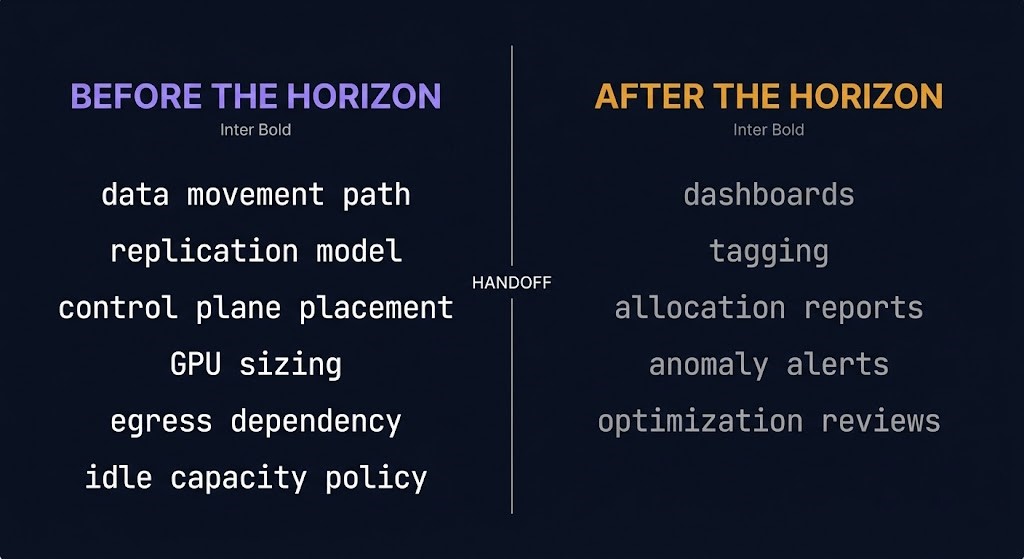
Before that horizon, cost is a design variable. Service topology, data movement paths, replication models, control plane placement, GPU sizing, retention architecture, egress dependencies, idle capacity policy — these decisions are live. The architect is in the room. The cost outcome is still shapeable. AI inference cost behaves like egress — invisible until it hits, generated by architectural patterns committed weeks before the first token is consumed.
After that horizon, cost is an observation. Dashboards appear. Tagging spreads. Allocation reports get generated. Anomaly alerts fire. Monthly optimization reviews happen. None of those activities change the architecture that produced the number.
The Spend Decision Horizon is not a concept. It is a handoff. Before it, the architect owns cost. After it, FinOps has the receipt.
The reason most cost governance programs underperform is that they are built entirely on the right side of that horizon. They are sophisticated receipt-reading operations with no authority over what gets ordered. Steady-state inference cost exists entirely on the left side of the horizon — permanent residency committed at deployment time, invisible to rightsizing logic applied weeks later.
This maps directly to what the exit cost architecture model makes visible for platform and migration decisions: the cost of a choice is not realized when you see the bill. It is committed when you make the architectural decision.
Where Cost Actually Gets Locked In
The Spend Decision Horizon is defined by five commitment points. These are the moments where spend transitions from negotiable to structural.
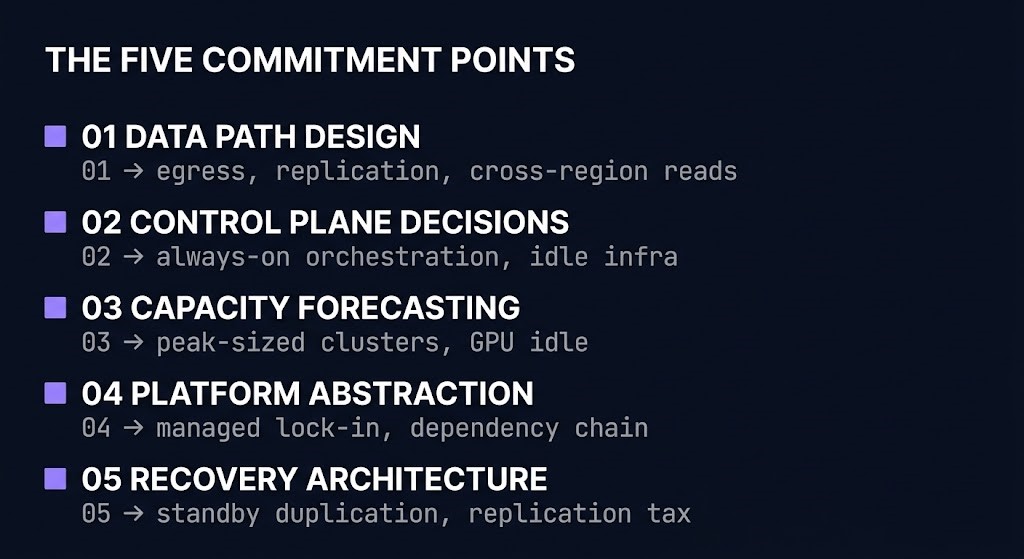
1. Data path design
How data moves through your architecture determines a significant portion of your recurring cost before a single workload runs. Cross-region reads, replication, egress, archive retrieval — these are not line items you optimize after deployment. They are the outcome of topology decisions made during design. Cloud egress costs are a direct function of architecture, not usage patterns. Once the data path is established, the cost model follows it.
How to Read a Cloud Bill Like an Architect maps the five architecture signals embedded in your spend data — the specific line items that tell you which of these commitment points fired and where.
2. Control plane decisions
Always-on orchestration, management overhead, idle infrastructure, and operational tooling all carry a cost that compounds at scale. The control plane shift describes how infrastructure decisions have converged around who owns the execution layer — and that ownership question has a direct cost implication that FinOps tools typically cannot touch. The control plane was placed before FinOps arrived. Inference steady state cost demonstrates why warm capacity and continuous serving overhead create a permanent residency floor that no FinOps optimization can eliminate.
3. Capacity forecasting
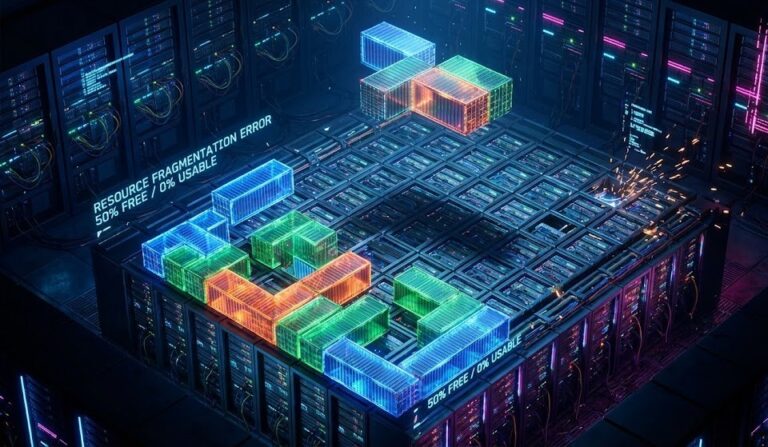
Peak-sized clusters, overprovisioned GPU infrastructure, and statically allocated compute are the loudest signals in any cost audit. But the overprovisioning was a forecast decision, not a utilization decision. GPU idle is a capacity forecasting failure, not a scheduler problem — and the same logic applies across all compute layers. You cannot optimize your way out of a demand model that was wrong at provisioning time. That forecasting discipline is precisely the muscle AI infrastructure has forced enterprises to rebuild — not a scheduling problem, a planning discipline that atrophied for fifteen years and is now back on the architect’s side of the horizon, not FinOps’s.
Capacity forecasting is a commitment point in both directions, and this post’s Spend Decision Horizon frame applies to each the same way. The Capacity You Paid For But Never Used takes the horizon concept and applies it specifically to the downside case — capacity committed against a forecast that never arrives — and asks why that side of the horizon gets so much less scrutiny at approval time than the side that protects against running short. Texas’s ERCOT interconnection queue is the same commitment-point failure one layer upstream of either direction — a reservation accepted into the planning system with no mechanism to validate it represented real demand before it ever influenced a forecast at all, the pattern Framework #171 names as Phantom Capacity.
4. Platform abstraction choices
Managed services, proprietary data layers, and convenience abstractions trade operational simplicity for structural spend commitment. Data gravity is the mechanism: once data accumulates around a managed platform, movement cost locks in. Vendor lock-in happens through the networking layer, not through APIs — and by the time the cost is visible in a dashboard, the dependency chain is already load-bearing.
5. Recovery architecture
Standby duplication, replication tax, and restore-path cost are a function of how recovery was designed. Ransomware recovery time is an architecture problem, not a backup product problem — and the same holds for cost. The replication model, the standby footprint, and the recovery tier placement all commit spend at design time. FinOps sees the storage and compute bill. It does not redesign the recovery architecture.
Why FinOps Can See Waste But Not Remove It
This is not a criticism of FinOps. It is a description of its structural position in the decision chain.
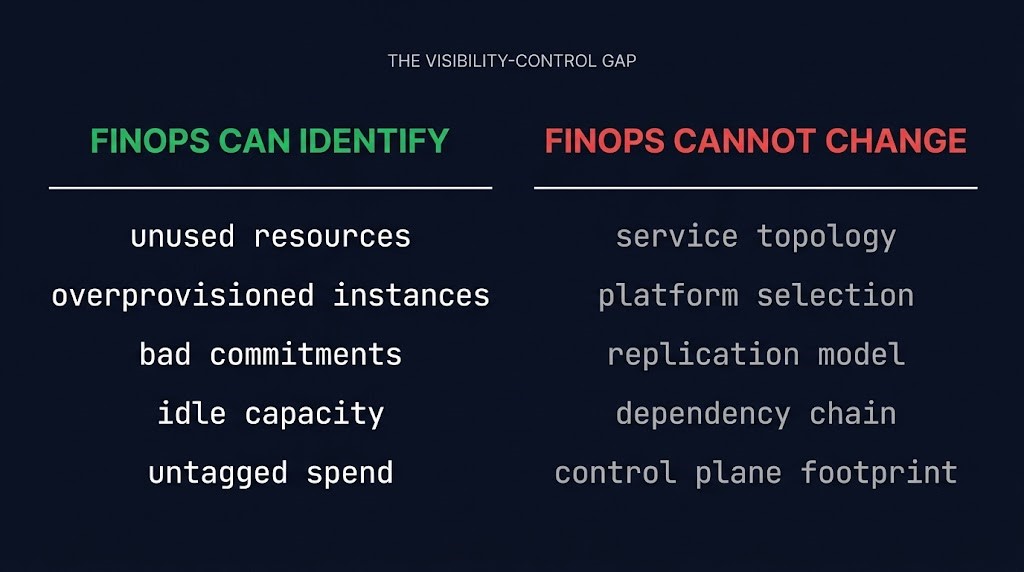
FinOps can identify unused resources, overprovisioned instances, bad commitment purchases, idle capacity, and untagged spend. That visibility is real and valuable. The problem is that identifying the consequence is not the same as owning the cause.
AI consumption pricing pushes that same gap one layer further — see Why C-Suite Leaders Struggle With AI Consumption Pricing for what happens when even the cause isn’t a provisioning decision anymore, but a runtime one.
FinOps typically cannot change:
- The service topology
- The platform selection
- The replication model
- The dependency chain
- The control plane footprint
- The egress architecture
Those decisions were made by architects, platform teams, and engineering leads — usually without cost explicitly modeled as a design constraint. AI inference cost is the clearest current example: the decision to use a particular model, route to a particular endpoint, or replicate across a particular region commits spend that observability tooling can surface but not prevent.
There is a pattern that has emerged as FinOps has scaled into larger organizations: shared ownership becoming no ownership. When cost accountability is distributed across engineering, finance, and platform teams without clear authority over architectural decisions, the observation layer grows while the control layer stays frozen. More people watching the dashboard. Nobody with authority to change what the dashboard is measuring.
Cost-aware model routing is one of the few places where control has been pushed back left — where the routing decision itself carries cost logic rather than cost logic being applied after the routing is done. It is a useful model for what pre-horizon control looks like in practice.
Cost Control Starts Before Deployment
The corrective framing is not a checklist. It is a single shift in where cost enters the architecture conversation.
Cost control starts at:
- Architecture review, where topology and data path decisions are still live
- Workload placement, where capacity forecasting is still a design input
- Control plane design, where operational overhead is still negotiable
- Dependency design, where platform abstraction tradeoffs are still explicit
- Demand modeling, where GPU scheduling and capacity shape are still shapeable
Not after the bill arrives.
The teams that consistently achieve meaningful cost efficiency are not the ones with the best dashboards. They are the ones that treat cost as a first-class architectural constraint — alongside reliability, security, and performance — before the first resource is provisioned. Inference observability provides the measurement layer that makes pre-horizon decisions traceable — but measurement without enforcement is still post-horizon reporting.
Execution budgets are an example of what this looks like in the AI inference layer: runtime cost limits designed into the system rather than imposed on it from a reporting layer after deployment. Cost-aware model routing operates at the same layer — routing decisions made before cost materializes, not billing adjustments made after. The limit is architectural. The visibility is secondary.
The five commitment points mapped above — data path, control plane, capacity forecasting, platform abstraction, and recovery architecture — are the architectural inputs to a cost structure that Economic Architecture, the Operational stage of the Cloud Strategy Architecture Learning Path, models in full (Framework #131: Economic Gravity Boundary). Egress as a recurring cost driver, data gravity as a capital allocation constraint, and idle capacity as structural waste are not separate FinOps findings — they are the economic behavior the architecture’s pre-horizon decisions already determined.
The same pre-horizon decisions also determine movement viability. A platform abstraction choice made for convenience at deployment time — Commitment Point 4 — is simultaneously a movement constraint: it determines which movement zone the resulting workload occupies if a future strategic decision requires moving it. Movement Architecture, the Operational stage that precedes Economic Architecture, classifies these constraints before they surface as a Constraint Discovery Event (Framework #127: Movement Authority Boundary).
Cost visibility is not the problem. Visibility is useful. The problem is treating it as the solution. Concentration exposure is the same argument aimed at a different commitment — the number that matters isn’t what a dependency costs monthly, it’s what it costs if it’s unavailable for a day, and that number is just as pre-horizon as any of the five commitment points above.
Architect’s Verdict
The FinOps stack has never been more sophisticated. Spend is visible. Allocation is granular. Anomalies are caught faster. Optimization recommendations are automated. And organizations are still wasting a third of their cloud budgets on structural decisions that no amount of dashboard sophistication can undo.
Visibility is lagging telemetry. It describes the cost of decisions already made. It cannot reach back across the Spend Decision Horizon and change the topology, the platform choice, the replication model, or the capacity forecast that produced the number.
Cost control is not a reporting discipline. It is an architecture discipline. The five commitment points — data path, control plane, capacity forecasting, platform abstraction, and recovery architecture — are where spend is decided, not observed. Governance programs built entirely after those decisions are sophisticated receipt-reading operations with no authority over what gets ordered.
The Spend Decision Horizon is not a concept. It is a handoff. Before it, the architect owns cost. After it, FinOps has the receipt. The question is not whether your dashboards are good enough. The question is how much of your cost structure was already committed before FinOps was ever in the room.
Additional Resources
Editorial Integrity & Security Protocol
This technical deep-dive adheres to the Rack2Cloud Deterministic Integrity Standard. All benchmarks and security audits are derived from zero-trust validation protocols within our isolated lab environments. No vendor influence.

R.M.
Senior Solutions Architect with 25+ years of experience in HCI, cloud strategy, and data resilience. As the lead behind Rack2Cloud, I focus on lab-verified guidance for complex enterprise transitions. View Credentials →
Get the Playbooks Vendors Won’t Publish
Field-tested blueprints for migration, HCI, sovereign infrastructure, and AI architecture. Real failure-mode analysis. No marketing filler. Delivered weekly.
Select your infrastructure paths. Receive field-tested blueprints direct to your inbox.
- > Virtualization & Migration Physics
- > Cloud Strategy & Egress Math
- > Data Protection & RTO Reality
- > AI Infrastructure & GPU Fabric
Zero spam. Includes The Dispatch weekly drop.
Architecture Audit Services
Fixed-scope audits for Zero-Trust Azure, VMware migration readiness, and recovery posture — no discovery call required to start.
>_ View Audit Services>_Related Posts
Your Monitoring Didn’t Miss the Incident. It Was Never Designed to See It.
I’ve watched observability vs monitoring play out as a live incident more times than I can count. >_ Architect’s Brief 60-second read before you commit to the full post · Full post: 10 min Generating brief… The dashboard was green. The on-call engineer was not paged. The monitoring system did exactly what it was designed…
Your Kubernetes Cluster Isn’t Out of CPU — The Scheduler Is Stuck
Compute Tier 1 Authority Cascades to ➔ >_ Architect’s Brief 60-second read before you commit to the full post · Full post: 9 min Generating brief… [Storage] [Network] 🚨 Failure Signature Detected Grafana shows cluster CPU utilization is under 50%, but pods are stuck in Pending. Events show: 0/10 nodes are available: 10 Insufficient cpu….
Your Identity System Is Your Biggest Single Point of Failure
Part 2 of the Rack2Cloud’s Cloud Fragility Series >_ Cloud Fragility Series 01 Multi-Cloud Cascading Failure Risks 02 Your Identity System Is Your Biggest Single Point of Failure [CURRENT] 03 Vendor Lock-In Happens Through Networking — Not APIs 04 Your Cloud Bill Quietly Increased in 2026 — Here’s Where the Money Is Actually Going >_…
Your Identity Provider Was Never Your Spend Boundary
Every enterprise cloud governance program assumes a spend boundary sits somewhere between identity and money — a checkpoint that catches compromised access before it becomes compromised spend. It doesn’t exist. Not as a distinct control. Not as a separate policy layer. Not anywhere in the architecture most organizations have actually built. >_ Architect’s Brief 60-second…
Your Identity Controls Passed. Your Authorization Chain Failed.
A credential chain functioned exactly as it was designed to. No firewall failed. No exploit executed. No malware bypassed a control. A red team walked past physical and social barriers using nothing more exotic than a plausible pretext, and came out the other side holding network admin credentials — issued correctly, authorized correctly, working exactly…
Your DR Test Passed. The Assumptions Didn’t.
DR plan failure rarely happens where you tested. It happens at the assumptions the exercise never reached — the dependencies that weren’t in scope, the runbook written for last year’s architecture, the authority chain nobody tested at 2am.