

Nutanix vs VMware: The Post-Broadcom Decision Framework (2026)
The Nutanix vs VMware post-Broadcom decision isn’t a hypervisor evaluation anymore — it’s a vendor-exposure decision with multi-year budget consequences.
Pre-Broadcom, the VMware vs. Nutanix conversation was an architecture conversation. You weighed feature sets, performance characteristics, ecosystem depth, and operational fit. The hypervisor was a technical decision.
Post-Broadcom, the unit of decision changed entirely. You are no longer optimizing architecture. You are optimizing vendor exposure. The question on the table isn’t which platform performs better in a benchmark — it’s whether you accept VMware’s new contract model or design around it.
That reframe matters because it changes who needs to be in the room. This isn’t a vSphere admin decision. It’s a CTO and infrastructure architect decision with multi-year budget implications. If you’re evaluating this comparison to settle a technical debate, you’re solving the wrong problem.
It’s also worth being precise about which room this is. Nutanix is one answer inside what has become a three-way market split — Consolidators staying on VMware, Replacers swapping hypervisors, Absorbers folding VMs into Kubernetes. This post covers the Replacer decision specifically.
What Actually Changed After Broadcom
Before making any platform argument, it’s worth being precise about what shifted — the details are what make this decision non-trivial. They’re the foundation of any Nutanix vs VMware post-Broadcom evaluation.
The cost impact varies significantly by environment. For detailed modeling of VVF vs. VCF core economics, the VMware Licensing Cost Model walks through the per-core math. The VMware Licensing Costs post covers where most estimates go wrong under the new structure.
VMware’s New Operating Model
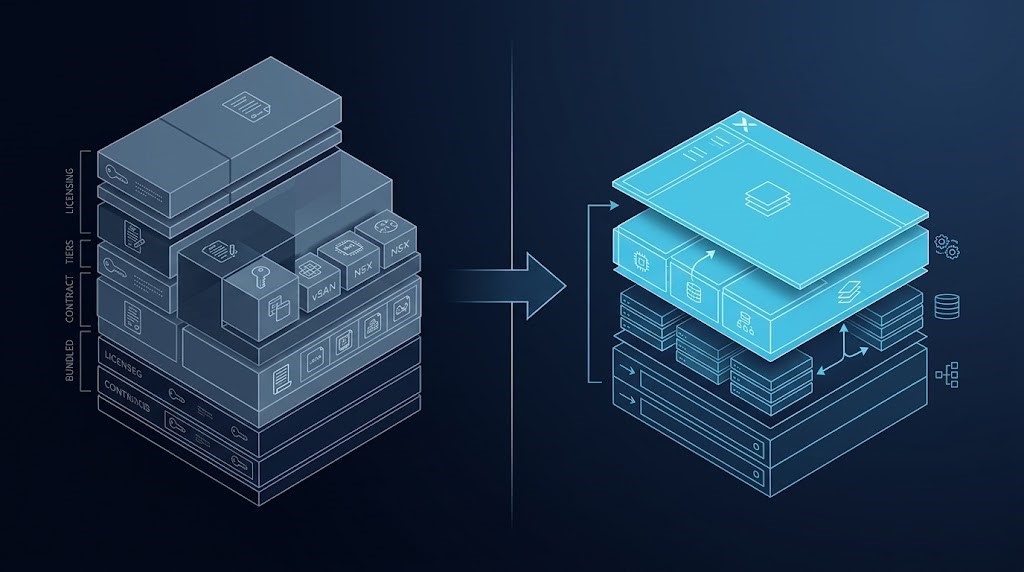
The framing that matters for architects: VMware is no longer a modular stack. It is a bundled platform with enforced consumption patterns.
You are no longer licensing components. You are accepting a platform contract.
That’s not editorializing — it’s a structural description of what VVF and VCF actually are. When you sign a VMware renewal today, you are committing to a consumption tier that determines what you can run, at what scale, under what support terms. The architectural flexibility that made VMware’s ecosystem valuable — the ability to compose your own stack from vSphere, NSX, vSAN, SRM independently — is now gated behind bundle economics.
For organizations that were running partial VMware stacks (vSphere only, or vSphere + vSAN without NSX), the new model forces a choice: pay for capabilities you don’t use, or re-evaluate the platform entirely.
The Four Axes That Actually Decide This
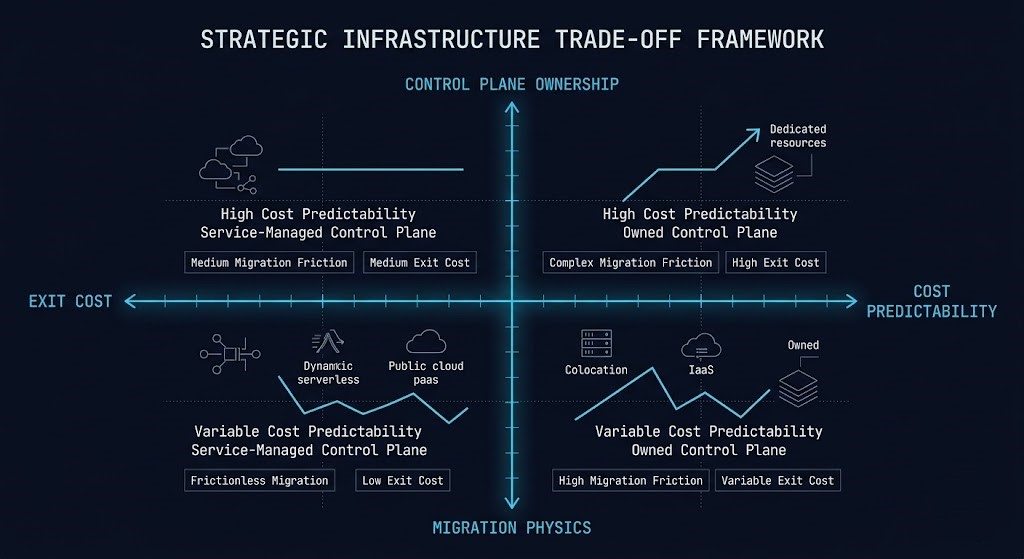
Most VMware vs. Nutanix comparisons run a feature matrix. That’s the wrong lens. These are the four axes that actually determine whether you stay or migrate:
Axis 02 deserves a direct answer for architects choosing to stay. VMware Private AI Cloud Doesn’t Eliminate Fragmented Control Planes — It Creates an Authority Relay tests Broadcom’s VCF 9 pitch against exactly this question and finds that “control plane ownership” under the new unified-platform framing means VCF Operations coordinates the roadmap across virtualization, AI governance, and security — it doesn’t mean any one of those domains’ architectural decisions become more yours to make.
What Nutanix AHV Actually Is (With the Reality Check)
AHV is mature. That’s no longer a debate — Nutanix has been shipping AHV in production enterprise environments since 2015, and the “immature hypervisor” narrative is a decade out of date. The real evaluation is what you’re getting and what you’re giving up.
What AHV delivers today:
AHV is the native Nutanix hypervisor, tightly integrated with AOS (the distributed storage fabric) and managed through Prism Central — a single control plane for compute, storage, and networking across sites. In 2026, AHV supports live migration, microsegmentation via Nutanix Flow, NearSync replication for near-zero RPO DR scenarios, and native Kubernetes via NKE.
The integrated control plane is the operational story. Instead of managing vSphere, vSAN, NSX, and vCenter as separate layers with separate licensing, AHV unifies those functions. That reduces operational fragmentation — fewer interfaces, fewer vendor relationships, fewer licensing negotiations.
The reality check layer:
Nutanix’s ecosystem is narrower than VMware’s. If your environment depends on specific backup integrations, security tooling, or legacy enterprise workflows built around vSphere APIs, you will encounter gaps. The operational model shift is also non-trivial — teams that have run VMware for a decade are not going to retrain overnight, and the tooling muscle memory runs deep.
This is not a reason to stay on VMware post-Broadcom. It’s a reason to scope the migration honestly and not underestimate the change management component.
Migration Physics: The Constraint That Invalidates Half the Options
Most Nutanix vs VMware post-Broadcom comparisons treat migration as a step. It isn’t. Migration is the constraint that determines which theoretical options are actually available to your environment.
The analysis that matters before any platform decision:
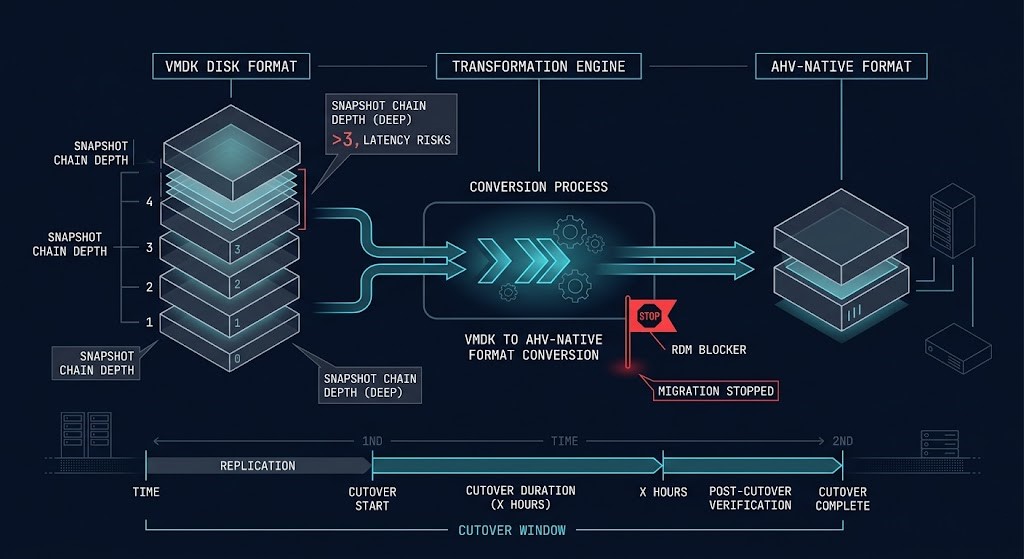
Disk format translation reality. VMware’s VMDK format does not map cleanly to AHV’s native formats. Nutanix Move handles the conversion, but conversion at scale introduces downtime windows, and the translation fidelity varies by workload type. High-I/O databases during cutover are a different problem than idle application servers. The execution physics post covers this in depth.
Snapshot debt. If your environment carries VMs with deep snapshot chains — common in organizations that deferred snapshot consolidation for years — those chains become migration blockers. Snapshot debt must be resolved before migration, not during.
RDM / passthrough edge cases. Physical RDMs (pRDMs) are a hard migration blocker for Nutanix Move. If your inventory includes VMs with raw device mappings — common in Oracle and SQL environments — those workloads require a different migration path or architectural redesign before you can migrate.
Downtime vs. replatform tradeoffs. For business-critical workloads, the question isn’t whether you can migrate — it’s whether you can migrate within an acceptable downtime window. NearSync replication can minimize RPO during cutover, but the cutover itself requires planning that your workload inventory drives, not your preference.
Before committing to a migration path, run your environment through the VMware Migration Readiness Assessment. It surfaces RDM blockers, snapshot debt, zombie VMs, and ISO hygiene issues before they become mid-migration problems.
For architects who have cleared the pre-migration inventory and are ready to sequence the actual transition, the VMware Migration Strategy Track maps the full execution sequence: physics translation, failure domains, policy portability, platform decision criteria, and the governance normalization work that closes the operational continuity gap post-cutover. For architects sizing the destination cluster, the HCI Failure-State Architecture specialization track covers the operational boundary the cluster must maintain to remain deterministic under migration burst load, rebuild amplification, and day-2 operations — the capacity model the platform decision depends on.
Where VMware Still Wins
Being precise matters here — no honest Nutanix vs VMware post-Broadcom comparison skips where the incumbent still wins. VMware’s ecosystem still has genuine depth that Nutanix hasn’t fully matched:
Where Nutanix Wins in 2026
Translated to outcomes rather than features:
For a direct comparison of how availability and authority trade off between the platforms, the Nutanix vs. VMware: Availability vs. Authority post covers that dimension specifically.
Architect’s Verdict
The Nutanix vs VMware post-Broadcom verdict isn’t about which hypervisor is technically superior. It’s whether you accept VMware’s new contract model — or design around it. That’s a business decision with architectural consequences, not an architecture decision with business consequences.
Re-evaluate now if you’re under 500 VMs with no deep NSX dependency, facing a renewal within 12 months, and your snapshot and RDM inventory is clean or manageable. The math has changed. Run a parallel evaluation before you sign the next renewal.
Stabilize and defer if you have a deep NSX investment with production microsegmentation policies, SRM runbooks embedded in DR compliance workflows, or complex Oracle and SQL environments with RDM dependencies. Don’t migrate under renewal pressure — document your dependencies and plan a structured exit over 18–24 months.
Run a parallel evaluation if you’re mid-transformation with hybrid VMware/Nutanix already in place, or facing competing internal pressures between cloud, on-prem, and HCI. Don’t commit either direction yet. Let your actual workload inventory drive the decision before the next budget cycle forces it.
The Post-Broadcom Migration Series covers the full exit strategy across five parts if you’re moving toward a structured migration. The Proxmox vs. Nutanix vs. VMware post covers the three-way comparison if Nutanix isn’t the only alternative under evaluation.
Additional Resources
View 4 more resources
Editorial Integrity & Security Protocol
This technical deep-dive adheres to the Rack2Cloud Deterministic Integrity Standard. All benchmarks and security audits are derived from zero-trust validation protocols within our isolated lab environments. No vendor influence.

R.M.
Senior Solutions Architect with 25+ years of experience in HCI, cloud strategy, and data resilience. As the lead behind Rack2Cloud, I focus on lab-verified guidance for complex enterprise transitions. View Credentials →
Get the Playbooks Vendors Won’t Publish
Choose the architecture problems you care about. Get field-tested playbooks and frameworks delivered to your inbox.
- > AI Infrastructure & Inference Economics
- > Cloud Strategy & Hidden Cost Models
- > Virtualization & Deterministic Migration
- > Kubernetes, IaC & Modern Infrastructure
- > Data Protection & Recovery Engineering
Zero spam. Includes The Dispatch weekly drop.
Need Architectural Guidance?
Independent review before major infrastructure decisions.
- > Validate assumptions
- > Identify hidden dependencies
- > Quantify migration risk
- > Challenge vendor narratives
Triage · Advisory · Fractional · Direct Hire