

RECOVERY READINESS ASSESSMENT
WHAT BREAKS FIRST IN YOUR ARCHITECTURE — BEFORE IT ACTUALLY DOES.
Most organizations discover their recovery architecture during an incident — not before it. The Recovery Readiness Assessment maps the five architectural dimensions that determine whether recovery executes or stalls under real incident conditions: identity survivability, control plane availability, data layer integrity, dependency complexity, and recovery validation maturity.
The gap between backup readiness and recovery readiness is where most ransomware recovery failures happen. Having immutable backups does not guarantee recovery. Having a runbook does not guarantee execution. This assessment surfaces the specific architectural dependency that is most likely to block recovery before the incident occurs — when it can still be addressed.
The output is not a maturity score. It is a failure analysis. Each dimension is evaluated against the failure mode it produces under incident conditions — and the assessment identifies your first failure point, the architectural gap most likely to stop recovery before data restoration begins. The result includes an architecture profile classification, a recommended first action, and a consequence framing for what the current configuration means under real pressure.
Five questions. Two minutes. A diagnostic that most architecture reviews never produce. No account required. No data collected. Runs entirely in your browser.
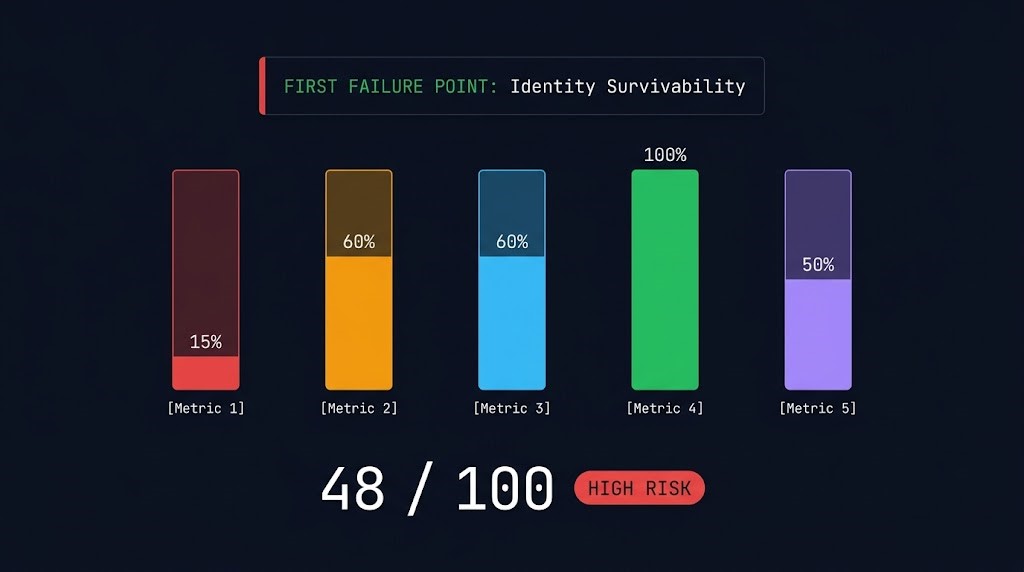
Recovery Readiness Assessment: Key Features
Five Dimensions. One First Failure Point.
The assessment evaluates the five architectural layers that determine whether recovery executes or stalls under real incident conditions. Each dimension maps directly to a failure mode — not a maturity tier.
The #1 real-world recovery blocker. If your identity provider is in the same blast radius as the incident, recovery cannot begin — regardless of backup integrity.
Recovery requires orchestration. If your control plane is shared with production or reachable from a compromised network, automated recovery workflows cannot execute.
Immutability protects your data — not your access paths or orchestration. This dimension evaluates whether your backup data survives the attack and remains reachable under pressure.
Where your backup data lives determines whether a single failure event can eliminate both production and recovery simultaneously. Data placement is a hidden RTO constraint.
A runbook is not a recovery path. Architectures drift from their documentation. This dimension evaluates whether your recovery execution has been tested against the infrastructure that will actually run it.
YOUR SCORE MAPS THE GAP
The assessment identifies where your architecture fails first. The next step is deciding whether to close that gap alone or with someone who has mapped this terrain before. One conversation. Deterministic output.
WORK WITH MEFrequently Asked Questions
Q: What does the Recovery Readiness Score actually measure?
A: The score is not a maturity rating — it is a failure probability index. Each of the five dimensions is scored based on the architectural configuration most likely to fail under real incident conditions, not against an abstract best-practice framework. A score of 40 does not mean your architecture is 40% mature. It means your current configuration has multiple dimensions where recovery may stall before data restoration begins. The First Failure Point callout identifies which dimension will cause that stall first.
Q: What is an Architecture Profile and how is it assigned?
A: The Architecture Profile classifies the combination of your five dimension selections into a named pattern that reflects the primary character of your recovery risk. Profiles include Default Configuration Risk, Backup-Ready Not Recovery-Ready, Segmented but Coupled, Well-Architected Under-Tested, Secure but Operationally Fragile, and Recovery-First Architecture. The profile drives the Recommended First Action.
Q: What should I do with the results?
A: Start with the Recommended First Action. It is derived from your Architecture Profile and targets the highest-leverage improvement for your specific combination of gaps. The First Failure Point identifies the dimension most likely to block recovery first — address that before optimizing other dimensions. The download includes your full scorecard and links to the architectural deep-dives most relevant to your results.
Q: How often should I reassess?
A: Reassess when your infrastructure changes materially — after a migration, a control plane change, a backup architecture update, or a DR test. Architectures drift from their documentation silently. A quarterly reassessment cadence is reasonable for most enterprise environments.
Q: Does this tool store any data?
A: No. The Recovery Readiness Assessment runs entirely in your local browser session. No inputs, scores, or results are transmitted to any server. No cookies are set. No tracking pixels are loaded. When you close the tab, the session ends