

Idle Cost Is the New Egress Cost

Idle cloud cost is now the bill surprise egress used to be — except it’s structurally worse. Egress escaped the architecture. Idle cost is required by it. The entire optimization playbook built around idle assumes you can eliminate it by correcting a provisioning decision. Increasingly, you can’t.
Most modern cloud environments are no longer optimized for utilization efficiency. They’re optimized for response-time predictability. That shift happened gradually — first with pre-warmed Kubernetes nodes, then with always-on service meshes, then with reserved GPU capacity for inference workloads that run in bursts but can’t tolerate cold-start. The bill reflects an architecture that was designed to hold resources, not consume them.
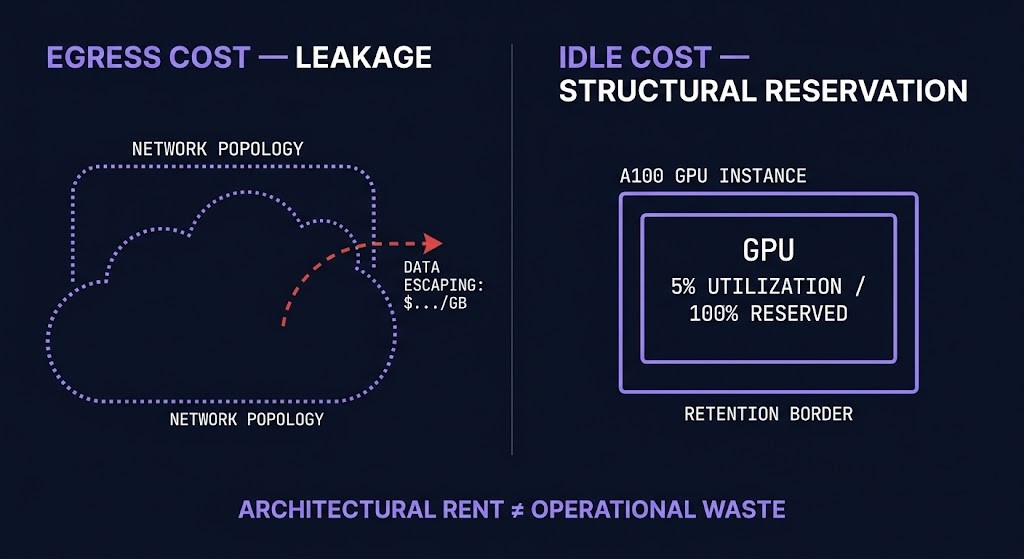
How the Egress Problem Got Solved — And What Replaced It
Egress became a known variable. Teams started modeling it at design time, pricing it into architecture proposals, and running it through tools like the Cloud Egress Calculator before workloads went live. The cloud bill analysis framework turned egress into a legible signal rather than a monthly surprise. The pattern became recognizable: high egress meant a placement problem, not a usage problem. Fix the topology, fix the cost.
Idle cost never got that treatment. The assumption was always that idle capacity was temporary — a forecasting error that autoscaling would eventually correct, a reserved instance that would reach utilization once the workload matured. Finance teams built forecasting models on that assumption. Platform teams built optimization runbooks on it. Neither assumption holds for the architecture patterns running most enterprise cloud environments in 2026.
The Cloud Architecture Strategy covers why workload placement decisions produce cost commitments before FinOps ever sees the number. Idle cost is where that principle becomes visible on the invoice.
Why Idle Cloud Cost Is Now Structurally Embedded
The shift is architectural, not operational. Three distinct patterns produce idle cost that doesn’t respond to rightsizing, reserved instance matching, or autoscaling policy tuning — because the idle capacity is intentional. It exists to satisfy a requirement the workload has, not to cover a demand forecast that turned out to be wrong.
This is the distinction that most cost optimization programs miss. They treat all idle capacity as waste because traditional FinOps was built on the assumption that idle equals unused. That assumption was accurate when compute was sized for workloads with predictable, continuous utilization profiles. It breaks down when the workload’s primary requirement is deterministic response time rather than throughput.
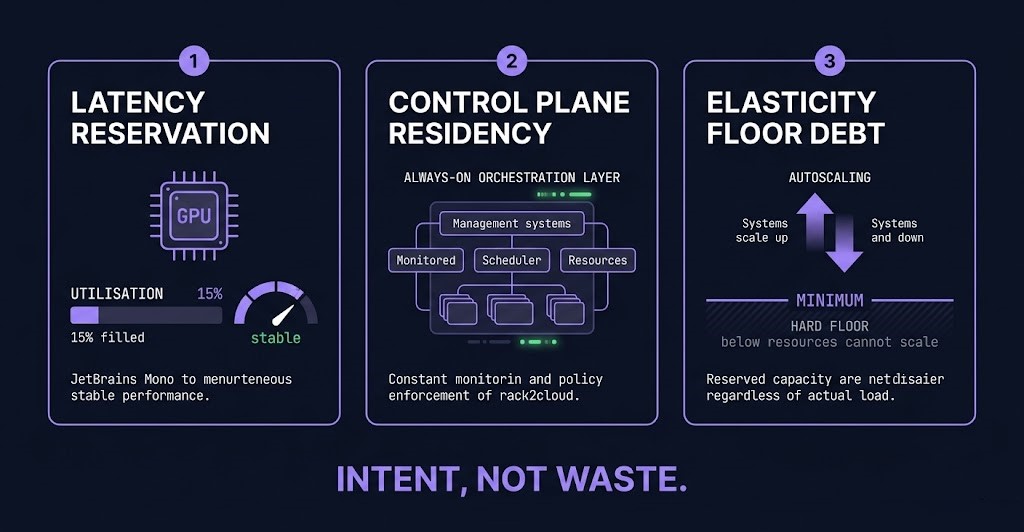
01 — LATENCY RESERVATION
Capacity held online to avoid cold-start latency or queue depth. GPU pools, inference headroom, pre-warmed Kubernetes nodes. The infrastructure is intentionally idle because the workload requires deterministic response time — not because demand was forecasted incorrectly.
02 — CONTROL PLANE RESIDENCY
Infrastructure that cannot scale to zero because the management layer must remain active. EKS, AKS, and GKE control plane dependencies, service meshes, observability pipelines, security brokers. These components exist to govern the environment — their cost is continuous by design, independent of workload utilization.
03 — ELASTICITY FLOOR DEBT
Autoscaling exists on paper, but operational constraints prevent scale-down below a floor. Minimum node counts, licensing minimums, replication quorum requirements, reserved instance commitments. The elastic layer operates above a structural baseline that never moves.
The Idle Cloud Cost That Doesn’t Respond to Rightsizing
The post on AI FinOps and traditional cost models identified the canonical example: a reserved H100 at 5% utilization costs the same as one at 95%. Traditional FinOps says right-size down. AI infrastructure says you can’t — the reservation exists to guarantee availability for burst inference, not to cover steady-state demand. The idle cost is the cost of readiness. Rightsizing logic doesn’t apply when the resource is reserved for availability rather than consumed for throughput. The same reservation dynamic operates at significantly higher cost density inside GPU pools. A cluster held for burst inference availability runs idle at dollars per hour — and the utilization signal that FinOps tooling reads looks identical to a provisioning error. It isn’t. See GPU Utilization Is Becoming the New Cloud Waste Crisis.
The same pattern runs across non-AI workloads. Cost visibility doesn’t translate to cost control when the architectural decision generating the spend was made before FinOps arrived. A pre-warmed node pool for a latency-sensitive API isn’t waste — it’s a deliberate trade against cold-start risk that the platform team made during design. The FinOps dashboard sees idle nodes. The architecture review saw a p99 latency requirement that couldn’t tolerate a 30-second scale-up event.
The optimization lever doesn’t exist for this class of idle cost. You can’t autoscale below the minimum. You can’t right-size below the quorum. You can’t eliminate the control plane residency without eliminating the management capability it provides. The only way to reduce this cost is to change the architectural requirement that produced it — and that decision belongs to the team that set the latency SLA, the availability target, or the licensing commitment, not the team running the monthly optimization review.
THE DISTINCTION THAT MATTERS
- Operational idle — a provisioning decision that turned out to be wrong. Correctable with rightsizing, autoscaling, or instance type changes.
- Architectural idle — capacity held by design to satisfy a latency, availability, or governance requirement. Not correctable without changing the requirement that produced it.
Operational idle is where this gets interesting architecturally — it’s not really a rightsizing failure, it’s a pricing failure that happened earlier. The Capacity You Paid For But Never Used traces operational idle back to the commitment decision itself: capacity gets converted from uncertain demand into fixed capital at a single moment, and the model authorizing that conversion typically never priced what happens if demand comes in low. Rightsizing treats the symptom. That piece is about the decision that created it. Phantom Capacity goes back one step further than even that: whether the reservation feeding the commitment decision was ever validated as real demand before it got to influence the decision at all.
Forecasting Debt and the Idle Cost You Inherited
Finance teams inherit cloud forecasting models that assume idle capacity is temporary. Modern AI and platform architectures make it permanent. That gap — between what the forecast assumes and what the architecture requires — is where budget variance lives, and it compounds as the environment matures.
The cheaper cloud strategy post covers why cost reduction programs fail when they address the invoice rather than the architectural decision that produced it. Idle cost is the clearest example of that dynamic. A FinOps program that identifies idle GPU capacity and flags it for rightsizing is doing exactly what it was designed to do. The problem is that the recommendation is wrong — not because the analysis is flawed, but because the tool was built for a different category of idle cost than the one it’s looking at.
The forecasting model breaks in a specific way: it treats latency reservation and elasticity floor debt as if they were demand forecasting errors. They aren’t. They’re architectural commitments that happened to look like waste on a utilization dashboard. Correcting them as if they were waste doesn’t reduce cost — it degrades the service property the idle capacity was purchased to protect.
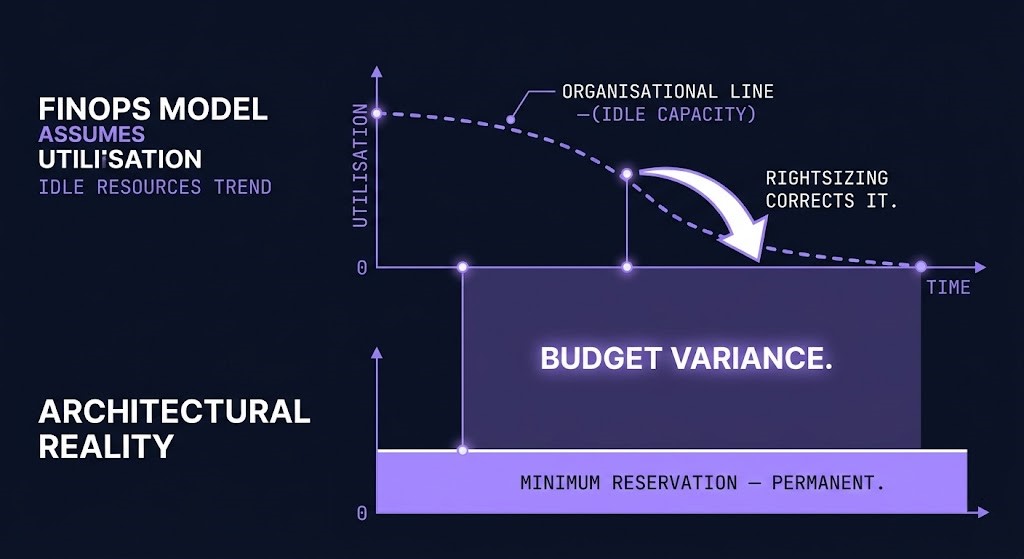
Architect’s Verdict
Idle cost is not what it used to be. The optimization playbook built for idle capacity — right-size, auto-scale, eliminate waste — was designed for an era when idle meant wrong. A demand forecast that missed. A reserved instance that never matured. Capacity that could be reclaimed without consequence.
The three architectural idle patterns don’t work that way. Latency reservation, control plane residency, and elasticity floor debt are costs you bought deliberately, even if the purchase wasn’t framed that way. They exist because the workload required deterministic response time, because the management layer needed to stay active, because the minimum couldn’t go to zero. The utilization dashboard shows idle. The architecture review would show intent.
The industry still treats idle cost as operational waste. Increasingly, it is architectural rent.
Additional Resources
View 2 more resources
Editorial Integrity & Security Protocol
This technical deep-dive adheres to the Rack2Cloud Deterministic Integrity Standard. All benchmarks and security audits are derived from zero-trust validation protocols within our isolated lab environments. No vendor influence.

R.M.
Senior Solutions Architect with 25+ years of experience in HCI, cloud strategy, and data resilience. As the lead behind Rack2Cloud, I focus on lab-verified guidance for complex enterprise transitions. View Credentials →
Get the Playbooks Vendors Won’t Publish
Choose the architecture problems you care about. Get field-tested playbooks and frameworks delivered to your inbox.
- > AI Infrastructure & Inference Economics
- > Cloud Strategy & Hidden Cost Models
- > Virtualization & Deterministic Migration
- > Kubernetes, IaC & Modern Infrastructure
- > Data Protection & Recovery Engineering
Zero spam. Includes The Dispatch weekly drop.
Need Architectural Guidance?
Independent review before major infrastructure decisions.
- > Validate assumptions
- > Identify hidden dependencies
- > Quantify migration risk
- > Challenge vendor narratives
Triage · Advisory · Fractional · Direct Hire