

Ransomware Recovery Survivability Analyzer
Authority Survivability Score · Recoverability Gap Ladder · Recovery Kill Switch · Recoverability Horizon · Bus Factor
A recovery test that passes validates restart. It does not validate whether recovery authority survives ransomware.
The credential store may be encrypted. The control plane — vCenter, Prism Central, the backup console itself — may be unreachable. The only engineer who can execute recovery may be unavailable. The recovery environment may share an identity provider with production. None of these failures appear in test results — they appear in the first real incident that triggers recovery under the same conditions that caused the failure.
The recoverability gap is the distance between a recovery plan validated under clean-failure scenarios and a recovery architecture that survives adversarial compromise. The Ransomware Recovery Survivability Analyzer makes this visible before the incident. It evaluates six authority domains against a specific recovery threat scenario, builds a causal ladder showing exactly where authority collapses, and surfaces a Recovery Kill Switch naming the single dependency most likely to stop recovery before it starts. This is part of the data protection architecture discipline — the ransomware-specific authority layer that closes the gap between a passing recovery test and a recovery that can actually execute under attack.
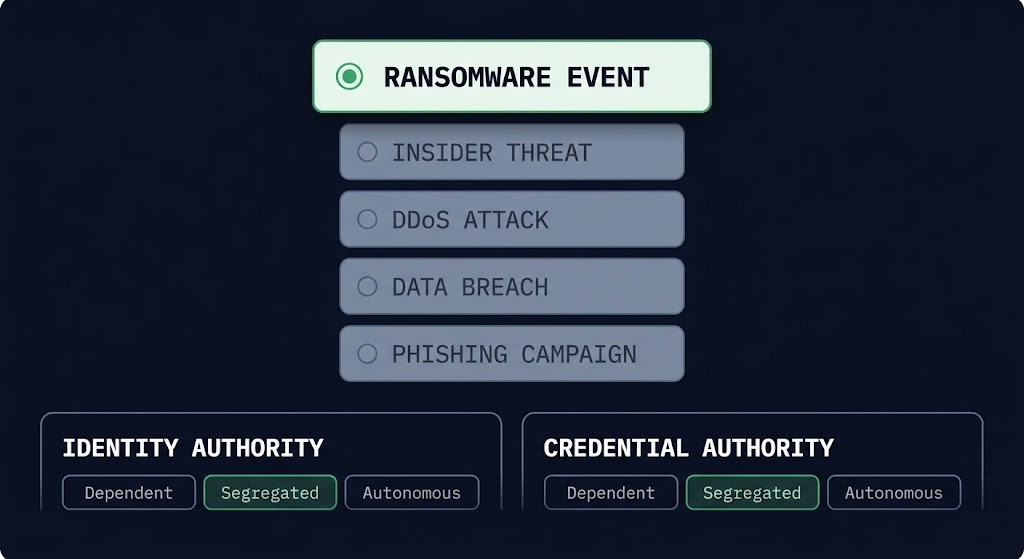
What the Ransomware Recovery Survivability Analyzer Surfaces
01 — Identity Authority
Can recovery authenticate without production identity systems? If recovery depends on the same Entra ID or Active Directory instance ransomware just encrypted, recovery cannot begin — regardless of how strong backup or storage architecture is. The analyzer evaluates identity provider independence, offline account availability, and production dependency.
02 — Credential Authority
Can recovery retrieve the credentials it needs once the incident has started? A production-only vault that ransomware can reach is a single point of failure for every downstream recovery step. The analyzer evaluates vault isolation, break-glass account architecture, and offline retrieval capability.
03 — Control Plane Authority
Can recovery execute if the management plane itself is unavailable? vCenter, Prism Central, Cohesity, Rubrik, Veeam, Azure Portal, AWS Console — if the platform used to orchestrate recovery is encrypted or unreachable, recovery cannot initiate even when backups and identity survive intact. This is the most commonly underestimated authority domain. The analyzer evaluates platform independence and offline orchestration capability.
04 — Backup Authority
Can backups be reached and restored once ransomware has activated? Backup infrastructure reachable from the production network is in the same blast radius as the systems it exists to protect. The analyzer evaluates network segregation and immutability architecture.
05 — Governance Authority
Can recovery proceed without a live approval workflow? Organizations that require full change-management sign-off during a declared ransomware event add a structural delay into the first hours of recovery, when speed determines blast-radius containment. The analyzer evaluates pre-authorization and decoupled approval paths.
06 — Storage Authority
Is backup storage isolated from the systems ransomware compromised? Object lock, immutable repositories, and air-gapped vaults frequently become the final recoverability boundary in real incidents — not because they’re unimportant, but because they’re assumed to be safe until tested. The analyzer evaluates network isolation and access independence.
Why Recovery Authority Fragments Under Ransomware
Authority fragmentation in ransomware scenarios isn’t random. It follows the pattern named in Framework #131: the authority required to execute recovery was designed against steady-state assumptions, not against the adversarial conditions that trigger recovery.
Blast-Radius Overlap
The most common authority failure: the systems that hold recovery authority — identity providers, credential vaults, management consoles — sit in the same blast radius as the ransomware event they exist to recover from. An attack that encrypts production storage also frequently reaches the backup console used to restore it.
Authority Concentration
Recovery authority concentrated in a single person creates a Bus Factor of 1. The one engineer who can execute recovery is on vacation. The one administrator with vault access is part of the incident. Concentration risk caps how resilient an organization can become, regardless of how strong its technical controls are.
Steady-State Design
Recovery runbooks written during normal operations assume normal operations. They assume the control plane is reachable. They assume the identity provider is healthy. They assume approval workflows function. None of these assumptions survive the scenario most likely to trigger recovery in the first place.
Scenario-Specific Authority Analysis
Authority that survives a Management Plane Failure is not the same as authority that survives a Ransomware Event. The analyzer evaluates declared authority state against five distinct recovery threat scenarios, each with its own blast radius:
Ransomware Event
Targets backup infrastructure, credential stores, and identity systems directly. Critical domains: Identity, Credential, Backup, Storage.
Identity Provider Compromise
Removes SSO-dependent access paths across every environment that trusts the compromised IdP. Critical domains: Identity, Credential, Control Plane, Governance.
Management Plane Failure
Takes down vCenter, Prism Central, Azure Portal, or AWS Console — the orchestration layer recovery depends on. Critical domains: Control Plane, Bus Factor.
Insider Action
A malicious or negligent individual with elevated access disrupts recovery authority from inside the trust boundary. Critical domains: Identity, Credential, Governance.
Backup Repository Loss
Ransomware encrypts or destroys the backup targets directly, independent of identity or control plane state. Critical domains: Backup, Storage.
Output Architecture
All output derives from declared authority state — no inference, no heuristics. The analyzer evaluates your declarations across six domains against the selected recovery threat scenario and surfaces findings as scored, named results organized from the executive verdict outward.
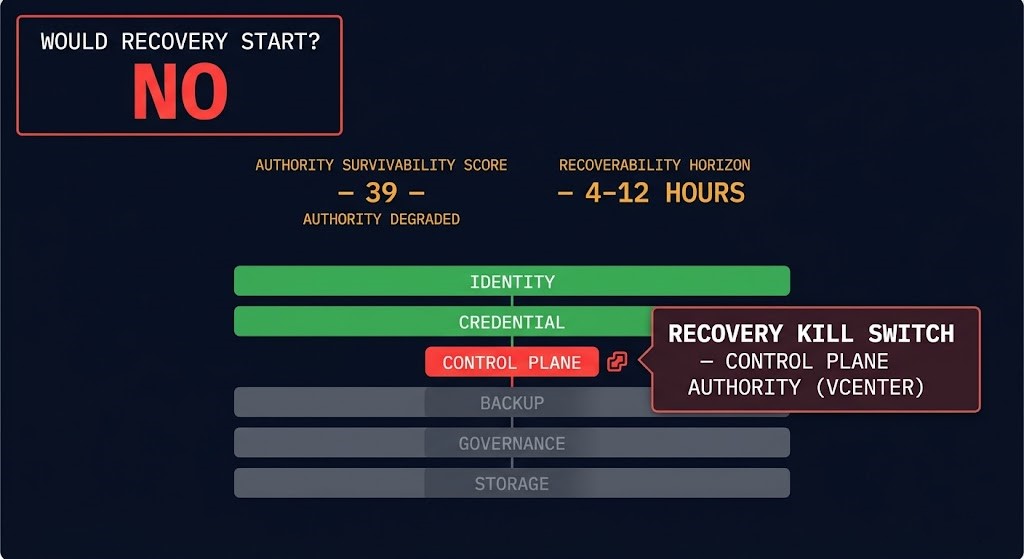
Would Recovery Start?
Binary YES/NO verdict derived from whether critical authority domains survive the selected scenario. The first output, displayed at maximum scale — because the question a board asks in the first hour of an incident is not “what is our score?” It is “can we recover?”
Authority Survivability Score (AIS)
0–100 weighted composite across six domains. Four tiers: Authority Resilient (81–100), Authority Hardened (61–80), Authority Degraded (31–60), Authority Broken (0–30). Identity and credential authority are weighted most heavily — and a simultaneous failure in both collapses AIS to zero regardless of how the remaining domains score.
Recoverability Horizon
A time estimate, not a quality score: how long can recovery authority sustain before cascading failures make recovery impossible? Calculated independently from identity, credential, backup, and storage authority plus bus factor — not derived from AIS. An organization can score well on AIS and still face a short horizon if backup and storage authority are weak. Executives understand time. They don’t naturally understand authority concentration.
Recovery Kill Switch
A single statement naming the first authority dependency that would stop recovery before it starts — not a fixed priority order, but the lowest-surviving authority layer given your specific declarations. Every architect immediately understands it. Every executive understands it. Every auditor understands it. It becomes the first thing discussed after the assessment.
Recoverability Gap Ladder
The signature visualization — six authority domains rendered as a causal chain in authority-first order (Identity → Credential → Control Plane → Backup → Governance → Storage), with the first domain that cannot survive the selected scenario marked as a structural break. The first failed stage is highlighted — not the aggregate score — because that’s the stage that actually stops recovery.
Ransomware Recovery Survivability Analyzer: Key Features
- Scenario-specific blast-radius analysis: Five recovery threat scenarios — Ransomware Event, Identity Provider Compromise, Management Plane Failure, Insider Action, Backup Repository Loss — each with a defined blast radius that determines which authority domains are under direct threat. The same organization can score very differently across scenarios.
- Recoverability Gap Ladder: Six authority domains rendered as a causal chain in authority-first order, with structural break annotation. Updates live as you declare each domain’s state — the tool feels alive, not like a black box waiting for a final submit.
- Recovery Kill Switch: A single, specific statement naming the first dependency that stops recovery — including the actual platform name (vCenter, Rubrik, Entra ID) when control plane or identity is the constraint. Not a generic label.
- Recoverability Horizon: An independently calculated time estimate — not derived from the composite score — answering how long recovery authority can sustain before it collapses. Complements AIS with the question executives actually ask first: how long do we have?
- Bus Factor ceiling model: Authority concentration doesn’t subtract points — it caps the maximum achievable score. An organization with excellent technical controls and a single point of failure in personnel cannot score above its ceiling, which mirrors how concentration risk actually plays out in real incidents.
- Client-side only — no telemetry: All analysis runs locally in your browser. No data is transmitted, logged, or stored. No account required. Recovery authority state is operational information — it belongs in your environment, not in a SaaS platform’s database.
THE ANALYZER REVEALS THE GAPS.
A REVIEW CLOSES THEM.
Authority analysis identifies where ransomware recovery will fail. Closing the gaps requires independent control-plane orchestration, credential isolation, and storage architecture that survives the same blast radius the recovery exists to address.
|
>_ Architectural Guidance
Recovery Authority AssessmentA structured review against your survivability findings — resolving control-plane independence gaps, isolating credential authority from production, and hardening backup and storage architecture against the blast radius your assessment surfaced.
|
>_ The Dispatch
Architecture Playbooks. Field-Tested Blueprints.Weekly breakdowns of recovery architecture, ransomware survivability patterns, and the authority decisions that determine whether recovery plans survive the incident that triggers them.
Zero spam. Unsubscribe anytime. |
Frequently Asked Questions
Q: What does the Ransomware Recovery Survivability Analyzer actually measure?
A: The analyzer measures whether the authority required to execute recovery — identity, credentials, control plane access, backup reachability, governance approval, and storage isolation — survives the specific ransomware threat scenario most likely to trigger recovery. It does not measure recovery readiness in the general sense. It measures authority survivability: can the six domains required to execute recovery function independently of the blast radius of the selected scenario? A recovery test can pass and the authority can still collapse under ransomware conditions. The two are different questions.
Q: How is this different from the Disaster Recovery Authority Analyzer?
A: The Disaster Recovery Authority Analyzer (DRAA) measures personnel-centric recovery authority — credentials, approvals, operators, and runbook execution — across general DR failure scenarios. The Ransomware Recovery Survivability Analyzer answers a narrower, ransomware-specific question: does authority survive across identity, credentials, control plane, backup, governance, and storage when the threat is ransomware specifically? The two tools are designed to be used together — DRAA identifies personnel authority gaps, RRSA identifies infrastructure-and-platform authority gaps under adversarial compromise. An organization can score well on DRAA and still have a control-plane single point of failure that RRSA surfaces.
Q: What recovery threat scenarios does the analyzer cover?
A: Five scenarios: Ransomware Event (targets backup infrastructure, credential stores, and identity systems directly), Identity Provider Compromise (removes SSO-dependent access paths across every trusting environment), Management Plane Failure (takes down vCenter, Prism Central, Azure Portal, or AWS Console), Insider Action (a malicious or negligent individual with elevated access), and Backup Repository Loss (ransomware encrypts or destroys backup targets directly). Each scenario defines a specific blast radius, and authority analysis is evaluated against that blast radius — not against generic recovery criteria.
Q: Is any data sent to a server or stored?
A: No. All analysis — Authority Survivability Score, Recoverability Horizon, Recovery Kill Switch, Recoverability Gap Ladder, Bus Factor ceiling — runs locally in your browser. Nothing you enter is transmitted, logged, or stored anywhere. The tool produces no network requests after the initial page load. Recovery authority state is operational information — it belongs in your environment, not in a SaaS platform’s database.
🔒 Privacy Architecture: No cookies. No tracking pixels. No server-side database.
This logic runs entirely in your local browser session.