

CLOUD COST GOVERNANCE
OPERATIONAL TOOLING FOR CLOUD COST VISIBILITY, STRUCTURAL RISK ANALYSIS, AND ECONOMIC SEPARATION.
Operational tooling for cloud cost failure — from idle infrastructure and density collapse to sovereignty exposure and repatriation viability.
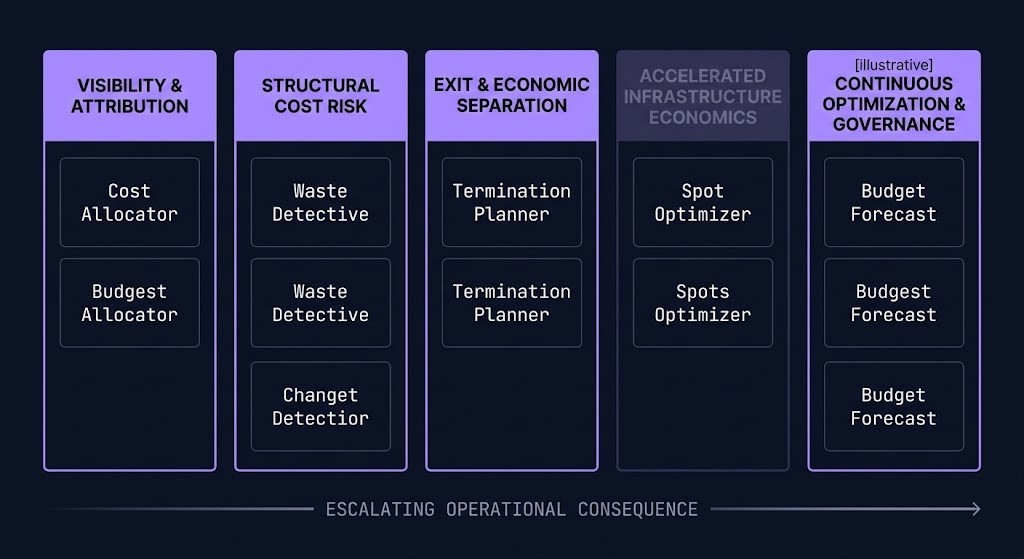
>_ Operational Framework
Cloud cost failures don’t arrive as events. They arrive as compounding conditions — idle spend that accumulates into governance drift, density collapse that amplifies egress exposure, architectural lock-in that forecloses the repatriation path before the economics are ever modeled. The tools below are organized to surface those conditions in order: visibility and attribution first, structural cost risk second, sovereignty and economic separation third. Working through the phases in sequence traces the failure path before it becomes irreversible.
>_ Operational Phase 01 Visibility & Attribution
Cloud Idle Resource Analyzer
Surfaces idle and underutilized cloud resources across compute, storage, and networking. Identifies persistent baseline waste — the spend floor that accumulates before any optimization conversation can be had. Start here to establish the actual cost baseline.
Kubernetes Cost Density Calculator
Calculates actual workload density against node cost across Kubernetes environments. Surfaces density inefficiency — the gap between what orchestration infrastructure costs and the value it’s actively delivering. Low density is not a scheduling problem; it is a governance failure.
Cloud Egress Cost Analyzer
Models real-world egress cost across provider tiers, transfer patterns, and data gravity scenarios. Egress is the spend category most organizations undermodel — it doesn’t appear in provisioning decisions and surfaces only after the architecture that generates it is already locked in.
Phase 01 surfaces where spend is coming from. The harder question is why it will keep growing — and which architectural decisions are actively compounding future cost. Idle spend and density inefficiency are operational conditions. Architectural lock-in, coupling economics, and topology rigidity are structural ones. Phase 02 addresses the structural layer.
>_ Operational Phase 02 Structural Cost Risk
Refactoring Cliff Calculator
Models the point at which refactoring cost exceeds migration value — the Refactoring Cliff. Architectural debt compounds silently until the migration conversation surfaces a number that the original platform decision never modeled. This tool makes that number visible before the architecture review, not during it.
Azure Private Endpoint Checker
Audits Azure Private Endpoint configuration against network topology to surface hidden cost exposure from misrouted traffic, missing PE coverage, and public endpoint fallback patterns. Network topology decisions create cost structures that accumulate for years before appearing in a billing review.
Phase 02 surfaces the architectural decisions that are compounding future cost. The final question — and the one that determines whether the organization can actually act on what Phases 01 and 02 surface — is whether economic separation from cloud dependency is operationally viable. That is not an optimization question. It is a sovereignty question. Phase 03 addresses it directly.
>_ Operational Phase 03 Exit & Economic Separation
Shadow Sovereignty Auditor
Audits cloud operational dependencies that survive workload repatriation — identity, observability, CI/CD, DR, CDN/edge, and managed database coupling. Shadow Sovereignty is the condition where an organization has repatriated workloads but retained the operational dependency structure that made them cloud-resident in the first place.
Cloud Repatriation Economics Engine
Models repatriation viability across four interpretive pillars: economic break-even, elasticity utilization, dependency residue, and operational amortization window. Produces a Repatriation Viability Signal — including Cloud Persistence Favorable when the data supports it. The economics of the exit decision, not the advocacy for one direction.
>_ Operational Phase 04 Accelerated Infrastructure Economics FORMING
GPU Utilization & AI Capacity Analyzer
Surface Effective GPU Yield, Capacity Illusion Index, and Phantom Scarcity — the architectural signals your monitoring dashboard does not show. Determines whether GPU shortage is structural inefficiency or genuine demand. The accelerator layer of the cost governance chain.
Cloud cost failures don’t arrive as events. They arrive as compounding conditions — each unresolved state creating the conditions for the next.
| Initial Condition | Escalation Path |
|---|---|
| Persistent idle spend | → Density collapse |
| Density collapse | → Governance drift |
| Governance drift | → Egress amplification |
| Egress amplification | → Refactoring avoidance |
| Refactoring avoidance | → Dependency residue |
| Dependency residue | → Economic Persistence Bias |
| Economic Persistence Bias | → Repatriation infeasibility |
Named failure patterns that appear across cloud cost governance failures. Each one represents a structural condition, not an operational mistake.
The progressive erosion of cost accountability when no team owns the aggregate spend surface. Accumulates faster in environments where provisioning authority and cost authority are separated.
The condition where workload growth has outpaced density optimization, leaving infrastructure sized for projected peaks running at persistent underutilization. The cost floor rises independently of value delivered.
Transfer cost that compounds as data gravity accumulates — each architectural layer added increases the egress surface. By the time egress appears in the billing review, the topology generating it is already locked in.
The point at which accumulated coupling and architectural debt makes migration cost exceed migration value. Most organizations discover this threshold during the architecture review — after the decision to migrate has already been made.
The condition where workloads have been repatriated but the operational dependency structure — identity, observability, CI/CD, DR — remains cloud-resident. Sovereignty was declared. Operational authority was not achieved.
Financial inertia caused by accumulated sunk cost in cloud operational dependencies. The switching cost that compounds over time without creating value — and that makes the repatriation conversation feel more expensive than continued cloud spend, regardless of the actual economics.
The risk that repatriated infrastructure remains underutilized due to workload variance. On-premises infrastructure cannot shed capacity between utilization peaks — the cost floor is fixed regardless of demand, unlike cloud elasticity assumptions.
Tool output is most useful when it triggers the next analysis. These paths map signal to next step.
| If This Tool Detects | Run Next | Why |
|---|---|---|
| Cloud Idle Resource Analyzer — persistent idle infrastructure, predictable workload baseline, high utilization ratio | → Cloud Repatriation Economics Engine | Predictable workload profiles with idle baseline are strong repatriation candidates — model the economics before the architecture decision |
| Kubernetes Cost Density Calculator — low workload density, orchestration overhead exceeding workload value | → Refactoring Cliff Calculator | Low density often signals over-engineered orchestration architecture — model the refactoring cost before assuming optimization will close the gap |
| Shadow Sovereignty Auditor — structural cloud dependency residue, operational authority coupling across identity / observability / CI/CD | → Cloud Repatriation Economics Engine | Dependency residue is the Economic Persistence Bias input — the Cloud Repatriation Economics Engine models whether separation is economically viable given the residue profile the Shadow Sovereignty Auditor surfaces |
Operational characteristics at each maturity level. The tools above map to the transition between levels — not to a single level.
| Maturity Level | Operational Characteristic |
|---|---|
| Foundation | Visibility into spend and utilization — costs are known, attribution is partial |
| Operational | Density governance and egress awareness — cost patterns are understood and owned |
| Strategic | Architectural cost accountability — structural decisions are evaluated against cost impact before they are made |
| Resilient | Dependency and refactoring risk control — lock-in accumulation is actively managed |
| Sovereign | Economic separation capability — repatriation viability is known and the operational authority boundary is designed, not assumed |
WHEN THE FRAMEWORK SURFACES A GAP, THE ASSESSMENT CLOSES IT.
Tooling surfaces the cost structure. Architectural review determines what to do about it — repatriation sequencing, dependency separation strategy, cloud governance restructuring. These require architectural judgment layered on top of deterministic output, not another iteration through the tools.
Cloud Cost Architecture Review
A structured review of your cloud cost architecture — spend attribution gaps, structural lock-in exposure, and repatriation viability analysis.
- > Idle and density gap audit
- > Structural lock-in and refactoring cliff analysis
- > Dependency residue and sovereignty exposure review
- > Repatriation viability summary with sequencing recommendations
Architecture Playbooks.
Field-tested blueprints for cloud cost governance and repatriation architecture from production environments.
- > Cloud cost failure patterns and governance models
- > Repatriation sequencing and dependency separation
- > Egress architecture and lock-in exposure control
- > Sovereignty and operational authority design
Zero spam. Unsubscribe anytime.