

Cloud Repatriation Economics Engine
Evaluate whether a workload should still live in cloud — across economics, elasticity efficiency, operational separation, and infrastructure persistence.
The cloud repatriation cost model most teams use stops at break-even math. They model capex against monthly spend and return a payback period. That answers the wrong question.
The payback period is one data point. It tells you when the cumulative cost lines cross. It does not tell you whether the workload will stay usefully utilized after it moves, whether cloud elasticity is actually providing value at current utilization patterns, whether the operational services that make the workload function will remain cloud-bound regardless of where compute runs, or whether the economic case survives the migration itself.
The Cloud Repatriation Economics Engine is built on that distinction. It evaluates whether a workload should still live in cloud — not just whether moving it produces a positive number on a spreadsheet.
What the Engine Evaluates
Pillar 01 — Economic Viability
Break-even month, 5-year TCO curve, and the Economic Inversion Point — the month where cloud elasticity premium exceeds the operational value the workload actually extracts from it.
Pillar 02 — Elasticity Efficiency
Elasticity Utilization Signal — High, Moderate, or Low. Scores how much of the cloud elasticity premium is actually being used by the workload’s operating pattern. Low Elasticity Utilization is one of the strongest repatriation indicators the engine surfaces.
Pillar 03 — Operational Separation
Cloud Dependency Residue, Cloud Lock-In Sensitivity, and Economic Separation Achievability. Many repatriation programs move the workload while leaving identity, observability, CI/CD, and DR cloud-bound. The workload moves. The cost obligations don’t.
Pillar 04 — Infrastructure Persistence
Stranded Capacity Risk and Workload Pattern interpretation. On-premises infrastructure cannot shed capacity between utilization peaks. For elastic and burst workloads, this is the primary failure mode — not the economics.
The Repatriation Viability Signal
The engine’s primary output is a named classification — not a number. Four tiers:
Break-even timing, utilization profile, and dependency configuration are aligned. This workload is a viable repatriation candidate within the current planning cycle.
Repatriation is economically viable but requires deliberate planning. The economics are positive over the 5-year window, though capital intensity, dependency residue, or capacity risk creates execution risk that must be managed.
Capital intensity, commitment lock-in, stranded capacity risk, or structural dependency coupling makes the cloud path economically dominant at current inputs. Revisit when commitment windows align or dependency configuration changes.
Cloud economics are the dominant path at current inputs. Workload elasticity, variance profile, or dependency coupling makes cloud the operationally and economically correct choice. This is not a failure — it is the correct signal for this workload profile.
The neutrality of the Cloud Persistence Favorable tier is intentional and important. A tool that always favors repatriation is not an analysis tool — it is advocacy. When the engine says stay in cloud, that output carries the same weight as when it says exit.
Cloud Repatriation Cost Model: Output Architecture
The engine surfaces eleven outputs in a fixed narrative sequence — signal first, math second.
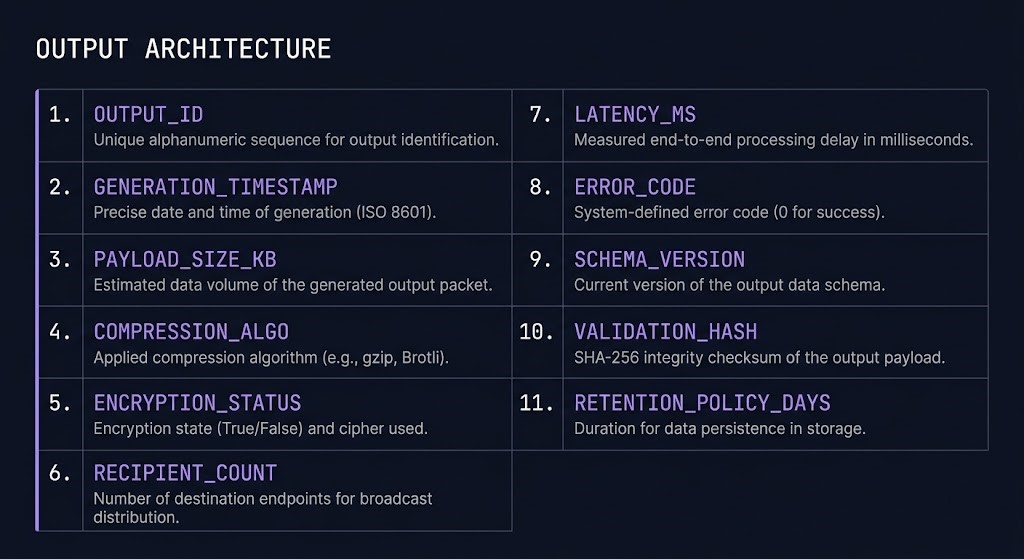
| Output | What It Surfaces |
|---|---|
| Repatriation Viability Signal | Primary named classification: Strong Exit Signal / Strategic Repatriation Window / Capital Trap Risk / Cloud Persistence Favorable |
| First Economic Failure Point | The single most likely reason the repatriation economics break down at current inputs — the architectural sentence that explains the number |
| Break-Even Month | Month where on-premises path becomes cumulatively cheaper than the cloud path |
| Economic Inversion Point | Month where cloud elasticity premium exceeds the operational value the workload actually extracts from it |
| Elasticity Utilization Signal | High / Moderate / Low — how much of the cloud elasticity premium the workload’s operating pattern is actually using |
| Stranded Capacity Risk | Low / Moderate / Severe — driven by utilization forecast, variance, and workload type |
| Cloud Lock-In Sensitivity | Low / Moderate / High / Structural — commitment tenure combined with operational dependency coupling |
| Cloud Dependency Residue | Minimal / Persistent / Structural — which operational services remain cloud-bound after repatriation |
| Economic Separation Achievability | Achievable / Partial / Unlikely — whether full cost decoupling is realistic at current dependency configuration |
| Migration Shock Window | Low / Moderate / Severe — operational disruption risk during the transition itself |
| Repatriation Timing Window | Immediate / Renewal-Cycle Aligned / Hardware-Cycle Aligned / Deferred |
Workload Behavioral Archetypes
Section 2.5 of the engine maps inputs to one of seven named archetypes. The archetype drives the Elasticity Utilization Signal, Stranded Capacity Risk weighting, and Workload Pattern Interpretation output.
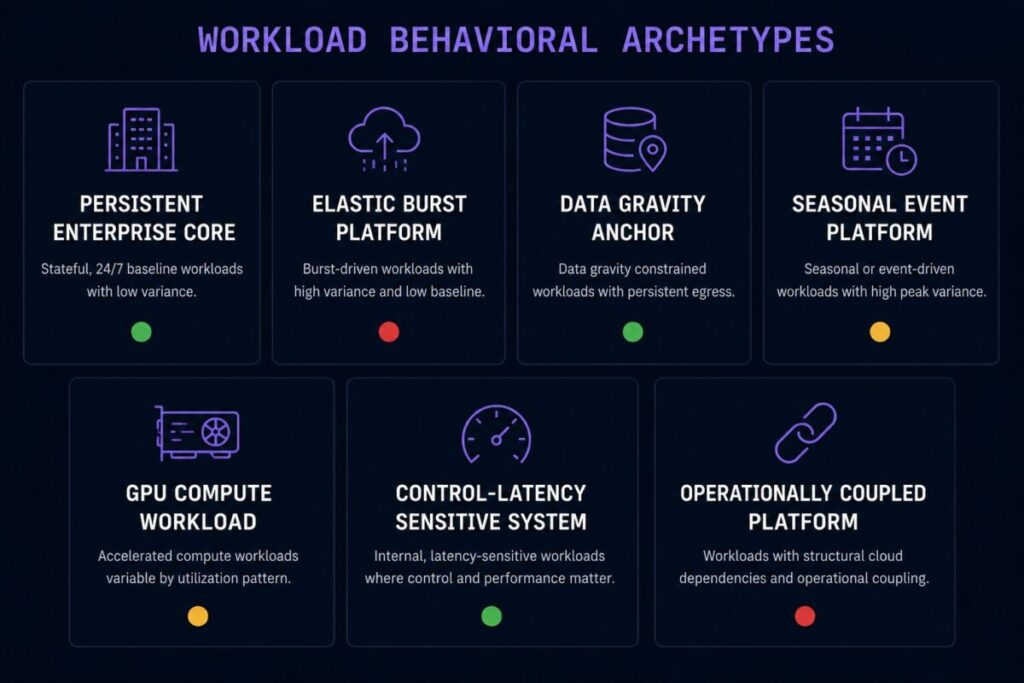
| Archetype | Repatriation Profile |
|---|---|
| Persistent Enterprise Core | Strong candidate — continuous utilization amortizes well against fixed infrastructure cost |
| Elastic Burst Platform | Cloud-favorable in most configurations — stranded capacity risk is high |
| Data Gravity Anchor | Repatriation accelerant — egress costs compound with data growth |
| Seasonal Event Platform | Mixed — depends on baseline utilization between peaks |
| GPU Compute Workload | Utilization-dependent — continuous workloads are viable, burst-only patterns are risky |
| Control-Latency Sensitive System | Often undercosted in cloud — network path control and deterministic performance have value that doesn’t appear in TCO math |
| Operationally Coupled Platform | Repatriation economics undermined by dependency coupling regardless of the compute economics |
The Operationally Coupled Platform archetype is the most important failure pattern the engine identifies. These are workloads where the compute moves on-premises but identity, observability, CI/CD, and DR remain externally anchored. The workload physically relocates. The operational authority — and the cost obligations that follow it — does not. That pattern is Framework #77, Dependency Residue: first identified alongside this tool, and since generalized beyond repatriation.
If your workload profile suggests Structural Cloud Dependency Residue, run the Shadow Sovereignty Auditor for a detailed dependency map before committing to a repatriation program.
Named Frameworks
Five architectural frameworks underpin the cloud repatriation cost model and are applied directly to the engine’s output logic:
| Framework | Definition |
|---|---|
| Repatriation Elasticity Gap | The mismatch between cloud elasticity assumptions and real workload utilization patterns |
| Dependency Residue (#77) | Dependencies that persist after a transformation program declares something eliminated, and that its cost model no longer counts. In repatriation: the operational services that remain cloud-bound after the workload moves |
| Stranded Capacity Risk | The risk that repatriated infrastructure remains underutilized due to workload variance |
| Economic Persistence Bias | Financial inertia caused by accumulated sunk cost in cloud operational dependencies |
| Operational Amortization Window | The period required for on-premises infrastructure economics to normalize after the initial capital outlay |
FRAMEWORK #76 — REPATRIATION ELASTICITY GAP
The elasticity lost when workloads move from cloud burst capacity to fixed owned capacity — a delta repatriation economics must explicitly price.
When the delta isn’t priced going in, it gets discovered the hard way — at the first demand spike fixed capacity can’t absorb.
FRAMEWORK #77 — DEPENDENCY RESIDUE
Originating instance · Canonical home: /dependency-residue/
Dependency residue is the economic, operational, contractual, or governance dependency that persists after a transformation program declares its originating system, platform, service, or capability eliminated, and that the program’s cost model no longer counts.
This engine is where the framework was first identified. A repatriation program scopes the move around compute, while identity, observability, CI/CD, backup/DR, CDN/edge, and managed database sit outside that scope by default. The compute relocates on schedule, the program reports complete, and the cloud bill keeps arriving. The engine’s Cloud Dependency Residue output (Minimal / Persistent / Structural) measures exactly that repatriation instance.
The mechanism isn’t specific to repatriation: any transformation program whose cost model stops counting a dependency it declared eliminated produces the same residue. Read the full framework →
FRAMEWORK #78 — STRANDED CAPACITY RISK
The risk that capacity purchased for repatriated peak demand sits idle, stranding capital when demand shifts or forecasts miss.
Owned capacity can’t shed load the way cloud does — when the forecast misses, the hardware sits idle and the capital stays stranded.
FRAMEWORK #79 — ECONOMIC PERSISTENCE BIAS
The tendency to keep workloads where they already run because sunk cost and operational familiarity bias the economics against movement.
The bias operates upstream of the analysis — discounting every other repatriation variable before the spreadsheet is even built.
Framework #78 is bounded specifically to on-premises capacity sized against a forecast peak. For the general case — capacity that can technically be released, transferred, or resold, spanning cloud reservations, colocation contracts, and GPU allocations alongside on-prem hardware — see The Capacity You Paid For But Never Used, which asks the same commitment-before-demand-resolves question one level up from this framework’s specific exit-path failure mode.
FRAMEWORK #80 — OPERATIONAL AMORTIZATION WINDOW
The period over which repatriation’s operational investments — staff, tooling, facilities — must amortize before the move nets positive.
Nobody re-checks whether the window actually closed — the forecast gets confirmed once, at approval, and never again.
Architectural Relationships — The Repatriation Economics Cluster
These five frameworks describe distinct, moderately-coupled exposures inside the same repatriation decision — none depends structurally on another, but each interacts with the rest.
Repatriation Elasticity Gap
Why It Connects
Prices the burst capacity forfeited by leaving cloud — the inverse of what #78 strands on-prem, a cost #80 has to absorb, and a variable #79 keeps underpriced.
Explore Framework →Dependency Residue
Why It Connects
Prices what stays cloud-billed after compute relocates, the repatriation instance of a framework since generalized to any transformation program. Parallels #78’s on-prem idle cost, extends #80’s window, and stays unaddressed for the same reason #79 does.
Explore Framework →Stranded Capacity Risk
Why It Connects
Prices owned capacity that sits idle post-move — the inverse of #76’s forfeited elasticity, distorted by #79’s forecast bias, and dead weight inside #80’s window.
Explore Framework →Economic Persistence Bias
Why It Connects
The decision-making layer that discounts #76, #77, #78, and #80 alike — sunk cost and operational familiarity bias every one of the other four findings downward.
Explore Framework →Operational Amortization Window
Why It Connects
The realized timeline that has to absorb #76’s forfeited elasticity, #77’s residue, and #78’s stranded capacity, while #79 makes it feel shorter than it is.
Explore Framework →Cloud Repatriation Economics Engine: Key Features
- Repatriation Viability Signal: Four named classification tiers — Strong Exit Signal, Strategic Repatriation Window, Capital Trap Risk, and Cloud Persistence Favorable. The primary output is a named architectural verdict, not a number. Cloud Persistence Favorable fires when cloud is the correct answer — the engine is operationally neutral by design.
- Economic Inversion Point: The month where the cloud elasticity premium exceeds what the workload actually extracts from it. This is a different calculation from break-even — a workload can reach inversion months before it reaches break-even, meaning the organization is paying for flexibility the workload doesn’t use long before the cost lines cross.
- Elasticity Utilization Signal: Derived from workload type and variance profile. Low Elasticity Utilization Detected fires for persistent, stateful, and data-gravity workloads that are paying cloud pricing for elasticity they don’t operationally need.
- Cloud Dependency Residue taxonomy: Six dependency classes — identity, observability, CI/CD, backup/DR, burst compute, CDN/edge, managed database. The engine classifies residue as Minimal, Persistent, or Structural. Structural residue fires a direct advisory: the workload can move, but economic separation requires a separate decoupling program.
- Client-Side Only: No data leaves the browser. No telemetry, no server-side logging, no account required. The engine runs entirely in the local browser session against your inputs.
THE ENGINE SURFACES THE SIGNAL.
A REVIEW MAPS IT TO YOUR ENVIRONMENT.
The viability signal names the architectural verdict. A cost architecture review translates it into a sequenced action plan — mapped against your commitment window, dependency configuration, and workload profile.
|
>_ Architectural Guidance
Cost Architecture ReviewStructured review of your cloud cost posture and repatriation signal against your actual environment profile.
|
>_ The Dispatch
Architecture Playbooks. Field-Tested Blueprints.Cloud cost governance, workload placement, and repatriation decision patterns — delivered as field-tested operational blueprints.
Zero spam. Unsubscribe anytime. |
Frequently Asked Questions
Q: What does the Cloud Repatriation Economics Engine actually evaluate?
A: The engine takes spend profile, workload operating pattern, dependency configuration, and timing inputs — and returns an architectural verdict across four pillars: Economic Viability, Elasticity Efficiency, Operational Separation, and Infrastructure Persistence. It does not connect to your cloud environment, read billing data, or require telemetry. The output is deterministic — the same inputs produce the same analysis every run.
Q: How is this different from a break-even calculator or FinOps tool?
A: Break-even calculators return a payback period. FinOps tools quantify waste in dollar terms. This engine evaluates whether the economics of repatriation survive the operational realities of your specific workload — elasticity utilization, stranded capacity risk, cloud dependency residue, and commitment lock-in. The primary output is a named architectural signal, not a number.
Q: What does Cloud Persistence Favorable mean?
A: Cloud Persistence Favorable is one of four Repatriation Viability Signal tiers. It fires when cloud economics are the dominant path at current inputs — typically when workload elasticity is high, stranded capacity risk is severe, or structural cloud dependency coupling makes economic separation unlikely. It is not a failure state. It is the correct output for workloads that genuinely belong in cloud. The engine is operationally neutral by design — an analysis tool that always favors repatriation is advocacy, not analysis.
Q: What is Cloud Dependency Residue and why does it matter?
A: Cloud Dependency Residue refers to the operational services that remain cloud-bound after a workload moves on-premises — identity, observability, CI/CD pipelines, backup and DR, CDN, and managed database dependencies. Many repatriation programs move compute while leaving these services externally anchored. The workload physically relocates, but operational authority and its associated cost obligations do not. The engine classifies residue as Minimal, Persistent, or Structural. Structural residue means full economic separation is unlikely without a dedicated decoupling program. The engine measures the repatriation instance of Framework #77, Dependency Residue, which applies to any transformation program whose cost model stops counting a dependency it declared eliminated.
Q: Is any data sent to a server or stored after the analysis runs?
A: No. The engine runs entirely in the local browser session. No data is transmitted to any server, no telemetry is collected, no account is required, and nothing persists after the browser tab is closed. All calculation logic is client-side JavaScript executed against your inputs.
🔒 Privacy Architecture: No cookies. No tracking pixels. No server-side database.
This logic runs entirely in your local browser session.