

Shadow Sovereignty Auditor
Your infrastructure may be sovereign. Your control plane probably isn’t. Detect hidden jurisdiction dependencies across identity, routing, telemetry, trust, and software supply chain authority.
Data residency is not operational sovereignty. An organization can store every byte of regulated data inside national boundaries and still operate infrastructure that depends on foreign control planes for identity, routing, certificate trust, observability, and software supply chain authority.
The Shadow Sovereignty Auditor is built to surface that gap. It maps sovereignty function dependencies across five architectural domains — identity, routing, trust, telemetry, and software supply chain — and returns an operational independence assessment that reveals where execution authority actually resides, not where the data sits at rest.
This is not a compliance tool. Compliance tools enumerate what policies apply. This tool diagnoses where operational authority lives — and what happens when foreign dependencies revoke access.
What the Auditor Surfaces
01 — CLASSIFICATION BANNER
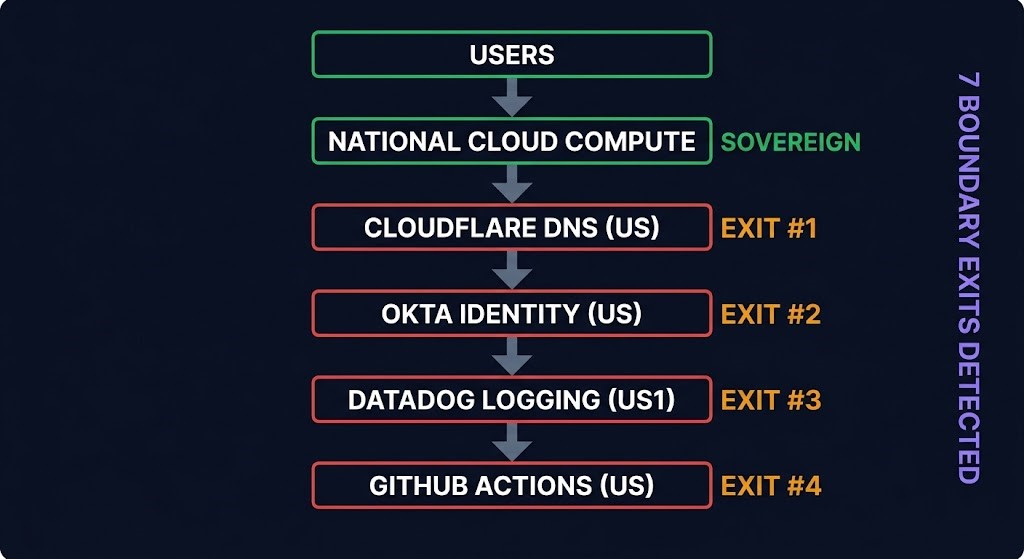
Immediate classification across four tiers: Operationally Sovereign (90–100), Jurisdictionally Exposed (70–89), Shadow Sovereignty (40–69), Sovereignty Theater (0–39). The banner displays the number of times your architecture exits sovereign boundaries.
02 — HIDDEN EXPOSURE COUNT
Total sovereignty exposures detected, broken down by: runtime control plane, metadata layer, build pipeline, trust chain, and identity authority. Quantifies the magnitude before showing the dependency chain.
03 — DEPENDENCY VISUALIZATION
Visual flow diagram showing where your architecture exits sovereign boundaries. Each external dependency is labeled with jurisdiction and numbered sequentially. Screenshot-ready presentation fuel for board meetings and architecture reviews.
04 — OPERATIONAL INDEPENDENCE SCORE
Four-dimensional scoring across: data sovereignty, control plane sovereignty, operational survivability, and metadata sovereignty. Exposes mismatched maturity — organizations frequently score high on data sovereignty and low on control plane sovereignty.
05 — BLAST RADIUS ANALYSIS
Operational impact if foreign dependencies revoke access. For each critical external dependency, the auditor surfaces what breaks first: DNS resolution fails, identity federation stops, observability goes blind, deployments halt. Answers the existential question: can you operate if they disappear?
06 — LAYER SEVERITY TABLE
Technical credibility layer. Maps failures to architectural blast domains: identity control plane, routing layer, build pipeline, telemetry layer, trust chain. Each layer tagged with severity (Critical / High / Moderate) and exposure type.
07 — REMEDIATION PRIORITIES
Sharp, architectural guidance. Not product recommendations. Each remediation identifies the sovereignty gap, the operational consequence, and the architectural path to independence. Effort and impact ratings included.
The Five Sovereignty Functions
The auditor assesses jurisdiction dependencies across five control plane domains. Each domain represents a category of operational authority that can reside inside or outside sovereign boundaries.
SOVEREIGNTY FUNCTION DOMAINS
- Identity Authority — Who authenticates your users and administrators. Self-hosted identity infrastructure vs external SaaS IdP determines whether authentication can continue if foreign services become unavailable.
- Routing Authority — Who controls DNS and CDN layers. External DNS providers create single points of jurisdictional failure. If DNS resolution depends on foreign infrastructure, platform ingress becomes inaccessible during service suspension.
- Trust Authority — Who issues and revokes certificates. Certificate authority jurisdiction determines whether your trust chain survives foreign CA revocation. Let’s Encrypt, DigiCert, and commercial CAs reside in US jurisdiction.
- Telemetry Authority — Who receives operational metadata. Logs, traces, metrics, and headers flowing to foreign observability platforms violate metadata sovereignty even when primary data remains sovereign.
- Software Supply Chain Authority — Who controls build infrastructure, artifact registries, and code repositories. CI/CD runners executing in foreign data centers create software supply chain jurisdiction dependencies most compliance frameworks do not assess.
Operational Sovereignty: The Organizing Framework
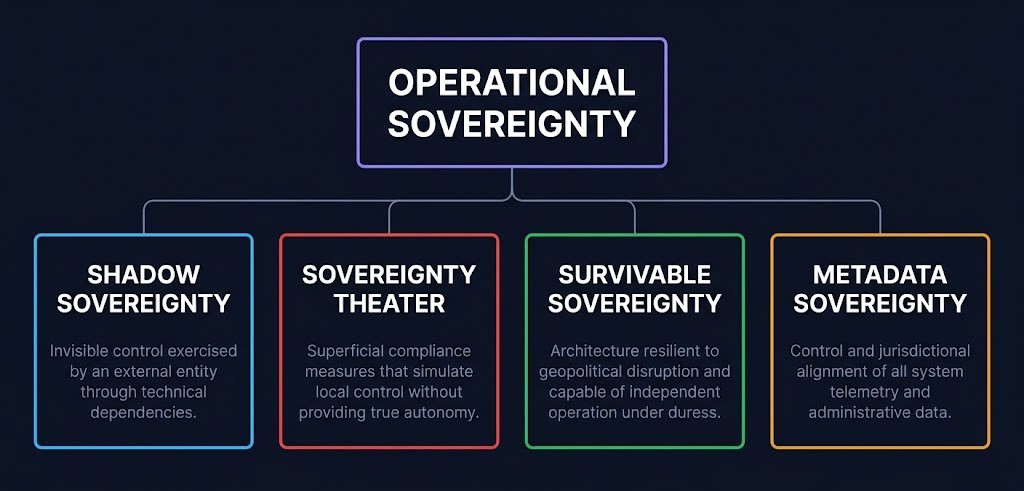
Operational Sovereignty is the ability to continue infrastructure operations without external jurisdictional dependency. It is the umbrella framework that unifies the auditor’s architectural diagnosis.
Most sovereignty conversations fixate on data location. Where bytes sit at rest. Operational Sovereignty reframes the question: where does execution authority reside? Who can revoke your access? Can you operate independently if foreign dependencies disappear?
Four sub-frameworks support this thesis:
- Shadow Sovereignty — Infrastructure that appears sovereign but depends on foreign control planes. Compute runs on-premises or in a national cloud, but DNS, identity, logging, and CI/CD all route through US jurisdiction. The sovereignty claim is accurate for data residency and false for operational authority.
- Sovereignty Theater — Claimed sovereignty with foreign operational authority. Organizations market themselves as sovereign infrastructure providers while depending on Cloudflare for DNS, Okta for identity, and GitHub Actions for deployments. The claim exists. The architecture contradicts it.
- Survivable Sovereignty — Ability to continue operations if foreign dependencies are revoked. The diagnostic question: if US SaaS vendors suspend your accounts tomorrow, does your platform keep running? Can workloads function without external DNS? Does auth work offline? Can certificates renew internally? Can builds execute locally?
- Metadata Sovereignty — Jurisdictional control over telemetry and operational data. Logs, traces, metrics, API headers, and observability metadata flowing to foreign platforms create sovereignty violations that data residency audits do not catch. Regulated data stays sovereign. Operational metadata does not.
Shadow Sovereignty Auditor: Key Features
- Real-Time Jurisdiction Escape Counter: As you fill the form, the auditor tracks sovereign boundary exits in real time. The counter updates live showing which dependencies route through foreign jurisdictions — DNS → US, Identity → US, Logs → US, CI Runners → US. Immediate visual feedback before the full audit runs.
- Operational Independence Scoring: Four-dimensional assessment across data sovereignty, control plane sovereignty, operational survivability, and metadata sovereignty. Scoring reveals mismatched maturity — organizations commonly score 80+ on data sovereignty and 20–40 on control plane sovereignty.
- Blast Radius Analysis: For each critical external dependency, the auditor surfaces operational consequences if access is revoked. If Cloudflare suspends your account: DNS fails, cert renewal breaks, API ingress unreachable. If Okta suspends access: admin control plane inaccessible, federated auth stops, emergency break-glass required.
- Layer Severity Mapping: Technical credibility for architects. Maps sovereignty failures to blast domains with severity ratings: Identity Control Plane (Critical), Routing Layer (Critical), Build Pipeline (Moderate), Telemetry Layer (Moderate), Trust Chain (High). Creates actionable remediation priorities without prescribing vendor solutions.
- Architectural Remediation Guidance: Sharp, non-sales language. Not “buy product X.” Instead: “External identity authority prevents disconnected operation. Remediation: Self-hosted identity or national provider migration. Effort: High. Impact: Critical.” Keeps the tool positioned as architectural analysis, not vendor comparison.
- Client-Side Only: No data leaves the browser. No telemetry, no server-side logging, no account required. The audit runs entirely in the local browser session against your inputs. No cookies, no tracking pixels, no database.
THE AUDIT SURFACES THE EXPOSURE.
A REVIEW MAPS IT TO YOUR ENVIRONMENT.
Sovereignty exposures compound. An operational independence score names the gap — it does not resolve the architectural dependencies or revocation risks that produced it. A cost architecture review translates the audit output into a sequenced remediation plan against your actual regulatory constraints and operational requirements.
Cost Architecture Review
Structured review of your sovereignty posture against your compliance framework and operational dependencies.
- > Control plane jurisdiction mapping
- > Operational survivability assessment
- > Metadata sovereignty audit
- > Sequenced remediation roadmap
Architecture Playbooks. Field-Tested Blueprints.
Operational sovereignty patterns, metadata governance frameworks, and control plane consolidation blueprints — delivered as field-tested operational guidance.
- > Sovereignty architecture patterns
- > Control plane consolidation
- > Metadata governance frameworks
- > Operational independence blueprints
Zero spam. Unsubscribe anytime.
Frequently Asked Questions
What does the Shadow Sovereignty Auditor measure?
The auditor assesses jurisdiction dependencies across five control plane domains: identity authority, routing authority, trust authority, telemetry authority, and software supply chain authority. It returns an operational independence score across four dimensions: data sovereignty, control plane sovereignty, operational survivability, and metadata sovereignty. The output is a deterministic architectural diagnosis — not a compliance checklist.
How is this different from a compliance audit tool?
Compliance tools enumerate what policies apply and whether data residency requirements are met. The Shadow Sovereignty Auditor diagnoses where operational authority resides and what happens when foreign dependencies revoke access. The distinction: compliance answers ‘where is the data?’ Operational sovereignty answers ‘who controls the system?’
What are the five sovereignty functions?
Identity Authority (who authenticates users and admins), Routing Authority (who controls DNS and CDN), Trust Authority (who issues certificates), Telemetry Authority (who receives logs/metrics/traces), Software Supply Chain Authority (who controls build infrastructure, code repos, and artifact registries). Each function can reside inside or outside sovereign boundaries.
Is any data sent to a server or stored after the audit runs?
No. The audit runs entirely in the local browser session. No data is transmitted to any server, no telemetry is collected, no account is required, and nothing persists after the browser tab is closed. The logic is client-side JavaScript executed against your inputs.
🔒 Privacy Architecture: No cookies. No tracking pixels. No server-side database.
This audit runs entirely in your local browser session.