

OPERATIONS & LLMOPS ARCHITECTURE
Execution running is not execution governed when operational state is not observable.
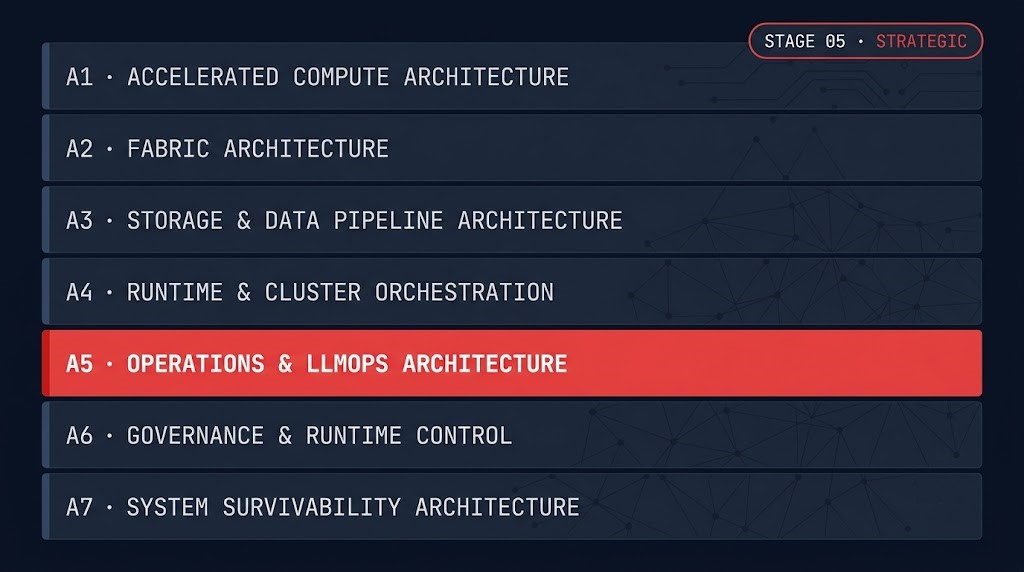
MATURITY POSITION — AI INFRASTRUCTURE STAGE 05 OF 07
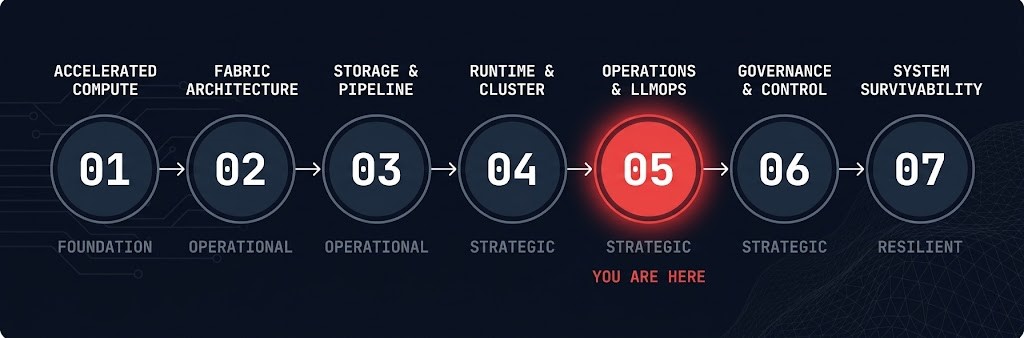
- Current Stage: Strategic — Maturity Stage 05 of 07
- Primary Architectural Concern: How operational state — model versions, inference behavior, cost accumulation, routing decisions, and SLO adherence — is made consistently visible to the governance layer across running AI workloads, and what happens when that visibility is incomplete or lagging
- Primary Failure Mode: Observability-Blind Operations — LLMOps environments where execution is running but its operational state is invisible to the teams responsible for governing it; model drift, latency degradation, cost accumulation, and SLO erosion accumulate without visible signal until the lag becomes a production event
- Stage Outcome: Ability to identify the Operational Observability Boundary (#120) and design LLMOps pipelines, inference governance, and cost observability architectures that maintain operational continuity under scale
- Next Stage: Governance & Runtime Control → Governance & Runtime Control
Operations LLMOps architecture is the stage where the question shifts from whether execution is permitted to whether it remains governed once it is running. A4 established who decides where execution occurs and defined the authority model that permits or blocks workload placement. A5 addresses what happens after that decision is made — when models are deployed, inference is serving, and the operational state of the running environment begins to diverge from the authority model without producing a visible signal.
The failure mode at this stage is not an event. It is accumulation. Cost compounds per request without attribution. Latency degrades across request profiles without crossing individual alert thresholds. Model behavior drifts from deployment baseline without triggering observability alerts. Routing decisions diverge from the placement authority model A4 established without leaving an audit trail. None of this is visible until the lag between state and signal has already made governance reactive rather than operative.
The articles in this stage treat observability as an architectural constraint, not an instrumentation task. What you cannot see, you cannot govern. The Operational Observability Boundary defines the limit of governance — not the limit of infrastructure. Where that boundary sits, what crosses it first, and how it is pushed outward are the architectural decisions this stage covers.
WHY THIS STAGE EXISTS — OBSERVABILITY-BLIND OPERATIONS
At A5, absence of visibility is equivalent to absence of control.
Models deploy. They run. Cost accumulates. Latency degrades. Model behavior drifts from baseline. Routing decisions diverge from the authority model A4 established. None of it is visible until the signal lags the event by hours or days — by which point the governance layer is responding to history, not state.
A4 established whether execution is permitted. A5 establishes whether it remains within the bounds the authority model defined. Those are different questions with different failure surfaces. Locality constraints determine where data lives. Authority constraints determine whether execution is allowed. Observability constraints determine whether anyone can see what execution is doing once it runs.
Most LLMOps failures at this layer share a common origin: Observability-Blind Operations. Deployment pipelines are built. Inference services are running. Monitoring dashboards show uptime. What is absent is the architectural layer that surfaces operational state — model version state, per-request cost, routing decisions, drift signals, latency profiles — to the governance systems responsible for acting on it. The result is not a single failure event. It is a governance gap that widens invisibly until a cost spike, an SLO breach, or a model behavior complaint surfaces it from the outside.
Stage Anchor Question
How is execution governed once it’s running?
Boundary Object — A5
Operational Observability Boundary (#120)
The point at which the runtime state of running AI workloads — model version state, inference latency, cost accumulation, routing decisions, and drift signals — is no longer consistently visible to the governance systems responsible for acting on it. Once crossed: governance responds to lagged state. Drift goes undetected. Cost compounds without attribution. SLO erosion is identified retrospectively.
Includes: model version state · inference latency profiles · cost accumulation per request · routing decision audit trail · drift signals against baseline
What This Stage Is Not
Not MLOps toolchain selection. MLflow, Kubeflow, and Weights & Biases appear throughout this stage as architectural options with specific tradeoffs under specific workload conditions — not as ranked products. The observability architecture is the design decision. The toolchain is the implementation layer. Selecting tooling before designing the observability architecture is the same order-of-operations failure that produces Authority-Blind Orchestration at A4.
Not a model training guide. Training architecture, accelerator configuration, data pipeline design, and checkpoint strategy belong to A1 through A3. This stage covers what happens after models are deployed into running inference environments — the operational continuity problem that training infrastructure decisions do not address.
Not the governance enforcement layer. A5 makes operational state visible — it establishes what can be seen and where the Operational Observability Boundary sits. A6 determines who has the authority to act on what is seen, who owns the enforcement rights, and how escalation authority is structured. These are different architectural problems on the same observability axis. Conflating them collapses A6’s governance layer into A5’s visibility layer before the authority model is defined.
Not a substitute for A4. Execution authority must exist before operational governance can enforce it. Undefined authority at A4 surfaces as ungovernable operations at A5 — routing decisions without a placement authority model, cost accumulation without a runtime budget model, and drift without a baseline the authority model can reference. A5’s observability architecture operates within the governance frame A4 established, not independently of it.
>_ Estimated Reading Depth
| Format | Count | Estimated Time | Notes |
|---|---|---|---|
| Architecture articles | 12 | ~5 hrs | Core reading sequence — all five clusters |
| Live diagnostic tools | 2 active + 1 forming | ~30–45 min | ISA, FPA — apply observability analysis to your environment |
| Total stage depth | 12 | ~4–6 hrs | Complete before proceeding to A6 Governance & Runtime Control |
>_ Where to Enter This Stage
This stage is the right entry point if you are designing or evaluating AI infrastructure where operational governance — not deployment cadence or scheduler throughput — is the architectural concern. Specifically, enter here if:
– Inference cost is accumulating but you cannot attribute it to specific models, routes, or request patterns
– Model behavior has changed in production but you have no baseline drift signal to confirm or quantify it
– SLO violations are being identified retrospectively — latency degradation is visible in incident reviews, not in operational dashboards
– Your LLMOps pipeline has deployment and versioning but no operational state visibility feeding back into the authority model A4 established
– Routing decisions are being made at runtime with no audit trail connecting them to the placement authority model
Do not enter this stage expecting to resolve scheduler configuration, quota contention, or gang scheduling failures — those belong to A4. Operational governance cannot substitute for an absent authority model, and observability cannot govern what authority never defined.
>_ Architecture Maturity Position
| Stage | Name | Maturity Level | Stage Question |
|---|---|---|---|
| A1 | Accelerated Compute Architecture | Foundation | What does an accelerator actually execute? |
| A2 | Fabric Architecture | Operational | What constrains execution movement? |
| A3 | Storage & Data Pipeline Architecture | Operational | What constrains data movement? |
| A4 | Runtime & Cluster Orchestration | Strategic | Who decides where execution occurs? |
| A5 ← YOU ARE HERE | Operations & LLMOps Architecture | Strategic | How is execution governed once it’s running? |
| A6 | Governance & Runtime Control | Strategic | Who owns runtime authority? |
| A7 | System Survivability Architecture | Resilient | What degrades gracefully and what collapses? |
>_ Stage Reading Sequence
The sequence below is organized by architectural problem cluster. Each cluster answers: what becomes architecturally unstable if this discipline is misunderstood?
Architectural question: What does it mean for inference to be operationally stable?
What does it mean for inference to be operationally stable?
LLMOps is not DevOps applied to language models. The lifecycle of a generative model in production introduces operational governance problems that software deployment pipelines were not designed to address — model versioning carries behavioral drift, not just version state; inference hardware has diverged from training hardware at the architectural level, creating two distinct operational surfaces with different observability requirements. These two articles establish why operations at this layer requires a different architectural frame before any toolchain is selected.
Architectural question: How does inference cost accumulate without visible operational signal?
How does inference cost accumulate without visible operational signal?
Inference cost is not a billing problem. It is an observability problem. Per-request cost accumulates across model invocations without producing an operational signal until it surfaces as a cost spike in a billing dashboard — at which point the governance layer is weeks behind the state it needs to govern. This cluster covers the three architectural layers of cost accumulation: the cost model nobody built before deploying inference, the absence of runtime execution budgets that lets cost compound without attribution, and the steady-state economics that emerge when inference scales without per-request visibility. Cost-aware model routing, covered as primary in Cluster 05, is the governance response this cluster establishes the need for.
Architectural question: Where does the Operational Observability Boundary sit in your environment?
Where does the Operational Observability Boundary sit in your environment?
Monitoring tells you when known states breach known thresholds. Observability tells you what happened in states you did not anticipate. AI inference environments produce the second category systematically — semantic failures behind HTTP 200s, cost spikes that emerge from latency patterns rather than request volume, and SLO erosion that spans multiple request profiles simultaneously without triggering any individual alert. This cluster maps the architectural distinction between monitoring and observability, identifies where AI inference collapses deterministic observability models, and establishes where the Operational Observability Boundary manifests in production environments.
Architectural question: How does operational state degrade without triggering visible failure?
How does operational state degrade without triggering visible failure?
Operational drift is not a failure event — it is a failure mode. The system does not produce an error. It produces a continuous divergence from the intended operational state that remains below the detection threshold of every individual monitoring signal while accumulating across all of them simultaneously. These two articles cover why drift is the dominant failure mode in AI operational environments: autonomous systems and inference clusters share the same architectural gap — operational change happens at a rate that observability was not designed to track, not because the observability tooling is insufficient, but because the Operational Observability Boundary was never defined. Note: this article also appears in A4 Cluster 04, where the framing addresses why authority gaps permit drift. Here the framing addresses why observability gaps leave drift undetected — the same phenomenon at a different failure surface.
Architectural question: How do routing decisions become operational governance commitments?
How do routing decisions become operational governance commitments?
Routing is not an optimization decision at operational scale — it is a governance commitment. Where inference requests are sent, which models handle them, and at what cost threshold determines how the execution authority model A4 established is expressed at runtime. This cluster covers the two governance surfaces of inference routing: the infrastructure placement problem that emerges when inference routing decisions become inseparable from the placement authority model, and the cost governance layer that determines whether every request should hit the most capable model or whether routing itself is the primary cost control mechanism. Both articles establish Cluster 05 as the governance interpretation layer that bridges A5 into A6.
>_ Live Diagnostics — AI Operations Layer
These systems surface operational state across the Operational Observability Boundary (#120), where traditional observability systems begin to lose signal fidelity. They are not monitoring tools — they are boundary instruments.
Identify where inference load is approaching saturation before latency SLOs are affected. Maps the request queue against token throughput to surface the pressure point before it becomes a production incident.
>_ Open ISA →Surface east-west fabric pressure across the inference cluster — where bandwidth coupling between nodes is creating systemic stress that individual node metrics do not show and that crosses the Observability Boundary before it reaches alert thresholds.
>_ Open FPA →Models degrade before they fail. This analyzer will surface the survivability boundary of your distributed inference architecture — identifying where partial failure propagates into full inference collapse before production load finds it.
>_ Operations & LLMOps Architecture — Failure Pattern Taxonomy
Failure patterns are categorized by where the Operational Observability Boundary collapses: visibility, system dynamics, or governance interpretation.
I. Visibility Failures
II. Systemic Cost & Drift Failures
III. Governance & Routing Failures
>_ Stage Graduates Can Now
Completing this stage establishes operational observability as a first-class architectural constraint in AI infrastructure design. A1 graduates understand compute. A2 graduates understand movement. A3 graduates understand data. A4 graduates understand authority. A5 graduates understand operations. Earlier stages defined the physical and governance constraints. This stage defines the visibility layer that determines whether those constraints are being honored — and whether anyone can see when they are not. What Strategic maturity at A6 adds is the authority to act on what A5 makes visible.
- Identify the Operational Observability Boundary in a running AI environment — where governance lag begins, what crosses it first, and what architectural changes push it outward
- Design inference cost observability architectures that attribute accumulation per request, per model, and per route before it surfaces as a billing event rather than an operational signal
- Detect model drift against operational baselines without relying on incident retrospectives or external complaint as the primary signal
- Connect runtime routing decisions back to the placement authority model established at A4 — routing as governance expression, not runtime optimization, with an audit trail the governance layer can act on
- Propagate operational visibility requirements forward into A6 — the governance and runtime control stage requires the observability infrastructure A5 establishes; undefined observability at A5 means A6 governs blind and cannot act on what it cannot see
No Specialization Tracks currently exist for the AI Infrastructure Architecture Path. Tracks are built after all seven maturity stages are live. This section will be populated as the path matures.
>_ Where Do You Go From Here
YOU’VE READ THE ARCHITECTURE.
NOW TEST WHETHER YOUR ENVIRONMENT HOLDS.
The Operational Observability Boundary is a design decision, not a monitoring configuration. Identifying where it sits in your environment requires reviewing inference cost attribution, model drift baseline design, routing audit architecture, and the handoff from A4’s execution authority model — before the boundary is crossed and governance becomes retrospective.
Infrastructure Architecture Review
A structured review of your AI operations and LLMOps architecture against the observability model this stage covers. Delivered as a written assessment with findings and remediation sequencing.
- > Inference operations observability assessment — where the Operational Observability Boundary sits
- > Cost accumulation architecture review — per-request visibility and runtime budget enforcement
- > Model drift detection architecture — baseline definition and signal latency
- > LLMOps pipeline review — deployment, versioning, rollback governance, and A4 authority handoff
Architecture Playbooks. Field-Tested Blueprints.
Field-tested blueprints for AI operations and inference governance — covering the failure modes this stage introduces.
- > Operational Observability Boundary identification and architecture
- > Inference cost attribution and per-request observability design
- > Model drift baseline architecture and signal latency reduction
- > LLMOps routing governance and audit trail architecture
Zero spam. Unsubscribe anytime.
>_ Frequently Asked Questions
What is the Operational Observability Boundary?
The Operational Observability Boundary is the point at which the runtime state of running AI workloads — model version state, inference latency, cost accumulation, routing decisions, and drift signals — is no longer consistently visible to the governance systems responsible for acting on it. Once crossed, governance responds to lagged state rather than current state. Drift goes undetected. Cost compounds without attribution. SLO erosion is identified retrospectively. At A5, absence of visibility is equivalent to absence of control.
What is Observability-Blind Operations?
Observability-Blind Operations is the failure mode where LLMOps environments run without the architectural layer that surfaces operational state to the governance systems responsible for acting on it. Deployment pipelines are built. Inference is serving. Uptime dashboards are green. What is absent is the visibility into model version state, per-request cost, routing decisions, drift signals, and latency profiles that the governance layer requires. The result is not a single event — it is a governance gap that widens invisibly until a cost spike, SLO breach, or external complaint surfaces it.
How does A5 differ from A6 — what does A5 make visible that A6 then governs?
A5 establishes what can be seen and where the Operational Observability Boundary sits — it is the visibility layer. A6 establishes who has the authority to act on what is seen, who owns the enforcement rights, and how escalation authority is structured — it is the governance enforcement layer. A5 answers: is this visible? A6 answers: who is authorized to act on it? These are different architectural problems on the same observability axis. A6 cannot govern what A5 has not made visible, and A5 cannot enforce what it can only observe.
What does inference cost observability actually require architecturally?
Inference cost observability requires four architectural layers: per-request cost attribution that traces cost to a specific model, route, and request pattern rather than an aggregate billing line; runtime execution budget enforcement that defines the cost ceiling before requests are served rather than after billing surfaces the overage; a routing audit trail that connects runtime routing decisions back to the authority model; and a steady-state cost model that projects inference economics under scale before they become unmanageable. Traditional cloud cost monitoring provides none of these — it surfaces cost after it has accumulated, not while it is accumulating.
How does model drift become an observability failure rather than a model failure?
Model drift is a model behavior change. Model drift without signal is an observability failure. The model changes are real — behavioral divergence from the deployment baseline occurs due to data distribution shift, fine-tuning side effects, or hardware inference variation. The observability failure is that no architectural layer surfaces this divergence to the governance systems responsible for acting on it. The signal is absent, not the event. A5’s observability architecture does not prevent drift — it makes drift visible before it accumulates into a production incident.
How does A4’s execution authority model connect to A5’s operational governance?
A4 establishes the execution authority model — who is permitted to consume resources, under what constraints, in what order. A5’s operational governance layer inherits that model and must keep it visible at runtime. Routing decisions must be traceable back to A4’s placement authority. Cost accumulation must be attributable to the workloads A4’s quota model permitted. Drift must be detectable against the operational baseline that A4’s execution model defined. When A4’s authority model is undefined, A5 has no governance frame to observe against — it can surface operational state, but cannot determine whether that state is compliant with an authority model that was never established.
What does the Distributed Inference Survivability Analyzer address that ISA and FPA do not?
The AI Inference Saturation Analyzer surfaces state pressure — where the inference queue is approaching saturation against token throughput capacity. The AI Fabric Pressure Analyzer surfaces system-wide coupling stress — where east-west bandwidth coupling between nodes creates systemic pressure that individual node metrics do not show. The Distributed Inference Survivability Analyzer addresses predictive boundary failure — where partial failure in a distributed inference architecture propagates into full inference collapse. ISA and FPA observe current operational state. The Survivability Analyzer will model where the survivability boundary sits before production load finds it — predictive rather than observational.
>_ Related Systems
Defines the execution authority model that A5 governs operationally — undefined authority at A4 propagates into ungovernable operations at A5; routing decisions, cost attribution, and drift baselines all require the authority frame A4 established.
Open Stage →Upstream data constraints shape inference pipeline behavior at A5 — storage locality decisions from A3 affect inference routing options and the cost accumulation patterns that operational observability must surface.
Open Stage →A5 makes operational state visible. A6 determines who has the authority to act on it — the Observability Authority Boundary (#121) governs what A5’s Operational Observability Boundary surfaces, and who owns enforcement rights over the signals A5 produces.
Open Stage →The full AI infrastructure pillar — operations and LLMOps architecture in the context of the wider AI infrastructure decision landscape.
Open Pillar →The AI operations diagnostic stack — AI Inference Saturation Analyzer, AI Fabric Pressure Analyzer, and the forming Distributed Inference Survivability Analyzer featured in the Live Diagnostics block above.
Open Workbench →The observability instrumentation standard underlying AI inference observability implementations — the signal collection layer that feeds into the architectural observability model this stage covers.
Open Reference →The CNCF Observability Whitepaper — distributed systems observability architecture model that underlies the operational observability patterns and Observability Boundary concepts this stage covers.
Open Reference →