

Terraform
Feature Lag
Tracker
Every tracked cloud GA announcement across AWS, Azure, and GCP, cross-referenced against the Terraform provider release that shipped support for it — or hasn’t yet. Scanned daily at 08:00 UTC.
Terraform Feature Lag: Navigating the “Gap of Grief”
The Terraform Feature Lag Tracker exists because, in the high-velocity world of hyperscale cloud, “Generally Available” is often a half-truth for the Infrastructure-as-Code engineer. While AWS, Azure, and GCP are quick to announce new services, the bridge to official HashiCorp Terraform provider support is rarely built on day zero. This tool quantifies the recurring architectural friction known as the “Gap of Grief” — the interval where architectural intent meets implementation reality.
Because of this gap, engineers are forced into a high-stakes trade-off: delay the project, resort to manual “ClickOps” that breaks the state file, or implement fragile workarounds like AzAPI, the AWS Cloud Control API, or custom shell wrappers.
Strategic Intelligence for Architects
This tool provides an independent, deterministic audit of Terraform feature lag. By quantifying the delay in days across the big three providers, it moves beyond vendor optimism to cold, hard telemetry. This isn’t just a list of missing features — it’s a strategic input. It tells you when to build, when to wait, and when to reach for a workaround.
Engineering Key Features
A daily pipeline scrapes official cloud release feeds and cross-references them against Terraform provider releases on GitHub — no manual maintenance, no stale spreadsheet.
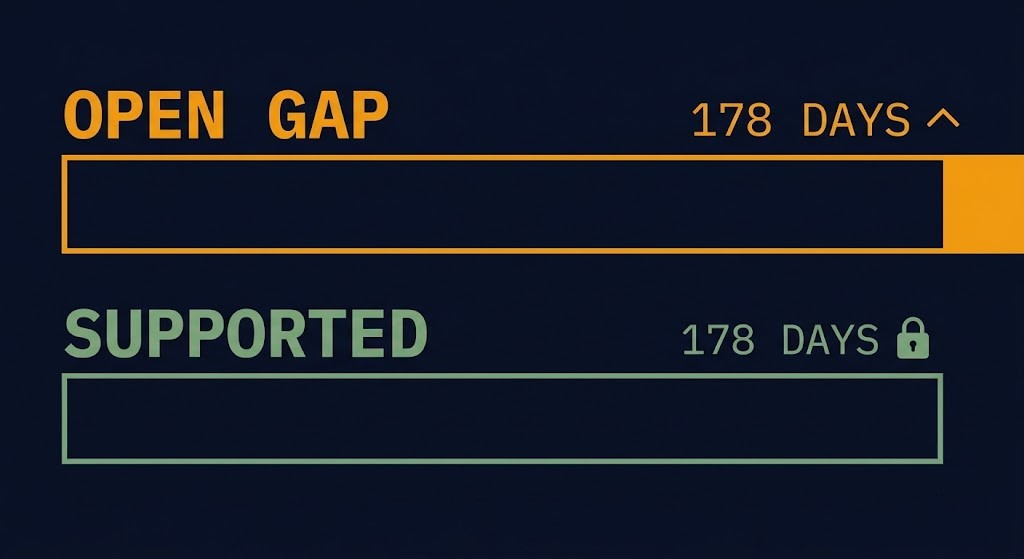
Open provider gaps sort to the top by lag, highest first — the table answers “what’s hurting me right now,” not just “what exists.”
Compare side-by-side how quickly AWS, Azure, and GCP synchronize their release announcements with their Terraform provider automation.
Every tracked feature links directly to the official cloud announcement, so you can verify the technical requirements yourself before committing to a build.
A Gap List Isn’t
a Migration Plan.
Knowing where Terraform lags provider reality is the input. Deciding what to build around, wait for, or work around across your actual estate is the architecture conversation.
IaC Modernization Review
Vendor-agnostic audit of where provider lag actually blocks your roadmap — and whether a workaround, a wait, or an OpenTofu migration path is the right call.
- > Provider gap triage against your actual roadmap
- > Terraform & OpenTofu migration runway
- > AzAPI / Cloud Control API workaround review
- > IaC governance & drift enforcement design
Architecture Playbooks. Every Week.
Field-tested IaC blueprints covering Terraform drift patterns, OpenTofu migration physics, sovereign baseline design, and GitOps enforcement models from real enterprise environments.
- > Terraform & OpenTofu Migration Physics
- > IaC Sovereignty & Drift Enforcement
- > GitOps & CI/CD Architecture Patterns
- > Real Failure-Mode Case Studies
Zero spam. Unsubscribe anytime.
Frequently Asked Questions
Q: How do I read the “Lag” column?
A: For a Supported feature, the number of days shows how long it took the Terraform provider to ship support after cloud GA — a fixed, historical figure. For a Gap, the number shows how many days have passed since GA with no support yet, and it grows daily until the feature ships.
Q: How accurate is the matching engine?
A: Matching natural-language cloud announcements to technical Terraform resource names is complex. The engine uses technical synonym and resource-prefix matching against release-note text. It’s deterministic and high-accuracy, but edge-case features may occasionally show as a Gap if the provider’s naming convention deviates significantly from the marketing name.
Q: A feature has a 100+ day gap. What should I do?
A: A significant gap usually indicates a console-only service or a complex resource HashiCorp or the community hasn’t prioritized. Common workarounds: Azure — the AzAPI provider for direct ARM calls. AWS — the AWS Cloud Control API provider. GCP — check for google-beta provider availability.
Q: How often is the data refreshed?
A: The pipeline scans daily at 08:00 UTC. The scan runs every day without fail, but the newest date shown reflects the most recent GA announcement actually found — not every day produces a new item across all three providers.
Q: Is any data sent to a server or stored?
A: No. The tool fetches a public dataset directly from GitHub and renders it client-side. There’s no input to submit, no account, and no server-side processing of anything you do on the page.
🔒 Privacy Architecture: No cookies. No tracking pixels. No server-side database.
This logic runs entirely in your local browser session.