


GitOps Boundary Mapper
Boundary Integrity Index · Authority Mapping · Contested Zones · Policy Intent Drift · Unowned Infrastructure
Modern infrastructure platforms rarely fail because ownership is absent. They fail because ownership is declared in one place, enforced in another, and assumed somewhere else entirely. The team that wrote the Terraform module believes they own the network policy. The platform team that deployed ArgoCD believes they do. Neither has mapped what the enforcement layer actually shows — because until something breaks, nobody checks.
Most environments are running three ownership models simultaneously: documented ownership, operational ownership, and enforcement ownership. They are rarely the same thing. That gap — between what the runbook says, what the platform enforces, and what teams assume during an incident — is where authority conflicts originate. The GitOps Boundary Mapper makes that gap visible before it becomes a failure. It declares ownership across 11 infrastructure domains, scores Boundary Integrity against Framework #135, and surfaces contested authority, unowned zones, and policy drift as named findings. This is part of the broader modern infrastructure architecture discipline — the boundary analysis layer that closes the gap between declared intent and enforced control.
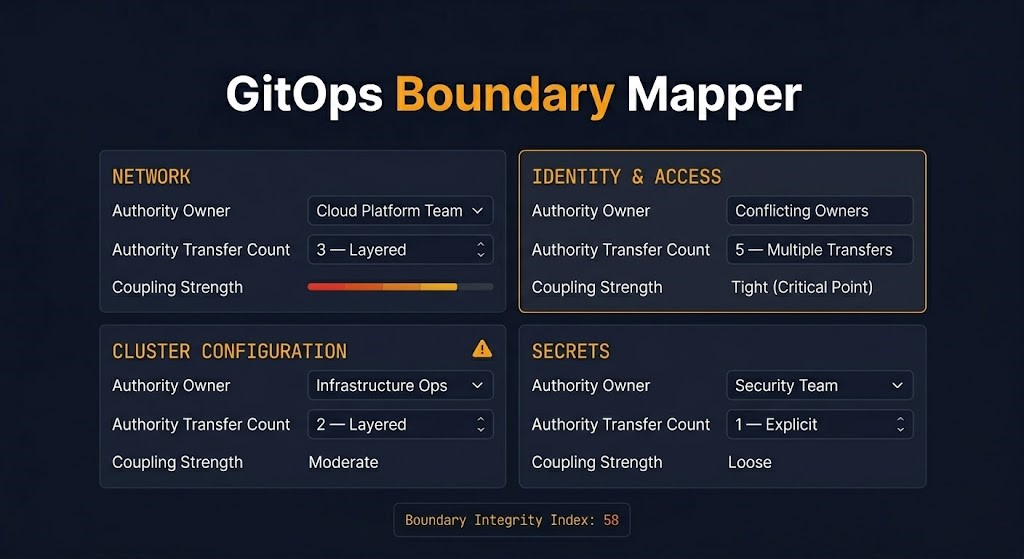
What the GitOps Boundary Mapper Surfaces
01 — Unowned Infrastructure
Domains and systems where no authority has been explicitly declared — or where the declared owner no longer exists as an operational entity. Unowned infrastructure isn’t neutral. It means the next person to touch that domain makes authority up. The mapper surfaces every unowned zone as a named gap, not an omission in a spreadsheet.
02 — Contested Authority
Domains where multiple systems claim the right to make changes — Terraform managing a resource ArgoCD also reconciles, or a policy engine overriding what an admission controller already enforced. Contested authority doesn’t resolve itself during steady state. It resolves itself during an incident, when the wrong system wins. The mapper names the conflict and scores its severity against the Boundary Integrity Index.
03 — Policy Intent Drift
The divergence between what a policy was designed to enforce and what the enforcement layer actually checks — surfaced against Framework #133 (Policy Intent Drift). This isn’t configuration drift. It’s intent drift: the policy still exists, still runs, but no longer enforces what the original design required. The mapper identifies where declared intent and operational enforcement have separated.
04 — Infrastructure Domains Analyzed
11 infrastructure domains form the authority mapping surface: Network, Identity & Access, Cluster Configuration, Workload Deployment, Ingress, Secrets, Policy, Autoscaling, Storage, Certificates, and DNS. Each domain is analyzed independently for ownership declaration, authority transfer count, and coupling strength — then scored as part of the composite Boundary Integrity Index.
Why Ownership Boundaries Fail
Boundary failures in GitOps environments aren’t random. They follow three structural patterns — each tied to a named framework, each surfaced explicitly by the mapper.
Policy Intent Drift — Framework #133
Declared ownership diverges from operational reality. The policy exists. It runs. It no longer enforces what the design required. The enforcement layer has moved; the intent documentation hasn’t.
Control Plane Ownership Boundary — Framework #135
Multiple systems claim authority over the same infrastructure object. Each believes it owns the change right. The conflict only becomes visible when both attempt to enforce — and the infrastructure resolves it in the wrong direction.
Stale Boundaries — Framework #129
Ownership assumptions persist long after they were last validated. The team that originally held authority has reorganized, the system they owned has been replaced, but the boundary documentation treats both as current. Stale boundaries aren’t inaccurate records — they’re active misdirection during incidents.
Output Architecture
All output derives from declared ownership — no inference, no heuristics. The mapper analyzes the authority declarations you provide across all 11 domains and surfaces findings as scored, named results. The outputs are organized from the map itself outward: the visual artifact first, the score that supports it, the findings that drive the score, and the scenario engine that pressure-tests the architecture.
Ownership Boundary Map
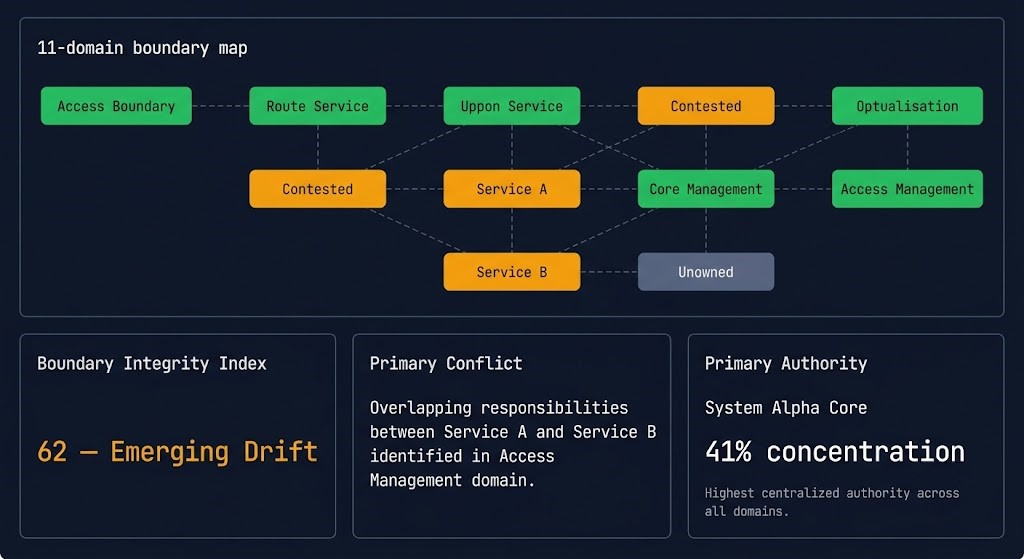
The primary output artifact — a live-updating visual map of all 11 infrastructure domains, rendered with authority state, ownership concentration, and conflict zones marked. Domains color-coded by integrity status. The map updates in real time as authority declarations are adjusted — it is the artifact you bring into the architecture conversation, not a report you export afterward.
Boundary Integrity Index (BII)
0–100 composite score across all 11 domains. Four tiers: Clear Authority (76–100) — ownership is declared, uncontested, and current. Emerging Drift (51–75) — early signals of contested or stale authority. Contested Control (26–50) — multiple authority claims active; conflict resolution is undefined. Authority Collapse (0–25) — significant unowned or contested zones; change authority is not deterministic. The BII is a diagnostic, not a target. A score of 95 in a poorly scoped declaration is not the same as a score of 95 in a fully mapped environment.
Primary Conflict Card
A single-sentence finding identifying the highest-priority authority gap in the declared architecture. Not a list — the most actionable conflict, stated plainly. The Primary Conflict card is the first thing to resolve before the BII score is meaningful.
Primary Authority Card
The dominant system in the declared architecture — the one carrying the highest authority concentration — named explicitly with its concentration percentage. Authority concentration isn’t a problem in itself, but unrecognized concentration is. If 70% of your infrastructure domains route change authority through a single system and that dependency isn’t in your runbook, it will surface during the incident that exposes it.
Tier 2 Diagnostics
Five secondary diagnostic surfaces: Unowned Zones (domains with no declared authority), Contested Zones (domains with competing authority claims), Policy Intent Drift (Framework #133 — declared vs. enforced divergence by domain), Stale Boundaries (Framework #129 — authority declarations that haven’t been validated against current operational reality), and Drift Drivers (the specific systems and configuration patterns generating the highest BII degradation). Tier 2 outputs are the explanation behind the Primary Conflict card — they show which pattern is driving the score, not just that the score is low.
Tier 3 Scenario Engine
Two adversarial scenario surfaces. Who Wins? Simulator: given a declared conflict between two systems over the same domain, which authority wins under the current enforcement model — and why? Failure Pressure Scenario: what does the boundary architecture look like when a specific system is removed or unavailable? Scenario outputs are forward-looking — they identify which conflicts become active under failure conditions that don’t yet exist in steady state.
GitOps Boundary Mapper: Key Features
- Boundary Integrity Index across 11 domains: BII scoring weighted across all 11 infrastructure domains — Network, Identity & Access, Cluster Configuration, Workload Deployment, Ingress, Secrets, Policy, Autoscaling, Storage, Certificates, and DNS. Each domain analyzed independently; composite score reflects the full authority architecture, not a sample.
- Contested zone detection: Surfaces domains where multiple systems claim change authority — named by system, scored by severity, classified by Authority Transfer Count. Direct (0–2 transfers), Layered (3–4), Fragmented (5–6), Authority Churn (7+). The classification matters: Fragmented and Authority Churn domains are where incident resolution goes wrong first.
- Policy Intent Drift surface (Framework #133): Per-domain analysis of declared enforcement intent versus operational enforcement state. Not configuration drift — intent drift. The distinction is that drift is recoverable; intent drift means the policy was never enforcing what the design required, and the gap has been accumulating silently.
- Stale Boundary detection (Framework #129): Identifies authority declarations that haven’t been validated against current operational reality — ownership assigned to systems that have been replaced, teams that have reorganized, or controls that no longer exist in the enforcement layer. Stale boundaries are the most common source of confusion during post-incident reviews.
- Client-side only — no telemetry: No data leaves the browser. No account required, no server-side logging, no network requests after initial page load. The entire analysis engine runs locally in your browser session. Authority architecture is operational information — it doesn’t belong in a SaaS platform’s database.
THE MAPPER SURFACES THE CONFLICTS.
A REVIEW RESOLVES THEM.
Mapping authority boundaries identifies where ownership is contested, stale, or absent. Closing the gaps requires defining enforcement hierarchy, eliminating competing claims, and building a control plane architecture that survives the question “who owns the right to change this?”
Infrastructure Architecture Review
A structured review against your Boundary Integrity findings — resolving contested authority, eliminating stale ownership declarations, and designing an enforcement hierarchy that holds under operational pressure.
- > Control plane authority hierarchy design
- > Contested zone resolution
- > Policy intent drift remediation
- > Boundary validation architecture
Architecture Playbooks. Field-Tested Blueprints.
Weekly breakdowns of control plane architecture, boundary failure patterns, and the enforcement decisions that determine whether a GitOps environment holds under operational pressure.
- > Control plane authority patterns
- > GitOps boundary failure cases
- > Policy intent drift architecture
- > Infrastructure governance design
Zero spam. Unsubscribe anytime.
Frequently Asked Questions
What does the Boundary Integrity Index actually measure?
BII is a 0–100 composite score across all 11 infrastructure domains — it measures how clearly and unambiguously change authority is declared in your environment. A high score means ownership is declared, uncontested, and current across all domains. A low score means authority is distributed across competing systems, undeclared in key domains, or based on assumptions that the enforcement layer no longer supports. BII is a diagnostic: it tells you where the authority architecture is fragile before the fragility becomes a production incident.
How is this different from a CMDB or a GitOps runbook?
A CMDB records what systems exist. A runbook records who you call when something breaks. The GitOps Boundary Mapper analyzes who has the right to change each infrastructure domain — and whether that right is uncontested, enforced, and current. It runs scenario modeling to show which authority conflicts activate under failure conditions, and surfaces Policy Intent Drift and Stale Boundaries as named findings rather than documentation gaps. The output isn’t a record — it’s a scored verdict on whether your authority architecture holds.
What infrastructure environments does the mapper cover?
The mapper is architecture-agnostic. It models any GitOps environment where authority over infrastructure domains needs to be declared and analyzed — Kubernetes-native, hybrid Terraform-plus-ArgoCD, platform-team-plus-developer-team split models, and multi-cluster architectures where authority may differ by cluster. The 11 domains (Network, Identity & Access, Cluster Configuration, Workload Deployment, Ingress, Secrets, Policy, Autoscaling, Storage, Certificates, DNS) cover the structural authority surface present in every enterprise GitOps environment.
Is any data sent to a server or stored?
No. All analysis — BII scoring, contested zone detection, policy drift surface, scenario modeling — runs locally in your browser. Nothing you enter is transmitted, logged, or stored anywhere. The tool produces no network requests after the initial page load. Authority architecture is operational information — it belongs in your environment, not in a SaaS platform’s database.
🔒 Privacy Architecture: No cookies. No tracking pixels. No server-side database.
This logic runs entirely in your local browser session.