

AI Runtime Governance Analyzer
Diagnose authority fragmentation, governance drift risk, and runtime control gaps across AI infrastructure environments.
Most AI environments can answer who operates the infrastructure.
Very few can answer who governs it.
The gap between those two questions is where governance risk accumulates. Operational ownership covers day-to-day runtime management — who restarts services, who responds to incidents, who deploys workloads. Governance authority is a different layer: who sets the rules that bound those operations, who enforces them, and critically — who has final authority to deny or halt inference execution when something violates those rules.
In most enterprise AI environments, that authority is undefined. Models run. Infrastructure scales. Teams coordinate. But the question “who can actually stop a workload from running?” often has no answer. That condition is the Runtime Authority Vacuum — and it exists independently of whether the rest of the governance architecture looks healthy.
The AI Runtime Governance Analyzer surfaces this gap structurally. It is not a maturity survey. It is not a questionnaire that scores effort or intent. It is an authority diagnostic — input your actual ownership and control model across seven governance domains, and receive a deterministic assessment of where authority fragmentation exists, how blast radius amplifies it at scale, and which framework conditions are active in your environment.
Framework — Runtime Authority Vacuum
The condition where AI models are running, inference infrastructure exists, and governance policies are documented — but no team has defined authority to deny, halt, or restrict inference execution. The vacuum exists regardless of operational maturity; it is an authority gap, not a capability gap.
What the AI Runtime Governance Analyzer Diagnoses
01 — Scale & Environment
Number of AI teams, inference environments, and observability platforms. These inputs do not directly measure governance quality — they measure blast radius. The same authority fragmentation across 12 teams and 8 environments produces categorically different risk exposure than 2 teams and 1 environment. Numerics act as multipliers against every authority signal that follows.
02 — Operational Authority
Runtime Operations Owner, Runtime Policy Authority, Deployment Authority, and Policy Enforcement Model. This section surfaces the distinction the analyzer is built around: who operates the runtime versus who governs it. Those two authority types frequently belong to different teams, different charters, and different accountability structures — and the gap between them is where Governance Drift begins.
03 — Incident & Visibility Authority
Incident Authority and Observability Authority. Visibility governance is the most commonly fragmented layer in AI operations — multiple monitoring platforms, shared ownership, and unclear incident accountability create the conditions for Visibility Fragmentation before any specific failure occurs. The analyzer scores this domain against observed ownership patterns and platform count simultaneously.
04 — Inference Execution Authority
Who has final authority to deny, halt, throttle, or restrict inference execution? This is the governance question most enterprises have not answered. It is also the only input in this diagnostic that can fire a hard trigger — if no group holds this authority, the Runtime Authority Vacuum condition activates unconditionally, independent of all other inputs. The answer drives the most consequential output in the diagnostic.
Output Signals
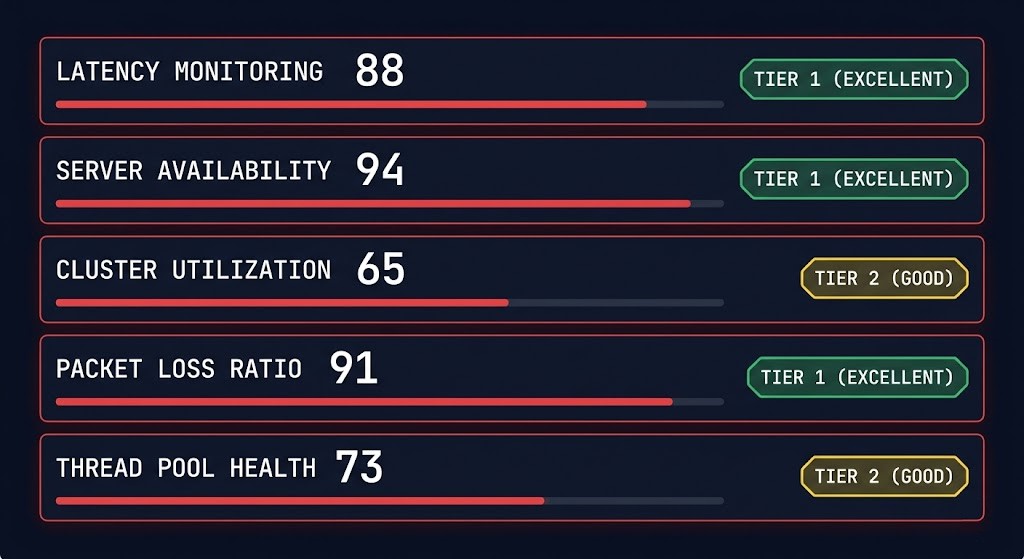
Five primary output signals, one secondary diagnostic signal. The primary signals are scored 0–100 and amplified by the scale inputs — not because larger environments are inherently worse governed, but because authority gaps at greater scale produce greater failure surface.
Governance Authority Rating — Primary
0–100 composite score reflecting overall governance maturity — the degree to which authority is consolidated vs fragmented across all seven domains. Inference Execution Authority is weighted 1.5× in this calculation; the ability to stop a workload is the governance capability that makes every other authority signal meaningful. Tiers: Consolidated / Partial Authority / Fragmented / Authority Gap.
Operational Fragmentation Score
Ownership dispersion across runtime operations, policy authority, incident response, and observability. Measures how distributed operational accountability is — not whether individual teams are capable, but whether accountability is coherent across domains. Mixed, shared, and undefined ownership patterns each score progressively higher fragmentation.
Runtime Control Concentration
Whether deployment, policy enforcement, and runtime policy authority are centralized or diffuse. This signal specifically distinguishes the enforcement architecture from the ownership structure — federated standards and best-effort compliance produce diffuse control even when individual teams have clear ownership. Tiers: Centralized / Partially Distributed / Distributed / Diffuse.
Observability Authority Exposure
Visibility governance risk derived from observability ownership, incident authority, and platform count. Observability authority is scored at 1.5× weight because its absence produces an asymmetric risk — when nobody owns the view of AI operations, incidents are harder to detect, harder to scope, and harder to assign. Multiple platforms with shared ownership is the highest-risk configuration in this domain.
Governance Drift Risk
Likelihood of diverging operating standards across teams and environments. High team counts with mixed deployment authority and inconsistent enforcement models produce divergent operating standards — not from malice, but from structural pressure. Each team optimizes for its own constraints. Over time, the operating model fragments even when the governance intent was consistent.
The secondary diagnostic signal — the Governance Dependency Index — measures how many governance decisions require coordination between multiple authorities. High values indicate slower policy enforcement, slower incident response, and greater operational ambiguity. It is a measure of governance friction, not governance failure; the distinction matters because the remediation path differs.
Framework Conditions
The analyzer evaluates three named framework conditions against your inputs. Two fire on weighted scoring. One fires unconditionally.
Runtime Authority Vacuum — Hard Trigger
Fires unconditionally when Inference Execution Authority = No Defined Authority. No other input can suppress it. The condition is binary: either a group holds the authority to deny or halt execution, or it doesn’t. Team count, environment sprawl, and enforcement model are irrelevant to the trigger — they only affect the scale at which the vacuum produces consequences.
Governance Drift — Scored Trigger
Fires when multiple ownership domains are mixed, deployment authority is shared or uncontrolled, policy enforcement is federated or best-effort, and team count amplifies the divergence pressure. A hard variant also fires when both Policy Enforcement Model and Runtime Policy Authority are simultaneously undefined — that combination means governance drift is already structural, not probabilistic.
Visibility Fragmentation — Scored Trigger
Fires when observability authority is shared or undefined, multiple monitoring platforms are in use, or incident ownership is distributed across parties. The condition is not about which monitoring tool is deployed — it is about whether anyone has authority over the complete view of AI operations. Without that, no single team can detect cross-environment anomalies, and incident response starts from ambiguity rather than from signal.
Where the Governance Layer Fits
The AI Runtime Governance Analyzer occupies the Governance plane in the AI Infrastructure operational stack — above runtime saturation and operations, below system survivability. The tools below it answer whether the infrastructure is working. This tool answers who actually controls it.
AI Infrastructure Operational Stack
The Runtime Authority Vacuum this analyzer diagnoses is an AI-specific instance of a broader pattern — undefined control plane ownership. CS4: Control Plane Architecture addresses the same authority-concentration and shadow-control-plane dynamics at the cloud strategy level, generalized across any infrastructure domain where control plane ownership was never explicitly assigned.
AI Runtime Governance Analyzer: Key Features
- Deterministic authority fragmentation scoring: Governance Authority Rating derived from seven authority domain inputs weighted by blast-radius scale — no inference, no sampling, no averages across teams.
- Hard-trigger framework detection: Runtime Authority Vacuum fires unconditionally when no group holds inference execution authority — independent of all other inputs. Governance Drift fires on a dual hard condition when both policy enforcement and policy authority are simultaneously undefined.
- Blast-radius multiplier architecture: Numeric scale inputs (team count, environment count, observability platform count) act as fragmentation amplifiers rather than standalone signals — the same authority gap produces categorically different risk at different organizational scales.
- Governance Dependency Index: Secondary diagnostic signal measuring coordination points across authority domains. Surfaces governance friction — how many decisions require multi-party handoffs before anything can be enforced or acted on.
- Client-Side Only: No data leaves the browser. No telemetry, no server-side logging, no account required.
THE DIAGNOSTIC NAMES THE GAP.
A REVIEW MAPS THE BOUNDARY.
Authority fragmentation at the governance layer is an architectural problem, not an org chart problem. A structured review maps your actual control boundaries, identifies the Runtime Authority Vacuum conditions, and defines the enforcement architecture before production incidents expose it.
Infrastructure Architecture Review
Structured review of your AI governance architecture — authority model, enforcement boundaries, and runtime control gaps mapped against your actual operating environment.
- > Authority boundary mapping across governance domains
- > Runtime Authority Vacuum identification and resolution path
- > Enforcement architecture design for AI workloads
- > Governance Drift conditions and remediation sequencing
Architecture Playbooks. Field-Tested Blueprints.
AI governance architecture, runtime control design, and authority boundary patterns — delivered as field-tested operational blueprints.
- > AI runtime governance design patterns
- > Authority boundary modeling for inference environments
- > Enforcement architecture for distributed AI teams
- > Governance Drift identification and containment
Zero spam. Unsubscribe anytime.
Frequently Asked Questions
Q: What does the AI Runtime Governance Analyzer actually measure?
A: The analyzer measures authority fragmentation across seven governance domains — runtime operations, runtime policy, deployment authority, policy enforcement, incident response, observability ownership, and inference execution authority. It is not a maturity survey and does not score governance intent or documented policy. It scores the actual authority model: who holds each governance function, how ownership is distributed, and whether any authority is undefined. The Inference Execution Authority input carries the most diagnostic weight — the ability to deny or halt inference execution is the governance capability that makes every other authority signal meaningful.
Q: How is this different from a governance maturity assessment?
A: Governance maturity assessments score processes, documentation, and capability development. The AI Runtime Governance Analyzer scores authority structure — specifically, whether defined authority exists across the domains where it is most consequential. A mature governance program with well-documented policies and undefined inference execution authority still produces a Runtime Authority Vacuum. The analyzer surfaces structural gaps, not maturity gaps. Those are different problems with different remediation paths.
Q: What environments and team structures does the analyzer cover?
A: The analyzer is designed for enterprise AI environments operating inference workloads across one or more teams, environments, or platforms. It is relevant for centralized AI platform teams, federated ML team models, and hybrid structures where platform, SRE, and AI/ML ownership intersect. The scale inputs (team count, environment count, observability platforms) calibrate the blast-radius amplification — the diagnostic is equally valid for a 3-team organization and a 50-team one; the scale inputs adjust the risk exposure accordingly.
Q: Is any data sent to a server or stored?
A: No. The analyzer runs entirely in your browser session. No inputs are transmitted, logged, or stored. No account is required. The application is a single HTML file with no backend dependencies.
🔒 Privacy Architecture: No cookies. No tracking pixels. No server-side database.
This logic runs entirely in your local browser session.