

Disaster Recovery Authority: The Missing Layer in Most Recovery Plans
Most disaster recovery programs are built around three questions: what systems need to recover, in what order, and within what timeframe. Those are legitimate questions. They produce dependency maps, runbooks, RTO targets, and recovery priority tiers. What they don’t produce is an answer to the question that precedes all of them: who still has the authority to execute recovery when the incident has destroyed the conditions under which authority normally functions?
That’s the disaster recovery authority problem. And it’s absent from most DR programs.
The Assumption Hidden Inside Every Recovery Plan
Every DR program contains an unstated belief: that the people, credentials, approvals, and access paths required to execute recovery will survive whatever event triggers it. That belief is rarely documented. It’s never tested directly. It’s simply assumed.
Your runbooks assume credentials remain accessible. Your escalation paths assume decision-makers are reachable. Your recovery procedures assume the engineers who wrote them are available to run them. Your tooling assumes identity systems are functional enough to authenticate the accounts that matter. Your approval gates assume that the processes used to authorize production changes still work under incident conditions.
None of those assumptions are recovery dependencies in the traditional sense. They don’t appear in a dependency map or a system inventory. They aren’t modeled in an RTO calculation. But they are load-bearing — and they are the first things an incident attacks.
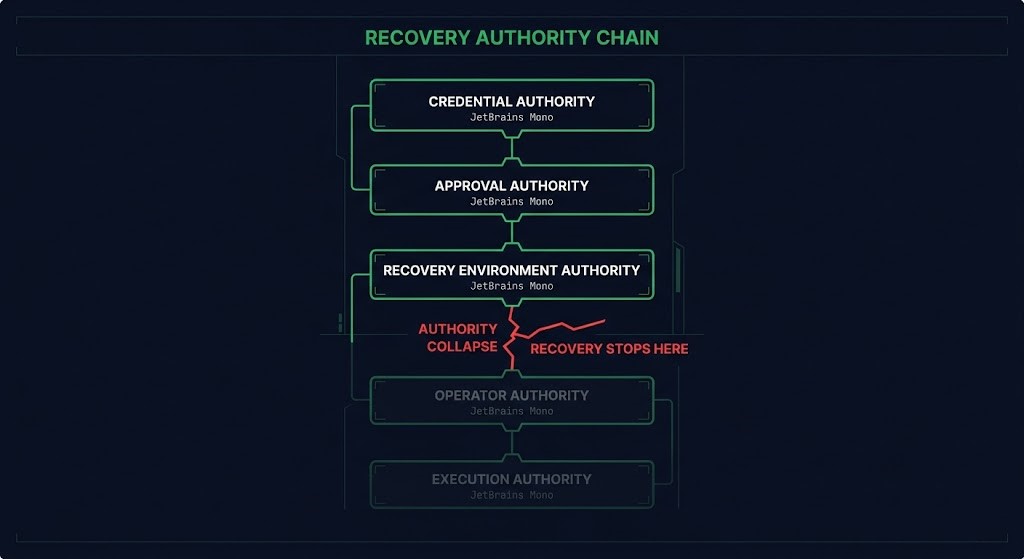
The authority chain underneath every recovery plan looks like this:
RECOVERY AUTHORITY CHAIN
01
Credential Authority
Access to accounts, vaults, and recovery credentials
02
Approval Authority
Decision-makers who can authorize recovery execution
03
Recovery Environment Authority
Operator access to recovery infrastructure and management plane
04
Operator Authority
Personnel who can execute the recovery procedures
05
Execution Authority
Recovery knowledge that survives without its original authors
If any link in this chain fails, recovery does not begin — regardless of whether systems are recoverable.
This chain is implicit in every recovery plan. Most programs test whether systems can be recovered. Almost none test whether this chain survives the incident that triggers recovery.
⚠ COMMON MISTAKE
DR tests validate whether systems can be restored to a known-good state. They rarely validate whether the people, credentials, and approvals required to start that restoration would survive a real incident. A passing test score against a functioning identity system proves nothing about authority survivability.
Recovery Dependencies Are Not Recovery Authority
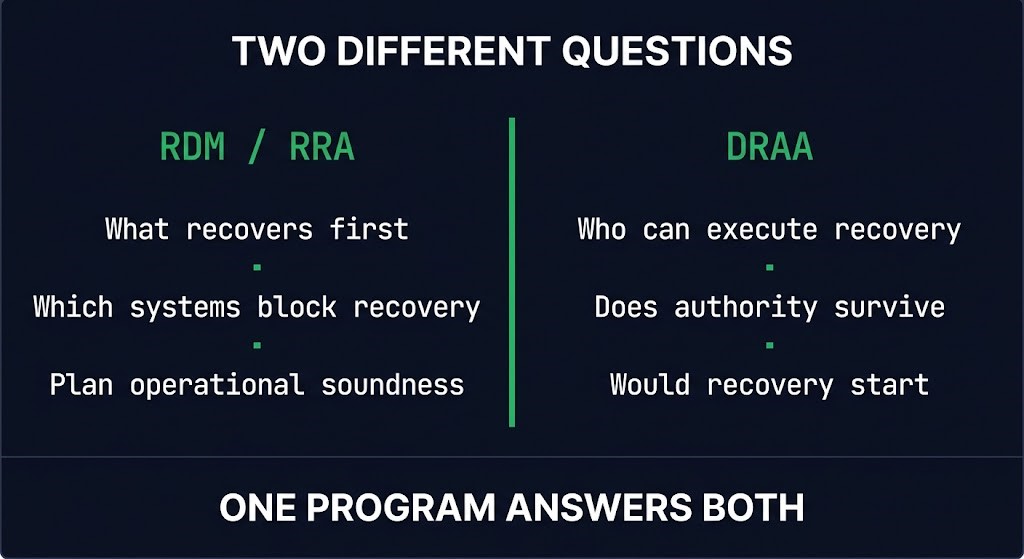
The data protection architecture discipline has good tooling for dependency questions. Recovery Dependency Mapping tells you what must come back first. Recovery Readiness Analysis tells you whether your recovery plan is operationally sound. What neither of those answers is the authority question.
The distinction matters because the questions being answered are categorically different:
| Question | RDM Answers | DRAA Answers |
|---|---|---|
| What must recover first? | ✓ Yes | — |
| Which systems block recovery? | ✓ Yes | — |
| Is the recovery plan operationally sound? | ✓ Yes | — |
| Who can execute recovery? | — | ✓ Yes |
| Does authority survive the incident? | — | ✓ Yes |
| Would recovery actually start? | — | ✓ Yes |
RDM and RRA answer infrastructure questions. The Disaster Recovery Authority Analyzer answers an authority question. These are not competing tools — they operate on different problem layers. A program that has strong dependency mapping and a validated recovery plan can still fail to start recovery if authority has been fragmented by the incident.
The same layer-confusion shows up in infrastructure sizing, not just DR governance. Two Nodes Can Preserve Availability. They Can’t Preserve N+1 Capacity. makes the parallel case for two-node edge clusters: quorum surviving a node failure answers whether the cluster is up, not whether the surviving node can carry the workload — a different question, the same way “authority survived the incident” and “recovery capability exists” are different questions here. In both cases, the metric that’s easiest to check isn’t the one that determines whether operations actually continue.
DIAGNOSTIC QUESTION
“If the incident started right now, does your organization have sufficient authority to begin recovery execution — or does the incident itself destroy the conditions under which recovery can start?”
Recovery Authority Fragmentation — Framework #144
Recovery authority becomes fragmented when the people, systems, credentials, approvals, and operational knowledge required to execute recovery do not survive the same failure conditions that trigger recovery.
FRAMEWORK #144 — RECOVERY AUTHORITY FRAGMENTATION
Recovery authority becomes fragmented when the people, systems, credentials, approvals, and operational knowledge required to execute recovery do not survive the same failure conditions that trigger recovery.
The framework surfaces three failure conditions that standard DR assessments miss entirely.
AUTHORITY CONCENTRATION
Recovery authority concentrated in a small number of people, systems, or approval paths creates a single failure surface. When that surface is inside the incident blast radius, authority collapses at the moment it’s needed most.
AUTHORITY SURVIVABILITY
Not all authority domains survive equally. Credential authority can survive a personnel outage. Operator authority cannot survive a personnel outage. Authority survivability maps which domains are exposed to which failure scenarios — and which combinations break the chain entirely.
AUTHORITY INDEPENDENCE
Recovery authority is independent when its survivability is architecturally separated from the systems it governs. Authority that depends on the same identity provider, management plane, or network segment as the production environment it’s designed to recover is not independent — it shares the blast radius.
These three concepts define how authority can be measured, distributed, and hardened. They also make concrete the difference between a DR program that has tested its systems and one that has validated its authority.
Framework #144 assumes the prior architectural question has already been answered — that recovery topology, blast radius, and restore sequencing were deliberately designed in the first place. When they weren’t, the condition the Recovery Design Boundary (Framework #146) names as Recovery-Blind Architecture, authority fragmentation is frequently the symptom that surfaces first, not the root cause underneath it.
The Five Authority Domains
Framework #144 structures recovery authority across five domains. Each domain represents a discrete layer in the recovery chain. Failure in any one domain stops the chain regardless of the state of the others.
01 — CREDENTIAL AUTHORITY
Who controls access to recovery credentials, break-glass accounts, vault keys, and privileged identities? Credential authority fails when the identity provider used to authenticate those accounts is itself inside the blast radius — or when vault access requires approvals from systems that are down.
02 — APPROVAL AUTHORITY
Who can authorize the recovery execution decision? In most enterprises, production changes — including recovery actions — require approvals. If the approval path runs through ticketing systems, change management platforms, or executives who are unreachable, recovery waits regardless of technical readiness.
03 — RECOVERY ENVIRONMENT AUTHORITY
Can operators reach recovery infrastructure? This domain covers access to the management plane — vCenter, Prism, the cloud console, or whatever control surface governs the environment being recovered into. If that plane is down, compromised, or inaccessible, recovery infrastructure that is technically operational cannot be reached.
04 — OPERATOR AUTHORITY
Who can actually execute recovery procedures? Operator authority maps the personnel surface: which engineers hold the knowledge, authorization, and access to execute each recovery step, how many of them must be simultaneously available, and what the organization’s exposure is when key personnel are unavailable.
05 — EXECUTION AUTHORITY
Can recovery knowledge survive without its original authors? This domain addresses procedure portability: whether runbooks are sufficiently documented, tested by engineers other than their authors, and accessible in a format that survives the incident itself. Execution authority fails when institutional knowledge walks out with the people who hold it.
These domains are not independent. They form the chain illustrated in Section 1. A break at any point stops execution — and the break doesn’t announce itself in advance. Authority survivability is one of four variables that determine whether a recovery process behaves deterministically at all. The Deterministic Recovery Model names the other three — Sequence, Dependency, and Validation — and treats an authority chain that resolves differently depending on who’s running the incident as the sharpest case of a recovery process left probabilistic by design rather than engineered against it.
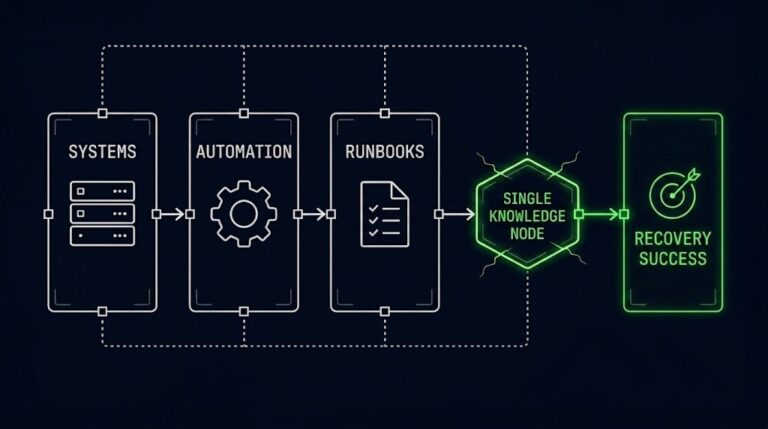
Operator Authority and Execution Authority are where this framework’s personnel exposure concentrates, and it’s worth naming the failure mode directly rather than leaving it as a sub-bullet: recovery bus factor is the measurable version of both domains at once — the number of people who could be unreachable before a documented, authority-clean recovery plan stops being executable. An organization can pass every domain in this framework’s authority audit and still have a bus factor of one, because authority clean enough to survive audit and knowledge concentrated in one or two engineers are different findings entirely.
How Authority Fractures
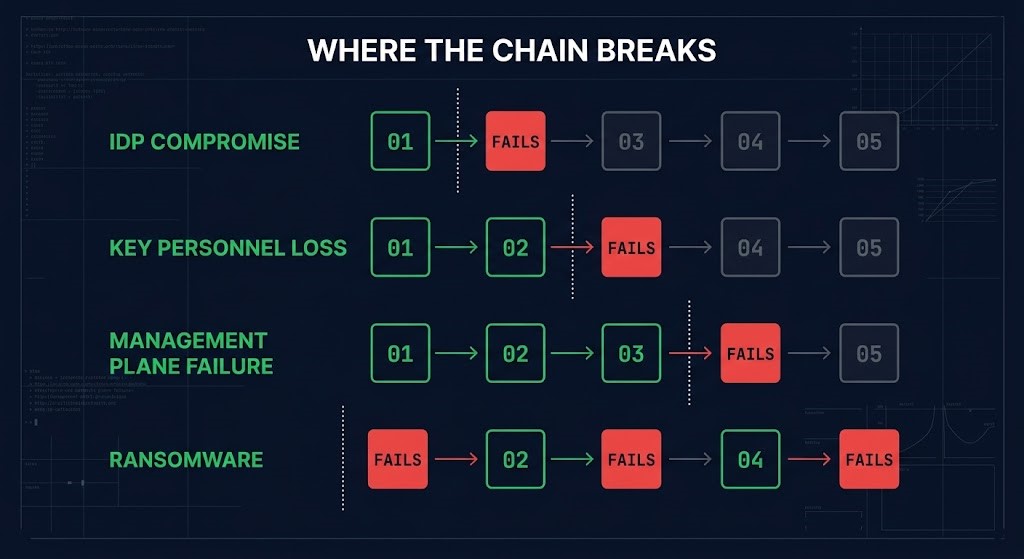
Authority doesn’t fail uniformly. Different incident types break the chain at different points. What makes this operationally dangerous is that the break point isn’t predictable from system state alone — it depends on which domains the specific incident scenario puts inside its blast radius.
Four failure patterns account for the majority of authority collapses in practice.
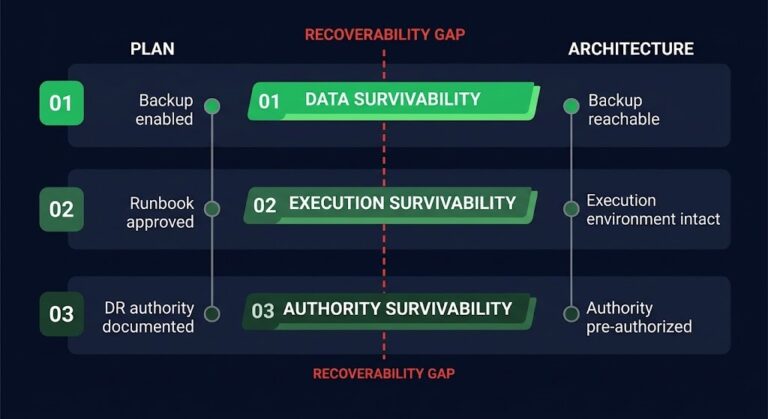
Ransomware is also where the recoverability gap tends to surface for the first time. A backup that has passed every completion check for years can still fail to produce a validated recovery — and authority collapse is precisely the condition under which that gap gets discovered, rather than tested for in advance.
⚠ BLAST RADIUS OVERLAP
Authority independence requires that recovery authority domains are architecturally separated from the systems they govern. Authority that shares a network segment, identity provider, management plane, or storage layer with production is inside the same blast radius. When that blast radius expands, authority and infrastructure fail together.
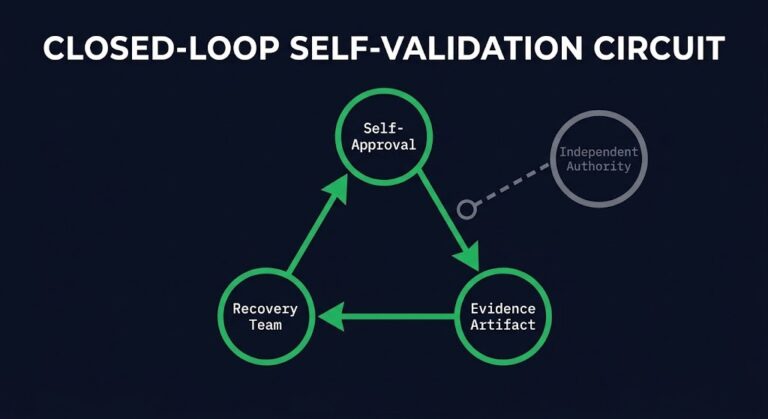
The common thread across all four failure chains: the incident that triggered recovery also degraded the authority required to start it. Standard DR testing does not surface this because tests are run under normal operating conditions — with credentials accessible, personnel available, management planes functional, and approval paths clear. The authority chain is never stressed because the test doesn’t simulate the conditions that stress it.
Adversarial restore testing is the practice built to stress exactly this chain on purpose — staged credential revocation timed to land mid-restore is functionally an authority-chain stress test, forcing the Recovery Start Line question during a drill instead of leaving it to whichever real incident happens to break credential, approval, or management-plane authority first.
The Recovery Start Line
This analysis identifies where authority breaks. It does not identify whether the platform used to execute recovery survives at the same time. The two are separate problems. Authority can fail while the backup and recovery infrastructure remains technically sound. That infrastructure can fail while authority structures remain fully intact. Recovery only proceeds when both survive together — when the platform is operable and reachable, and the people authorized to operate it still have the access, credentials, and approvals to do so. Validating whether a recovery platform and its execution authority hold up together under the same failure conditions, rather than separately, is the focus of Recovery Platform Architecture, the second stage in the Data Protection & Resiliency Learning Path. Crossing the Recovery Start Line means recovery can begin. What happens next is a separate architectural question. Restore architecture — the layers between data recovery and operational recovery — is rarely designed and almost never tested. Authority intact, platform reachable, data restored: none of that guarantees the workload returns to operation if platform recovery, identity recovery, and dependency recovery were never architected. Proving it does — producing the artifact that shows recovery actually works, rather than assuming it — is the evidence problem Restore Evidence Is the Missing Artifact in Every DR Program addresses directly.
Every disaster recovery strategy has a Recovery Start Line.
It is the point at which an organization possesses sufficient authority — across all five domains — to begin recovery execution. Below that line, recovery is theoretically possible but operationally stalled. Above it, recovery can proceed regardless of incident conditions.
Most DR programs never identify where that line actually exists. They assume it’s always crossed automatically when a declared disaster triggers the runbook. Framework #144 says otherwise: the Recovery Start Line is a specific, measurable threshold, and whether it’s crossed depends entirely on which authority domains survive the incident.
This reframes what DR preparation actually means. A program that has mapped its recovery dependencies, validated its RTO targets, and tested its restore paths has answered infrastructure questions. It has not answered the authority question. The Recovery Start Line is where those two categories of preparation converge — or fail to. Whether your organization can cross the Recovery Start Line under real incident conditions — where platform authority and execution capability must survive simultaneously — is the core question of D2 Recovery Platform Architecture. D2 validates execution authority and platform survivability against the failure scenarios that most degrade both.
Authority survivability is exactly the kind of finding a board can’t verify from the outside — which is why recovery readiness is increasingly reported as a governance metric in its own right, not just an internal audit line. A board asking whether recovery would work is functionally asking whether the Recovery Start Line has ever been crossed under real conditions; authority is one of four qualities — alongside evidence, determinism, and adversarial survival — that separates a defensible answer from a reassuring one.
There’s a narrower version of this same authority-survival question worth naming directly, because it inverts the assumption this post makes about who holds recovery authority in the first place. Your Cloud Isn’t Compromised. Your Vendor Is. Now What? examines credential authority — Domain 01 of the chain above — when the party holding it isn’t the organization at all, but a consultant, MSP, or platform partner with standing recovery-adjacent access. This framework asks whether internal authority survives the incident. That post asks a related but distinct question: whether external authority that does survive should still be trusted, given that the incident may have been on the vendor’s side of the relationship rather than the organization’s own.
The operational implication is direct: if your organization cannot cross the Recovery Start Line under the incident conditions you’re most likely to face, the quality of the recovery plan below that line is irrelevant. You cannot execute what you cannot authorize. The Start Line also has a mirror at the far end of the incident: even a fully authorized, fully executed recovery still terminates at the Continuity Execution Boundary (#163) — whether the business is actually operating once recovery succeeds is a separate claim from whether recovery was able to begin — the exact handoff point between this post’s Cluster 5 and the rest of the Disaster Recovery & Failover Architecture stage.
There’s a second mirror further out, on the validation side rather than the execution side: authority determines whether recovery starts and who’s accountable for running it; it says nothing about whether anyone besides that same accountable team has standing to confirm, afterward, that what they ran actually worked. That’s the specific gap the Recovery Evidence Boundary (#167) names directly — an organization can have flawless execution authority (this framework) and zero validation authority (#167) at the same time. Different failure modes, same incident.
Identifying where the Recovery Start Line sits — and whether it’s crossable under each of your named failure scenarios — is what the Disaster Recovery Authority Analyzer is built to surface.
Architect’s Verdict
Dependency maps are necessary. They are not sufficient. A map of what must recover in what order tells you nothing about whether the authority to begin that recovery exists at the moment you need it. These are different artifacts answering different questions — and most DR programs have invested heavily in one while ignoring the other entirely.
Authority survives incidents differently than infrastructure does. Infrastructure failures are usually scoped: a storage array fails, a network segment goes down, a compute cluster loses power. Authority failures are architecturally coupled: when the identity provider goes down, every system that authenticates through it loses its access surface simultaneously. When the management plane fails, every system it governs becomes unreachable at once. The blast radius of an authority failure is often wider than the blast radius of the infrastructure failure that caused it — and it compounds the recovery problem rather than being part of it.
Every DR program should be able to identify its Recovery Start Line: the specific configuration of surviving authority domains that is sufficient to begin recovery execution. If that line has never been defined, the program has never tested whether it can be crossed. The Disaster Recovery Authority Analyzer exists to surface that answer before an incident does.
Additional Resources
Editorial Integrity & Security Protocol
This technical deep-dive adheres to the Rack2Cloud Deterministic Integrity Standard. All benchmarks and security audits are derived from zero-trust validation protocols within our isolated lab environments. No vendor influence.

R.M.
Senior Solutions Architect with 25+ years of experience in HCI, cloud strategy, and data resilience. As the lead behind Rack2Cloud, I focus on lab-verified guidance for complex enterprise transitions. View Credentials →
Get the Playbooks Vendors Won’t Publish
Field-tested blueprints for migration, HCI, sovereign infrastructure, and AI architecture. Real failure-mode analysis. No marketing filler. Delivered weekly.
Select your infrastructure paths. Receive field-tested blueprints direct to your inbox.
- > Virtualization & Migration Physics
- > Cloud Strategy & Egress Math
- > Data Protection & RTO Reality
- > AI Infrastructure & GPU Fabric
Zero spam. Includes The Dispatch weekly drop.
Architecture Audit Services
Fixed-scope audits for Zero-Trust Azure, VMware migration readiness, and recovery posture — no discovery call required to start.
>_ View Audit Services>_Related Posts
Your Recovery Program Has a Recovery Evidence Boundary
Recovery evidence boundary is the point where a recovery program stops being an engineering question and starts being a governance one — and most organizations cross it without ever finding out, because everything on the way there still looks like success. The backups completed. The DR test passed. The tabletop went well. Somebody wrote a…
Your Recovery Architecture Has A Bus Factor Problem
Recovery bus factor is the gap between a recovery plan that has been tested, documented, and signed off — and a recovery plan that can actually be executed when the one or two people who know how to run it aren’t in the room. The recovery program had passed everything that mattered on paper: RTO…
Your Ransomware Recovery Plan Has a Recoverability Gap
The recoverability gap is the structural distance between what your recovery plan assumes and what your infrastructure can actually deliver under failure conditions. Most organizations don’t discover it during planning. They discover it on day three of an incident. >_ Architect’s Brief 60-second read before you commit to the full post · Full post: 12…
Your Ransomware Plan Is Fiction: 5 Recovery Metrics Nutanix, Cohesity, Rubrik & Pure Can’t Hide
Ransomware recovery metrics are the only thing standing between your recovery plan and a PowerPoint. Every vendor demo shows a single VM booting in 60 seconds. Every real ransomware recovery looks like this: the backups are intact, the ransomware is neutralized, the executives are on the bridge — and nothing is coming back online. >_…
Your Logs Are Not Evidence If The Infrastructure That Produces Them Can Rewrite The Record
The evidence layer is not a byproduct of your infrastructure — it is infrastructure, and on August 30, Sygnia documented what happens when the evidence layer is captured along with everything else. Fire Ant, a China-nexus threat actor Sygnia has tracked since 2025, spent this year moving past the VMware hypervisors it was previously known…
Your Identity System Is Your Biggest Single Point of Failure
Part 2 of the Rack2Cloud’s Cloud Fragility Series >_ Cloud Fragility Series 01 Multi-Cloud Cascading Failure Risks 02 Your Identity System Is Your Biggest Single Point of Failure [CURRENT] 03 Vendor Lock-In Happens Through Networking — Not APIs 04 Your Cloud Bill Quietly Increased in 2026 — Here’s Where the Money Is Actually Going >_…