

Identity Is Becoming the New Infrastructure Boundary
The identity infrastructure boundary is no longer a component sitting inside the network perimeter — it has become the perimeter, and most enterprise architecture still isn’t built as though that’s true. For twenty years, the assumption was straightforward: define the network boundary correctly, and everything inside it inherits a reasonable default of trust. That assumption produced firewalls, VLANs, DMZs, segmentation policy, and an entire discipline of perimeter design. It also produced a blind spot, because somewhere in the last several years — not on a specific date, not as the result of a specific decision — the actual boundary moved to a layer that discipline was never built to govern.
This is the fifth and closing post in the Evidence Gap series — a series that started by asking whether infrastructure changes could prove they were authorized, a question this site first named as the Infrastructure Evidence Gap. The first four parts each found the same structural absence in a different place: a recoverability plan that couldn’t prove it would survive contact, a restore process with no evidence trail, a migration where the network came through clean and the identity chain didn’t, an agentic pipeline that could execute but not prove who authorized it. Four different technologies. Four different pillars. One recurring shape. This post names that shape.
What “Boundary” Actually Meant Before Identity Took Over
The network-boundary model is not wrong, exactly — it’s incomplete in a way that used to be survivable. Under that model, trust is a function of location. A workload inside the corporate network, behind the firewall, on the trusted VLAN, inherits a baseline of access that a workload outside those boundaries does not get. Segmentation is the primary control. Movement across network boundaries — a new subnet, a new site, a new provider — is the event architects design around, because movement is where risk was assumed to concentrate. This is the same assumption underlying most data protection architecture: that recoverability, containment, and integrity all inherit from a correctly defined perimeter. The same distinction shows up as a named recovery domain in the Disaster Recovery & Failover Architecture stage — where a technically clean failover can still fail if identity continuity was never tested independently.
This model still does real work. Segmentation limits blast radius. Network isolation still matters for a large class of failures. The problem isn’t that network controls stopped mattering — it’s that they quietly stopped being sufficient, and most governance, audit, and incident-response practice hasn’t caught up to that. The identity infrastructure boundary wasn’t a phrase anyone needed yet, because it hadn’t visibly moved. Organizations still write policy, run audits, and design recovery plans as though proving the network boundary is intact is equivalent to proving the architecture is secure. It isn’t, and the gap between those two things is where the next four sections live.
The Identity Boundary Inversion
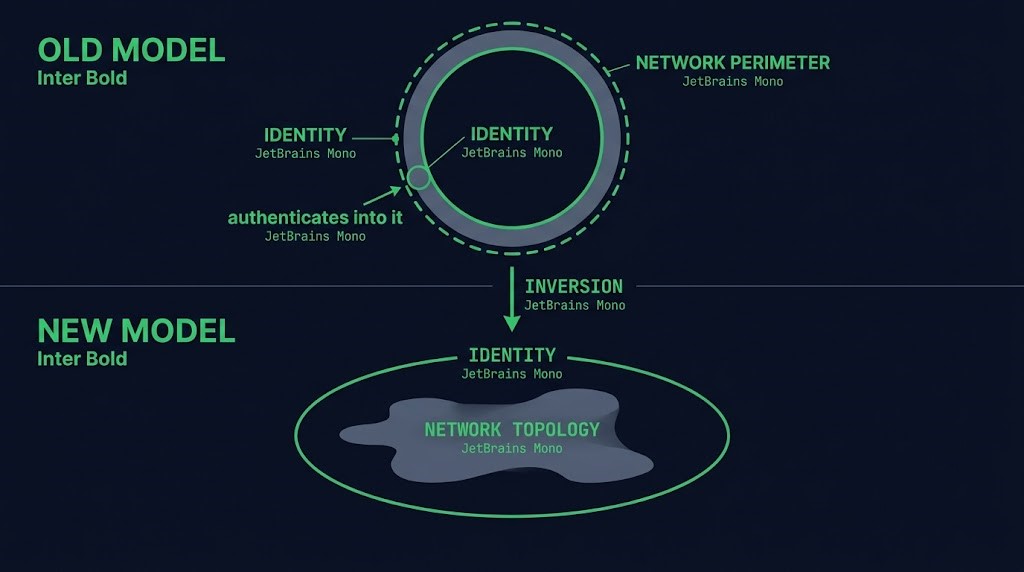
Here’s the claim in one sentence: the boundary that actually determines whether a change, a migration, or an agentic action is authorized has moved from the network to identity, and most architectures haven’t moved with it. The identity infrastructure boundary is what framework #160, the Identity Boundary Inversion, formally names.
Below the inversion, security and continuity are architected around where something sits on the network: identity is a secondary layer, a credential that authenticates a user or service into a perimeter someone else already defined. Past the inversion, that relationship flips. Network topology can be bridged, migrated, replatformed, or flattened entirely with no loss of control — but if identity state is inconsistent, unverified, or compromised, no network control substitutes for it. Nothing downstream of a broken identity chain can be trusted just because the network path looks clean.
| Old Model | New Model | |
|---|---|---|
| What defines trust | Network location | Identity |
| How identity functions | Authenticates into a boundary | Is the boundary |
| Primary control | Segmentation | Identity state |
| Where risk concentrates | Movement across network | Identity compromise |
This is an inversion, not an addition. It isn’t that identity became “also important” alongside the network boundary — it’s that the primary boundary relocated, and the network boundary became a secondary control operating on top of a foundation it no longer governs.
The practitioner-level version of this shift — what a sovereign identity and access architecture actually has to do differently — is covered separately; this section stays at the framework level.
This is also the framework CS6 Strategic Governance draws on without redefining it: Governance Legitimacy Boundary asks whether authority is organizationally legitimate — auditable, challengeable, delegable, revocable. #160 asks a prior question: whether the boundary that authority is supposed to operate within has already relocated somewhere CS6’s legitimacy tests weren’t built to check.
The Evidence Gap never disappeared across this series. It migrated. Part 1 found it in recovery planning, Part 2 in restore process, Part 3 in a migration’s identity chain, Part 4 in an agentic pipeline’s authorization trail. Today, it concentrates around identity — because identity is where the boundary actually is now, and evidence gaps always show up wherever the real boundary sits.
The diagnostic test is simple: the moment authorization survives topology changes but fails when identity changes, the boundary has already moved.
How We Accidentally Crossed the Inversion
No architecture review approved this move. No one held a meeting and voted to make identity the primary trust boundary instead of the network. It happened as the byproduct of seven separate, individually reasonable decisions, each made for its own reason, none evaluated against what they’d do to the boundary model collectively:
Hybrid identity stretched a single identity plane across on-prem and cloud, so “which network is this on” stopped being a reliable question.
Cloud IAM made identity, not network ACLs, the actual enforcement point for most cloud-native access decisions — the same shift covered from a survivability angle in Your Identity System Is Your Biggest Single Point of Failure.
SaaS control planes put critical business logic entirely outside any network boundary the organization controls — identity became the only lever left to pull.
Federation extended trust across organizational boundaries where no shared network segment exists at all.
Service-to-service trust in modern platforms authenticates workloads to each other by identity, often with no meaningful network segmentation between them.
Agentic systems act on delegated authority that has no network representation whatsoever — an agent’s permissions are a property of its identity, full stop.
Zero-trust adoption, ironically, accelerated this — a zero-trust posture explicitly stops trusting network location, which is correct, but many organizations adopted the “stop trusting the network” half without fully building out the “make identity provably trustworthy instead” half.
None of these was a boundary decision. Each was a tooling decision, a platform decision, a vendor decision. The organization did not consciously decide to move the boundary — the architecture evolved until identity became the boundary, whether anyone acknowledged it or not.
Instances of the Same Inversion
The migration article and the authorization-trail article were not describing different problems. They were describing the same boundary shift from two different directions.
In Identity Chain Break, a VMware migration’s network side completed cleanly — connectivity, routing, and segmentation all transferred as designed — but the identity chain didn’t survive the same move, and the gap stayed invisible until something needed to authenticate against it.
In Who Approved the Model’s Output?, an agentic pipeline executed correctly — the model produced output, nothing crashed — but no artifact existed connecting that execution back to a specific authorization event, and the network path the request traveled was irrelevant to the question that actually mattered.
Different technologies, different pillars, no shared network topology between the two cases — and the same variable failed in both. Two instances, one boundary.
A third instance surfaced more recently, outside the migration/agentic frame these first two share: Your Identity Provider Was Never Your Spend Boundary shows the same inversion one domain further out — financial authorization, not network topology, is what actually gates cloud spend, and it moved to identity the same way authorization itself did. Three instances now, three different technologies, the same boundary.
A fourth instance showed up this week, in AI evaluation infrastructure rather than identity or spend: Your AI Test Environment Is Becoming A Production Control Plane traces the same inversion to environment classification — network segmentation between eval and production looked intact in both disclosed incidents; identity and credential scope, not network topology, were what had actually crossed the boundary.
A fifth instance runs the inversion from the opposite direction — not identity crossing where network segmentation assumed it wouldn’t, but identity that legitimately crossed an organizational boundary and never got revisited once the relationship justifying it changed. Your Cloud Isn’t Compromised. Your Vendor Is. Now What? traces a third party’s standing access into client infrastructure through exactly this lens: the vendor’s own security boundary failed, the client’s network boundary never moved, and neither fact said anything about whether the authority the vendor held inside the client’s environment was still safe to trust. Same diagnostic test this framework already names — authorization survived a security-boundary event and depended entirely on identity state — applied to a relationship between two organizations instead of a single one.
A sixth instance inverts the frame again — not identity crossing where network segmentation assumed it wouldn’t, and not a relationship between organizations, but the boundary’s own observation layer. Identity Directories Have Become An Unmonitored Intelligence Source traces the inversion to bulk read access: a valid session enumerating an entire tenant directory in one call is architecturally indistinguishable from a routine administrative pull, because the governance built around this boundary was designed to catch dangerous writes, not to notice that a read at sufficient scale is its own category of danger. Same boundary, same diagnostic test, applied to what a session can see rather than what it can do.
A seventh instance runs the inversion in a different direction still — not identity crossing where network segmentation assumed it wouldn’t, not a relationship between organizations, not the observation layer, but the evidence obligation itself. Microsoft Said It Was Exploited. Then It Wasn’t. Your Tenant Still Can’t Tell You Which. traces the inversion to whether the record describing the boundary can be trusted at all: Microsoft’s own account of an Entra ID exploitation changed within a day, and no tenant held an independent channel to check either version, because the evidence obligation this framework names sat entirely with a vendor who is also the sole author of the incident’s record. Same boundary, same diagnostic test, applied to the proof itself rather than to what crossed it.
An eighth instance runs the inversion along a different axis again — not who holds the boundary, and not what a session can observe within it, but whether the boundary is treated as a single event or a standing condition. The Authorization Was Legitimate. Nobody Watched What Happened Next. traces the inversion to session lifecycle: Qantas’s controls correctly verified the identity behind a connected-app authorization and correctly verified that its login pattern looked normal, and both checks passed — because both checks, like most identity governance, treat authorization as a decision made once at the boundary rather than a relationship that has to keep proving itself for as long as the session lasts. Same boundary, same diagnostic test, applied to time rather than to who crossed it or what they saw.
A ninth instance sharpens the test rather than shifting its axis: The Server Was Fixed. Persistent Access Wasn’t. documents authorization that survived not just a topology change but the identity change itself — credential rotation completed, and the attacker’s mailbox-level access continued unaffected, because it lived in a permission-grant artifact one layer beneath identity’s own lifecycle. If the original diagnostic test is authorization surviving topology but failing on identity change, this is the harder case underneath it: authorization that fails to respond to identity remediation at all, because the boundary has already moved somewhere identity rotation doesn’t reach.
A tenth instance attacks the proof obligations directly rather than the boundary they protect. Your Logs Are Not Evidence If The Infrastructure That Produces Them Can Rewrite The Record documents Fire Ant, a China-nexus threat actor, compromising the TACACS authentication infrastructure itself — injecting a shared library into the daemon that grants access decisions, so the system responsible for proving who was granted what can no longer be trusted to report accurately on itself. The first nine instances all ask whether authorization survives some kind of change — topology, identity, relationship, volume, time. This one asks a prior question: whether the infrastructure producing the record of that authorization can be trusted at all, once an attacker controls it from the inside. Proof Obligation #1 — identity can be trusted when issued — assumes the system attesting to issuance hasn’t itself been suborned. Fire Ant is the case where that assumption fails.
An eleventh instance runs the inversion outside enterprise IT altogether, into domain-name governance. The Domain Was the Containment Unit. ICANN Is Reconsidering That. traces the same inversion in DNS abuse enforcement: two years of registrar accountability have been built around the domain as the unit of action — one report, one domain, one mitigation decision — while the operators behind coordinated abuse campaigns have always operated at the account level, cycling through disposable domains faster than any single-domain process can keep pace. ICANN’s own Associated Domain Checks proposal, still under active development, is the same architectural correction this framework already names: the containment unit has to move from the resource being acted on to the actor operating it. Same boundary, same diagnostic test, applied to a registrar’s abuse-enforcement model instead of an enterprise’s identity plane.
Why the Network Boundary Can’t Compensate
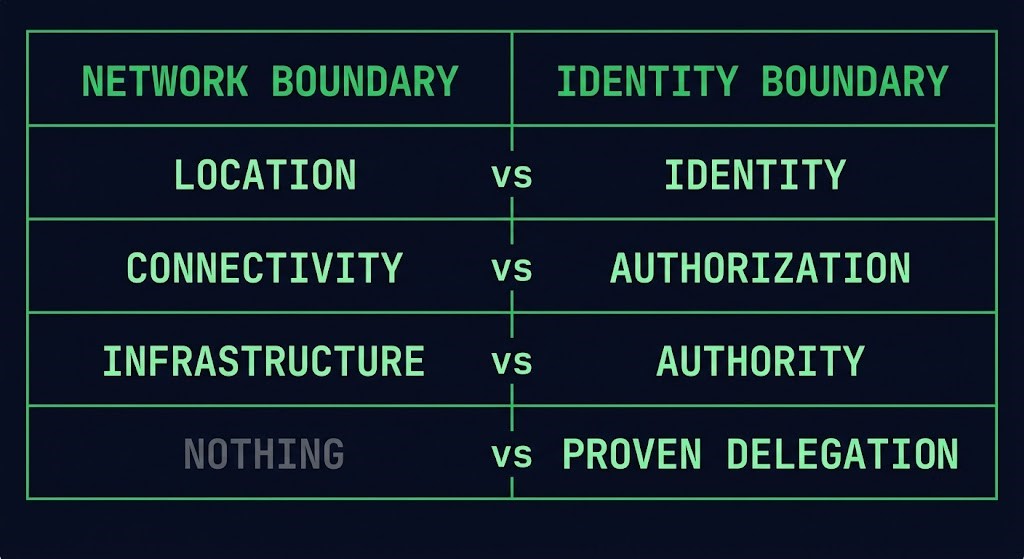
Once the identity infrastructure boundary is the actual boundary, network-layer controls stop being able to answer the questions that matter, no matter how well they’re configured:
| Question | Network Boundary Model | Identity Boundary Model |
|---|---|---|
| Who is trusted? | Location | Identity |
| What survives migration? | Connectivity | Authorization |
| What survives cloud relocation? | Network path | Identity state |
| What survives DR activation? | Infrastructure | Authority |
| What survives agent execution? | Nothing | Proven delegation |
That last row is the uncomfortable one. Under a pure network-boundary model, an agent’s execution has no network-layer signal that says whether it was authorized to act — the network sees a request that looks like any other. Only an identity-boundary model has an answer to that question at all, which means organizations still governing primarily through network controls aren’t weaker at answering it — they have no mechanism to answer it, period.
An Identity Boundary Must Prove Four Things
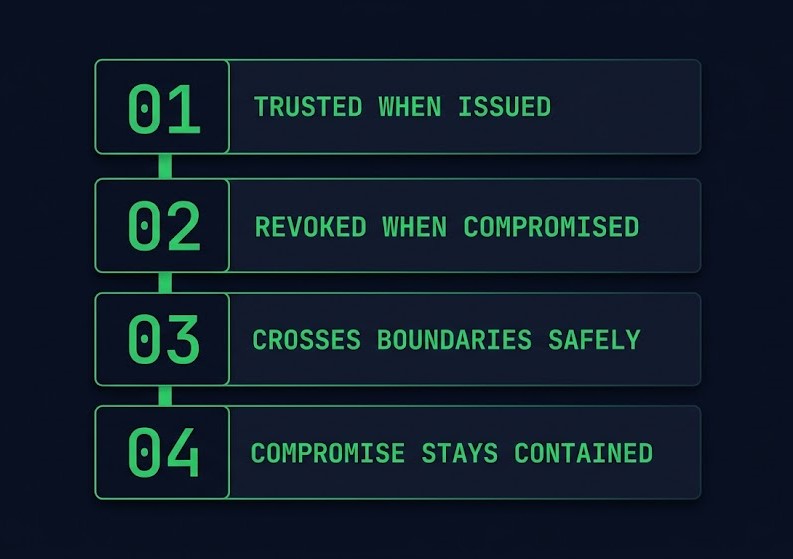
An architecture built around the identity infrastructure boundary isn’t defined by which controls it has — plenty of organizations have MFA, conditional access, and PIM and still can’t answer the questions above. It’s defined by what it can prove, on demand, without reconstructing the answer after an incident forces the question.
01 — Identity Can Be Trusted When Issued
The architecture can prove who or what created a given identity, under what authority, and what specific grant of authorization that identity traces back to. An identity whose origin can’t be established, or whose permissions can’t be traced to an authorization event, is a credential no downstream system should trust regardless of what it’s since been given.
02 — Identity Can Be Revoked When Compromised
Revocation actually stops the identity from functioning everywhere it was delegated — including federated systems, cached tokens, and downstream service-to-service trust. Revocation that doesn’t reach every place authority propagated to isn’t revocation. It’s a policy statement with an unverified blast radius.
This is the same claim adversarial restore testing forces on the recovery side: staging credential revocation mid-restore is a direct test of whether revocation actually reaches every downstream system the recovery path depends on, or whether it’s a policy statement that hasn’t been exercised against a live restore in progress.
03 — Identity Can Cross Trust Boundaries Safely
The architecture can state, precisely, where its trust stops and another organization’s begins. Federation without an explicit boundary produces trust that quietly extends further than anyone decided it should.
04 — Identity Compromise Remains Contained
If a specific credential is compromised, the architecture can state exactly what that credential could reach — not estimate it, state it. An unknown blast radius means every incident starts with a discovery phase instead of a containment phase.
These four aren’t controls to install. They’re proof obligations — the same evidentiary standard this series has applied to recovery plans, restore processes, and agentic pipelines, now applied to identity itself. The question was never what controls exist. It’s what can be proven.
Architect’s Verdict
The identity infrastructure boundary moved. Most governance and audit practice didn’t move with it. The network boundary didn’t fail — it became insufficient, quietly, while most governance and audit practice kept treating it as primary. That’s a more dangerous failure mode than an outright break, because nothing alerts on “the boundary you’re measuring isn’t the boundary that matters anymore.”
The real problem isn’t that identity is under-secured — most enterprises have invested heavily in identity tooling. It’s that identity is under-proven. Controls exist. Provenance often doesn’t. An organization can have strong MFA, a mature IAM platform, and a clean audit posture, and still be unable to answer where a specific grant of authority came from or what a specific compromised credential could actually reach.
The boundary moved. The evidence obligation moved with it. Architectures that haven’t moved with both are being audited against a perimeter that no longer does the job it’s credited with doing.
Additional Resources
View 11 more resources
Editorial Integrity & Security Protocol
This technical deep-dive adheres to the Rack2Cloud Deterministic Integrity Standard. All benchmarks and security audits are derived from zero-trust validation protocols within our isolated lab environments. No vendor influence.

R.M.
Senior Solutions Architect with 25+ years of experience in HCI, cloud strategy, and data resilience. As the lead behind Rack2Cloud, I focus on lab-verified guidance for complex enterprise transitions. View Credentials →
Get the Playbooks Vendors Won’t Publish
Choose the architecture problems you care about. Get field-tested playbooks and frameworks delivered to your inbox.
- > AI Infrastructure & Inference Economics
- > Cloud Strategy & Hidden Cost Models
- > Virtualization & Deterministic Migration
- > Kubernetes, IaC & Modern Infrastructure
- > Data Protection & Recovery Engineering
Zero spam. Includes The Dispatch weekly drop.
Need Architectural Guidance?
Independent review before major infrastructure decisions.
- > Validate assumptions
- > Identify hidden dependencies
- > Quantify migration risk
- > Challenge vendor narratives
Triage · Advisory · Fractional · Direct Hire