

TCP Failure Boundary: The Kernel, Not the Container
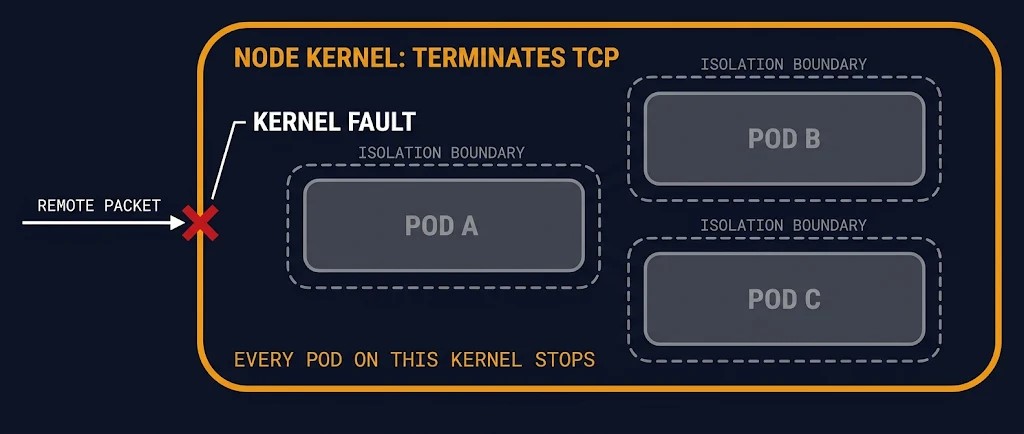
The TCP failure boundary for CVE-2026-99288 is the kernel that terminates the connection, not the container that receives the traffic. Google’s GKE bulletin GCP-2026-088 describes a denial of service that can panic the affected virtual machine, and says the flaw does not allow privilege escalation or container breakout to code execution on the host. That separates it from the flaw in The Host Networking Stack Is Part of the Guest Isolation Boundary. That one ran from a guest into the host’s networking stack through a checksum hint the guest supplied. This one is a remote packet reaching the kernel that owns the listening socket, with no guest on the attacking side. In the first case, the guest-to-host isolation boundary was crossed. Here, the flaw does not require that boundary to be crossed. The isolation boundary can remain intact while the kernel that terminates TCP fails, which makes it the wrong thing to measure exposure against.
This post is a decision register, not an advisory. It records what three vendor pages state as of November 22, where they disagree, and which endpoint and node-image combinations the GKE bulletin names as exposed or not exposed. It makes no claim of observed exploitation, remote code execution, or exposure for any estate it has not seen.
What Was Reported, and at What Evidence Level
Three vendor pages were read on November 22: the GKE security bulletin GCP-2026-088 (published November 19, updated November 20), the Red Hat CVE page (last modified November 20) and the Ubuntu CVE page (updated November 20). Nothing was reproduced. For modern infrastructure architecture, the question the pages leave to you is where the TCP failure boundary sits for each endpoint you run, meaning which kernel terminates the connection. The table labels each claim by who stated it.
| Claim | Basis | Evidence label |
|---|---|---|
| A flaw in the Linux kernel TCP implementation can be triggered remotely and causes a kernel panic. It does not allow privilege escalation or container breakout to code execution on the host. | GKE GCP-2026-088. Red Hat’s statement also says the flaw does not allow data alteration or arbitrary code execution. | Vendor-stated by two vendors |
Established-socket lookups are lockless. Socket memory can be reused while a reader still holds the old address, so a lookup can return a new, unhashed socket. A proof of concept using a SYN cookie request socket reproduced the crash, a NULL pointer read in tcp_v4_rcv on a virtio-net receive path. | The kernel change description, reproduced on Ubuntu’s CVE page | Upstream change text as reproduced by Ubuntu; not independently reproduced |
| Severity: Red Hat Important, CVSS 3.1 base 7.5 (attack complexity High, privileges Low, confidentiality, integrity and availability High). cve.org base 7.5 (attack complexity Low, privileges None, availability High only). Ubuntu priority High, CVSS 5.9. | Red Hat page, Ubuntu page | Three scorings; not reconciled |
| GKE Standard and Autopilot clusters on Container-Optimized OS or Ubuntu node images before the patched versions are affected, across control planes and nodes. Pods in GKE Sandbox and Windows Server node pools are not affected. | GKE GCP-2026-088 | Vendor-stated |
RHEL 8, 9 and 10 and OpenShift 4 and 5 components are listed Affected with no errata. RHEL 7 is Not affected. Ubuntu’s CVE page lists the linux package rows examined (16.04, 18.04, 20.04, 22.04, 24.04, 26.04 and 26.10) as Vulnerable, with no fixed package shown in those rows, and 14.04 as Not affected. The table was not fully reviewed; later HWE rows are not represented here. | Red Hat page; Ubuntu page | Vendor-stated, partial read (see the last section) |
| Observed exploitation in the wild | None of the three pages states it | NOT STATED |
⚠ SEVERITY DISAGREEMENT, NOT RECONCILED
Red Hat’s vector scores confidentiality and integrity as High, while its own statement says the flaw does not allow data alteration or arbitrary code execution, and it marks its metrics preliminary. The cve.org vector scores availability only. Ubuntu scores 5.9. This post treats them as three scorings of one flaw and does not choose among them.
One name collision stays out of this register. GCP-2026-078 sits on the same bulletin page and covers CVE-2026-98432, a different IPv4 TCP flaw that the bulletin says can cause a kernel panic or a container escape to root code execution on the node. Its exposure, mitigation and fixed versions are not this register’s.
The TCP Failure Boundary Is Where the Kernel Terminates the Connection
An isolation boundary answers whether code in one workload can reach another workload or the host. A TCP failure boundary answers a different question: which kernel’s state does a remote packet touch, and what stops running if that kernel faults. For this flaw the state in question is the kernel’s table of established sockets. The recorded crash was raised from network receive processing in interrupt context, and a panic there ends the node’s kernel. Every Pod on that node stops with it, whatever isolation each Pod had.
That also narrows what pod-level controls can do. Seccomp and AppArmor profiles constrain what a workload asks the kernel to do, and the recorded call trace starts in the receive path, not in a system call. That reading is analysis from the trace, not a vendor statement, and it explains why the exposure question moves from the workload to the place where TCP ends.
What shares the kernel
Pods on one node run on that node’s kernel, and the bulletin names a reachable TCP listener on a node, a Pod or the control plane’s IP-based endpoint as the trigger path. Container-Optimized OS and Ubuntu node images are both in scope. Internal traffic within the same VPC can also trigger the flaw, according to the bulletin, so the external path is not the only one.
What does not
The bulletin states that Pods in GKE Sandbox (gVisor) and Windows Server node pools are not affected. It gives no mechanism for either exclusion. A reading that a sandboxed Pod’s connections are handled by a different network stack is plausible, but it is analysis, not a bulletin statement. The exclusion is also stated for Pods. The bulletin does not say whether the node hosting a sandboxed Pod is exposed through its own listeners.
Exposure Is Decided by Endpoint and Node Image
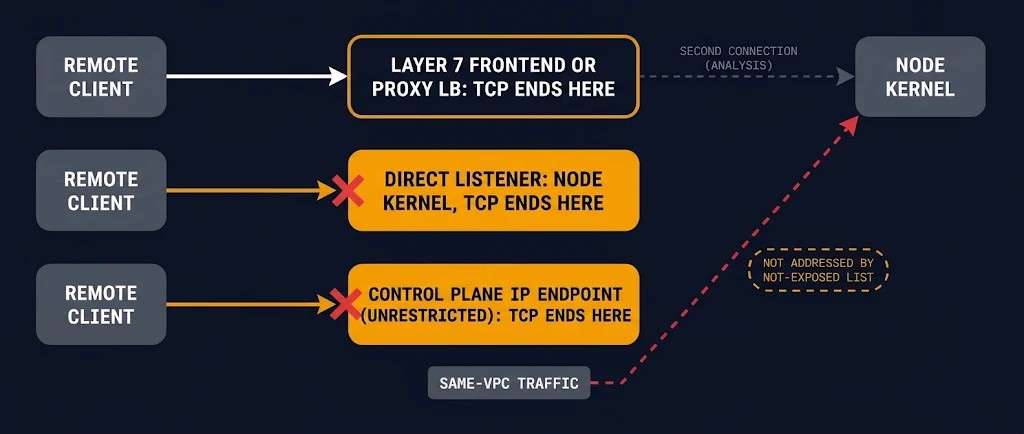
The register below is built from the bulletin’s own exposure statements, one row per TCP failure boundary an estate can have. Each row says where TCP ends, what the bulletin says about exposure, and what the three sources give for mitigation and remediation. Where a row is exposed only by exclusion from the bulletin’s not-exposed list, the cell says so. Read the exposure column as limited claims, not as a vulnerability determination:
HOW TO READ THE EXPOSURE COLUMN
- “Not exposed” means not exposed to the external traffic paths the bulletin specifies.
- Internal VPC reachability remains a separate consideration, and the bulletin says internal traffic can trigger the flaw.
- Exposure is not established for an individual estate until its own configuration has been validated against the row.
| Endpoint | Where TCP terminates | Exposure basis (external reachability per GCP-2026-088; internal reachability assessed separately) | Mitigation | Remediation status (bulletin, Nov 20) |
|---|---|---|---|---|
| Private node whose services are reached only through a Layer 7 Application Load Balancer (Ingress, Gateway API) or a proxy Network Load Balancer | At the load balancer, upstream of the node. The balancer-to-node leg is on the node kernel (analysis). | Listed as not exposed to the bulletin’s external traffic paths. Same-VPC reachability is not addressed in that list and is assessed separately. | Not stated | Node image row below |
| Node or Pod listener reached directly, through hostNetwork, or through a passthrough network load balancer | On the node | Not on the not-exposed list; exposed by exclusion (analysis, not a bulletin statement) | Red Hat steps only; GKE states none | Node image row below |
| Control plane, IP-based endpoint, not otherwise restricted | The control plane’s kernel | Affected: the bulletin names the IP-based endpoint as a trigger path | Red Hat steps only; GKE states none | Upgrade control plane and nodes to the listed versions |
Control plane, IP-based endpoint with authorized networks and Google Cloud public IP access disabled (--no-enable-google-cloud-access) | The control plane’s kernel, for permitted sources only | Listed as not exposed to the bulletin’s external traffic paths; internal reachability assessed separately | Not stated | Same |
Control plane, DNS-based endpoint only (--no-enable-ip-access) | Google’s Layer 7 frontends | Listed as not exposed to the bulletin’s external traffic paths; internal reachability assessed separately | Not stated | Same |
| Control plane, private IP endpoint only | The control plane’s kernel, from inside the network | Listed as not exposed to the bulletin’s external traffic paths; same-VPC traffic can trigger (bulletin) | Not stated | Same |
| Any listener above, reached from the same VPC | Node or control plane kernel | Bulletin: internal traffic within the same VPC can trigger | Red Hat steps only | Same |
| Pod in GKE Sandbox | Mechanism not stated | Not affected (bulletin); node-level exposure not addressed | None needed per bulletin for the Pod | Not applicable to the Pod |
| Windows Server node pool | Not stated | Not affected (bulletin) | None needed per bulletin | Not applicable |
Remediation status depends on the node image as much as on the endpoint. For Container-Optimized OS, the bulletin lists fixed GKE versions of 1.32.13-gke.3234000, 1.33.13-gke.2533000, 1.34.13-gke.1091000, 1.35.10-gke.1155000 and 1.36.6-gke.1189000 or later. Patches for 1.37 on Container-Optimized OS and for Ubuntu node images were still in progress in the November 20 update. The bulletin’s closing note still lists 1.33 and 1.32 as in progress, while its November 20 update adds fixed versions for both. This post records both statements and does not reconcile them.
| Node image | State on November 22 | Source |
|---|---|---|
| GKE Container-Optimized OS 1.32 to 1.36 | Fixed versions listed (above) | GCP-2026-088 |
| GKE Container-Optimized OS 1.37 | Patch in progress as of Nov 20 | GCP-2026-088 |
| GKE Ubuntu node images | Patches in progress as of Nov 20 | GCP-2026-088 |
| RHEL 8, 9, 10; OpenShift 4, 5 | Affected; no errata listed | Red Hat page, Nov 20 |
| RHEL 7 | Not affected | Red Hat page |
Ubuntu linux package rows examined (16.04 to 26.10) | Vulnerable; no fixed package shown in those rows; table not fully reviewed | Ubuntu page, Nov 20 |
Ubuntu 14.04 (linux row) | Not affected | Ubuntu page |
A cluster with one Container-Optimized OS pool and one Ubuntu pool at the same cluster version therefore has two different remediation states, because the node image sets the TCP failure boundary’s patch status. That follows from the bulletin’s per-image statements; it is an inference, not a bulletin sentence.
What Each Mitigation Changes
Red Hat’s page lists two mitigations, and each one changes what sits inside the TCP failure boundary or how traffic reaches it. GKE’s bulletin lists none, and its remediation is the version upgrade, so whether either applies on managed GKE nodes is NOT STATED.
The first is disabling SYN cookies with net.ipv4.tcp_syncookies=0. Red Hat says it blocks the path where a request socket is rebuilt through a SYN cookie, that it is managed per network namespace and has to be applied to each container with a separate network namespace, and that it lowers protection against SYN floods. The kernel change text describes a proof of concept that used that path, and the fix also touches the Fast Open and request migration paths. Neither page says whether the sysctl closes those other paths, and Red Hat’s page does not map the per-namespace setting onto a node’s own listeners versus a Pod’s.
The second is reducing the receive queues on the interface that takes external packets to one and disabling RPS and RFS. Red Hat’s reasoning is that the flaw needs different receive contexts to race concurrently. The page states no cost for this mitigation, and this post does not guess one.
Both change exposure. One has a documented cost, the lower SYN flood protection Red Hat names; the other has no cost stated in the source. This post recommends neither. Each is a compensating control in the sense of A Compensating Control Exit Needs Proof From the Process That Serves Traffic: the sysctl or queue setting stays in place as unowned state until someone proves, from the node actually serving the traffic, that the fixed kernel is running and retires it.
Where the Remediation Boundary Sits
The remediation boundary is not the TCP failure boundary. The kernel that fails is one object, and the object a fix or mitigation changes can be a different one held by a different party. This section is limited to who controls each change, which object or boundary the change touches, and what the exposure register identifies as provider-managed versus customer-managed. It does not cover patch sequencing, reboot planning, throughput or capacity.
WHERE EACH CHANGE LANDS
- Workload. A Pod cannot change its node’s kernel. The levers the sources describe at this level are the per-namespace sysctl (Red Hat) and the runtime the Pod runs under, since the bulletin states GKE Sandbox Pods are not affected.
- Node and image family. The change is a node pool upgrade to a fixed version, and the fixed versions differ by image family. Container-Optimized OS and Ubuntu pools are separate objects with separate states.
- Cluster and control plane. The bulletin tells you to upgrade both the control plane and the nodes. It also says patch versions can be run from a newer release channel when the cluster is on the same minor version, to secure nodes before the patch becomes the default in the cluster’s channel. Which party triggers the control-plane change on a given cluster depends on configuration the bulletin does not describe.
A node pool returned to an older image reopens the exposure on that row, which is the rollback problem in Patch Rollback Risk: When Recovery Reintroduces the Exposure You Just Closed. The register’s remediation column is only true for the image that is running now.
How long existing compute stays on the old image after a fix exists is a separate interval, measured for AWS and CVE-2026-98432 in Managed Compute Patching Is Not Managed Remediation. How many such changes an organization can absorb inside its deadlines is the subject of Patch Consumption Capacity: Deadlines Attach to Assets. Delivery Runs on Updates.. The register here stops at what the change touches and who holds it, so that each TCP failure boundary has a named owner of its fix.
What Remains Unestablished
NOT ESTABLISHED
- Exploitation. None of the three pages states whether exploitation has been observed. The absence of a statement is not a statement of absence.
- Code execution. Google and Red Hat each state the flaw does not allow it. The pages do not claim a code-execution chain, and this post makes none.
- Mitigation cost and coverage. The cost of the single-queue mitigation is not stated. Whether the SYN cookie sysctl covers the Fast Open and request migration paths is not stated.
- Partial reads. Red Hat’s package table has twelve rows and this post read the first ten. Ubuntu’s status table was read in part; the
linuxpackage rows are complete, and laterlinux-hwerows were not all read. - Sources not read. The upstream fix commit, Debian, Oracle and Rocky advisories, and the researcher’s own write-up were not read for this post. When the flaw was introduced is therefore not stated here.
- Other vendors. Fix status is image-, release- and vendor-specific. The Red Hat and Ubuntu pages list no errata or fixed package on November 22, which describes those pages on that date and nothing about any other distribution.
- GKE’s own statements. The mechanism behind the GKE Sandbox and Windows exclusions, the node exposure of a sandboxed Pod’s host, and the reconciliation of the bulletin’s closing note with its November 20 update are all not stated.
What to Verify on Your Own Estate
The register is only as good as the inventory under it, and the inventory is a list of TCP failure boundaries, one per termination point. For each cluster:
INVENTORY, PER CLUSTER
- Where TCP ends for each reachable endpoint. Record whether it is a Layer 7 Application Load Balancer, a proxy Network Load Balancer, a passthrough load balancer, a NodePort, a hostNetwork Pod or a direct listener, and whether the same listener is reachable from inside the VPC.
- Control plane endpoint configuration. Record whether the IP-based endpoint is enabled, whether a DNS-based endpoint is the only one, which authorized networks apply, and whether Google Cloud public IP access is disabled.
- Node image and version per pool.
kubectl get nodes -o wideshows the OS image and kernel version columns. For GKE the bulletin keys fixes to the GKE node version and image family, and a distribution kernel string alone does not establish a patched state. - Receive queue and RPS state per node pool.
ethtool -l <interface>reports channel counts, and/sys/class/net/<interface>/queues/rx-*/rps_cpusshows RPS masks. Recordsysctl net.ipv4.tcp_syncookiesin each namespace if that mitigation is in use. - Date and source revision for every row. Each cell should say which vendor page, at which update date, it rests on, because the November 20 updates already changed the picture.
Architect’s Verdict
A container is the right boundary for asking what a compromised workload can reach. It is the wrong boundary for asking what a remote packet can stop. For CVE-2026-99288 the TCP failure boundary is the kernel that terminates the connection, and everything on that kernel shares its fate, whatever isolation each workload was given.
The real problem is that an exposure record kept per workload cannot see what decides this exposure, which is the termination point and the node image. The bulletin’s not-exposed list is a list of places where TCP ends somewhere else, in a Layer 7 frontend or a proxy. Everything not on that list is exposed by exclusion until a vendor says otherwise, and the same-VPC statement is the row that a register built around the external path leaves out.
Mitigations and fixes sit on different objects held by different parties. The register’s job is to name the object, name who holds it, and record what the pages said on which date. It does not need to know how fast you can patch to do that work, and it should not pretend to.
Isolation tells you who can reach whom. The TCP failure boundary tells you what stops when the kernel does.
Additional Resources
View 2 more resources
Editorial Integrity & Security Protocol
This technical deep-dive adheres to the Rack2Cloud Deterministic Integrity Standard. All benchmarks and security audits are derived from zero-trust validation protocols within our isolated lab environments. No vendor influence.

RM
I’m a Senior Solutions Architect with 25+ years of experience in HCI, cloud strategy, and data resilience. I lead Rack2Cloud, delivering lab-verified guidance for complex enterprise transitions. View Credentials →
Get the Playbooks Vendors Won’t Publish
Choose the architecture problems you care about. Get field-tested playbooks and frameworks delivered to your inbox.
- > AI Infrastructure & Inference Economics
- > Cloud Strategy & Hidden Cost Models
- > Virtualization & Deterministic Migration
- > Kubernetes, IaC & Modern Infrastructure
- > Data Protection & Recovery Engineering
Zero spam. Includes The Dispatch weekly drop.
Need Architectural Guidance?
Independent review before major infrastructure decisions.
- > Validate assumptions
- > Identify hidden dependencies
- > Quantify migration risk
- > Challenge vendor narratives
Triage · Advisory · Fractional · Direct Hire