

Nobody Buys Capability Anymore. They Buy a Promise.
Vendor trust has become one of the most important factors in enterprise technology purchasing decisions. Every shortlist in this market today is full of vendors that can technically do the job — that stopped being the hard part years ago. What separates the vendor who gets the contract from the four who don’t is no longer a feature diff on a spec sheet. It’s whether the buying committee believes the platform they’re choosing today will still be recognizable, supported, and priced the same way in three years.
That’s not a contract question. It’s a confidence question — and it’s being asked earlier in the sales cycle than most vendors realize.
Capability Stopped Being The Differentiator
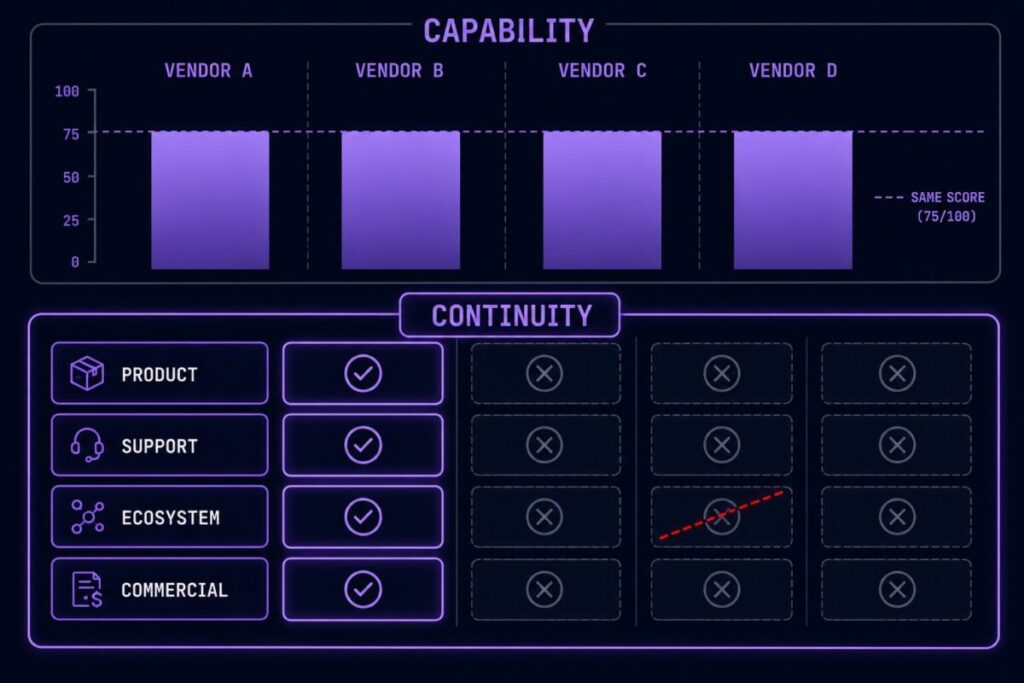
There was a period — not that long ago — when a procurement committee could build a scorecard, weight the rows, and let the numbers pick the winner. Benchmark throughput, feature parity, integration count. The vendor with the best row totals won.
That era is over, at least in the categories rack2cloud covers. Compute, orchestration, backup, cloud tooling — the leading vendors in every one of these categories now clear the same functional bar. Nobody is choosing a hyperscaler because it’s the only one with object storage. Nobody is choosing a hypervisor because it’s the only one that can live-migrate a VM. The scorecard still gets filled out. It just doesn’t decide anything anymore — every vendor on the shortlist passes it.
What decides it instead is a second, less explicit evaluation running in parallel: will this vendor still be who they say they are when the environment gets harder. That’s the same shift last week’s piece on predictability described from a different angle — buyers not paying to remove today’s risk, but to buy confidence that tomorrow won’t surprise them. Capability gets a vendor shortlisted. Trust gets them selected.
What Buyers Are Actually Purchasing
Vendor trust isn’t a feeling procurement teams have — it’s a specific, evaluable claim, even when nobody writes it down as a line item. Strip the sentiment out and what’s actually being purchased is confidence that the platform selected today remains recognizable tomorrow, across four dimensions. This is a distinct claim from the shift toward architectural optionality — optionality is about preserving the ability to change direction later; vendor trust is about whether the direction you already committed to stays viable at all.
01 — PRODUCT CONTINUITY
The roadmap you were sold keeps shipping. The architecture you standardized on doesn’t get quietly deprecated three point-releases from now.
02 — SUPPORT CONTINUITY
The team that answers your ticket in year three is resourced the same way the team that closed your deal in year one was. Support doesn’t get “optimized” out from under an existing customer base.
03 — ECOSYSTEM CONTINUITY
The partners, integrations, and third-party tooling you built dependencies on stay viable. A platform can be technically alive while its ecosystem quietly dies around it.
04 — COMMERCIAL CONTINUITY
The pricing model, licensing terms, and unit economics you underwrote in the business case don’t get restructured against you once switching costs are sunk.
None of these four show up on a capability scorecard. All four show up in the outage postmortem, the renewal negotiation, or the acquisition announcement — whichever one arrives first. Buyers who’ve been through one of those events evaluate differently on the next purchase. That’s the entire mechanism behind vendor trust as a purchasing criterion: it’s capability’s warranty, priced in advance.
There’s a fifth continuity worth naming separately, because it doesn’t fail while the relationship is active — it only becomes visible once the buyer believes the relationship is over. Vendor Relationships End. Audit Rights Often Don’t. covers contractual continuity: whether the audit-rights and record-retention obligations written into the original agreement survive termination on the vendor’s own clock, regardless of how confidently the buyer has moved on. Product, support, ecosystem, and commercial continuity are what a buyer is trusting the vendor to keep delivering. Contractual continuity is what the vendor is trusting the buyer to still owe, long after the buyer stopped thinking of it as an active relationship.
Three Places This Shows Up
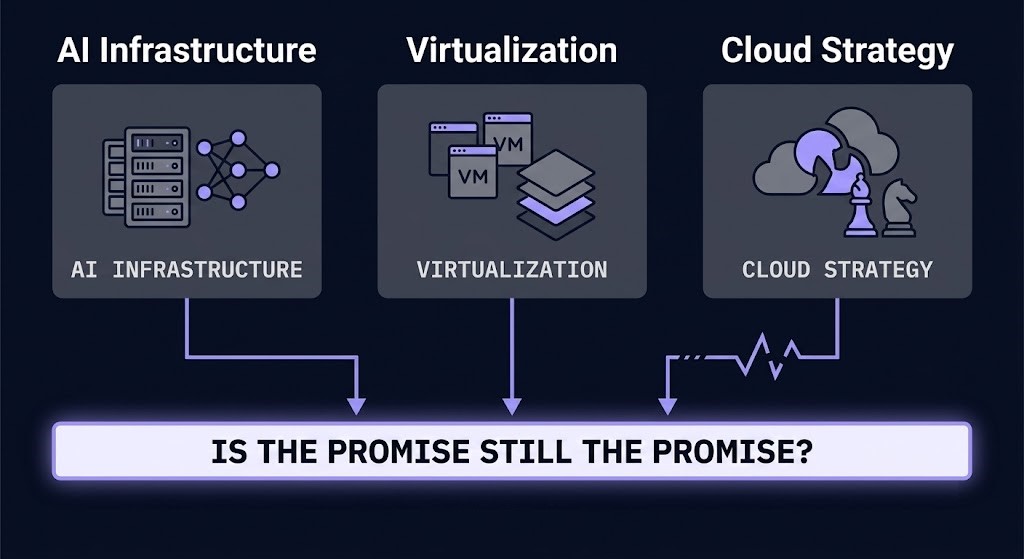
Different industries express the same underlying concern in very different vocabulary. Here’s what the evaluation mechanism looks like in three markets rack2cloud covers directly.
01 — AI INFRASTRUCTURE
Enterprises are watching model providers, orchestration platforms, and GPU-adjacent vendors churn through repositioning, pricing resets, and consolidation at a pace the rest of enterprise IT hasn’t seen in a decade. The capability is rarely in question — whether the vendor survives its own market’s volatility long enough to matter is. Your AI vendor became critical infrastructure before the contract caught up — the contractual half of this same problem.
02 — VIRTUALIZATION
The post-Broadcom VMware renewal cycle didn’t reopen because VMware’s technical capability declined. It reopened because the commercial and support continuity buyers had priced into a renewal decision made two years earlier changed underneath them. Renewal committees now model vendor behavior under ownership change as its own line item — evidence of the shift, not the argument itself.
03 — CLOUD STRATEGY
Repatriation decisions get framed publicly as cost corrections. Underneath the cost narrative is frequently a trust correction — a workload moving because the operational promise made at initial migration (predictable egress, predictable support response, predictable roadmap direction) stopped holding once the workload was locked in. This is cloud strategy architecture working as intended once trust, not just cost, is priced into the model.
Different industries express the same concern differently, but the evaluation mechanism underneath is identical: is the promise this vendor made still the promise they’re keeping.
When The Promise Breaks
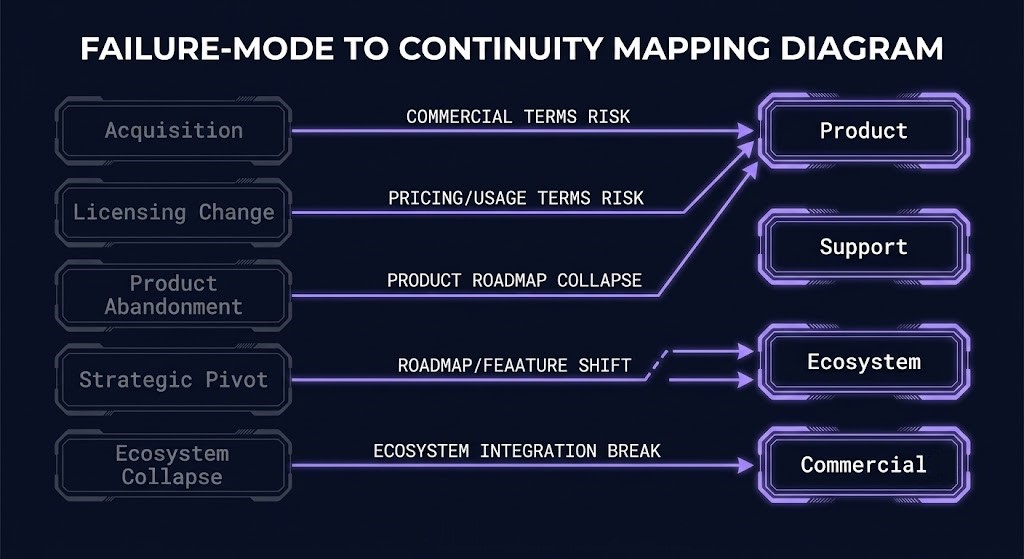
Capability doesn’t disappear when a vendor relationship goes bad. It’s almost always still there, technically, on the day the trust breaks. What strands the investment is one of the four continuities failing — and each failure mode maps to a specific one:
| Failure Mode | Continuity Broken |
|---|---|
| Vendor acquisition | Commercial |
| Licensing model change | Commercial |
| Product abandonment | Product |
| Strategic pivot | Product / Ecosystem |
| Ecosystem collapse | Ecosystem |
Notice what’s absent from that list: nothing in it is a capability failure. Every named failure mode is a continuity failure. This is the part of the pattern most post-mortems get backwards — teams write up “the platform stopped meeting our needs” when the platform’s capability didn’t move at all. What moved was the buyer’s confidence that tomorrow would look like today. That’s what actually strands an architecture: not the technology failing, but the promise underneath it failing first.
How Architects Evaluate Vendor Trust
Senior architects who’ve been burned by a continuity failure stop evaluating vendors the way procurement templates ask them to. The signals that actually predict vendor trust rarely appear on an RFP:
01 — LEADERSHIP STABILITY
Has the executive team turned over since the roadmap was published, and did the roadmap survive the turnover.
02 — ROADMAP BEHAVIOR
Does the vendor ship what it said it would ship, on a timeline resembling the one it committed to — or does the roadmap function as a sales asset that quietly resets every year.
03 — ECOSYSTEM HEALTH
Are the partners and integrators who built on this platform still investing in it, or are they visibly hedging toward alternatives.
04 — COMMERCIAL CONSISTENCY
Has pricing or licensing structure moved against existing customers in the recent past, and under what circumstances.
05 — BEHAVIOR DURING STRESS
This is the strongest signal of the five, and the one procurement templates almost never ask for directly. How did the vendor behave the last time customers pushed back publicly, the last time licensing changed, the last time there was a major outage, the last time the company itself was acquired. Feature history tells you what a vendor can do. Stress history tells you what a vendor will do when doing it is inconvenient for them — and that’s the actual question underneath every vendor trust evaluation.
A positive instance of exactly this evaluation is easier to point to than a negative one, and worth naming for that reason. Proxmox’s Arm64 Bet Runs On Lifecycle Parity, Not A Feature Release treats the sustained cost of a vendor’s commitment as the actual signal a buyer should be reading, not the announcement — the same due-diligence instinct this section is describing, applied at the moment a commitment is made rather than after it’s broken. Roadmap behavior and product continuity are usually only visible in the failure case, in a postmortem. Full lifecycle parity, funded indefinitely on a second CPU architecture, is the rarer case where the continuity signal shows up before anything has gone wrong to reveal it.
Architect’s Verdict
Capability gets a vendor shortlisted. Trust gets them selected. That’s the mechanism this piece has been describing from four different angles — the scorecard that no longer decides anything, the four continuities buyers are actually underwriting, the failure modes that strand investments without ever touching the technology itself.
The real problem most organizations haven’t caught up to yet is that they’re still building evaluation processes around capability parity in a market where capability parity is the baseline, not the differentiator. Trust breaks before capability does. That’s what strands the investment — not a feature falling behind, but a promise quietly stopping being kept while the technology underneath it kept working the whole time.
Enterprise technology purchases increasingly resemble institutional trust decisions rather than technical evaluations. Capability opens the conversation. Confidence in the future closes the deal.
Additional Resources
Editorial Integrity & Security Protocol
This technical deep-dive adheres to the Rack2Cloud Deterministic Integrity Standard. All benchmarks and security audits are derived from zero-trust validation protocols within our isolated lab environments. No vendor influence.

R.M.
Senior Solutions Architect with 25+ years of experience in HCI, cloud strategy, and data resilience. As the lead behind Rack2Cloud, I focus on lab-verified guidance for complex enterprise transitions. View Credentials →
Get the Playbooks Vendors Won’t Publish
Field-tested blueprints for migration, HCI, sovereign infrastructure, and AI architecture. Real failure-mode analysis. No marketing filler. Delivered weekly.
Select your infrastructure paths. Receive field-tested blueprints direct to your inbox.
- > Virtualization & Migration Physics
- > Cloud Strategy & Egress Math
- > Data Protection & RTO Reality
- > AI Infrastructure & GPU Fabric
Zero spam. Includes The Dispatch weekly drop.
Need Architectural Guidance?
Unbiased infrastructure audit for your migration, cloud strategy, or HCI transition.
>_ Request Triage Session