

VMWARE MODERNIZATION PLANNER
EVALUATE RENEWAL EXPOSURE, MEASURE MIGRATION COMPLEXITY, AND COMPARE FOUR ARCHITECTURAL SCENARIOS SIDE-BY-SIDE.
The VMware Modernization Planner models a VMware renewal as an architecture decision, not only a procurement one. Broadcom’s licensing changes have altered the economics of enterprise virtualization: for many environments, the renewal is also the moment to decide whether to consolidate, modernize, or begin migration before the next contract cycle.
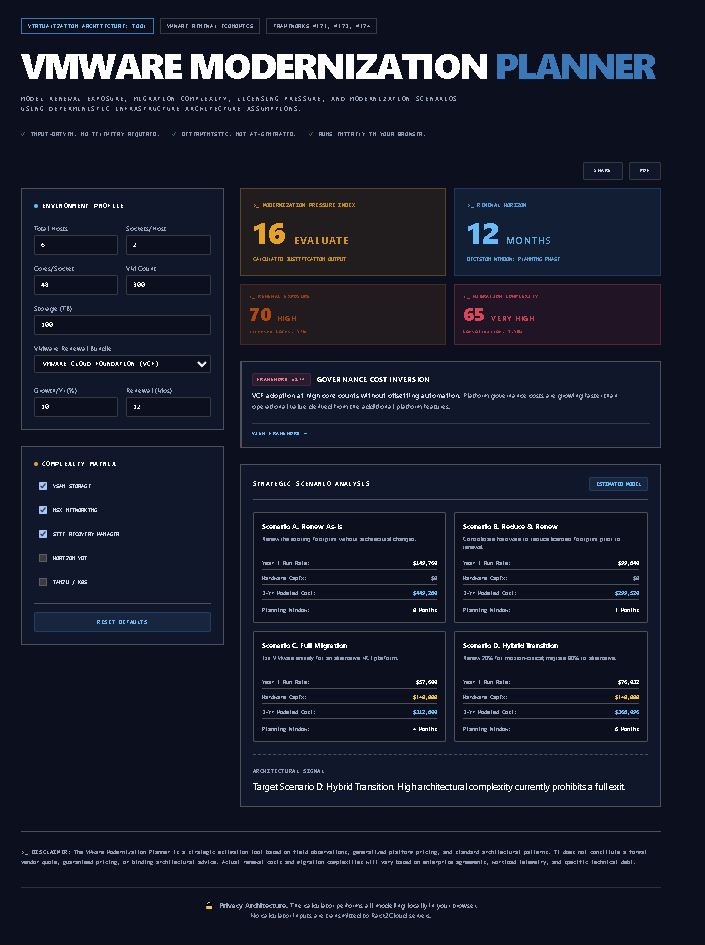
As part of the broader Virtualization Architecture decision process, the VMware Modernization Planner models that decision from the environment outward. Enter the VMware footprint, renewal horizon, growth rate, and major platform dependencies to calculate a weighted Renewal Exposure Score and Migration Complexity Score.
The planner then compares four structural paths: renew the existing footprint, reduce and renew, migrate to an alternative hypervisor, or transition through a hybrid model. The financial outputs use generalized planning assumptions rather than vendor quotations. The comparison is intended for architecture and budget planning, not as a procurement quote or vendor-specific price forecast. (For a deep-dive financial projection specifically on a strict renewal, run your footprint through the VMware Licensing Cost Model).
Rack2Cloud framework signals add another layer to the model. Derived from the Infrastructure Playbooks, conditions such as Lifecycle Convergence and Phantom Capacity are surfaced when the environment profile crosses their defined triggers, connecting the financial and migration models to the architectural conditions they are intended to expose. Part of the deterministic Virtualization Architecture Learning Path.
VMware Modernization Planner: Key Features
- Renewal Exposure Score: A weighted model of the factors contributing to renewal exposure, including total licensed cores, VCF vs. VVF deployment, environment growth rate, consolidation potential, and contract horizon. The resulting score is categorized as Low, Moderate, High, or Critical.
- Migration Complexity Model: A point-based model that assigns complexity penalties to dependencies on vSAN, NSX, Site Recovery Manager (SRM), Horizon, and high VM densities. The resulting score provides a structured estimate of the technical complexity involved in an exit.
- Four-Scenario Analysis: Compares four structural paths rather than reducing the decision to a single cost-savings calculation: Scenario A (Renew), Scenario B (Reduce & Renew), Scenario C (Migrate), and Scenario D (Hybrid Transition).
- Rack2Cloud Framework Layer: Surfaces defined architectural conditions when the environment profile crosses their configured triggers, including Lifecycle Convergence, Phantom Capacity, and Governance Cost Inversion.
- Strategic Output: Generates a modeled path based on the supplied environment profile — for example, renewing for 12 months while reducing the licensed footprint — together with an Executive Summary PDF suitable for architectural and leadership review.
The planner is one of several tools in the VMware Exit & Migration workbench. If the modeled path points toward an HCI platform, the VMware to HCI Migration Advisor takes the next step; for core-level licensing accuracy, start with the VMware Core Licensing Auditor.
THE PLANNER SURFACES THE STRATEGY.
THE ASSESSMENT IDENTIFIES THE BLOCKERS.
If your recommended path points toward an exit, you must determine whether your environment is operationally ready to move. The Migration Readiness Assessment runs locally in your vSphere environment and returns a scored readiness report across five domains within two business days.
|
>_ Architectural Guidance
VMware Migration Readiness AssessmentDetermine whether your VMware environment is operationally ready for migration before investing in tooling, discovery, or cutover planning.
|
>_ The Dispatch
Architecture Playbooks. Field-Tested Blueprints.Broadcom renewal decision frameworks, VMware exit architecture, and post-migration Day 2 operations — built from production environments, not vendor documentation.
|
Frequently Asked Questions
Q: What is the VMware Modernization Planner?
A: It is a strategic planning tool designed for IT architects and infrastructure leaders. Rather than calculating subscription costs alone, it evaluates an environment’s technical profile to model renewal exposure, estimate migration complexity, and compare four structural paths using configurable environment inputs and generalized planning assumptions.
Q: How is the Renewal Exposure Score calculated?
A: The score is a weighted model evaluating multiple renewal-exposure factors. Total licensed core count carries a 30% weight and VCF versus VVF deployment carries a 20% weight, with the remaining inputs accounting for factors such as environment growth rate, consolidation potential, and contract horizon. The resulting score is mapped to an exposure category from Low to Critical. Read more about VMware Licensing Costs: Why Most Estimates Are Wrong.
Q: How does the Migration Complexity Model work?
A: Migration complexity isn’t just about host count. The planner assigns specific complexity penalty points to deep-stack VMware dependencies. For example, relying on NSX networking, running vSAN as a primary storage tier, or utilizing Site Recovery Manager (SRM) will increase the modeled complexity score according to their assigned dependency weights. This helps expose cases where the technical dependencies underlying the environment may represent a larger migration constraint than the licensing decision itself. Review The Architecture of Migration for a breakdown of these dependencies.
Q: Does the planner tell me which platform to migrate to?
A: Based on the supplied inputs, the planner compares renewal, footprint reduction, migration, and hybrid transition paths. Where the modeled migration path is selected, the output can identify an alternative HCI or virtualization direction for further architectural evaluation, such as Nutanix, Azure Local, or Proxmox VE.
Q: Is my environment data stored or sent to a database?
A: No. The VMware Modernization Planner executes all logical scoring and financial modeling entirely within your local browser session. No footprint data, architectural choices, or company information is transmitted to a backend server or saved in a database.
🔒 Privacy Architecture: No cookies. No tracking pixels. No server-side database.
This logic runs entirely in your local browser session.