


DISASTER RECOVERY READINESS
OPERATIONAL TOOLING FOR DISASTER RECOVERY READINESS ASSESSMENT, DEPENDENCY MAPPING, AUTHORITY VALIDATION, AND RANSOMWARE SURVIVABILITY.
Diagnostic tooling for recovery architecture failure — from readiness assumption and dependency blind spots to authority fragmentation and ransomware survivability gaps.
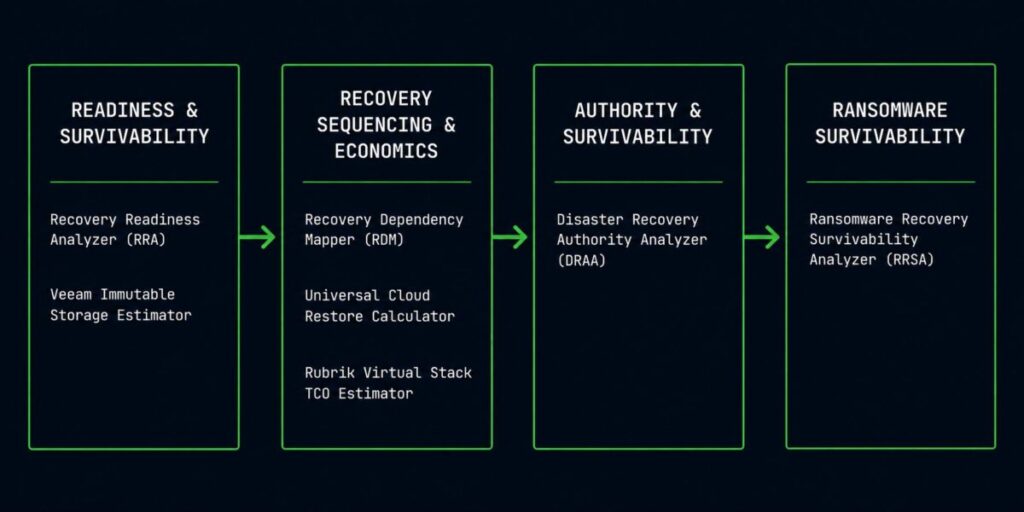
>_ Operational Framework
Recovery failures don’t announce themselves before they happen. They accumulate — invalidated readiness assumptions compound into dependency blind spots, dependency blind spots produce sequence failures at recovery time, sequence failures expose authority gaps, and authority gaps determine whether a ransomware event becomes a recoverable incident or an organizational crisis. The tools below are organized to surface those conditions in order: readiness validation first, dependency mapping second, authority and survivability analysis third and fourth. Working through the phases in sequence traces the failure path before it becomes irreversible.
>_ Operational Phase 01 Readiness & Survivability
Recovery Readiness Analyzer
Scores recovery architecture across five domains — Dependency Isolation, Recovery Testing, Identity Resilience, Backup Survivability, and Authority During Recovery. Surfaces the Recovery Confidence Illusion: the condition where components have been tested individually but the organization has never validated that recovery restores operational authority, governance sequencing, and identity continuity alongside workloads. Start here to establish your actual readiness baseline before any dependency or economics analysis.
Veeam Immutable Storage Estimator
Validates the economic architecture of your backup survivability layer. Immutable storage is the control that separates backup integrity from blast radius — but its cost is rarely modeled against actual retention requirements and growth before the architecture is committed. If the Disaster Recovery Readiness Analyzer flags Backup Survivability as Partial or below, this tool surfaces whether the gap is architectural or a sizing problem the economics never resolved.
Phase 01 establishes whether your recovery architecture has been validated and whether the economics behind backup survivability hold. The harder question is whether recovery can actually be executed in the right order. A clean readiness score means nothing if the dependencies between systems haven’t been mapped and the recovery sequence collapses the moment a dependency is unresolvable. Phase 02 maps the execution layer — sequencing first, then the cost of what happens during and after the event.
>_ Operational Phase 02 Recovery Sequencing & Economics
Recovery Dependency Mapper
Determines whether your recovery plan can actually execute in the order you’ve documented. Maps directed dependencies across all six backbone categories — Identity, Network, Storage, Virtualization, Data Protection, Applications — and surfaces where the sequence fails before the event forces you to find out. Detects cycles that make sequencing impossible, identifies Recovery Gatekeepers with no recovery path, and scores overall Recovery Order Confidence. A recovery plan that doesn’t map dependencies will encounter them as failures.
Universal Cloud Restore Calculator
Models actual restore cost across cloud providers and restore scenarios. Cloud restore economics are systematically undermodeled — egress charges, API call volumes, and cross-region transfer costs during a recovery event accumulate in ways the original backup architecture never priced in. Run after dependency mapping to understand what executing the sequence actually costs under real recovery conditions, not planning assumptions.
Rubrik Virtual Stack TCO Calculator
Models total cost of ownership for Rubrik virtual stack deployments against alternative data protection platforms. Recovery platform decisions carry multi-year economic consequences that rarely surface in the initial procurement conversation. Run after restore cost modeling to understand the full platform economics — not just what recovery costs during an event, but what the underlying platform costs to maintain the capability to run that event.
Phase 02 establishes whether your recovery sequence is executable and what it costs to run. The question that determines whether any of that matters is whether operational authority survives the event itself. Workloads coming back online without identity systems, governance controls, and decision authority restored is not recovery — it is infrastructure without an organization capable of running it. Phase 03 addresses the authority layer.
>_ Operational Phase 03 Authority & Survivability FORMING
DR Authority Analyzer
Validates whether operational authority restores in the correct sequence during a DR event — not just whether workloads come back online. Surfaces Recovery Authority Fragmentation: the condition where systems are restored but the organization cannot make decisions, execute governance actions, or authorize infrastructure changes because identity, governance sequencing, and authority continuity were never part of the recovery architecture.
>_ Operational Phase 04 Ransomware Survivability FORMING
Ransomware Recovery Survivability Analyzer
Models recovery survivability against ransomware scenarios where identity, backup, and governance systems are simultaneously compromised. Surfaces the Recoverability Gap — the delta between documented recovery capability and actual ability to recover while maintaining operational authority, governance continuity, and data integrity. Ransomware recovery fails not because backups don’t exist, but because the recovery architecture was never tested against simultaneous blast radius across the systems that recovery itself depends on.
Recovery failures don’t arrive as single events. Each unresolved condition creates the structural precondition for the next failure state.
| Initial Condition | Escalation Path |
|---|---|
| Unvalidated readiness assumption | → Recovery Confidence Illusion |
| Recovery Confidence Illusion | → Dependency blind spot |
| Dependency blind spot | → Recovery sequence failure |
| Recovery sequence failure | → Recovery Dependency Spiral |
| Recovery Dependency Spiral | → Authority gap during restoration |
| Authority gap during restoration | → Recovery Authority Fragmentation |
| Recovery Authority Fragmentation | → Recoverability Gap under ransomware blast radius |
Named failure patterns that appear across recovery architecture failures. Each represents a structural condition — not an operational mistake made at incident time.
The condition where an organization believes its recovery architecture is sound because components have been tested individually — without validating that recovery restores operational authority, governance sequencing, and identity continuity alongside workloads.
The progression by which recovery dependencies compound in complexity until the recovery plan can no longer be executed in sequence without triggering downstream dependency failures. Each unresolved dependency extends RTO, creates authority gaps, and introduces blast radius that wasn’t in the original plan.
The condition where workloads restore successfully during a DR event but operational authority does not — leaving a recovered environment that cannot make decisions, execute governance actions, or authorize infrastructure changes. Recovery was declared. The organization was not restored.
The delta between an organization’s documented recovery capability and its actual ability to recover from a ransomware event while maintaining operational authority, governance continuity, and data integrity. Most organizations discover the gap during the event — not before it.
The threshold a DR test must cross to produce genuine evidence of recovery capability — as opposed to evidence that workloads restart. A test that doesn’t cross this boundary is not a recovery test. It is an infrastructure restart test with no recovery validity.
Failure amplification through unresolved recovery dependencies — the mechanism by which a single unresolvable dependency propagates through the recovery sequence, extending RTO and creating governance voids at each dependent system that cannot restore until the upstream dependency is resolved.
Tool output is most useful when it triggers the next analysis. These paths map signal to next step.
| If This Tool Detects | Run Next | Why |
|---|---|---|
| Recovery Readiness Analyzer — Dependency Isolation or Authority During Recovery scored Untested or Blind | → Recovery Dependency Mapper | Untested dependency isolation means the recovery sequence has never been validated — map the dependency graph before assuming execution order is safe |
| Recovery Dependency Mapper — cycle detected, Recovery Order Confidence below 50%, or Blocked/Unresolvable dependencies present | → DR Authority Analyzer (Phase 03 — forming) | Unresolvable dependencies indicate identity or governance systems are in the blast radius — authority validation must precede recovery sequence optimization |
| Recovery Readiness Analyzer — Backup Survivability scored Partial or below, combined with Recovery Dependency Mapper showing Identity as a Recovery Gatekeeper | → Ransomware Recovery Survivability Analyzer (Phase 04 — forming) | Partial backup survivability plus identity as a recovery gatekeeper is the exact scenario ransomware exploits — model survivability before assuming the backup architecture closes the gap |
Operational characteristics at each maturity level. The tools above map to the transitions between levels — not to any single level in isolation.
| Maturity Level | Operational Characteristic |
|---|---|
| Foundation | Backups exist and are tested for restoration — recovery is assumed but not architecturally validated against dependency or authority sequencing |
| Operational | Recovery dependencies are mapped and the recovery sequence is validated as executable — dependency blind spots are known before the event, not discovered during it |
| Strategic | Recovery economics are modeled — platform TCO, restore cost, and immutable storage requirements are sized against actual retention and growth before architecture decisions are made |
| Resilient | Operational authority restoration is validated — governance sequencing, identity continuity, and decision authority are tested as first-class recovery outcomes alongside workload restoration |
| Sovereign | Ransomware survivability is architecturally validated — the recovery architecture has been tested against simultaneous compromise of identity, backup, and governance systems and the Recoverability Gap is known and closed |
WHEN THE TOOLS SURFACE A GAP, THE ASSESSMENT CLOSES IT.
Tooling surfaces the readiness gaps, dependency failures, and authority blind spots. A structured recovery architecture review determines what to do about them — sequencing remediation, authority restoration design, and ransomware survivability strategy require architectural judgment layered on top of diagnostic output, not another pass through the tools.
Recovery Readiness Assessment
A structured review of your recovery architecture — readiness gaps, dependency sequencing failures, authority restoration blind spots, and ransomware survivability exposure.
- > Recovery readiness domain audit across all five domains
- > Dependency mapping and sequence viability review
- > Authority restoration and governance continuity assessment
- > Ransomware survivability gap analysis with remediation sequencing
Architecture Playbooks.
Field-tested blueprints for recovery architecture and data protection from production environments.
- > Recovery dependency mapping and sequencing models
- > Authority restoration architecture and governance continuity design
- > Ransomware survivability architecture and blast radius containment
- > Immutable storage architecture and backup survivability design
Zero spam. Unsubscribe anytime.