

Most Sovereignty Strategies Fail Before Architecture Begins

Sovereignty strategy control plane failures follow a pattern that most organizations never diagnose correctly. The infrastructure appears sovereign. The compliance posture is confirmed. The certifications are in place. The gap is not in the architecture. It is in the scope definition that preceded it — and by the time engineering teams evaluate runtime authority, the operational boundaries have already been implicitly accepted.
This post is about the organizational failure pattern, not the architecture. The sovereign AI control plane architecture covers the runtime topology in full — the four planes, the dependency mapping exercise, the three routing topologies, and the failure modes. What that post does not cover is why most organizations never get to that analysis in the first place.
Sovereignty Gets Scoped Wrong Before Architecture Starts
Most sovereignty initiatives begin as procurement or compliance programs. The trigger is a regulatory requirement, a contract clause, an audit finding, or a board-level directive about data jurisdiction. The team that receives the mandate is legal, procurement, or compliance — not infrastructure architecture.
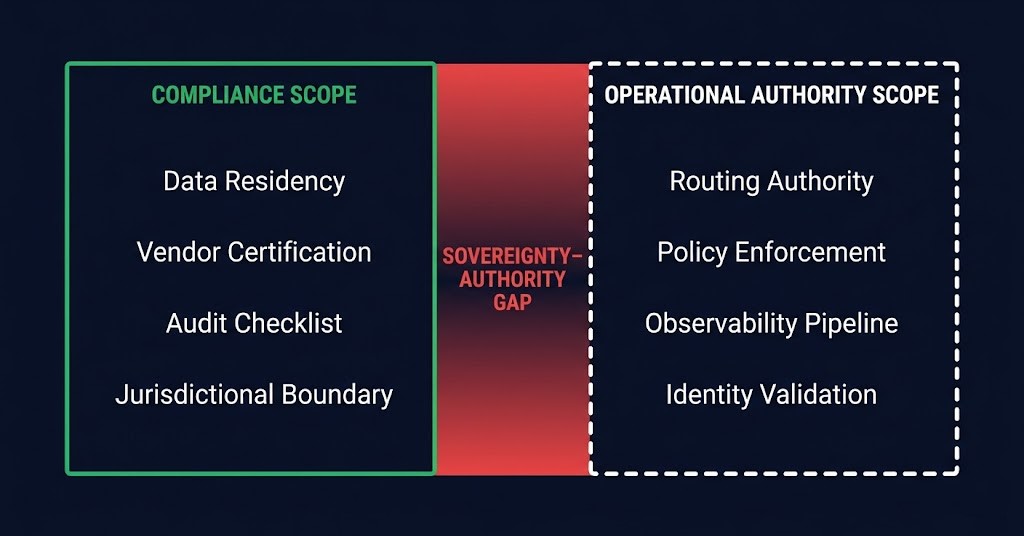
That team scopes the initiative against the tools it has. Procurement can evaluate vendor contracts and data processing agreements. Legal can assess jurisdictional exposure. Compliance can map requirements against certification frameworks. None of those functions has a natural scope boundary that includes runtime authority. The question “who can mutate the behavior of this system at runtime?” does not appear in a data processing agreement. It does not appear in a SOC 2 audit. It does not appear in a GDPR compliance checklist.
So it does not get asked. The scope collapses around the artifacts the compliance-led team is equipped to produce: data residency documentation, vendor certifications, jurisdictional boundary maps. Sovereignty is defined as what those artifacts describe. By the time architecture teams are engaged, the operational boundaries have already been accepted — not through an explicit decision, but through the implicit assumption that compliance artifacts equal sovereignty.
This is procurement-led sovereignty: a sovereignty strategy whose scope was defined by the functions responsible for procurement and compliance rather than by the functions responsible for runtime governance. The resulting architecture is designed to satisfy the compliance scope, not to achieve operational authority. The sovereignty strategy control plane question — who governs runtime behavior — was never in the room.
The Compliance Proxy — False Completion
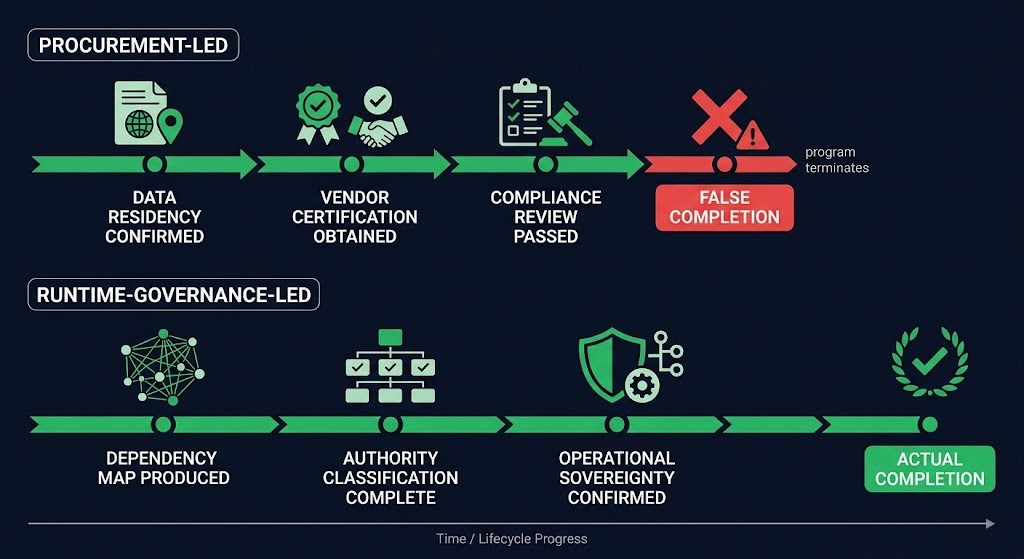
Sovereignty programs terminate at the point of regulatory satisfaction. The architecture inherits an assumption of sovereignty long before operational authority is ever audited.
The trigger for this termination is false completion: the organizational condition where a program closes at symbolic completion rather than operational completion. The residency requirements have been met. The vendor certifications have been obtained. The compliance review has passed. The procurement checklist is clear. From the program’s own success criteria — the ones defined during the procurement-led scoping phase — the initiative is complete.
The control plane is not in those success criteria. Whether runtime routing authority, policy enforcement, observability pipelines, and identity validation are under local governance was never a question the program was designed to answer. The program did not fail to answer it. The program was never designed to ask it.
False completion is not a failure of execution. It is a failure of scope definition. The program completed exactly what it was designed to complete. The problem is that what it was designed to complete was not sovereignty. It was the procurement-visible surface of sovereignty.
Many enterprise AI deployments now carry this condition forward: infrastructure documented as sovereign, compliance posture confirmed, certification obtained — and runtime authority quietly residing in vendor SaaS endpoints that no one audited because no one scoped that question.
DIAGNOSTIC QUESTION
“When your last sovereignty initiative closed, what was the success criterion that triggered closure — and did it include a runtime authority audit of your inference control planes?”
Where Scope Collapses — The Four Planes Nobody Audited
Sovereignty failures rarely begin in infrastructure. They begin when scope collapses around compliance artifacts instead of operational authority boundaries.
The four planes that constitute runtime control plane authority — inference routing, policy enforcement, observability, and identity — share a structural characteristic that makes them systematically invisible to procurement-led sovereignty programs. None of them are data. All four are operational governance functions. They govern how the AI system behaves, who can authorize actions, what gets logged, and how requests are routed. Compliance frameworks measure data residency, not behavioral authority.
This is not a gap in the compliance frameworks. They were not designed to assess operational authority. The gap is in assuming that passing the compliance framework means sovereignty has been achieved.
The reason the four planes are never audited is that auditing them requires asking a different class of question. Not “where does the data reside?” but “who can mutate this system’s runtime behavior without my knowledge or approval?” That question does not have a checkbox in a certification framework. It requires an architecture team to walk the inference path, name every vendor dependency, and classify each one against a mutability boundary. That work is not procurement work. It is infrastructure architecture work. And it only happens if someone scoped it in.
Why the Gap Persists — Inherited Trust Assumptions and Safe-Looking Integrations
Sovereignty erosion rarely enters through a single catastrophic architecture decision. It accumulates through integrations that each appear operationally harmless in isolation.
Most sovereignty gaps are inherited rather than explicitly designed. Teams accept trust assumptions embedded in existing SaaS integrations long before sovereignty becomes a strategic requirement. The managed guardrail service was already in the stack when the sovereignty initiative launched. The hosted observability pipeline was already configured. The third-party identity provider was already the standard. Each of these was a reasonable decision at the time it was made — before sovereignty requirements existed, before the control plane analysis was relevant, before anyone was asking where runtime authority resided.
When the sovereignty initiative arrives, those integrations are already in place. The team evaluating compliance does not flag them because they are not data. The team building the architecture does not replace them because that is out of scope. The team operating the infrastructure does not audit them because no one asked them to.
The result is an architecture that was built sovereign-by-intent but is externally-governed-by-inheritance. The sovereignty claim is genuine. The team believes it. The compliance artifacts support it. The control plane tells a different story. This is the same accumulation pattern that drives shadow control plane exposure in traditional infrastructure — untracked operational authority that exists outside the governance boundary not because anyone made a bad decision but because no one was tracking the boundary.
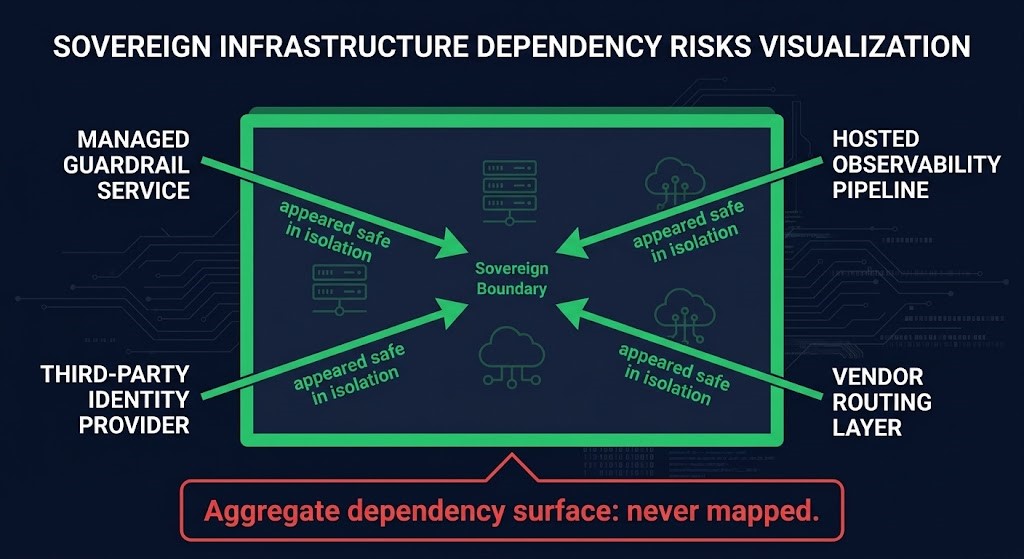
This pattern also explains why sovereignty initiatives repeatedly underestimate scope. Each integration that inherited an external trust assumption was evaluated in isolation. The aggregate dependency surface was never mapped. When the full picture is finally assembled — typically during an incident, an audit, or a forced vendor migration — the scope of what “closing the gap” actually requires is significantly larger than the original initiative anticipated.
What Closing It Actually Requires
Closing the sovereignty–authority gap requires reframing what sovereignty means inside the organization before the next initiative is scoped.
The reframe is specific: sovereignty is an operational property, not a compliance state. A system is not sovereign because its data resides in a compliant region and its vendor holds the right certifications. It is sovereign when the runtime behavior of the system — how it routes requests, enforces policy, records activity, and validates identity — is under local authority and cannot be altered by an external party without a local configuration change.
That definition has organizational implications. It means sovereignty assessments require architecture teams at scope definition, not at implementation. It means success criteria include runtime authority audit, not only compliance certification. It means the dependency mapping exercise — walking the inference path, naming every vendor dependency, classifying each against a mutability boundary — is a required deliverable, not an optional architecture review.
The organizational change is harder than the tooling. Procurement-led sovereignty programs close when compliance is satisfied. Runtime-governance-led sovereignty programs close when operational authority is confirmed. Those are different programs with different scope, different teams, different deliverables, and different success criteria.
The same reframe applies to recovery. Disaster recovery authority — who can declare a recovery event, approve failover, and release production systems — shares the same control plane failure mode as sovereignty: both assume a defined, survivable chain of command that can operate under adversarial or degraded conditions. When that chain isn’t documented and tested, neither sovereignty nor recovery holds under pressure. Scoping sovereignty without scoping recovery authority leaves both programs incomplete.
“Documented and tested” is doing real work in that sentence, and it’s worth being precise about what “tested” needs to mean. Adversarial restore testing is the version of that test that actually stresses the chain — staged credential revocation and control-plane contention, not a tabletop walkthrough under normal operating conditions. A sovereignty program that closes on documentation alone is repeating exactly the false-completion pattern this post names, one layer over, at the recovery-authority chain instead of the compliance artifact.
Architect’s Verdict
The sovereignty–authority gap is not an infrastructure problem. It is a scoping problem that produces infrastructure consequences. Most organizations have closed the compliance gap. They passed the audit, obtained the certification, met the residency requirement. They have not mapped the authority gap — because the program that ran the initiative was never designed to look for it.
False completion is the mechanism. Procurement-led sovereignty is the cause. Inherited trust assumptions are the surface where the gap lives. None of these show up in the compliance artifacts the program produced. They only appear when someone asks the question the program was not designed to ask: who can change how this system behaves at runtime, without a change ticket on your side?
If the control plane remains external, sovereignty remains conditional. The compliance posture can be real and the operational authority can be absent at the same time — and most enterprise AI deployments are currently demonstrating exactly that.
Additional Resources
View 1 more resource
Editorial Integrity & Security Protocol
This technical deep-dive adheres to the Rack2Cloud Deterministic Integrity Standard. All benchmarks and security audits are derived from zero-trust validation protocols within our isolated lab environments. No vendor influence.

R.M.
Senior Solutions Architect with 25+ years of experience in HCI, cloud strategy, and data resilience. As the lead behind Rack2Cloud, I focus on lab-verified guidance for complex enterprise transitions. View Credentials →
Get the Playbooks Vendors Won’t Publish
Choose the architecture problems you care about. Get field-tested playbooks and frameworks delivered to your inbox.
- > AI Infrastructure & Inference Economics
- > Cloud Strategy & Hidden Cost Models
- > Virtualization & Deterministic Migration
- > Kubernetes, IaC & Modern Infrastructure
- > Data Protection & Recovery Engineering
Zero spam. Includes The Dispatch weekly drop.
Need Architectural Guidance?
Independent review before major infrastructure decisions.
- > Validate assumptions
- > Identify hidden dependencies
- > Quantify migration risk
- > Challenge vendor narratives
Triage · Advisory · Fractional · Direct Hire