


RECOVERY PLATFORM ARCHITECTURE
Recovery succeeds through execution authority, not platform capability alone.
MATURITY POSITION — STAGE 2 OF 6
- Current Stage: Recovery Platform Architecture
- Primary Architectural Concern: Execution capability — can the selected platform actually execute the recovery topology D1 designed?
- Primary Failure Mode: Recovery Control Plane Vacuum — recovery tooling exists, recovery jobs execute, and recovery plans are documented, but no authoritative recovery control plane exists with the ability to execute the designed recovery topology under failure conditions.
- Stage Outcome: Reader can evaluate recovery platforms against execution authority, recovery topology alignment, and operational control-plane capability — rather than feature comparisons alone
- Next Stage: D3 — Immutability & Cyber-Vaulting — How is recovery isolated from compromise?
Recovery platform architecture is the discipline of evaluating whether a platform can execute the recovery topology that was designed — not which platform has the most features. D1 established the design vocabulary: recovery economics, blast radius, restore sequencing, and authority ownership decided on paper, before any vendor was selected. This stage is where that design either survives contact with a real platform or doesn’t. Most organizations never test the distinction, because most organizations select a platform first and discover its execution limits during an actual incident.
Platform evaluation conducted correctly starts with the topology and works backward to the vendor — not the reverse. Rubrik, Cohesity, Veeam, and Commvault each implement a control plane with real, specific limits on execution authority, orchestration scope, and failure-condition behavior. None of those limits show up in a feature comparison matrix. They show up when the platform is asked to execute a designed topology under conditions the vendor’s defaults never anticipated. This stage builds the evaluation framework for finding those limits before an incident does.
WHY THIS STAGE EXISTS — RECOVERY CONTROL PLANE VACUUM
A platform is not a recovery architecture. It is the execution layer for one — or the reason one never gets executed.
Stage Anchor Question
Can the platform execute the recovery topology that was designed?
Not: does the platform have the feature? Not: did the vendor demo work? Recovery platform architecture answers whether the control plane in front of you can actually execute the topology behind you — under the failure conditions that matter, not the conditions a sales engineer chose for the demo.
Platform selection has consumed the recovery engineering conversation for twenty years, and D1 already explained why: it’s easier to compare feature matrices than to design a topology. But platform selection done in isolation produces a second, quieter failure. The platform gets chosen. The jobs run. The dashboard shows green. And no one has confirmed that the platform’s control plane has the actual authority to execute the designed topology when the failure is large enough to matter — when the identity provider it depends on is also down, when the network path it assumed is also gone, when the person who normally clicks “approve” is also unreachable. That gap is a Recovery Control Plane Vacuum, and it is invisible until the day it isn’t.
D1 crossed the Recovery Design Boundary — the line between systems whose recovery characteristics have been intentionally designed and systems whose recovery behavior is only discovered at restore time. This stage crosses a second, distinct line. Designing the topology is necessary. It is not sufficient. The topology still has to be executed by something, under conditions the design assumed, by an authority structure the platform actually has. That is the Recovery Execution Boundary, and it is where D2 lives.
How Recovery Platform Architecture Anchors the Full Path
| Stage | Name | Question |
|---|---|---|
| D1 | Recovery Architecture Foundations | Can this system be recovered? |
| D2 | Recovery Platform Architecture | How is recovery executed? |
| D3 | Immutability & Cyber-Vaulting | How is recovery isolated from compromise? |
| D4 | Ransomware Survival Architecture | How does recovery survive adversarial attack? |
| D5 | Disaster Recovery & Failover Architecture | How does recovery survive infrastructure failure? |
| D6 | Governance & Recovery Assurance | How does the organization continuously prove recoverability? |
D2 takes the topology D1 designed and tests it against a real control plane. Isolation design (D3), adversarial survival (D4), failover design (D5), and assurance (D6) all assume the platform underneath them can actually execute — D2 is where that assumption is either validated or exposed.
Stage Anchor Framework — Recovery Platform Architecture
Recovery Execution Boundary (#147)
The Recovery Execution Boundary is the point at which a designed recovery topology encounters the operational capabilities and authority model of the platform responsible for executing it. Architectures cross the boundary successfully only when recovery design, execution authority, and platform capability remain aligned under failure conditions.
Named Failure State: Recovery Control Plane Vacuum · Indicators: recovery jobs execute successfully with no single system of record for execution authority · the platform’s documented capability has never been tested against the actual designed topology · failover decisions during a drill required manual intervention outside the platform’s control plane · platform defaults silently overrode topology decisions made in D1
Why Architects Misjudge Recovery Platform Architecture
A platform demo is mistaken for execution capability under failure conditions. A demo proves the platform can execute a recovery when the network is healthy, the identity provider is reachable, and the person running the demo already knows which buttons to press. None of those conditions are guaranteed during the incident the platform exists to handle. The demo validates the happy path. It says nothing about the control plane’s authority when the path isn’t happy.
Feature parity across vendors is mistaken for control-plane equivalence. Rubrik, Cohesity, Veeam, and Commvault can each check most of the same boxes on a feature comparison — immutability, orchestration, multi-cloud targets. What differs, and rarely gets evaluated, is which system holds execution authority when the comfortable assumptions fail: whose control plane survives, whose orchestration engine has standing to act without a human in the loop, and whose defaults quietly override the topology that was actually designed.
Recovery authority is assumed to transfer to the platform by default. Buying a recovery platform does not automatically grant it the standing to declare a recovery, initiate failover, or act without waiting on an approval chain that may not survive the same incident. Authority is a design decision the organization has to make explicitly. Left undecided, the platform inherits whatever ad hoc authority structure existed before it was purchased — which is usually no structure at all.
What This Stage Is Not
Not a Rubrik vs. Cohesity vs. Veeam vs. Commvault feature bake-off. Feature comparisons are a vendor-selection exercise that happens after this stage’s evaluation framework is applied, not instead of it. This stage covers the criteria — execution authority, control-plane ownership, topology alignment — that determine which feature differences actually matter.
Not platform configuration or job-policy tutorials. Backup job scheduling, retention policy syntax, and deduplication tuning are vendor documentation. This stage covers the evaluation that happens before a platform is configured — whether it deserves to be the platform at all.
Not a substitute for D1. This stage assumes the Recovery Design Boundary has already been crossed — that a topology, blast radius, and restore sequence already exist on paper. Evaluating a platform’s execution authority against a topology that was never designed produces an answer to the wrong question.
Not vendor TCO modeling. Licensing cost, storage economics, and rehydration tax were covered in D1’s economic model and live in the Recovery Readiness workbench’s calculator layer. This stage evaluates whether the platform can execute — not what it costs to find out.
>_ Estimated Reading Depth
| Format | Count | Estimated Time | Notes |
|---|---|---|---|
| Architecture articles — Cluster 01 | 3 | ~33 min | Platform selection logic — what separates a feature comparison from an execution audit |
| Architecture articles — Cluster 02 | 2 | ~22 min | Execution under pressure — whether the platform executes what was designed, or only what it defaults to |
| Failure States Grid | 1 | ~10 min | Five execution-centric failure states — read between Cluster 02 and Cluster 03 |
| Architecture articles — Cluster 03 | 4 | ~45 min | Authority at execution time — who can actually make recovery happen |
| Total stage depth | 10 | ~112 min | Operational stage — complete before entering D3 Immutability & Cyber-Vaulting |
>_ Where to Enter This Stage
Enter here once a recovery topology has already been designed — once you can name your blast radius boundaries, your restore sequence, and who holds recovery authority on paper. If those decisions haven’t been made yet, start at D1: Recovery Architecture Foundations. Evaluating a platform’s execution capability against a topology that doesn’t exist yet produces an answer with nothing to validate against.
Specifically, enter here if:
- A recovery platform has already been selected, but no one has confirmed it can execute the designed topology under failure conditions
- Platform comparisons have stalled on feature checklists with no way to weigh the differences that actually matter
- A DR drill has succeeded technically while requiring manual intervention the platform’s control plane was supposed to handle
- No one can answer who — or what system — has the standing to declare a recovery is in progress and initiate it
- The recovery topology exists on paper, but the platform evaluation has not yet started
Skip-ahead criteria: Architects who can name their organization’s recovery control plane explicitly, who have validated that the platform’s execution authority survives the failure conditions the topology assumes, and who have tested at least one recovery scenario where the platform — not a human workaround — declared and executed the recovery, may consider entering at D3. If any of those three conditions is uncertain, start here. Recovery Platform Architecture answers one question: can the platform execute the recovery topology that was designed? The answer is the precondition for everything D3 through D6 address.
>_ Architecture Maturity Position
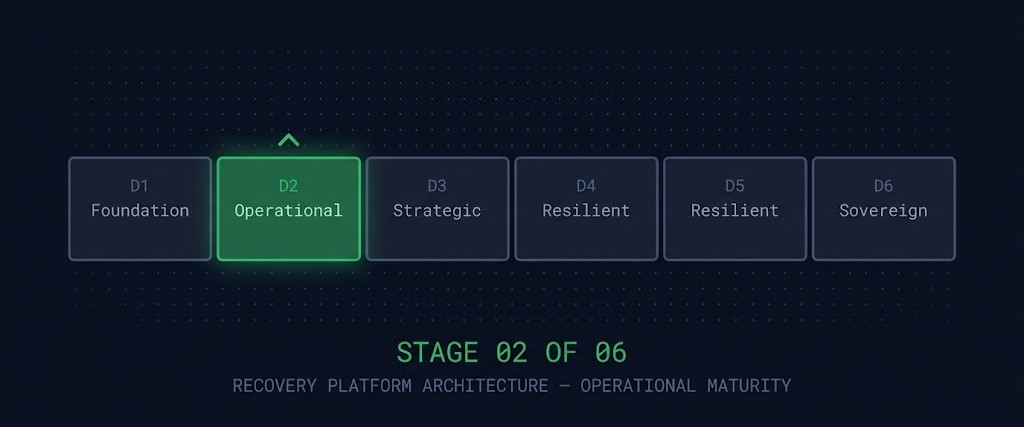
| Stage | Name | Maturity Level | Stage Question |
|---|---|---|---|
| D1 | Recovery Architecture Foundations | Foundation | Can this system be recovered? |
| D2 ← YOU ARE HERE | Recovery Platform Architecture | Operational | How is recovery executed? |
| D3 | Immutability & Cyber-Vaulting | Strategic | How is recovery isolated from compromise? |
| D4 | Ransomware Survival Architecture | Resilient | How does recovery survive adversarial attack? |
| D5 | Disaster Recovery & Failover Architecture | Resilient | How does recovery survive infrastructure failure? |
| D6 | Governance & Recovery Assurance | Sovereign | How does the organization continuously prove recoverability? |
>_ Where This Stage Sits
The Data Protection Path Is a Recovery Lifecycle Progression
| Stage | Architectural Question |
|---|---|
| D1 — Recovery Architecture Foundations | Can this system be recovered? |
| D2 — Recovery Platform Architecture | How is recovery executed? |
| D3 — Immutability & Cyber-Vaulting | How is recovery isolated? |
| D4 — Ransomware Survival Architecture | How does recovery survive attack? |
| D5 — Disaster Recovery & Failover Architecture | How does recovery survive infrastructure failure? |
| D6 — Governance & Recovery Assurance | How is recoverability continuously proven? |
D1 asks whether recovery is designed. D2 asks whether recovery can actually be executed. D3 through D6 progressively address whether that execution survives compromise, attack, infrastructure failure, and continuous scrutiny. Each stage inherits the execution authority D2 validates.
>_ Recovery Design vs. Recovery Execution
D1 and D2 are the doctrine spine of the entire Data Protection path. Every stage that follows assumes both have already happened — that a topology was designed, and that a platform was confirmed capable of executing it. The distinction is not a nuance. It is the difference between an architecture that exists on paper and one that survives contact with an incident.
| D1 — Design | D2 — Execution |
|---|---|
| Designs recovery | Executes recovery |
| Defines topology | Validates platform |
| Maps blast radius | Maps authority |
| Creates restore sequence | Executes restore sequence |
| Crosses #146 Recovery Design Boundary | Crosses #147 Recovery Execution Boundary |
The Reading Sequence below moves through this distinction in three clusters — platform selection, execution under pressure, and authority at execution time.
>_ Stage Reading Sequence
RECOVERY EXECUTION BEGINS HERE
The sequence below moves through three architectural questions in order. Cluster 01 establishes what separates an execution audit from a feature comparison. Cluster 02 tests whether a platform executes what was actually designed, or only what it defaults to — execution failure is the more common gap, and readers encounter it first. Cluster 03 closes with the harder question underneath execution capability: who has the standing to make recovery happen at all. Every stage that follows in this path — isolation design, ransomware survival, failover, governance — assumes the execution authority this stage validates.
Reading out of sequence is possible. The failure states grid between Cluster 02 and Cluster 03 gives the architectural reason to read in order.
Architectural question: What separates a platform comparison from an execution audit?
What separates a platform comparison from an execution audit?
Feature matrices answer what a platform can do in principle. They don’t answer who controls execution when the failure is real. These three articles establish the evaluation criteria that sit above and before any vendor-specific feature list.
Architectural question: Does the platform execute what the architecture designed, or only what the platform defaults to?
Does the platform execute what the architecture designed, or only what the platform defaults to?
A platform’s defaults are a design decision the vendor made for an environment that is not yours. These two articles examine what happens when a platform’s actual execution behavior diverges from the topology it was supposed to execute — and why that divergence usually surfaces during a drill, not a sales call.
>_ Recovery Execution Failure States
>_ Common Recovery Execution Failure States
Architectural question: Who can actually make recovery happen?
Who can actually make recovery happen?
Execution capability and execution authority are not the same property. A platform can be technically capable of executing a recovery and still lack the organizational or architectural standing to do so when it matters most. These four articles examine where that authority lives, how it fragments, how it concentrates in specific people, and why DR tests routinely fail to expose the gap until it’s real.
>_ Recovery Platform Architecture as an Ongoing Practice
Platform execution capability is not a property that gets validated once and stays validated. Vendor roadmaps change. Control-plane defaults shift with major version upgrades, often without a corresponding change-management review on the customer side. The execution authority confirmed during procurement can quietly erode as the platform’s own architecture evolves out from under the topology it was originally certified against.
The practice this stage establishes pairs drill-driven verification with platform change review. Every DR drill is an opportunity to confirm the platform executed the topology as designed — not a simplified version of it. When a drill requires manual intervention the platform’s control plane was supposed to handle, that is not a successful test with a footnote. It is the Recovery Control Plane Vacuum surfacing under controlled conditions, which is the only condition under which you want to find it.
Vendor change review closes the gap drills leave open: the platform updates, default changes, and quiet API deprecations that happen between drills, with no incident to force a re-validation. A standing review of major platform release notes against the recovery topology — not just the security bulletin — surfaces execution drift before the next incident makes it visible the expensive way.
>_ Stage Graduates Can Now
Recovery Architecture Foundations (D1) answers whether recovery is possible. Recovery Platform Architecture (D2) answers whether the platform in front of you can actually execute it. The capabilities below are what make that distinction operational rather than academic — each one requires testing a platform against a topology, not reading a feature sheet. D2 graduates can operate at scale. What Strategic maturity adds, starting at D3, is isolating that execution from compromise.
- Evaluate recovery platforms against execution authority, recovery topology alignment, and operational control-plane capability — rather than feature comparisons alone
- Determine whether a recovery platform can execute the recovery topology that was designed
- Distinguish a platform’s documented feature set from its demonstrated execution authority under failure conditions
- Identify a Recovery Control Plane Vacuum before a real incident does
- Enter D3 — Immutability & Cyber-Vaulting — with a validated execution layer, ready to evaluate isolation and immutability against it
>_ Live Diagnostics
>_ Where Do You Go From Here
ARCHITECTURE REVIEW
Recovery Readiness Assessment
A structured review of your recovery topology, blast radius design, restore path architecture, and platform execution authority — before the next incident exposes the gaps.
[+] Request Assessment →WEEKLY DISPATCH
Weekly Dispatch
Architecture signals, framework updates, and new content from across the five pillars — delivered weekly for senior infrastructure architects.
[+] Subscribe →>_ Frequently Asked Questions
Q: What’s the difference between recovery architecture and recovery platform architecture?
A: D1 designs the recovery topology — blast radius, restore sequencing, and authority ownership decided on paper, before any vendor is selected. D2 evaluates whether a platform can actually execute that topology — whether its control plane has the authority and capability to carry out the designed recovery under real failure conditions. D1 crosses the Recovery Design Boundary (#146). D2 crosses the Recovery Execution Boundary (#147). Designing recovery and executing recovery are separate architectural facts, and a platform can fail at the second even after the first has been done correctly.
Q: What is the Recovery Execution Boundary (Framework #147)?
A: The Recovery Execution Boundary is the point at which a designed recovery topology encounters the operational capabilities and authority model of the platform responsible for executing it. Architectures cross the boundary successfully only when recovery design, execution authority, and platform capability remain aligned under failure conditions. Crossing it is what separates an organization that has selected a recovery platform from one that has validated that platform can actually execute its recovery architecture.
Q: What is Recovery Control Plane Vacuum?
A: Recovery Control Plane Vacuum is the named failure state for this stage — the condition in which recovery tooling exists, recovery jobs execute, and recovery plans are documented, but no authoritative recovery control plane exists with the ability to execute the designed recovery topology under failure conditions. The organization has a platform. It does not have a validated execution layer. The gap is invisible during normal operations and during demos — it surfaces only when the failure is large enough that the platform’s defaults and assumptions are actually tested.
Q: How is Recovery Control Plane Vacuum different from Recovery Authority Fragmentation (Framework #144)?
A: Recovery Authority Fragmentation describes a human and organizational failure — the people, credentials, approvals, and operational knowledge required to execute recovery not surviving the same conditions that trigger the recovery. Recovery Control Plane Vacuum describes a platform and architecture failure — no system, human or otherwise, having clear, tested standing to execute the designed topology, regardless of whether the people involved survive the incident. The two compound in practice: a platform with a Control Plane Vacuum often gets backfilled by ad hoc human authority, which is exactly the structure Recovery Authority Fragmentation describes failing under pressure.
Q: How does the Disaster Recovery Authority Analyzer (DRAA) differ from a platform comparison or TCO tool?
A: A platform comparison tool weighs feature sets against each other. A TCO calculator models cost. DRAA evaluates something neither does: whether the platform in front of you, and the organizational structure around it, has validated execution authority for the recovery topology you’ve already designed. It maps control-plane ownership, execution readiness, and recovery decision paths against the Recovery Execution Boundary — the question of who, or what system, can actually make recovery happen, not which vendor has more checkboxes.
Q: When should you skip ahead to D3?
A: When you can name your organization’s recovery control plane explicitly, when platform execution authority has been validated against the designed topology rather than assumed from a demo, and when at least one DR drill has confirmed the platform — not a manual workaround — declared and executed the recovery. If any of those three conditions is uncertain, complete this stage first. D3 — Immutability & Cyber-Vaulting — assumes the execution layer this stage validates is already trustworthy.
>_ Related Systems
D1 — Recovery Architecture Foundations. The Recovery Design Boundary (Framework #146) this stage’s platform evaluation assumes has already been crossed.
Open Stage →Incident Recovery Process: Why the Incident Isn’t Over After Restore — execution continuity past the moment the platform declares recovery complete.
Open Post →Disaster Recovery Authority: The Missing Layer in Most Recovery Plans — Recovery Authority Fragmentation (Framework #144) and the human-authority half of execution failure.
Open Post →Disaster Recovery Authority Analyzer — evaluates recovery execution authority, control-plane ownership, and operational recovery decision paths against the Recovery Execution Boundary (Framework #147).
Open Tool →Control Plane Architecture (CS4) — Control Plane Ownership Boundary (Framework #135), the same authority-vs-capability distinction applied to cloud control planes generally.
Open Stage →NIST SP 800-184 — Guide for Cybersecurity Event Recovery. Federal guidance on recovery planning, testing, and improvement at the execution layer.
Open Reference →CISA Ransomware Guide — federal guidance on backup architecture requirements and recovery execution under adversarial conditions.
Open Reference →