

CYBER VAULT ARCHITECTURE
Object lock is a feature. Isolation architecture is a decision.
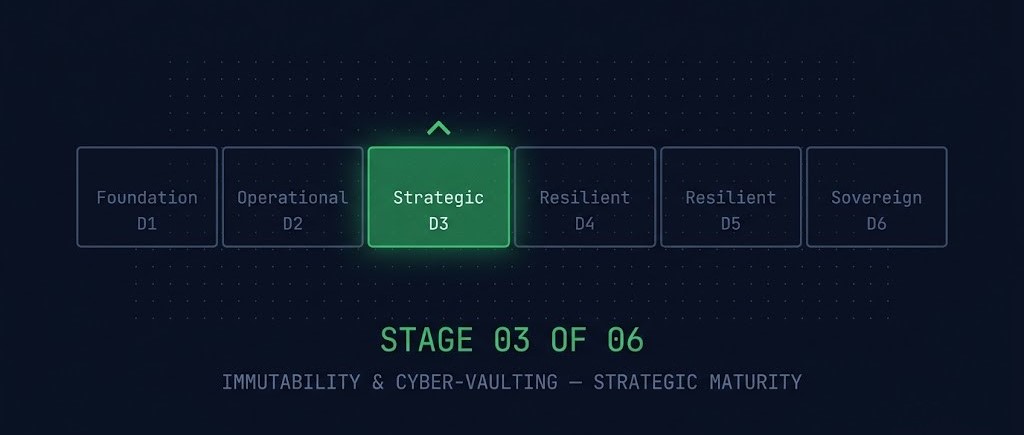
MATURITY POSITION — STAGE 3 OF 6
- Current Stage: Immutability & Cyber-Vaulting
- Primary Architectural Concern: Whether recovery isolation survives the attack that triggers the need for it
- Primary Failure Mode: Isolation-Theater Architecture — recovery isolation appears to exist, but depends on the same authority, identity, or management systems compromised during the attack
- Stage Outcome: Reader can design isolation architecture that remains effective after credential compromise, management-plane failure, and control-plane corruption — not just under clean failure conditions
- Next Stage: D4 — Ransomware Survival Architecture — Does recovery survive adversarial attack?
Cyber vault architecture is the discipline of designing recovery isolation that survives the event that triggers recovery — not just the event the vendor’s demo assumed. D2 validated that a recovery platform can execute the topology that was designed. This stage asks a harder question: does that isolation hold after the identity provider is compromised, after the management plane is encrypted, after the credentials required to invoke the vault are exactly the credentials the attacker targeted first? Most organizations believe object lock answers that question. It answers a different one.
Object lock enforces write immutability at the storage API layer. It does not protect the IAM principal with permission to modify the retention policy. It does not protect the management plane that issues object lock commands. It does not protect the network path between the vault and the system that declares a recovery. Cyber vault architecture begins where object lock ends — at the question of whether the isolation mechanism survives credential and control-plane compromise, not just whether it exists.
WHY THIS STAGE EXISTS — ISOLATION-THEATER ARCHITECTURE
Most organizations believe immutability solves ransomware. In practice, ransomware frequently succeeds because the authority required to invoke isolation is compromised before isolation is needed.
Stage Anchor Question
Does recovery isolation survive the attack that triggers recovery?
Not: is object lock enabled? Not: does the vendor call it a cyber vault? Cyber vault architecture answers whether the isolation mechanism in front of you remains effective after the authority chain required to invoke it has been compromised — under the conditions that actually trigger a recovery, not the conditions a storage vendor’s compliance checklist assumed.
D1 established recovery design principles and economics. D2 validated that the selected platform can execute the designed topology under failure conditions. Both stages assume the isolation layer underneath them holds — that immutable backups remain immutable, that air gaps remain isolated, that vault access authority survives the incident. D3 is where that assumption is tested. Isolation-Theater Architecture is the named failure state: isolation appears to exist — object lock is enabled, a vault is configured, air gap documentation is complete — but every mechanism depends on the same authority, identity, or management infrastructure the attack compromised before recovery was invoked. The vault is sealed. The key is in the attacker’s pocket.
This is not a failure mode that surfaces in normal operations or in vendor demos. It surfaces when the failure is exactly the type the isolation was designed to survive — adversarial, credential-aware, and management-plane-targeting. Ransomware operators know backup systems exist. Sophisticated operators specifically target the identity and management infrastructure that controls backup access before executing the encryption payload. An isolation architecture that hasn’t been designed to survive that sequence isn’t an isolation architecture. It’s storage configuration with a better marketing name.
How Immutability & Cyber-Vaulting Anchors the Full Path
| Stage | Name | Question |
|---|---|---|
| D1 | Recovery Architecture Foundations | Can this system be recovered? |
| D2 | Recovery Platform Architecture | How is recovery executed? |
| D3 | Immutability & Cyber-Vaulting | Does recovery survive compromise? |
| D4 | Ransomware Survival Architecture | How does recovery survive adversarial attack? |
| D5 | Disaster Recovery & Failover Architecture | How does recovery survive infrastructure failure? |
| D6 | Governance & Recovery Assurance | How is recoverability continuously proven? |
D3 sits at the transition between execution maturity and survivability maturity. D1 and D2 validate that recovery can be designed and executed. D3 validates that the isolation protecting that execution survives adversarial compromise. D4 through D6 extend that survivability across full ransomware scenarios, infrastructure failure, and continuous governance — but all of them inherit the isolation architecture D3 validates.
Stage Anchor Framework — Immutability & Cyber-Vaulting
Isolation Survivability Boundary (#150)
The Isolation Survivability Boundary is the point at which recovery isolation continues to function after identity, management-plane, and control-plane compromise. Architectures cross the boundary successfully only when the isolation mechanism — vault access authority, air gap enforcement, object lock retention control — remains effective under the conditions that trigger recovery, not only under the clean-failure scenarios the storage platform was designed to handle.
Named Failure State: Isolation-Theater Architecture — recovery isolation appears to exist but depends on the same authority, identity, or management systems compromised during the attack · Indicators: object lock enabled with no credential-survivability analysis · cyber vault access path traverses the same IAM plane the attack targeted · air gap implemented at network layer only, traversable via management VLAN · vault recovery runbook assumes credentials that may not survive the triggering event · isolation architecture designed but never tested under adversarial credential loss
Why Architects Misjudge Immutability & Cyber-Vaulting
Object lock is mistaken for isolation architecture. Object lock prevents a storage object from being modified or deleted within a retention window. It does not protect the IAM principal with authority to change that retention policy. It does not protect the management plane that issues the lock command. It does not protect the network path to the vault. Object lock is a necessary component of immutability design. It is not, by itself, an isolation architecture — and treating it as one is the most common single-point failure in enterprise cyber-vaulting.
Air gap is designed at the network layer, not the data-flow layer. A network-layer air gap disconnects the vault from the production environment at the switch or firewall. It does not prevent the backup replication job from crossing that boundary on schedule — because that job has to cross to function. The air gap that looks complete on a network diagram is often traversable through the management VLAN, the replication job, or the backup agent running on production hosts. True air-gap architecture isolates at the data-flow layer: when the vault is sealed, no path — not replication, not management, not agent telemetry — reaches production.
Isolation is designed but never tested under adversarial credential loss. Most organizations validate that the vault works — that backups land correctly, that object lock shows the right retention state, that recovery from the vault succeeds in a drill. None of those tests validate isolation survivability. A test that confirms recovery from a vault assumes valid credentials and a working management plane. The test that this stage requires is different: can vault access authority be exercised after the identity provider is offline, the management plane is encrypted, and the credentials in the runbook are unavailable? That test almost never happens before the incident that requires it.
What This Stage Is Not
Not a guide to enabling object lock or configuring immutability settings. S3 object lock, Azure Blob immutability policies, Veeam hardened repositories, and Cohesity DataLock are vendor implementation details. This stage covers the architectural evaluation that determines whether any of those implementations constitute survivable isolation — the criteria that exist above and before the vendor configuration.
Not a vendor comparison of immutable backup products. Platform-level comparisons — Rubrik versus Cohesity, Veeam versus Commvault, cloud-native versus third-party vault — were covered in D2 Recovery Platform Architecture. D3 evaluates what any of those platforms must prove about their isolation layer to cross the Isolation Survivability Boundary.
Not a ransomware response playbook. Ransomware Survival Architecture — D4 — covers full adversarial attack scenarios, blast radius under compromise, and recovery architecture across five ransomware threat types. D3 is the prerequisite: it establishes whether the isolation layer D4 depends on actually holds. Running D4 without D3 is running a ransomware survival assessment against an isolation architecture that has never been tested for survivability.
Not a compliance checklist for WORM storage requirements. Regulatory frameworks that mandate immutable storage (SEC 17a-4, FINRA, HIPAA audit logging) define retention requirements at the storage layer. They do not evaluate whether the authority chain controlling that retention survives the incidents that trigger audit review. Compliance is a floor, not an architecture. Meeting it does not cross the Isolation Survivability Boundary.
>_ Estimated Reading Depth
| Format | Count | Estimated Time | Notes |
|---|---|---|---|
| Architecture articles — Cluster 01 | 2 | ~22 min | Isolation foundations — the gap between object lock and isolation architecture |
| Architecture articles — Cluster 02 | 2 | ~24 min | Identity & authority survivability — why the authority chain is the load-bearing dependency |
| Isolation Failure States Grid | 1 | ~10 min | Six isolation failure patterns — read between Cluster 02 and Cluster 03 |
| Architecture articles — Cluster 03 | 2 | ~23 min | Vault economics & recovery constraints — cost, rehydration, and blast radius under adversarial load |
| Architecture articles — Cluster 04 | 2 | ~16 min | Adversarial recovery architecture — designing for the attacker who knows your playbook |
| Total stage depth | 8 | ~95 min | Strategic stage — complete before entering D4 Ransomware Survival Architecture |
>_ Where to Enter This Stage
Enter here once D2 Recovery Platform Architecture is complete — once a recovery platform has been selected and its execution authority validated against the topology that was designed. If that work hasn’t been done, start at D2. Evaluating isolation architecture against a platform whose execution authority hasn’t been validated answers the wrong question: whether isolation survives compromise of a platform you haven’t yet confirmed can execute recovery at all.
Specifically, enter here if:
- A cyber vault or immutable backup architecture is in place, but no one has confirmed it survives credential compromise
- Object lock or WORM storage is deployed as the primary immutability control, with no analysis of the IAM authority chain controlling the retention policy
- An air gap exists at the network layer, but the backup replication path traverses the same management plane the gap is supposed to isolate
- Vault recovery procedures exist in runbooks, but those runbooks assume credentials that depend on the same identity infrastructure the vault is supposed to protect against
- A DR drill has confirmed recovery from the vault under normal conditions, but no test has ever simulated credential loss or management-plane compromise before invoking vault access
Skip-ahead criteria: Architects who can explicitly name the authority chain for vault access — who can demonstrate that chain survives identity-provider outage and management-plane compromise — and who have tested vault recovery under simulated adversarial credential loss may consider entering at D4. If any of those three conditions is untested, complete this stage. D4 Ransomware Survival Architecture assumes the isolation layer this stage validates is already confirmed survivable.
>_ Architecture Maturity Position
| Stage | Name | Maturity Level | Stage Question |
|---|---|---|---|
| D1 | Recovery Architecture Foundations | Foundation | Can this system be recovered? |
| D2 | Recovery Platform Architecture | Operational | How is recovery executed? |
| D3 ← YOU ARE HERE | Immutability & Cyber-Vaulting | Strategic | Does recovery survive compromise? |
| D4 | Ransomware Survival Architecture | Resilient | How does recovery survive adversarial attack? |
| D5 | Disaster Recovery & Failover Architecture | Resilient | How does recovery survive infrastructure failure? |
| D6 | Governance & Recovery Assurance | Sovereign | How is recoverability continuously proven? |
>_ Where This Stage Sits
The Data Protection Path Is a Recovery Lifecycle Progression
| Stage | Architectural Question |
|---|---|
| D1 — Recovery Architecture Foundations | Can this system be recovered? |
| D2 — Recovery Platform Architecture | How is recovery executed? |
| D3 — Immutability & Cyber-Vaulting | Does recovery survive compromise? |
| D4 — Ransomware Survival Architecture | How does recovery survive adversarial attack? |
| D5 — Disaster Recovery & Failover Architecture | How does recovery survive infrastructure failure? |
| D6 — Governance & Recovery Assurance | How is recoverability continuously proven? |
D1 asks whether recovery is designed. D2 asks whether recovery can be executed. D3 asks whether the isolation protecting that execution survives compromise. D3 is the inflection point in the path — it is where the question shifts from “can we recover?” to “does recovery survive the event that requires it?”
>_ Stage Reading Sequence
ISOLATION SURVIVABILITY BEGINS HERE
The sequence below moves through four architectural questions in order. Cluster 01 establishes the gap between object lock and survivable isolation — why storage-layer immutability is necessary but not sufficient. Cluster 02 addresses the central dependency: identity and authority survivability, which is the load-bearing architectural question this stage builds toward. The failure states grid sits here, between Clusters 02 and 03, because it names what breaks when authority doesn’t survive. Cluster 03 covers vault economics and recovery constraints — cost, rehydration latency, and blast radius under adversarial load. Cluster 04 closes with adversarial recovery architecture: designing for the attacker who already knows the playbook.
Reading out of sequence is possible. The isolation failure states grid gives the architectural reason to read Clusters 01 and 02 before the economics and adversarial content.
Architectural question: Where does object lock end and isolation architecture begin?
Where does object lock end and isolation architecture begin?
Object lock is a storage API feature. Isolation architecture is the design discipline that determines whether that feature remains effective when the authority chain controlling it is compromised. These two articles establish the gap — and why closing it requires architectural decisions that object lock alone cannot make.
Architectural question: Does the authority chain that controls vault access survive the event that triggers recovery?
Does the authority chain that controls vault access survive the event that triggers recovery?
Identity survivability is the load-bearing architectural dependency in cyber vault design. A vault whose access authority depends on the same identity infrastructure the attack compromised is not isolated — it is locked, from the outside, by the attacker. These two articles address the structural decisions that determine whether vault authority survives credential and management-plane compromise.
>_ Isolation Failure States
>_ Common Isolation Survivability Failure States
Architectural question: What does survivable isolation cost, and what does rehydration expose?
What does survivable isolation cost, and what does rehydration expose?
Isolation architecture has two cost dimensions: the monetary cost of vault storage and the RTO cost of rehydration under adversarial load. Both are systematically underestimated. These two articles surface the real economics — the hidden fees, the deduplication throughput ceilings, and the vendor claims that only hold under conditions a real incident won’t reproduce.
Architectural question: How do you design backup systems for an attacker who already knows the playbook?
How do you design backup systems for an attacker who already knows the playbook?
Isolation architecture that was designed without adversarial assumptions will fail against adversaries with adversarial assumptions. These two articles close the stage with the design requirements for backup systems that survive attackers who have already studied — and specifically targeted — the recovery infrastructure.
>_ Stage Graduates Can Now
Recovery Architecture Foundations (D1) asks whether recovery is possible. Recovery Platform Architecture (D2) asks whether a platform can execute it. Immutability & Cyber-Vaulting (D3) asks whether that execution survives the event that requires it. The capabilities below are what make the distinction between object lock and isolation architecture operational — each one requires evaluating isolation against an adversarial failure scenario, not a storage compliance checklist. D3 graduates can operate at Strategic maturity. What Resilient maturity adds, starting at D4, is extending that survivability across the full adversarial attack surface ransomware presents.
- Distinguish between immutable storage and survivable isolation architecture — and identify which failure modes each addresses
- Evaluate whether a cyber vault’s access authority chain survives credential compromise and management-plane failure
- Identify air gap erosion paths in existing backup network topology — specifically: management VLAN traversal, replication job reachability, and agent telemetry paths
- Map identity dependencies in object lock retention policy enforcement — which IAM principals control the lock, and whether those principals survive the attack surface
- Size RTO exposure introduced by deduplication rehydration under adversarial load, distinct from vendor-quoted rehydration benchmarks
- Design vault recovery procedures that do not assume credential availability from the same identity infrastructure the attack targeted
- Enter D4 — Ransomware Survival Architecture — with a confirmed isolation layer, ready to evaluate full adversarial survival across the five ransomware threat types the RRSA models
>_ Live Diagnostics
>_ Where Do You Go From Here
ARCHITECTURE REVIEW
Recovery Readiness Assessment
A structured review of your isolation architecture, vault access authority chain, air gap design, and recovery survivability under adversarial credential loss — before the next incident tests it for you.
[+] Request Assessment →WEEKLY DISPATCH
Weekly Dispatch
Architecture signals, framework updates, and new content from across the five pillars — delivered weekly for senior infrastructure architects.
[+] Subscribe →>_ Frequently Asked Questions
Q1: Why isn’t object lock enough?
A: Object lock prevents a storage object from being modified or deleted within a retention window — it is enforced at the storage API layer. What it does not protect is the IAM principal with authority to change the retention policy, the management plane that issues the lock command, or the network path between the vault and the recovery system. An attacker who compromises the IAM account controlling object lock retention can legally modify or revoke that policy. An attacker who compromises the management plane can issue commands the storage layer treats as authorized. Object lock is a necessary component of immutability design. It becomes an architectural liability the moment it is treated as isolation architecture on its own — because it creates the appearance of protection without requiring the authority-survivability analysis that determines whether that protection holds under the conditions that trigger recovery.
Q2: What is the Isolation Survivability Boundary (Framework #150)?
A: The Isolation Survivability Boundary is the point at which recovery isolation continues to function after identity, management-plane, and control-plane compromise. Architectures cross the boundary successfully only when the isolation mechanism — vault access authority, air gap enforcement, object lock retention control — remains effective under the conditions that trigger recovery, not only under clean-failure scenarios. It is the third framework in the D1–D6 recovery maturity progression: D1 crosses the Recovery Design Boundary (#146), D2 crosses the Recovery Execution Boundary (#147), and D3 crosses the Isolation Survivability Boundary (#150). Each boundary represents a distinct architectural fact — design, execution, and isolation survivability are three separate properties, each of which can fail independently.
Q3: What is Isolation-Theater Architecture?
A: Isolation-Theater Architecture is the named failure state for this stage — the condition in which recovery isolation appears to exist, but depends on the same authority, identity, or management infrastructure compromised during the attack. Object lock is enabled. A vault is documented. Air gap policies are written. And every one of those mechanisms is controlled by the same IAM plane, management VLAN, or credential store that the attack compromised before recovery was invoked. The vault is real. The isolation isn’t. It is the cyber-vaulting equivalent of a DR test that succeeds because the failure conditions were simplified rather than validated.
Q4: How is the Isolation Survivability Boundary (#150) different from the Recovery Execution Boundary (#147)?
A: The Recovery Execution Boundary (#147) — the D2 framework — evaluates whether the recovery platform has the authority and capability to execute the designed recovery topology under failure conditions. It asks: can the platform execute? The Isolation Survivability Boundary (#150) evaluates a different property: whether the isolation layer protecting that execution survives the same adversarial conditions that trigger it. It asks: does the isolation hold? A recovery architecture can cross D2’s boundary — the platform has confirmed execution authority — and still fail D3’s boundary if the vault that platform recovers from is reachable through a compromised management plane. The two boundaries compound: execution authority without isolation survivability produces a platform that can recover from a vault the attacker can reach. Isolation survivability without confirmed execution authority produces a vault the organization cannot access faster than the attacker can.
Q5: What’s the difference between a network air gap and a data-flow air gap?
A: A network air gap disconnects the vault from the production environment at the switch or firewall — it prevents direct IP reachability. A data-flow air gap prevents any data movement between the vault and production when the vault is in sealed state — including the backup replication job, management agent telemetry, and remote administration paths. The critical difference: a network air gap that allows a backup replication job to traverse it is traversable by anything that can present as a backup replication job. True data-flow isolation requires that when the vault is sealed, no path reaches production — not replication, not management, not monitoring. Most implementations described as air gaps are network-layer implementations with traversable data-flow paths.
Q6: When should you skip ahead to D4?
A: When the authority chain for vault access has been explicitly named and documented, when that chain has been confirmed to survive identity-provider outage and management-plane compromise — through adversarial testing, not design review — and when at least one recovery test has confirmed vault access under simulated credential loss. If any of those conditions is untested, complete this stage first. D4 Ransomware Survival Architecture extends survivability evaluation across five specific ransomware threat types, using the RRSA as the primary diagnostic. It assumes the isolation architecture D3 validates is already confirmed survivable — running D4 against an unvalidated isolation layer produces a survivability score for a vault you haven’t confirmed you can access.
>_ Related Systems
Immutable Backup: Why Object Lock Isn’t Enough — the anchor article for Cluster 01; names the architectural gap between storage-layer immutability and survivable isolation architecture.
Open Post →The Connected Air Gap: Why Most Backup Isolation Fails — air gap erosion patterns at the network and data-flow layer; maps the most common traversal paths that undermine air gap isolation in practice.
Open Post →D2 — Recovery Platform Architecture. The Recovery Execution Boundary (#147) and execution-authority validation this stage’s isolation analysis assumes has already been completed.
Open Stage →Ransomware Recovery Survivability Analyzer (RRSA) — the primary D3/D4 bridge diagnostic. Evaluates recovery survivability across five adversarial threat types against the Recoverability Gap (#148).
Open Tool →Disaster Recovery Authority Analyzer (DRAA) — evaluates recovery execution authority against the Recovery Execution Boundary (#147). Run before D3 if D2 execution authority validation has not been confirmed.
Open Tool →Sovereignty Without Evidence (#134 Sovereignty Evidence Chain) — cross-domain: the “authority survives the event” requirement this stage maps in isolation architecture applies directly to evidence chain integrity under sovereignty architecture failure.
Open Post →NIST SP 800-209 — Security Guidelines for Storage Infrastructure. Federal guidance on storage security, immutability controls, and access authority design for enterprise backup systems.
Open Reference →CISA #StopRansomware Guide — federal guidance on backup architecture requirements and the specific sequencing problem this stage addresses: attackers target backup and recovery infrastructure before executing the encryption payload.
Open Reference →